ELK Studios game rules · South Island guide
Toro 7s: Wilds, respins and the Lucky Sevens bonus
 Best casinos available in New ZealandUpdated 7 November 2026

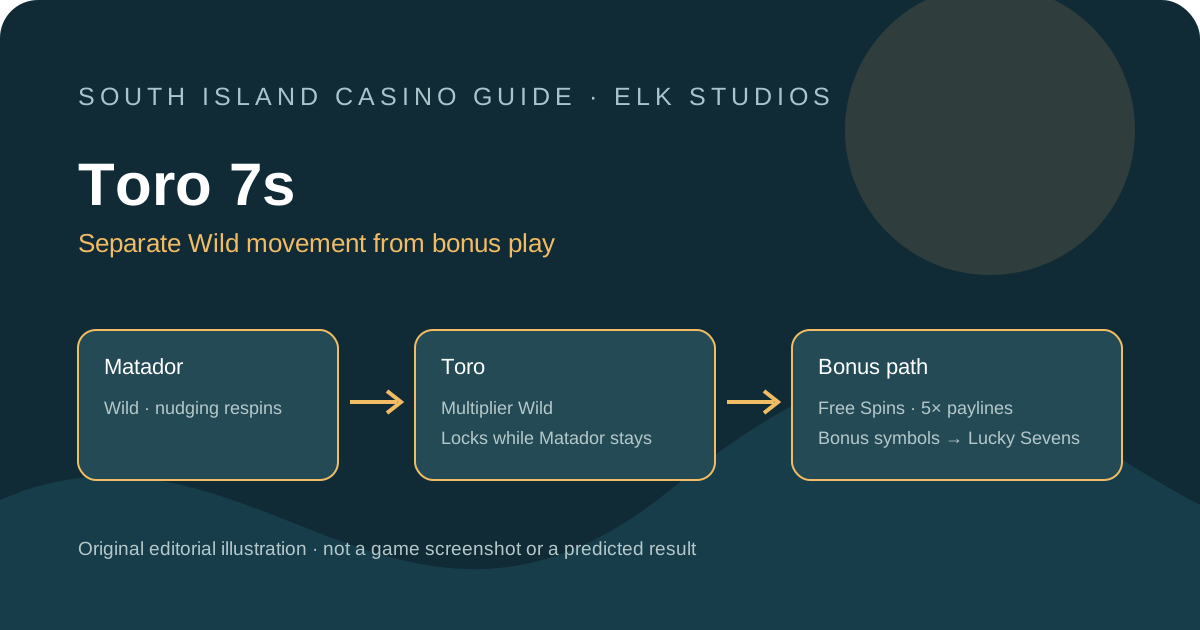
ELK describes Toro 7s as a three-reel slot with nudging Wilds, locked multiplying Wilds and a two-level Free Spins bonus. The Matador is a Wild that awards respins until it nudges out of view. Toro is a multiplier Wild that also awards respins; if both characters are in view, Toro locks until Matador nudges away. Three Bonus symbols trigger Free Spins with a stated 5× multiplier on all paylines, and three Bonus symbols during Free Spins trigger Lucky Sevens, where coloured 7s are collected. The official data sheet was inaccessible, so RTP and other numerical settings are not verified.
The short answer
Toro 7s is ELK Studios’ three-reel slot built around two character Wilds with different jobs. The Matador is a Wild that awards respins until it nudges out of view. Toro is a multiplier Wild that also awards respins. When both characters are visible at the same time, Toro locks in place until the Matador has nudged out. That means a review should track the two symbols separately rather than calling every movement a single “Toro respin”.
The bonus also has two stages. ELK says three Bonus symbols start Free Spins, during which all paylines receive a 5× multiplier. Landing three Bonus symbols during Free Spins triggers Lucky Sevens, where coloured 7 symbols are collected to climb toward the maximum payout. The product page explains the broad flow but does not provide the full paytable, exact nudge behaviour, active RTP, volatility or cap. The linked Game Data Sheet returned 403 on 7 October 2026, so this guide does not fill those gaps with third-party figures.
Confirm Toro 7s, not another Toro title
ELK’s public page labels Toro 7s “Live Now” and describes a three-reel slot. Toro and the Matador also appear in other ELK games, but their presence does not make the rules interchangeable. Toro 7s has its own Wild interaction, Free Spins and Lucky Sevens feature. Do not bring feature names, paytables, volatility ratings or maximum-win numbers from Wild Toro, Wild Toro 2, Toro 911, Book of Toro or another related title into this review.
Check the full title and provider in the game information panel. A casino lobby may shorten a name, use a cropped thumbnail or place several bull-themed games beside each other. The title inside the client and its help page should match the product you are reviewing. Supplier catalogue status is also different from operator availability: it does not show that a particular casino offers the game in New Zealand or that an account can open the same configuration.
The official page gives the basic three-reel structure but not the exact number of rows, paylines, symbol count or stake steps in a readable rules table. Some review pages list those values; they are not adopted here without the current data sheet or operator help. When an active paytable is available, record its title/version and the number of ways or lines it actually uses. The word “all paylines” in the feature description confirms a multiplier scope during Free Spins, but it does not reveal how many paylines the base game has.
Two characters, two Wild roles
The Matador and Toro are both Wild-related symbols, but the official summary assigns them different behaviour. Matador is described as a Wild that awards respins until it nudges out of view. Toro is a multiplier Wild that awards respins until it nudges out of view. If both are in view at once, Toro locks into place until Matador has nudged out. The character identity therefore determines what each symbol contributes to the sequence.
When the Matador appears, check its position and what the rules mean by a nudge. The supplier’s public text says it nudges out of view; it does not provide every step, the direction of movement, how many reel spaces it can travel, or whether the nudge happens before or after a result evaluation. The game help should show the reel state, the respin awarded and the exact event that ends the Matador’s time on screen.
Toro has a separate multiplier role. The public page says it is a multiplier Wild and awards respins until it nudges out of view. It does not specify the multiplier value, whether the value increases, how it is applied, whether it attaches to a position or a win, or what happens if multiple Toro symbols appear. Do not put an unverified multiplier number in a review. The game’s own symbol label and help screen should define its scope.
The lock rule is conditional: if Toro and Matador are in view at the same time, Toro locks until Matador has nudged out of view. It is not enough for one symbol to have appeared earlier in a round. Record the overlap state and the moment Matador exits. The public summary does not state whether a locked Toro continues to award respins on every step, how the multiplier changes while it waits or how the sequence resolves if both would otherwise leave at once. Those are exactly the details to confirm in the active help.
How to follow a nudge and respin sequence
Treat a respin as a continuation of the feature sequence described by the game, not automatically as a new paid wager. The exact stake handling belongs to the product rules. Start by identifying the event that awarded the respin, then note each character’s visible position. Watch whether the next action nudges Matador, nudges Toro, locks Toro or advances to a fresh evaluated board. A clear event log is more useful than a dramatic animation that combines several movements.
The Matador’s exit and Toro’s exit are not the same condition. ELK’s text says each character awards respins until it nudges out, while the simultaneous-view clause says Toro locks until Matador has nudged away. That lock changes the apparent duration of Toro’s presence. Avoid saying that both always leave on the same count or that Toro remains forever. The public rule sets the relationship, but not the exact count or direction.
If the characters overlap in a round, note whether Toro’s multiplier is shown before the lock, while locked and after Matador exits. The multiplier may have a particular calculation or maximum defined by the paytable. A symbol’s animation does not prove that its multiplier applies to every line or every result. Read the display that accompanies the settled win and the written help for the scope.
A feature may end without producing a win. Respins create further evaluations, but an extra evaluation is not itself a cash result. Likewise, an on-screen multiplier can be part of a possible win without becoming a credited amount if no eligible combination forms. Separate “triggered respin”, “locked symbol”, “multiplier shown” and “win credited” in any play-through description.
Free Spins: the first bonus level
ELK says three Bonus symbols trigger the Free Spins bonus. During this mode all paylines receive a 5× multiplier. The game’s accessible summary does not state how many free spins are awarded, which reels can show Bonus symbols, whether free spins can retrigger or whether the 5× multiplier applies to every kind of award. It does provide the key rule that the multiplier is applied across all paylines in the Free Spins state.
Read “all paylines” carefully. It tells you the multiplier scope described for the bonus; it does not provide the number of paylines or a payout amount. If a win qualifies on more than one line, the paytable determines how those line wins are counted and whether a symbol combination is evaluated independently. The multiplier changes the specified bonus calculation. It is not a guarantee that a winning line appears on each free spin.
The Free Spins state is also where the second bonus level can occur. Landing three Bonus symbols during Free Spins triggers Lucky Sevens. That trigger should be kept separate from the initial three-symbol condition: the location and current game state matter. The help should explain whether the Bonus symbol remains visible in the same positions, whether the three can arrive together on a single evaluation and exactly when the game transitions to Lucky Sevens.
When a bonus starts, note the remaining-spin counter, any displayed multiplier, the rules for retriggering and whether the base wager changes. A bonus entry does not mean that its total will exceed the cost of entry or that an additional feature will occur. The original stake and any later awards should be read from the client’s own history. No exact starting count or retrigger quantity is included here because the public page does not give one.
Lucky Sevens: collection is a separate state
The supplier describes Lucky Sevens as a feature in which the player collects coloured 7 symbols to climb to the top for the maximum payout. The public wording identifies the collection concept and its connection to the maximum-payout route, but does not give a full table of colours, thresholds, collection values, starting level, multipliers or whether collected symbols persist between rounds. Do not convert “climb to the top” into a particular number of steps without the client rules.
The name can encourage a reader to assume that any three 7s trigger the feature. ELK’s stated trigger is three Bonus symbols during Free Spins; coloured 7s are collected within Lucky Sevens after that state begins. Keep trigger symbols and collection symbols distinct. The game help should say whether coloured 7s are collected automatically, how a colour changes the counter and what happens when the top is reached.
The phrase “maximum payout” should be read with its exact context. It does not show the size of the award or establish the game’s overall maximum win. A maximum level in Lucky Sevens can be one feature outcome, while an overall cap may be specified elsewhere in the paytable. If the operator help gives a cap, record whether it is a multiplier of the stake, a currency amount or a per-round limit.
For a sample feature log, record the Bonus trigger, the Free Spins counter, the 5× multiplier, the event that starts Lucky Sevens, each coloured 7 collected and the final result. If the interface displays the same animation in a demo, remember that a demo explains the state but does not establish account eligibility or an operator’s active configuration. The collected sequence also does not predict what the next paid round will do.
What the paytable and data sheet need to answer
A complete review needs more than the names of the two Wilds. Find the symbol list, line or ways structure, win direction, payout per symbol, Wild substitution rules, Bonus trigger, Free Spins count, retrigger rule, Lucky Sevens collection schedule, multiplier calculation and maximum payout. Then verify the active RTP, any available variants, volatility or variance description, maximum win and stake range. These are separate fields and should not be guessed from a three-reel format.
The official product page links a Game Data Sheet, but that PDF returned HTTP 403 on 7 October 2026. The public page supports the broad feature descriptions in this article, not a verified numerical configuration. Review websites may publish an RTP or volatility rating, but without an accessible current operator help screen they cannot establish which setting is active in a New Zealand account. This guide leaves those numbers blank rather than suggesting an unverified “standard” value.
If the active help provides more than one RTP value, identify whether these are possible supplier configurations or a menu shown to the player. Operators can use one of several supplied return settings without exposing all choices. A review should say “listed variants” when it only sees a range, and “active setting” only when the client clearly states which one is loaded. A value copied from a casino in another market should not be represented as local.
Volatility and hit rate are not interchangeable. A hit rate might count any prize, a feature trigger or a return above a threshold. A volatility label might be a supplier classification or a third-party rating. If the source does not define the measure, do not assign a precise score. The respin feature may produce a chain of evaluations, but its existence does not prove the frequency of a win over all rounds.
X-iter and optional modes
ELK’s page describes X-iter as five game modes ranging from a 5× bet with selected symbols to a 500× Super Bonus with selected symbols and a progressive multiplier. That is a high-level description of a mode menu, not a mandatory part of a normal spin. The public page does not list all five choices, the exact selected symbols, the multiplier growth schedule or access restrictions. If the game client includes X-iter, inspect the full menu and its price before selecting anything.
The cost matters because a multiple of the bet can make an optional round substantially more expensive than the base spin. The existence of selected symbols can change the starting screen but does not guarantee that a line wins. A progressive multiplier describes a changing multiplier under the selected mode; it is not itself evidence of a progressive cash jackpot. Use the game help to distinguish a multiplier sequence from a separately funded progressive prize.
The 500× label is the cost range endpoint described by the provider, not a predicted win amount. It does not mean a maximum payout of 500 times stake, and it does not guarantee an outcome worth that amount. Check whether the operator offers the mode in the relevant account and whether a demo includes the same menu. A review in another country cannot verify New Zealand availability.
RTP, variance and New Zealand access
The public supplier page does not show an active RTP, volatility, hit rate or cap. Its linked official data sheet was not readable at the time of review. No operator client or account was supplied, so there is also no evidence that a casino offers Toro 7s in New Zealand. A title marked “Live Now” in a supplier catalogue should not be rewritten as “available in NZ”.
To check availability, use the operator’s current game lobby and terms for a New Zealand account. If the title is absent, a game aggregator or international review is not proof that it can be opened. To check RTP, enter the exact client’s help panel and record the title, date, operator, displayed variant and whether the shown value is an active value or list of possible configurations. Keep the claim narrow to the evidence.
RTP does not predict an individual spin. A long-run theoretical return cannot tell a player which session will win, and a high multiplier Wild does not guarantee that the multiplier will meet a paying combination. A maximum win is a cap, not a likely outcome. Set a spending limit independently of the game’s most prominent feature and do not increase a stake to recover earlier losses.
A careful way to inspect Toro 7s
Use the help menu before starting. Confirm the base layout, payline or ways system, Matador and Toro labels, nudge movement, respin conditions, lock rule, Free Spins trigger, multiplier application and Lucky Sevens settlement. Then review the paytable and settings for any RTP, volatility, cap and stake information. If a rule is missing, record it as missing rather than filling the gap with a review of another Toro game.
During a demonstration or permitted client session, observe the characters one at a time. Track when a Wild first appears, when a respin is granted, whether the character nudges, if Toro locks while Matador remains visible and when the state ends. In a separate log, record Bonus symbols, Free Spins count, the 5× multiplier and any Lucky Sevens collection. This makes the two core feature paths understandable without mixing them together.
Check the screen on the device you intend to use. The three-reel grid may occupy less vertical space than a large cluster slot, but the game still needs to show the paytable, button labels, feature counter and balance controls clearly. A desktop display recommendation from ELK is not evidence of a tested phone layout. This article has not opened a casino game, demo or mobile client; the included diagram is a conceptual flow, not a screenshot.
For the developer’s catalogue context, use the ELK Studios games guide. If you choose to gamble, set a limit before starting and refer to the site’s safer gambling information if play becomes difficult to control.
Mistakes that make a review unreliable
Do not transfer a multiplier value from another Toro title. The characters appear elsewhere in ELK’s catalogue, but the product’s active rules belong to Toro 7s. Do not say that the Matador and Toro are the same Wild; the official summary gives them different roles. Do not call Toro locked whenever it appears alone; the published lock condition is that both Toro and Matador are in view.
Do not infer the Lucky Sevens trigger from the 7 symbols. The stated trigger is three Bonus symbols during Free Spins; coloured 7s are then collected in the Lucky Sevens state. Do not call the top level the overall game cap unless the paytable explicitly does so. Keep a bonus trigger, collection progress and final payout as separate facts.
Avoid copying paylines, RTP or maximum-win numbers from a competitor without confirming them against the active rules. A secondary page may be current for its own market but cannot establish the settings loaded for another operator. Finally, never describe a respin or multiplier as guaranteed profit. It is a game feature whose payout depends on the full rules and resulting symbols.
Frequently asked questions
What do the Matador and Toro do?
The Matador is a Wild that awards respins until it nudges out of view. Toro is a multiplier Wild with respins; if both are visible, Toro locks until the Matador leaves.
What starts Free Spins?
ELK says three Bonus symbols trigger Free Spins. The accessible summary does not state the number of spins or the retrigger rules.
What is the Free Spins multiplier?
ELK says all paylines receive a 5× multiplier in Free Spins. The full payline and multiplier rules still need the active help screen.
How do I enter Lucky Sevens?
Three Bonus symbols during Free Spins trigger Lucky Sevens. Coloured 7s are collected in that feature, whose full award schedule is not provided in the public summary.
What is Toro 7s’ RTP?
No active RTP is verified. The linked official Game Data Sheet returned 403, and no operator help screen was supplied.
Is Toro 7s available in New Zealand?
This review does not verify any New Zealand operator listing or account eligibility. Check current local operator information.
Sources and verification boundary
- ELK Studios, Toro 7s official product page, accessed 7 October 2026: https://www.elk-studios.com/games/toro-7s/. Primary source for the three-reel description, Wild/respins/lock rule, Free Spins multiplier, Lucky Sevens and X-iter summary.
- ELK Studios, Game Assets catalogue, accessed 7 October 2026: https://www.elk-studios.com/promo-package/. The linked Toro 7s Game Data Sheet returned HTTP 403 on 7 October 2026.
- Secondary pages reviewed: FruitySlots (https://fruityslots.com/slots/reviews/toro-7s/); Online-Slot (https://www.online-slot.co.uk/online-slots/reviews/toro-7s/); AboutSlots (https://www.aboutslots.com/casino-slots/toro-7s); accessed 7 October 2026. Numeric configuration and payline details were not adopted as a local operator setting.
- Department of Internal Affairs advertiser guidance, accessed 7 October 2026: https://www.dia.govt.nz/Online-gambling-for-advertisers. No CPA link is included pending compliance review.
