ELK Studios game guide · South Island guide
Zulu Gold: ELK Studios rules, features and RTP checks
 Best casinos available in New ZealandUpdated 7 November 2026

Zulu Gold is ELK Studios’ six-reel slot with dropping symbols, Stacks, Wild Walker and Charged Wild features. Three or more Bonus symbols start Multiplier Free Drops, while multiplier symbols can add to a progressive feature multiplier. ELK’s public page explains the broad mechanics but does not verify the RTP, volatility or account-specific configuration for a New Zealand operator.
The short answer
Zulu Gold is a six-reel ELK Studios slot built around falling-symbol rounds and several symbol states. The provider describes Zulu Stacks, Wild Walkers and Charged Wilds in the base game. A Multiplier Free Drops feature begins when three or more Bonus symbols land. During that feature, multiplier symbols can increase a progressive multiplier, and additional multipliers can reactivate those still visible. Understanding how those states interact is more useful than relying on a review’s headline rating or maximum-win figure.
ELK’s public page confirms the game’s named mechanics and broad sequence. It does not establish the exact paytable, RTP variant, volatility label, hit frequency, local stake range or current New Zealand availability. The Game Data Sheet linked from the supplier page was inaccessible when checked. This review therefore separates supplier-described rules from configuration details that need to be read in the live operator help. No external casino or local demo is asserted.
Confirm the title and supplier
ELK’s catalogue lists Zulu Gold as “Live Now”, which describes supplier catalogue status; it does not confirm the game is offered by a particular casino. Verify the exact title in the lobby and the provider credit inside the client. “Gold” is used in more than one ELK title, and a similar title card or visual palette does not make two games share the same reel system, bonus trigger or RTP.
The official Zulu Gold product page is the primary source for the public mechanics covered here. The ELK Studios hub lists supplier-level context, while the site’s game guide index distinguishes title-specific reviews. These pages can establish that ELK documents this game. They cannot prove that an operator has licensed, configured or made it accessible in New Zealand.
Before recording a setting, note the full title, provider, client version if shown, displayed currency and the date you opened help. A screenshot of a review from another market is not equivalent evidence. If an operator’s lobby shows a generic provider tile, open the game information panel before assuming it is Zulu Gold rather than a different Gold release.
The grid and falling-symbol loop
The supplier describes a six-reel game with dropping symbols. The basic mental model is: a spin produces an arrangement, an eligible win may be evaluated, and the relevant symbols are removed or change state so further symbols can fall into the available positions. The public page describes avalanches and feature interactions, but does not provide every exact condition for starting or stopping the cascade. The active help should define that sequence.
Falling symbols can make one paid round contain several evaluations. That is not the same as several independent spins, and a cascade does not mean the next drop is more likely to win. Keep a record of the round’s total stake and the total result, rather than multiplying the apparent number of drops by the bet. The paytable and history panel should explain how a sequence is settled and whether the screen reports each step or only a round total.
If the game expands the grid during play, confirm when the extra positions appear, how long they remain, and whether expansion is linked to a particular feature. Secondary pages sometimes describe a maximum grid size or number of ways that the primary product summary does not establish. Do not assume those dimensions from another ELK Gold game. Read the help animation for Zulu Gold specifically and note any change to the number of visible rows.
Zulu Stacks and symbol categories
ELK names Zulu Stacks as one part of the game. Its public description identifies stacked symbols across low, mid, high and Wild categories. A stack is a display arrangement; it can occupy more than one position on a reel, but the exact size, combination rules and paytable amounts must come from the client. The label “Zulu Stack” should not be treated as a separate bonus unless the help explicitly defines a feature trigger.
Start with the symbols panel. Identify which symbols are regular pay symbols, which are Wilds, which are Bonus symbols and which are multipliers. Check whether the displayed stacked symbol counts as one symbol spanning positions or multiple symbols for a particular rule. That distinction can matter when reading a combination, even if the animation appears seamless. The paytable, rather than visual size, defines a qualifying win.
If a high or Wild stack appears during a cascade, ask what remains after a win: does the whole stack disappear, only the winning positions, or does a feature preserve some part of it? The supplier summary does not answer every such implementation question. Use the active help and game history. A third-party reviewer may have captured a different build or may use “stack” loosely, so do not present a secondary summary as a universal rule.
Wild Walker: movement and trail
ELK describes Wild Walker as a moving Wild that leaves Wilds behind as it advances. The practical point is that two roles are involved: the moving symbol can substitute under the Wild rules, while the trail can keep earlier positions relevant after the symbol itself moves. The public summary confirms that concept, but does not state every possible starting reel, direction, number of steps or end condition.
When reading the client help, look for the exact trigger, movement path, stopping rule and persistence. Does the Walker move after each avalanche, after a win, or according to another trigger? Are the trail Wilds retained through the entire spin or only the current feature? Can a Charged Wild affect the trail? The game’s own text should answer those questions; do not borrow a movement rule from another slot with a similarly named Wild.
Separate a visible Wild trail from a payout promise. A trail can create more eligible positions, but a winning combination still depends on the rules, symbol arrangement and paytable. It cannot guarantee that the following cascade will connect. A short demo, where legitimately available, can help show the animation. It cannot tell you how often a Wild Walker starts over the long run.
Charged Wilds and extra lives
ELK describes a Charged Wild as a Wild with extra lives. It loses a life only when it contributes to a win. That condition is different from a Wild that disappears simply because it is displayed or because a drop occurs. The feature’s practical state is therefore something to track: how many lives remain, whether the symbol actually contributed to a winning combination, and what the game does when its last life is used.
The accessible product-page summary does not show the starting number of lives, whether a life is visible in the symbol art, whether multiple Charged Wilds keep separate counters, or how a Wild interacts with a Wild Walker trail. Check the title-specific help for those details. If the in-game explanation uses “charged” or “life” as a metaphor, follow the graphic and text rather than inferring a real-world charge or a guaranteed number of wins.
This mechanic can be confusing when a Wild is present but does not form a pay combination. The provider’s phrasing says a life is lost only when the symbol contributes to a win, so the key question is contribution, not merely presence. If several lines or ways pay, ask whether the symbol is counted once for the spin or once for each winning combination. Do not calculate the counter yourself unless the help makes the counting rule explicit.
Bonus symbols and Multiplier Free Drops
ELK says three or more Bonus symbols trigger Multiplier Free Drops. The title’s bonus is distinct from ordinary cascades: it has its own free-drop state and a progressive multiplier. The supplier says multiplier symbols can appear during the feature; when three or more are in view, they activate and add their values to the progressive multiplier. This provides the core rule chain without specifying exact values or the full set of bonus rounds.
During a free drop, additional multiplier symbols can reactivate those still visible and add their values again, according to ELK’s description. “Reactivate” is a state change, so check whether the symbol is removed, stays in place, or can be counted in a later free drop. The public page does not disclose the possible multiplier values, the number of free drops at entry, or the exact feature ending condition. The client help must provide those details.
It is useful to separate a multiplier symbol’s displayed value from the total progressive multiplier. One is an input; the other is a running feature state. Check whether the progressive value starts at a baseline, grows only when symbols activate, applies to every win in the round, and resets at the end. A review may state a fixed number of free drops, but the supplier page available here does not confirm it. Avoid copying such specifics without access to the active game help.
How the bonus states relate
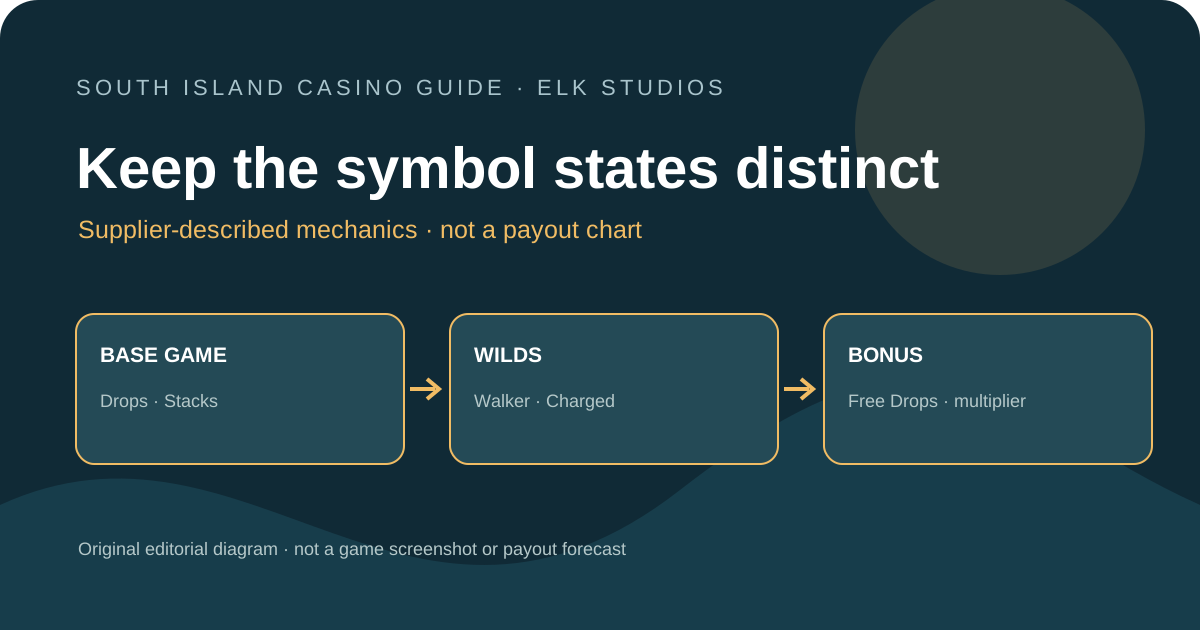
A reader can follow Multiplier Free Drops by asking four questions at each stage: what triggered entry, what remains on the grid, which multiplier symbols are active, and what changes the running total. This makes it possible to understand the feature without assuming that a large multiplier is already a large cash win. The final amount still depends on a qualifying payout and the active paytable.
If more than one effect occurs in one round, resolve the order using the client explanation. For example, a falling-symbol win might remove symbols before a multiplier activation; a visible symbol could remain for one free drop and reactivate later. The product summary tells us that reactivation is possible, but not every interaction or precedence. An accurate review should say when the supplier summary is silent, rather than filling the gap with a generic slot convention.
Bonus progress is not an investment account. A progressive multiplier shown during a feature belongs to that round’s rule state; it is not a balance the player owns or can withdraw. If the feature ends, the help will say whether any value carries forward. Do not interpret “progressive” here as a network jackpot or as a guaranteed future multiplier in another game session.
X-iter and optional feature modes
ELK lists optional X-iter modes, including paths that add a Wild Walker, give a larger grid, enter a Bonus or Super Bonus, and use sticky multiplier symbols. Some modes carry a price expressed as a multiple of the ordinary bet. The official page describes broad feature concepts, not the complete current price sheet for every operator or market. If a mode is absent from the client, do not assume it is available just because a review describes it.
Before choosing any mode, inspect the total cost in the displayed currency and read the condition attached to it. A mode can guarantee entry to a feature but not a winning result or positive return. Check whether it changes the stake, RTP, cap or feature sequence; those are operator-help questions, not details to infer from a marketing label. Do not confirm a purchase if the cost is not clear in advance.
The normal game is sufficient to understand the base grid and any naturally triggered features. An X-iter option is not a necessary tutorial and should not be treated as a way to skip a losing run. If you want to understand the named modes, compare each one’s price and guaranteed event on paper first, then leave it unselected. A planned limit is more reliable than changing the amount after a feature fails to appear.
RTP, volatility, win cap and other missing numbers
The ELK product page reviewed here does not publish the active RTP percentage or RTP variants for a New Zealand casino. The linked Game Data Sheet returned HTTP 403 on 7 October 2026, and the current operator game help was not supplied. This guide therefore does not repeat numbers from commercial review pages. A review may be describing a particular region, version or legacy configuration; it is not proof of the setting in a local account.
RTP is a theoretical return over a very large number of rounds under a specified configuration. It is not the percentage a player should expect from a short visit. Volatility concerns the range and frequency of outcomes, but a label does not tell you when the Bonus will trigger. A maximum-win headline is not the average result, and it does not reveal the probability of reaching it. Treat these as separate facts with separate sources.
When operator help is available, note the date, game title, currency and RTP selection shown. If the help lists alternatives, confirm which one is selected in that client, not merely which options exist. Also look for a volatility explanation, payout cap, minimum and maximum stake, and whether X-iter changes any setting. If a field is absent, mark it “not stated in the accessible help” instead of selecting a number from a secondary site.
Reading a paytable and round history
The paytable should define ordinary symbol combinations, Wild substitution, stacked-symbol treatment, Bonus entry and any multiplier rule. Read its examples in the displayed currency and check whether values are quoted in total bet multiples. A total bet can differ from a line stake or coin value in other game formats, and a number without its unit is not a complete payout description.
After a round, use the history panel to understand how the client recorded it. It may show an initial grid, one or more cascades, feature symbols, a progressive multiplier and a round result. That record can clarify what happened, but it is not a prediction tool. Past results do not tell you which symbols will land next or whether the next Charged Wild will preserve another life.
If a review lists a win table or symbol value, compare it with the current help before relying on it. Some third-party pages make the article readable with detailed figures, but they may not say which operator build was checked. The safest guide gives the reader the mechanic, the exact unresolved field and a practical verification step. It does not present an untraceable payout as universal.
Theme and culturally respectful reading
Zulu Gold’s title and setting refer to Zulu identity. A casino game’s visual treatment is not a substitute for learning about a living culture, and a slot review should not turn a people into a shorthand for danger, wealth or spectacle. The relevant task in this page is to explain the rules and mechanics, not to make claims about a community from game artwork or promotional language.
Some competitors foreground cultural research or describe the setting as “authentic”, but such assessments may not identify a source or explain who evaluated the representation. This review does not claim cultural authority or make independent findings about authenticity. If a supplier publishes a named cultural consultation or source note, a reviewer should link it and describe what it actually says. Without that evidence, distinguish the game’s fictional presentation from factual cultural context.
The mechanic labels—Stacks, Wild Walker and Charged Wild—are game terms, not traditional practices. Do not infer that a visual icon represents a real artefact or ceremony unless the supplier documents it. This separation makes the review more respectful and more useful: it keeps the game’s rules clear without presenting marketing art as cultural research.
Mobile play and interface checks
No mobile testing was performed for this review, and the public product summary does not certify a current layout for every device. If the title is offered by an operator to your account, check the help button, stake display, session history and feature price on the device you plan to use. The grid and feature meter should remain readable during a cascade; a useful interface should let you pause and understand a multiplier state before continuing.
Use the help panel to distinguish visual states. A Wild Walker trail may use colours or animation; a Charged Wild may show remaining lives; multiplier symbols may display values that feed a separate total. If colour, motion or sound makes these hard to follow, slow the animation if that option exists or use the written instructions. Do not let a fast sequence make a price or spin control hard to inspect.
An official or operator demo, when offered for a permitted location, can illustrate controls and the order of events. It cannot establish the real-money RTP or prove that a specific account is eligible. No local demo link is supplied here. The image on this page is an original explanatory diagram rather than a game client capture, so it should not be used to infer the actual interface dimensions.
New Zealand availability and advertising limits
This article does not state that Zulu Gold is available to New Zealand players. A provider listing, a casino review, or a button on an overseas page does not establish local access, licensing or eligibility. Check current operator terms and authoritative New Zealand information before acting. This is especially important because the local rules governing online casino services and their promotion are changing.
The Department of Internal Affairs’ current advertiser guidance says the online casino advertising prohibition is in effect and that duties can extend to third parties publishing or arranging advertisements. It also describes affiliate-marketing restrictions in initial regulatory decisions. That is why this guide contains no in-text casino CTA. Consult the DIA’s advertiser guidance for the official current position; this page is not legal advice.
If gambling is affecting your wellbeing, the site’s existing New Zealand safer gambling information provides support and ways to take a break. Understanding a feature is not a reason to extend a session or spend beyond a personal limit.
No commercial operator link is included in this guide, and no direct casino URL has been substituted. The page still answers the reader’s rules question, provides a way to inspect the game help and links to existing editorial resources. A commercial route requires an appropriate compliance decision before it is placed in article copy.
A verification checklist for the active client
Start by confirming Zulu Gold and ELK Studios in the game’s information panel. Open the paytable and label the ordinary symbols, Stacks, Wild Walker, Charged Wild, Bonus and multiplier symbols. Next, read the dropping-symbol rule, how a win is removed, and whether an avalanche can continue. If the grid can expand, record what causes that change and which positions persist after a round.
For the Wild Walker, note trigger, direction, trail and end condition. For a Charged Wild, find how many lives it starts with, what counts as contributing to a win and what happens at zero. For Multiplier Free Drops, record the Bonus trigger, initial drops, active-symbol condition, multiplier accumulation, reactivation and final settlement. Any detail not in the help remains unverified; do not use a nearby game’s rules to fill it.
Finally, write down the RTP variant, volatility label, cap, stake range, currency and any X-iter price only if the live help states them. Do not press a paid-mode button while investigating. If the operator help is missing or the game cannot be opened, ask the operator or stop there. There is no need to treat an incomplete information screen as a reason to gamble.
Frequently asked questions
What starts Zulu Gold’s Multiplier Free Drops?
ELK’s public page says three or more Bonus symbols trigger the feature. The exact entry sequence and number of drops should be checked in the active game help.
What does a Charged Wild do?
ELK describes it as a Wild with extra lives, losing a life only when it contributes to a win. The starting count and detailed interactions need operator-help confirmation.
Does Wild Walker guarantee a win?
No such guarantee is established by the public feature summary. The moving Wild leaves a trail according to the supplier description, but a payout still depends on the active rules and resulting symbol positions.
Which RTP is used in New Zealand?
No NZ operator variant was verified. The Game Data Sheet was inaccessible, and a supplier catalogue page is not an operator configuration record.
Is the X-iter menu available in every market?
The supplier describes X-iter options, but regional and operator availability is not confirmed here. Read the current client before assuming a mode exists or what it costs.
Sources and verification boundary
Checked 7 October 2026. Primary sources: ELK Studios, Zulu Gold and the ELK games catalogue. The linked Game Data Sheet returned HTTP 403; no active operator help or NZ availability was supplied, so numeric RTP, volatility, hit frequency, cap, stake limits and local access remain unverified. Competitor sample: FruitySlots, BigWinBoard, Fortune Games (page returned 403 on open), and ELK’s product page. Numeric competitor claims were not treated as active configuration. New Zealand Department of Internal Affairs, Online gambling for advertisers, checked the same date. No search-volume or NZ demand metrics were supplied.
