ELK Studios game guide · South Island guide
Wild Toro II: ELK Studios rules, features and setting checks
 Best casinos available in New ZealandUpdated 7 November 2026

Wild Toro II is ELK Studios’ five-reel slot with an initial five-row layout, walking Silver and Gold Matadors, expanding rows and a Toro interaction called Toro Goes Berserk. ELK’s public product page describes the feature relationships and X-iter options, but it does not confirm the RTP, volatility or current configuration of a New Zealand operator’s version.
The short answer
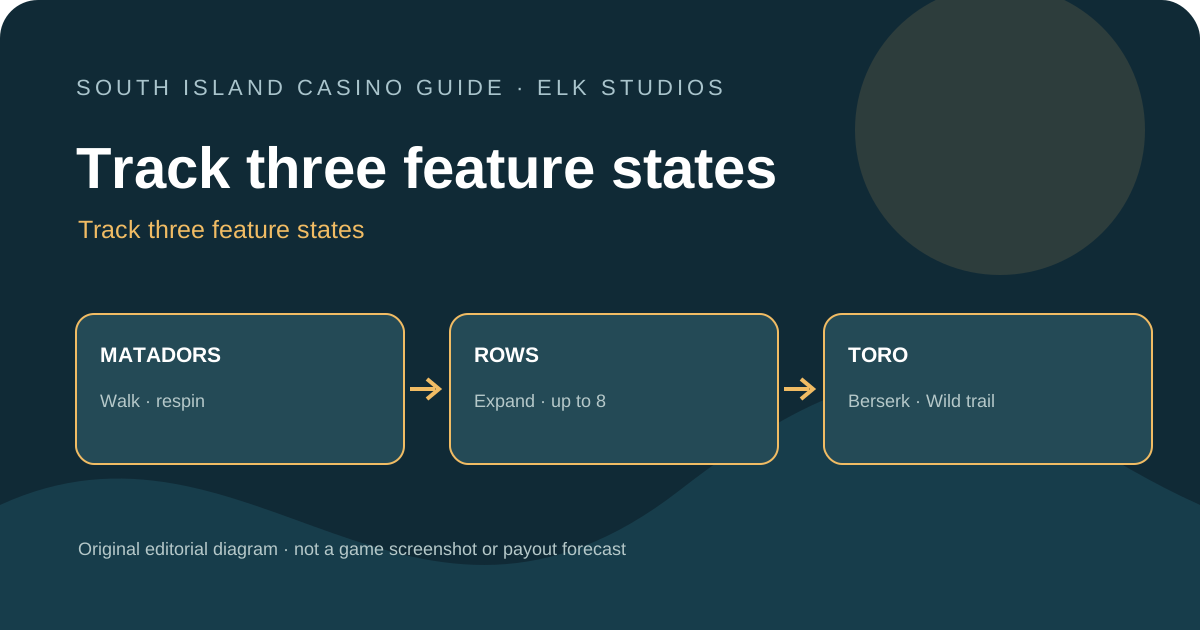
Wild Toro II is a five-reel ELK Studios slot that starts with five rows and can expand when Matadors appear. The supplier describes Silver and Gold Matadors that walk across the reels and trigger respins; Gold Matadors also carry a multiplier that rises as they move. Toro can interact with Matadors through Toro Goes Berserk, knocking them from the grid and leaving Wilds behind. This makes the game’s main question less about a single bonus round and more about how a moving symbol changes the grid over a sequence.
The supplier’s product page is useful for learning the feature names and broad sequence, but it is not a complete operator paytable. It does not establish an active RTP variant, volatility label, hit frequency, stake range, or whether a New Zealand account can launch the title. Those details need to come from the actual game help and operator terms. This review explains what can be confirmed, what remains uncertain, and how to inspect the distinction without treating an animation as a prediction.
Identify the exact game before reading a review
ELK’s product catalogue marks Wild Toro II as “Live Now”. That is a supplier catalogue status, not proof that every casino carries it or that it is available to a person in New Zealand. Search results may shorten the name to Wild Toro 2, Wild Toro II, or simply Toro. Confirm the full title and provider credit in the game client. The original Wild Toro and other titles in the Toro family are separate products with their own boards, rules, settings and paytables.
The official Wild Toro II product page is the primary source for the public feature summary used here. The ELK Studios catalogue provides supplier-level context. Neither page confirms a casino’s distribution agreement, account eligibility, or exact maths configuration. If the operator’s lobby shows more than one similarly named tile, open the information panel for each title rather than inferring identity from a bull illustration or shared branding.
When a review names a release date or calls the game a sequel, that may help distinguish it from the first Wild Toro, but it does not answer the rules question. A review can be accurate about a past build and still be unsuitable for a current operator. Treat the provider name, complete title, game version, displayed currency and help panel as the identity record for any comparison you make.
What the public supplier page confirms
ELK describes a five-reel game with five rows at the start and a reel-expansion mechanic that can add rows when Matadors are present. Its summary distinguishes Silver and Gold Matadors, moving Wilds, Toro Goes Berserk, sticky Wilds in a feature mode, and several X-iter modes. That public description supports a useful map of the main interactions. It does not publish every paytable value or every state transition an operator may expose.
The provider also refers to a maximum-win potential in its marketing material. A headline cap is only meaningful alongside its exact unit, conditions and active build. It does not disclose the chance of reaching that cap, the time a feature might take, or the distribution of smaller outcomes. Do not interpret a maximum as a typical result or as a reason to increase a stake. A maximum is a boundary on a possible result, not a forecast.
For this article, “confirmed by ELK” means the product page explicitly states the feature relationship. “Needs game-help confirmation” means the public summary does not settle the detail. “Not established” means we lack accessible current operator help or a verified NZ game client. Keeping these labels separate prevents one confident mechanic from making unsupported numbers nearby look equally certain.
A round as a sequence of states
It is easiest to understand Wild Toro II by separating an ordinary spin from a feature sequence. First the game presents its base grid. If a Matador appears, ELK says the grid may add another row and a walking respin can follow. A Gold Matador has an increasing multiplier while it walks. The Toro symbol can then interact with Matadors under the named Berserk mechanic. A state change may therefore affect both the symbols and the dimensions of the grid before the sequence resolves.
Do not collapse the whole sequence into “a Wild spin”. A Wild substitutes for eligible symbols according to the paytable; a walking Matador can move and trigger another evaluation; an expansion changes the number of visible positions; Toro Goes Berserk changes the presence of Matadors and leaves a Wild trail. Each is a different operation. The game help should tell you in which order the client performs them and how a win is credited if more than one happens in a sequence.
When reading the help, use the feature animation as an illustration, not as a complete rule. Pause at the explanation screen and note the trigger, what moves, what is removed, what persists, and when the spin is finally settled. This four-part checklist is particularly useful here because a visual trail can remain after the moving character leaves. The image may be memorable; the paytable determines what it means for a payout.
Expanding rows and what “more ways” does not mean
ELK says each Matador in view adds a row, up to a maximum of eight rows. More visible rows create additional symbol positions and can increase the number of ways in which eligible symbols connect, depending on the game’s evaluation rule. They do not guarantee that a matching combination will land. Expansion changes the layout; it does not remove the randomness of the next symbol or create a player-controlled path.
Check whether the initial five-row arrangement and eight-row ceiling are described in the operator help exactly as on the supplier page. The accessible product summary supports those broad dimensions, while the detailed Game Data Sheet link was inaccessible during this review. A third-party table may list intermediate ways counts or a fixed payline count, but those values cannot be used to certify a local operator build. Record the layout shown by your actual client instead.
It is also important to distinguish grid height from stake size. A wider or taller presentation can feel like “more action”, but a larger display does not mean the bet has changed. Confirm the total stake shown before starting a round, especially if the interface offers a feature price or mode selector. The feature can alter how a round begins; it should never be assumed to multiply the underlying stake silently or harmlessly.
Silver and Gold Matadors
ELK describes the Silver Matador as a walking Wild and the Gold Matador as a walking Wild with an increasing multiplier. The movement and respin are linked: a Matador’s position changes as the feature continues, and the game evaluates the resulting grid. The public supplier description says Gold Matador multipliers increase on each step. It does not provide all possible values, the precise increment schedule, or a complete explanation of how the multiplier applies when no winning line contains the symbol.
Read the operator’s help for the direction of travel, where Matadors can enter, which reels they can occupy, how movement ends, and whether multiple Matadors resolve in a fixed order. These details matter when a feature shows more than one moving character. A diagram may depict a leftward walk, but only the active rules define whether that path is universal, whether a blocker changes it, or whether the next respin takes place before or after a row is added.
The increasing multiplier belongs to the Gold Matador feature as described by ELK. Do not transfer it to a Silver Matador, to the Toro, or to a similarly named Wild in another game. Also separate “multiplier displayed” from “multiplier applied”: the paytable should state the eligible win, whether the value is additive or multiplicative, and what happens if a symbol contributes to multiple combinations. If the help uses an unfamiliar term, use its diagram and example rather than guessing from another slot.
Toro Goes Berserk and the Wild trail
The supplier says Toro Goes Berserk when a Matador appears in the relevant interaction: Toro knocks Matadors out and leaves a Wild trail. ELK further describes the possibility that Toro absorbs a Gold Matador multiplier and becomes a progressive-multiplier walking Wild; additional Toro symbols can inherit the current multiplier. These are feature relationships, not a promise that every Toro encounter produces the same multiplier or payout.
The phrase “knocks them all off” can sound simple, but a player still needs to know what happens to a Matador’s multiplier, whether a trail substitutes on all reels, how long those Wilds remain, and whether the current spin or a later respin is the one that settles. These exact questions belong in the operator help. If the active client’s text is brief, its rules animation may show the process; make notes on the symbol before and after the interaction rather than assuming a multiplier is carried over indefinitely.
When a Gold Matador is involved, track the displayed value through the animation. Does it attach to Toro, increase as Toro walks, or apply only to wins formed on a particular step? The supplier synopsis identifies absorption and progressive movement, but not every payline calculation. Avoid phrasing such as “the multiplier applies to all wins” unless the in-game rules say so. A precise guide explains the named transformation and reserves the payout scope for the verified paytable.
How to think about respins
A respin is a new evaluation in a feature sequence, not a second independent guarantee of a win. Some symbols may move or remain in place, while other positions can change. In Wild Toro II, the important distinction is that Matador movement and grid expansion make the board state different from a plain re-spin of the original layout. The help should identify which symbols are retained, which can land anew, and when a feature stops.
Watch for the end condition. A feature may stop when the character leaves the grid, when a set of respins is exhausted, or when a named interaction resolves. Do not assume a generic “three respins” rule: the public ELK page does not establish such a counter for the Matador sequence. Look for the specific trigger and stopping rule in the exact build. If the game uses a visual counter, check whether it counts remaining respins, movement steps or bonus turns.
A useful way to learn the mechanic, where an authorised demo is offered, is to observe a single sequence and write down three things: the initial layout, every feature state change, and the final credited result. This is a rules exercise, not a statistical test. One sequence cannot estimate RTP, volatility or trigger frequency. If no demo is presented by an operator for your location, do not use an overseas casino’s link as evidence of local access.
X-iter: optional modes and cost checks
ELK’s public description lists X-iter modes that are priced as multiples of a base bet and can begin a round with selected conditions. The page references a mode with a guaranteed win, modes that add or guarantee a walking Wild or Berserk interaction, and a Super Feature mode with sticky Wilds and persistent multipliers. These names help identify the menu, but they do not disclose every current price, condition or local availability.
Before selecting a mode, read the price as a total amount in the displayed currency. If the screen says a multiple of the spin stake, calculate that total before confirming. Check whether the option is one round, several rounds, or entry into a defined feature. A guaranteed feature or win condition does not mean the result will be profitable; the guaranteed event may settle at a value below its cost. Also check whether the mode uses a different RTP setting or maximum-win condition.
An optional feature mode is not necessary to understand the core game. The normal round already illustrates Matador movement, row expansion and Toro’s interaction when those symbols occur naturally. Avoid treating an X-iter price as a “shortcut” that improves expected returns. If the interface does not show the complete price and rules before confirmation, do not proceed until the help makes them clear. A pause is a sensible response to unclear terms.
RTP, volatility and the maximum-win question
The primary ELK product page reviewed for this guide does not publish a verified RTP percentage or a volatility label for an operator’s New Zealand version. Its linked Game Data Sheet returned HTTP 403 when accessed on 7 October 2026, and no operator client or live help panel was supplied. For that reason, this page does not repeat numeric settings from reviews that may describe another market. The current game help is the appropriate place to confirm which RTP variant, if any, is active.
RTP is a theoretical long-run return rate for a specified configuration. It is not a promise for a session, a forecast for a particular player, or a guarantee that the percentage of one deposit will be returned. Volatility describes how results are distributed over time, but a label such as “high” cannot say when a feature will appear or how long a losing stretch can last. A large maximum potential is a ceiling, not an expected outcome.
If the operator help lists several RTP variants, note the exact percentage alongside the game title, version or help date, and currency. Do not assume that a provider’s catalogue value, an aggregator’s current row, or another casino’s screenshot matches the version in front of you. If the help does not show a value, record it as not disclosed rather than estimating it from a review or a short sample of play.
Paytable reading without a false strategy
The paytable explains which symbol combinations pay, how a Wild substitutes, whether a feature multiplier changes a win, and how the stake unit is applied. Read the amount column with the total bet in view. A payout shown as a multiple of “bet” can mean total stake or a specific line amount in some game formats, so verify the operator’s definition. Wild Toro II’s variable row count makes it especially important to understand whether any paytable display updates as the grid expands.
There is no reliable way to use the previous spin to predict the next one. A Gold Matador multiplier that rises over a sequence does not make another Matador more likely to appear in the next base spin. A series without Toro does not make Toro “due”. These are independent result questions governed by the game’s random process and rules, not by a balancing pattern that the player can observe visually.
A review can help you learn where to find controls, but it is not a betting system. The practical decision is whether the rules and cost fit your limits. Choose an amount you can afford to lose, set a time boundary, and stop when either limit is reached. Do not raise a stake to recover a previous loss or to “unlock” a feature that has not appeared.
Wild Toro II versus the original Wild Toro
The sequel label can create an easy but risky shortcut: assuming that the first Wild Toro’s reel layout, paytable, payout cap or RTP still applies. Do not do that. ELK publishes a separate product page for Wild Toro II, and the game has its own five-row starting grid, expansion mechanic and named Matador/Toro interactions. The original is a distinct title, not an alternate skin that inherits all its rules.
When comparing two games, use a side-by-side note with the complete title, provider, grid, symbol rules, feature triggers, RTP from the game help and maximum payout wording. Leave a field blank if its source is unavailable. A table with missing entries is more informative than an apparent comparison where one number came from a different casino or an old game build.
This page does not cover Wild Toro, Toro 7s, Book of Toro or other ELK titles. They can appear in the same provider catalogue and share a character or visual motif, but shared branding does not prove shared mechanics. Use the ELK game hub to distinguish guide routes and the provider catalogue for the supplier’s own title listing.
If gambling is affecting your wellbeing, use the site’s existing New Zealand safer gambling information for support and ways to take a break. This game guide is informational and does not recommend a stake or session length.
Mobile, display and accessibility checks
The supplier’s public product summary does not provide a current New Zealand mobile-compatibility guarantee or a complete device matrix. If an operator offers the game to your account, check the game on the device you intend to use before risking money. Confirm that the stake, feature price, help control, spin button and stop or close control remain visible. An expanding grid can occupy more of a small screen, so make sure the interface does not obscure a rule explanation or the amount at stake.
Pay attention to colour and motion. The Silver and Gold Matadors are distinguished by type, and an increasing value may be displayed during movement. If colour alone is doing too much work, read the symbol legend and use any available animation setting or help text. A decorative trail can be attractive while still being difficult to interpret; the written rule should identify whether it is a Wild, a multiplier or simply a visual effect.
No device testing was performed for this review. The layout diagram on this page is an original editorial illustration, not a screenshot or a statement that the casino version has a particular responsive design. Availability, language, controls, demo access and responsible-play settings all belong to the operator’s current client and account terms.
New Zealand access and advertising context
This guide does not name a casino or claim that Wild Toro II is currently available to New Zealand residents. A provider catalogue can show that a game exists, but distribution and account eligibility are separate questions. Confirm the operator’s current terms, age requirements and jurisdiction notices through authoritative local information. Do not infer legality or availability from the fact that an overseas review contains a “play” button.
The New Zealand Department of Internal Affairs says its online casino advertising prohibition is in effect and that third parties publishing or arranging advertisements can be covered. Its current advertiser guidance also discusses affiliate-marketing restrictions in initial regulatory decisions. That is why this article does not contain an in-text commercial casino button or promote a particular operator. See the DIA advertiser guidance for the current official wording; this editorial notice is not legal advice.
No commercial operator link is included in this guide. The article remains useful without an affiliate click: the reader can understand the game concept, identify what the supplier has actually disclosed, and ask the operator the right configuration questions if an authorised offer is presented elsewhere.
A practical checklist for reading the game help
Before starting, verify the full title and provider, then open the help menu. First locate the grid dimensions and the rule for adding a row. Next identify Silver Matador, Gold Matador and Toro separately. Check what causes each respin, whether a multiplier rises on a step, what Toro Goes Berserk removes or leaves behind, and whether the resulting Wild trail persists. Write down the end condition before you interpret a feature sequence.
Then inspect the paytable and settings page. Record RTP only if the current client states it; note if there are variants and whether the selected mode changes the configuration. Find the volatility explanation, max-win cap and stake range in the same help context. If a field is missing, ask the operator or leave it unverified. Do not replace a missing value with a number from a third-party page, particularly if the page gives a different currency or jurisdiction.
Finally, review the optional X-iter menu without confirming a purchase. Note each price, the event it promises to start, and whether the terms display the total stake before acceptance. If you are trying a permitted demo, use it to learn the buttons and feature sequence only. A few observed outcomes do not establish a fair-return rate, future result or local account eligibility.
Questions readers commonly ask
Is Wild Toro II the same game as Wild Toro?
No. Wild Toro II is a separate ELK Studios title with its own product listing and described feature set. Do not transfer the original game’s settings or paytable to the sequel. Verify the exact name in the active client.
How many rows can the reels reach?
ELK’s public page says the grid begins at five rows and can expand to eight, with each Matador in view adding a row. Confirm the exact progression in the operator help.
Does a Gold Matador multiplier apply to every win?
The supplier says a Gold Matador has a multiplier that increases as it moves, and describes Toro absorbing it in the Berserk interaction. The accessible public summary does not define every payout calculation. Read the active paytable before assuming which wins qualify.
What are the RTP and volatility for a New Zealand player?
They were not verified for a New Zealand operator version. The Game Data Sheet was inaccessible during research, and the product page does not supply the needed variant details. Use the active game help.
Can I play a demo in New Zealand?
This review does not confirm a local demo. Availability depends on the operator and account location. Do not treat a foreign review’s demo button as proof of local access.
Sources and verification boundary
Checked 7 October 2026. Primary source: ELK Studios, Wild Toro II, including its catalogue status and public mechanics; ELK Studios games catalogue. The linked Game Data Sheet returned HTTP 403, so numeric RTP, volatility, hit frequency, limits and cap variants were not verified. No operator help or New Zealand availability was supplied. Competitor sample: Online-Slot, AboutSlots, MVideoslots, Casinoslots.net; their numerical claims were not used as configuration evidence. DIA: Online gambling for advertisers, checked the same date. No NZ demand or search-volume data was supplied.
