ELK Studios game guide · South Island guide
Avalon X: rules, features and settings to verify
 Best casinos available in New ZealandUpdated 7 November 2026

Avalon X is ELK Studios’ fantasy-themed cluster slot. The supplier describes a six-column, seven-row board with a Global Multiplier, Wilds, Mystery Boxes, coin wins and free drops. Three Bonus symbols start the feature, while Mystery Boxes can persist until opened. Those mechanics provide a map of the game, but a particular casino client’s help is still required to confirm numeric RTP, volatility, stake range, maximum win and local access.
The short answer
Avalon X is an ELK Studios slot built around clusters on a six-column, seven-row grid. ELK’s product description identifies a Global Multiplier, Wild and Multiplier Wild symbols, large symbols, Mystery Boxes, coin wins, Bonus and Super Bonus modes. The advertised feature sequence is unusual enough that it is worth reading the in-game help before playing: the Global Multiplier can move, Mystery Boxes can remain on the board until opened, and a winning cluster can create a Wild that may split or merge.
The supplier describes three Bonus symbols as the trigger for free drops. A Mystery Box can activate when five or more are visible. In the feature, a Super Bonus symbol can upgrade the mode; when one of the trigger symbols is a Super Bonus symbol, ELK says the Super Bonus begins with Holy Strike in every free drop. These are high-level mechanics from the current supplier page. They do not establish every timing, persistence or payout rule in every operator build.
No current operator game-help screen was available for this review. This page therefore does not give a numeric RTP, RTP variant, volatility rating, hit frequency, stake limits, maximum win or X-iter price as a verified setting. It also does not say Avalon X is available to New Zealand accounts or that a demo can be opened in New Zealand. ELK’s catalogue confirms its own product listing; the operator’s lobby, eligibility terms and loaded game help must establish the local product and configuration.
Confirm the exact game and build
Start with the title inside the game client rather than the image in a casino lobby. Look for “Avalon X” and “ELK Studios” in the information panel, then compare the listed mechanics with ELK’s Avalon X product page and the official supplier catalogue. Artwork can signal a fantasy theme without proving that the game is this exact release. If the supplier, title, or feature names differ, do not carry Avalon X rules over to the other client.
Record the context when checking a build: the casino brand, country or account region, currency, game title, supplier, mode, date, and any version or game-help date shown. These details are useful because a supplier can distribute a game to different operators, while each operator chooses what to offer and the game configuration available in its market. A supplier catalogue is not a market-availability list.
Keep four questions separate. Is Avalon X present in ELK’s catalogue? Does a particular operator list it? Can an account under a particular jurisdiction open that listing? Which settings does the loaded build use? A “yes” to the first question does not answer the other three. This article confirms the first from ELK; it does not identify a New Zealand operator that currently offers the game.
If a lobby uses a shortened title, match the full title in the client’s information panel and at least one distinctive feature description before treating it as Avalon X. A sequence involving clusters, Mystery Boxes, a Global Multiplier and Holy Strike is a stronger identifier than a castle image. If the help panel is absent or the name is ambiguous, pause rather than infer a game from its artwork.
Read the six-by-seven cluster board
ELK describes a board with six columns and seven rows. It is a cluster game rather than a conventional fixed-payline layout. A cluster win usually means a qualifying group of matching symbols appears in connected positions, but the exact connection rule, minimum group size, symbol values and cascade or reset behaviour must come from the current paytable. The supplier summary does not publish the full Avalon X paytable, so this article does not guess the precise winning group or whether each board change creates a new evaluation.
Before the first wager, open the help pages for the board and symbol rules. Confirm whether positions need to touch horizontally, vertically, diagonally, or in a supplier-defined way; find the minimum symbol count; and check whether the game removes winning symbols, fills empty spaces, or simply marks the result. A six-by-seven grid gives the interface a large number of possible arrangements, but the dimensions alone do not tell a player how a combination is evaluated.
Notice the difference between an ordinary symbol, a Wild and a Multiplier Wild. A Wild may substitute for eligible paying symbols, while a Multiplier Wild adds a modifier under a rule the paytable should explain. Do not assume every Wild substitutes for every symbol or that every multiplier applies to the whole round. The game help should specify exclusions, placement, and how a modifier is combined with other multipliers.
Large symbols can occupy more than one cell or visually dominate a portion of the board. A large symbol is not automatically a larger payout. Check whether the paytable treats it as several ordinary symbol positions, a single special symbol, or a feature object. The answer affects how a cluster is counted and whether the symbol can connect with a neighbouring group.
When a board animation unfolds, follow the steps instead of reading the final number alone. Identify the initial positions; note which symbols or objects activate; observe changes to the grid; and then check the win presentation. If several events happen at once, the history panel can help show whether the result came from an ordinary cluster, a multiplier effect or a feature. The aim is to understand the rule sequence, not to treat a dramatic animation as evidence of a higher long-run return.
Mystery Boxes and persistence
The supplier describes Mystery Boxes that persist on the board until they are opened. It also states that five or more visible Mystery Boxes activate. Those statements make persistence and activation separate ideas: a box may remain visible across a sequence, while a threshold determines when the group opens. The exact persistence boundary, reveal contents and trigger timing are still matters for the active game help.
When a Mystery Box appears, write down which positions are occupied and whether the next board state changes them. If a box survives a spin or feature step, check whether the help calls it persistent, sticky, locked or something else. Similar words can refer to different rules: a symbol can stay in place for the next drop, remain until a named event, or be part of a counter that resets at a boundary. Use the title’s own wording.
The count of visible boxes is not itself a win amount. A box may reveal a symbol, a value or a feature state according to the game rules. Do not call every opened box a prize, and do not assume a threshold has been reached until the game highlights the trigger or the help defines the count. If the client gives several kinds of box outcome, record the type separately from the number of boxes.
Persistence also raises a practical question: what resets the board? Check whether boxes clear at the end of a base spin, after the opening event, when a free-drop feature ends, or at some other point. The supplier’s public summary tells readers that boxes can persist until opening; it does not provide a complete state diagram for all phases. If the loaded help is more specific, it should take precedence over a short catalogue summary.
Global Multiplier, Wilds and Holy Strike
Avalon X’s Global Multiplier is a game-wide feature label, but the title’s help determines what it multiplies and when. ELK’s product description says the multiplier can step by one or two. That describes a change in its displayed value, not a guaranteed payout increase on every spin. A multiplier only affects a qualifying result under the applicable rule; a higher display by itself is not a settled win.
When a cluster pays, check whether the Global Multiplier applies to the entire cluster, to specific symbols, or to a later feature result. If Wilds or Multiplier Wilds appear together, find out whether the effects are additive or multiplicative and whether more than one modifier can apply to the same result. Do not invent a formula from an animation. If the paytable uses a worked example, that is the clearest source for how the calculation is performed.
ELK also describes Holy Strike as a random event. According to its summary, Holy Strike creates a Wild; when that Wild creates a winning cluster, it may split or merge. The description distinguishes the event from the result: a new Wild can appear without necessarily producing a winning cluster, and a winning cluster can then undergo another change. A useful explanation follows each stage and does not label the first animation as a payout.
Look for whether a split or merge is restricted to particular symbols or cells, whether a new board evaluation follows, and whether a Multiplier Wild can be involved. These details can materially change the way the sequence is presented. The public supplier summary does not expose all edge cases; the active help is the right place to confirm them.
Holy Strike should not be confused with a symbol that the player chooses or aims. The supplier describes it as random. Unless the loaded client explicitly offers a decision, do not suggest that a player can select a target, control a multiplier or influence the feature by choosing a particular stake. A choice in a user interface may select a bet or mode without changing the underlying feature outcome.
Free drops, Bonus and Super Bonus
ELK says three Bonus symbols trigger free drops. The supplier also distinguishes Bonus from Super Bonus and describes a Super Bonus symbol that can upgrade the feature. If one of the symbols that triggers the bonus is a Super Bonus symbol, the supplier says the Super Bonus begins with Holy Strike in every free drop. These details are enough to orient a reader, but not enough to reconstruct the exact counter, number of drops, symbol values or bonus settlement for an operator build.
Before treating the bonus as a single event, inspect the help for the trigger, entry state, number of drops and any rules that can add, retrigger or modify them. “Free” describes whether the game deducts a new base stake for those drops; it does not mean the mode has a guaranteed profit or a known monetary value. A feature can be entered for free and still finish with no payout, depending on its rules and outcomes.
Check how the Super Bonus differs from the ordinary Bonus. The supplier summary links a Super Bonus trigger symbol to a starting state with Holy Strike in every free drop. It does not establish every way the mode can begin, whether it can be reached in all jurisdictions, or which optional purchase choices a casino may enable. A mode can be described by a provider while an operator disables or changes the menu in a particular market.
Track state changes across the feature: the Global Multiplier display, Mystery Boxes, any Wilds, each free drop, and the final settlement. The key question is which values persist from one drop to the next and what resets at the end. If the game history separates wins by drop, compare the intermediate values to the final credit. This makes it possible to understand a bonus without assuming that every multiplier or object is banked.
Do not use a short demo session to estimate how often a Bonus symbol or Super Bonus appears. A small number of rounds cannot establish a long-run probability, RTP or feature frequency. A practice mode may be useful to learn the interface, where lawful and offered, but its results are not proof of the cash-game configuration or an operator’s access policy.
Optional modes and feature purchases
Some ELK titles expose optional feature modes through an X-iter menu, but a public product description does not prove that Avalon X presents a specific menu to every operator. If an active game client has optional modes, read the displayed rules and cost before selecting one. Record whether the cost is a multiple of the normal stake or a currency amount, what feature state it promises to start, and which outcomes remain random.
An option that guarantees a feature state does not guarantee a payout or a return of its price. The distinction is straightforward: the purchase can alter the initial conditions while the symbols and settlement remain uncertain. Avoid describing a mode as a shortcut to profit or as a way to recover earlier losses. A mode price belongs in the same entertainment budget as any other wager and can use up that budget faster than ordinary spins.
Availability can vary by operator and jurisdiction. Do not advertise a feature-buy price or claim the option is available to a New Zealand account without checking the same client and the current local terms. A screenshot from another country, another currency or a previous build is not enough to verify the present menu.
RTP, volatility, stake range and maximum win
This guide cannot responsibly supply a numeric RTP or RTP variant for Avalon X without the current game-help panel from a named operator build. RTP settings can differ across configurations, and the relevant figure should be checked in the loaded game’s information or paytable screen. If the interface lists more than one value, copy the exact labels and distinguish the currently active setting from a list of available configurations.
The same standard applies to volatility. If the game help publishes a volatility label, quote it with its source and date. Volatility describes how outcomes are distributed over time; it does not predict the result of the next round or promise a particular pattern. If the loaded client does not show a rating, say it is not confirmed instead of importing a rating from a review page.
For stake range, verify the minimum and maximum total wager in the client, including any selected bet level or multi-position setting. Currency matters. A value shown in euros or pounds should not be copied as though it were a New Zealand dollar amount. Convert the possible exposure into a familiar budget before making a decision, and remember that a saved bet or feature mode can cost more than one ordinary spin.
Maximum win claims need their denominator. Check whether the cap is stated as a multiple of the stake, a cash amount or a mode-specific limit. See whether it applies to one round, one feature or a combined sequence, and whether the game ends or continues after it is reached. The public catalogue summary reviewed for this page does not provide a verified Avalon X cap for a current operator build.
Do not treat a game’s displayed return as a personal forecast. RTP is a theoretical long-run figure under the game’s stated model; it is not a refund rate for a session and does not tell a player how much of one deposit will return. A high advertised number does not guarantee an individual win, and a short losing sequence does not prove a configuration is faulty.
Mobile presentation and demo access
The official product summary explains game mechanics but does not establish that every operator’s Avalon X build has a tested mobile layout or that the game is available through a New Zealand mobile account. If an eligible operator lists it, check the real interface on the device that will be used. Confirm that the full board remains visible, symbols and help text can be read, controls do not cover important areas and the balance and total stake are clear before a round.
Pay particular attention to the six-by-seven grid. It can be scaled to fit a narrow display, and small cells can make it harder to track a Mystery Box or multiplier. If the interface has a landscape layout, try it only if the game itself supports orientation changes. Do not assume rotation changes the rules or makes a feature easier to trigger; it is a display preference.
A demo may be offered by a publisher or a third-party catalogue, but this assignment did not open one. Demo access can depend on age verification, country, operator, account status and local terms. If a legitimate demo is available, use it only to understand controls and symbols. It is not a verified test of the cash game’s RTP, feature frequency, stake limits or local availability.
Check what happens if a connection drops during a feature. Read the operator’s rules for reconnecting, restoring a round, dispute handling and game history. Keep a note of the round identifier if the client provides one. A stream or browser error is an operational issue; it is not evidence that a game result has been changed. The operator’s procedures are the source for any complaint or unsettled-round question.
How to assess the feature sequence without overreading it
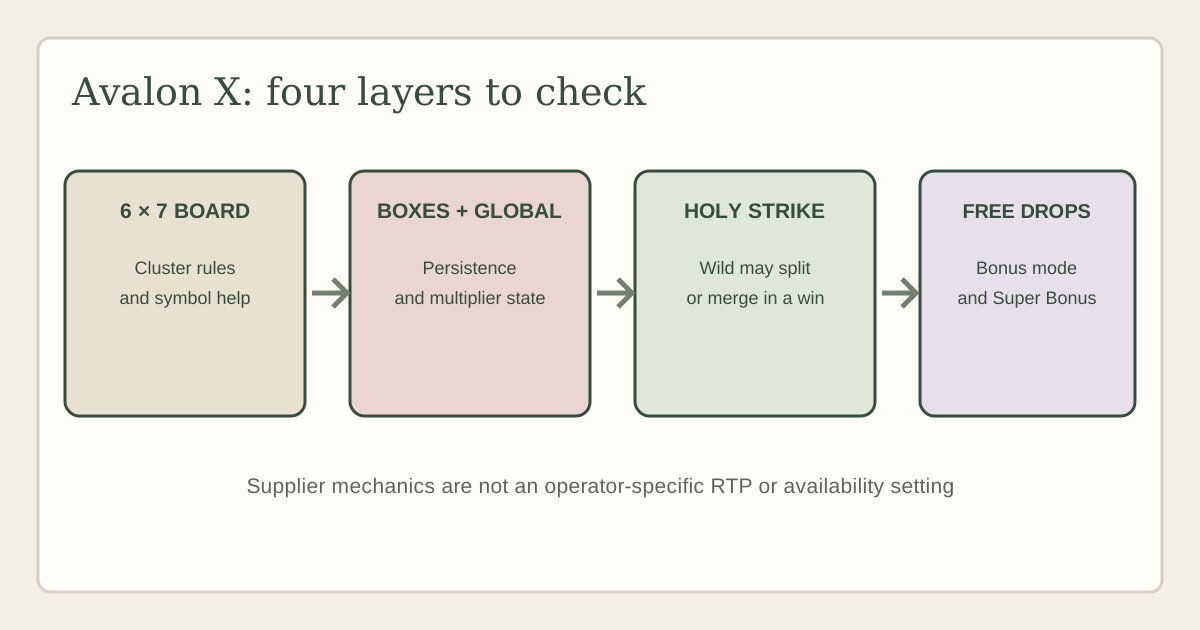
A useful way to assess Avalon X is to separate the interface into three layers. The first is the board: symbols and any qualifying cluster. The second is the modifier layer: Global Multiplier, Wilds and Mystery Boxes. The third is the feature state: free drops, Bonus or Super Bonus and Holy Strike. The same screen can show more than one layer, which is why readers should check which rule caused the change.
For an ordinary round, ask: what creates a cluster, what is removed or changed, and how does the paytable calculate the result? For a Mystery Box sequence, ask: when does the threshold open the boxes, what do they reveal, and what remains on the board afterward? For a bonus, ask: which counter advances, which symbols or values persist, and when does the feature end? These questions are practical and answerable from the help panel.
The board’s fantasy presentation should not be translated into claims about skill or control. An animated spell, strike or upgrade can make a change feel interactive while the supplier describes that event as random. Unless the rules present a decision that changes a defined outcome, a player does not control whether the next symbol, box content or cluster appears.
The same discipline applies to comparisons. Do not say Avalon X is “better” because it has a larger multiplier display or more feature names. A comparison needs a defined dimension: complexity of rules, board type, supplier-stated mechanics, or a verified numeric setting from the same market and mode. Since no current operator values were available, this review is a mechanics guide rather than a score or a ranking.
Who may find this format understandable?
Players who like to follow a board as it changes may find the cluster grid and persistent Mystery Boxes easier to discuss than a game with hidden, unlabelled meters. The sequence can be explained in visible terms: boxes appear, a threshold matters, a multiplier changes, and a feature may begin. This is an observation about how the supplier describes the mechanics, not a claim that the game is easy, generous or suitable for every person.
The same layers can feel busy if a player is unfamiliar with cluster rules or if several animations resolve close together. A sensible first step is to read the paytable, identify the symbols, and use a low, pre-set entertainment stake only if the person has already decided to play. If the rules remain hard to follow, stop rather than increasing the stake to learn them faster.
Someone looking for a simple fixed-payline layout may prefer a game with fewer state changes. Someone interested in Avalon X should still decide in advance how much time and money are available for entertainment and stop when either limit is reached. No feature diagram changes the uncertainty of gambling or makes a loss due.
A practical verification checklist
Use this list to compare the supplier description with the actual game client, without relying on an unrelated review’s score or settings:
- The client identifies the exact title Avalon X and ELK Studios.
- The board dimensions and cluster rules match the active help, including what counts as a connected group.
- The help explains how ordinary Wilds, Multiplier Wilds and large symbols are evaluated.
- Mystery Box activation and persistence are described, including the reset point.
- The Global Multiplier rule states what result it modifies and how multiple effects combine.
- Holy Strike’s Wild, split and merge sequence matches the description in the loaded build.
- Bonus and Super Bonus trigger rules, free-drop count and persistence are clear.
- Numeric RTP, volatility, stake range, maximum win and optional mode prices are recorded only if the current help publishes them.
- Local access and any demo terms apply to the actual account and jurisdiction.
For each item, write down the source and check date. If a value is absent, retain “not confirmed” rather than filling it with a third-party estimate. This creates a traceable update path and makes different operator builds easier to distinguish.
Frequently asked questions
What kind of slot is Avalon X?
ELK describes Avalon X as a six-column, seven-row cluster slot. The game also includes a Global Multiplier, Wilds, Mystery Boxes, coin wins and free-drop features. The current help panel supplies the exact symbol and payout rules.
What starts the free drops?
ELK’s public product description says three Bonus symbols trigger free drops. It also describes a Super Bonus symbol that can upgrade the feature. Check the loaded client for the precise entry, retrigger and end rules.
How do Mystery Boxes work?
The supplier says the boxes can persist until opened and that five or more visible boxes activate. The public summary does not fully specify every reset and reveal rule; use the current game help for the exact sequence.
What are Avalon X’s RTP and volatility?
No current operator help panel was available for this review, so no numeric RTP variant or volatility value is confirmed. Read the loaded game’s information screen and note the mode and date.
Is Avalon X available in New Zealand?
This article does not confirm a local operator listing. ELK’s catalogue shows the supplier’s product; it does not show that a particular casino offers it to a New Zealand account. Check the operator’s current lobby and eligibility terms.
Is there a demo or mobile version?
Neither a New Zealand operator’s mobile client nor a demo was tested for this page. Availability depends on the operator, account and jurisdiction. If offered, use a demo to learn the controls, not to infer the cash game’s maths.
Does a Super Bonus guarantee a win?
No. A bonus mode describes a feature state, not a guaranteed positive result. Any payout remains governed by the game rules and the outcomes in that feature.
Sources and verification boundary
Primary sources reviewed 6 October 2026: ELK Studios’ Avalon X product page for the board, cluster, Mystery Box, Global Multiplier, Holy Strike and free-drop summary; ELK Studios’ game catalogue for the supplier listing; and New Zealand DIA advertiser guidance for the current advertising transition. Supplier descriptions support the qualitative mechanics above.
The current operator help panel and a New Zealand operator listing were not available for verification. Numeric RTP, variants, volatility, hit frequency, stake range, maximum win, optional mode price, demo availability, mobile support and local access are not asserted. No game demo or CPA route was opened. Recheck the operator’s current rules before any public update.
