ELK Studios game guide · South Island guide
Dam Beavers: ELK Studios rules, features and RTP checks
 Best casinos available in New ZealandUpdated 7 November 2026

Dam Beavers is an ELK Studios CollectR slot that begins on a 5×5 grid and links collection, floorboard clearing and a four-level dam. The supplier describes a Feature Meter, changing grid and symbol levels, Bonus and Super Bonus rounds, and a 10,000× maximum-win potential. The public product page does not verify the active RTP, volatility or New Zealand operator settings.
The short answer
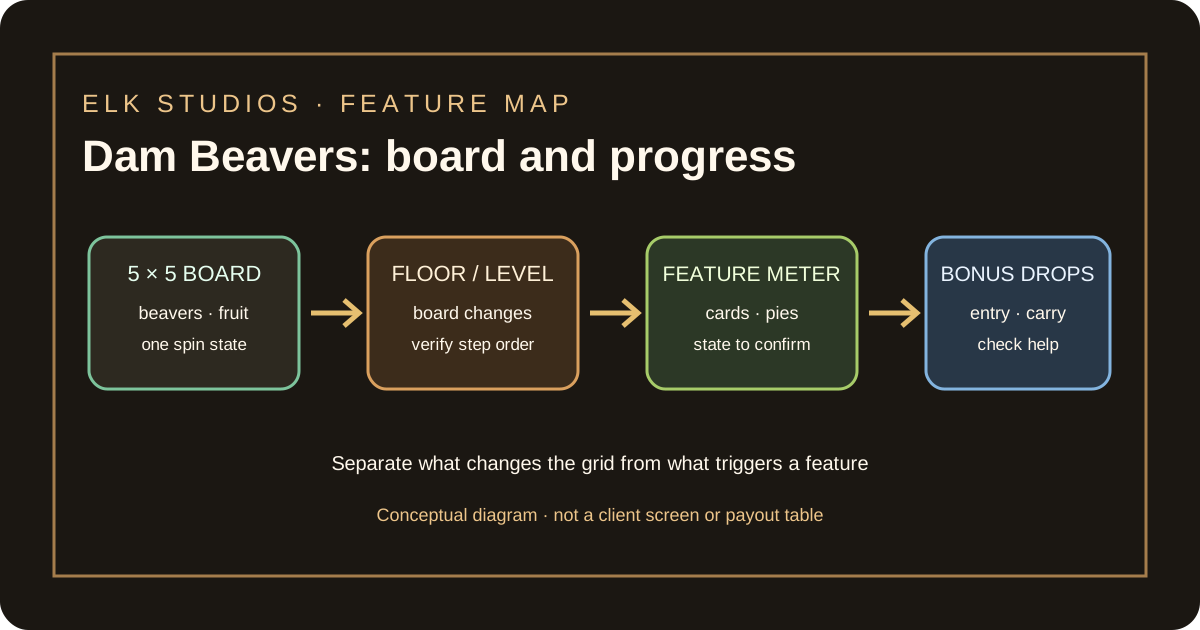
Dam Beavers is built around a board that can progress through floors of a multi-level dam. Its 5×5 opening grid is only the starting point: ELK describes beavers collecting fruit and feature symbols, breaking floorboards, unlocking larger grids and upgrading symbols. A Feature Meter connects collections to one of three feature cards. Three pie symbols trigger a Bonus Game with five free drops, and the supplier says several pieces of progression state remain during that feature.
That is enough to understand the game’s broad structure, but not enough to state the return, volatility or full settlement rules. ELK’s public page gives a maximum-win potential of 10,000 times the bet and feature descriptions, but does not provide the exact active RTP, full paytable, symbol-level values, hit frequency, wager limits or all operator-mode costs. Those belong to the live help for the version being considered. A third-party number should not be presented as a confirmed New Zealand setting.
What is confirmed and what is not
| Question | Supplier-published answer | Check in the active client |
|---|---|---|
| Starting board | 5 columns by 5 rows | Whether the displayed version opens on the same configuration |
| Progression | Clearing a breaking point unlocks a larger grid and upgraded symbols | Exact level-by-level requirements and reset behaviour |
| Feature Meter | Wins increase it; a full meter awards one of three feature cards | Meter units, card odds, and whether progress persists between spins |
| Bonus | Three pies award five free drops | Retrigger conditions, initial state and ending rule |
| Bonus persistence | Floor level, meter progress, fruit payout level and bonus-symbol collection persist | Exact symbol and feature interactions in that operator build |
| Top potential | Up to 10,000× the bet | How the client caps a round and displays the unit |
| RTP and volatility | Not stated on the public product page | The displayed value or variant, volatility label and version context |
This distinction protects against a common review mistake: treating a feature overview as a complete rulebook. A product page is a useful primary source for named mechanics, but the operator’s help defines the playable configuration.
Read the grid as a changing state
The opening 5×5 grid gives you a baseline. It does not guarantee that every later step uses the same number of visible positions. ELK describes a multi-level dam in which beavers break floorboards as they collect fruit and feature symbols. Reaching a breaking point unlocks the next level, a larger grid and upgraded symbols. The state of the board is therefore part of the game’s progression, not just scenery behind the symbols.
When reading the help, identify what a “level” refers to. It may be useful to note the current floor, its remaining boards, the feature meter, the current payout level of fruit symbols, and any collected bonus symbols separately. A screen can animate several changes in sequence; separating the indicators makes it easier to see which action moved the game forward.
Do not assume the board expands on every win or that each beaver clears one board per move. The supplier’s summary explains the broad effect, not all trigger conditions. Look for a visual legend showing the breaking point, the event that clears it, and the exact transition to the next floor. If a symbol’s appearance changes after a level-up, check whether the paytable value changes too or whether the visual change is only cosmetic.
Beavers, fruit collection and matching colours
The beavers are the collection characters in this title. The supplier says they move to collect fruit and feature symbols. Secondary reviews describe colour matching, but this guide uses the operator’s help as the authority for the exact colour-to-symbol rule. If the client says that a beaver collects fruit matching its colour, record which symbols qualify and whether a path or adjacency condition also applies.
For a first pass through the paytable, separate ordinary fruit from feature icons. A fruit symbol may be a payout item whose level changes as the game advances. A feature symbol may fill the meter, affect a board, upgrade an icon or start a special action. A single collection animation can involve both categories, but their jobs are different. Knowing which is which helps explain why a move changed the meter, the visible fruit value or a floorboard.
Write down only what the help demonstrates. The public page does not publish exact symbol values, movement order, whether multiple beavers can collect in one action, or how overlapping collection routes are prioritised. Those are precisely the kinds of details that vary in third-party descriptions because reviewers may be discussing different client builds or drawing on a demo version. When the help is silent, leave the field unconfirmed rather than importing a rule from Pirots or another CollectR game.
Floorboards and the four-level dam
Breaking the floor links symbol collection to the larger progression system. ELK says beavers destroy the floorboards beneath them and reveal hidden treasures. Completing the breaking point on one level unlocks the next level with a larger grid and upgraded symbols. The public page describes four floors and says clearing all boards on the final level awards the stated 10,000× maximum win.
There are several different milestones here, so do not compress them into “reach level four and win.” Unlocking a level is a transition; clearing its boards is another task; revealing a treasure may expose an outcome; and a maximum-win condition is a specific cap. The product page connects clearing the final level’s floorboards with the 10,000× potential. It does not say that entering the last floor alone awards the maximum.
To follow progress, look for an explicit floor indicator and a remaining-board count. If the interface includes treasure graphics, note whether they are revealed by an ordinary collection, a specific symbol or clearing the whole level. A progress animation is not evidence that the next level or top win is likely. It only reports what has happened in the current round.
The Feature Meter and three feature cards
ELK says all wins increase the Feature Meter. When it fills, the game awards one of three feature cards: Symbol Swap, Symbol Refresh or Wild Scatter. The supplier overview identifies the card names, but it does not publish the meter threshold, odds for each card, whether more than one can be held, or the exact sequence after a card is awarded.
The distinction between meter progress and floor progress matters. The meter tracks a feature route, while floorboards and levels track dam progression. They may advance from actions in the same round, but they are not the same bar. A guide should therefore avoid saying that a filled meter automatically opens another floor unless the active help explicitly connects those outcomes.
When a card appears, read its label before interpreting the animation. A Symbol Swap changes the identity or positions of symbols, a Symbol Refresh may replace or re-present a set, and Wild Scatter suggests a Wild-related outcome; however, the exact effect needs the in-game description. Those plain-English interpretations are not substitutes for the rules. Check what the card changes, when the next evaluation occurs, and whether any altered symbol remains in view for another step.
Feature symbols: treat each one as a separate instruction
The official Dam Beavers page lists Wilds, TNT, fireworks, a blender and a pie symbol. It says TNT blows away floorboards, fireworks upgrade symbols, the blender fills the Feature Meter, and pies are used for the bonus trigger. The product page does not specify every animation variant or whether these icons have additional effects in a particular mode.
When two feature icons appear close together, do not assume they resolve in the order they are shown on the screen. The help should define whether the collection character must reach the symbol, whether it counts at the time it lands, and how the feature is settled. For example, the blender’s stated connection to the meter is different from a card awarded after that meter fills. TNT’s floorboard action is different from a normal fruit collection. Keeping these actions separate makes a complex round much easier to explain.
If the help shows a feature icon with multiple possible outcomes, record the possible outcomes and the selection method only if the rules say how they are chosen. “Random” is not a reason to invent a probability. A bonus guide can explain what happens after an outcome appears without claiming that one card is more common than another.
Bonus Beaver: entry and five initial drops
Three pie symbols trigger the Bonus Game and award five free drops, according to the supplier. The Bonus is not described as a conventional fixed-payline free-spin feature; it continues the game’s broader progression. ELK says the current floor level, Feature Meter progress, fruit payout level and collection of additional bonus symbols all persist during the Bonus. The feature can be retriggered numerous times.
That persistence has practical consequences for how you read the bonus. If the game enters the feature on a higher floor, the help indicates that the floor state carries over. If the fruit payout level or meter has already advanced, the supplier says those are also retained. This does not mean a larger payout is guaranteed: retained state describes what the game carries forward, not the result of the next drop.
The public product description does not provide a full retrigger threshold or whether every additional pie grants the same number of drops. It also does not state how a fully filled meter behaves during the bonus. Check the feature rules panel for those details. If an operator’s help differs from a general review, preserve the operator wording and note the date rather than silently blending the two.
Beaver Night Fever and the Super Bonus
Beaver Night Fever is a named feature that starts when all floorboards on level one, two or three are cleared. ELK says the feature has “hugely upgraded symbols.” The summary does not fully explain the duration, the exact symbols affected, whether the regular floor progression continues during it, or how it interacts with bonus drops. Use the in-game description for each of those points.
The supplier also describes a Super Bonus, separate from the standard Bonus Game. It says that the Super Bonus is played on a fully expanded grid with all symbols upgraded in one X-iter mode. The public product page’s bonus section focuses on the standard Bonus trigger and persistence, so do not treat a paid Super Bonus configuration as an ordinary triggered feature unless the live rules say so.
Keep three concepts apart when reviewing: Beaver Night Fever is tied to clearing an early floor; the standard Bonus is triggered by pies; and the X-iter Super Bonus is a paid mode described by the supplier. Similar names do not prove that all three share the same entry conditions, number of drops, or price. The active client should explain the available route and terms.
RTP, volatility and the 10,000× ceiling
ELK’s public product page identifies a maximum-win potential of 10,000× the bet. A maximum is a ceiling, not an expected result, a target or a promise that a player will approach it. The page does not publish the title’s RTP or volatility label in the public text reviewed for this guide. Do not copy a percentage or volatility score from a casino review and describe it as universal.
RTP is a theoretical long-run statistic. It cannot forecast the next spin or tell you whether a short session will return a particular amount. Volatility is a different idea: it describes a distribution pattern, not a schedule for bonuses. A four-floor mechanic, persistent feature state or large maximum-win figure does not make the game’s random outcomes predictable.
For an exact check, open the title’s current info panel and find the RTP line, any available variants, volatility description, wager boundaries and maximum win. Record the currency, operator, date and client version if the interface shows them. A figure from another country may refer to a different build. If the game is not accessible without an account, deposit or a location check, do not claim that a public review verified the version offered to you.
X-iter and the cost of a shortcut
The supplier says X-iter has five modes. One 3× bet example offers more than four times the chance of triggering the Bonus; the 500× example starts a Super Bonus on the fully expanded grid with upgraded symbols. These are mode descriptions and costs, not evidence that either choice is favourable. The terms “more than four times the chance” and “fully expanded” should be read as the supplier states them, not translated into a guaranteed feature or return.
Before selecting a paid mode, confirm whether its price is based on the current total bet or another displayed amount. Check the full cost on the confirmation screen, whether the mode changes the RTP shown by the client, and whether the resulting feature may be excluded from any operator promotion. If the price is not clear, cancel and inspect the help first. A mode that starts a feature still has a random outcome.
You can understand the regular game without using X-iter. If you prefer to avoid a large optional stake, close the menu and continue with the standard configuration, or leave the game. Never raise a stake because a pie symbol seems close or the Bonus feels due. The interface does not make past spins predictive.
Mobile, demo and reading the game screen
ELK recommends a 1600×900 desktop window and a 16:9 aspect ratio if scaling is required. That supplier recommendation does not certify every phone or operator wrapper. On a smaller screen, check that the floor indicator, Feature Meter, paytable and stake control remain readable. The grid may occupy most of the display, so rotate or zoom only if doing so does not hide a cost or rule label.
If a demo is available in a permitted environment, it can help you learn the four-level map and recognise the symbols. A demo cannot verify the operator’s RTP setting, eligibility or account terms, and a short sample cannot estimate long-run results. Do not equate a page’s embedded demo with access for New Zealand accounts.
This site’s New Zealand-focused guide does not name an operator or provide an affiliate transition. Product availability and advertising rules can change, and the ELK catalogue is not a New Zealand casino directory. Check current local information directly before drawing conclusions about access.
A repeatable way to inspect one round
To understand Dam Beavers, follow one round with a small, written state list rather than trying to remember every animation. Start with the grid dimensions and floor. Note which beaver moves, what it collects, whether the item is fruit or a feature symbol, and whether the Feature Meter changes. Then record whether a floorboard breaks, a level unlocks, or a card is awarded. These are distinct events.
If a Bonus starts, pause at the entry screen and write down the retained floor, meter progress, fruit level and bonus-symbol collection. During each drop, check which of those remains and which new event changes it. When the feature ends, compare the final state with the help’s stated reset rule. This is a neutral way to learn mechanics, not a strategy for changing random outcomes.
If you cannot tell whether a feature was caused by the beaver, a card, the meter or a floor transition, replay the help animation rather than guessing. A good explanation should answer “what triggered this?”, “what changed?” and “what persists?” separately. If the answer is not visible, mark it as unknown.
Common reading errors to avoid
The first error is reading “four floors” as a four-step guaranteed route. The game may require a particular board event to reach a new level, and the supplier’s high-level description does not state the chance of that event. The second is treating all collected symbols as fruit payouts. Feature icons can change the board or meter instead of making an ordinary win.
The third error is mixing up floorboards and the Feature Meter. One tracks physical progression through the dam; the other fills from wins and awards feature cards. They may influence the same round, but they are not interchangeable counters. A fourth error is assuming a bonus retrigger repeats the original entry exactly. Check how additional pies work and whether persistence rules continue without a reset.
Finally, avoid treating a max-win figure as a recommendation to buy the Super Bonus or continue until the final level. A maximum describes a theoretical upper bound. It says nothing about the probability of reaching the level, clearing its boards or hitting the cap. Read the cost, decide a limit in advance, and stop if the activity is no longer within that limit.
Frequently asked questions
What is the starting grid in Dam Beavers?
ELK describes a five-column by five-row starting grid. The game can progress to larger grids as floor levels are unlocked. Check the active help for exact transition conditions.
How do you reach the next floor?
The supplier says completing a breaking point unlocks the next level with a larger grid and upgraded symbols. The precise collection or floorboard conditions need to be read in the game help.
What fills the Feature Meter?
ELK says all wins increase the meter. When it fills, one of three cards is awarded: Symbol Swap, Symbol Refresh or Wild Scatter. The public page does not give the meter threshold or card probabilities.
How does the Bonus Game start?
Three pie symbols trigger the Bonus Game and award five free drops according to the supplier. Additional bonus-symbol rules and retrigger counts should be checked in the current client.
Which values persist in the bonus?
ELK lists the current floor level, Feature Meter progress, fruit payout level and collection of additional bonus symbols as persistent during the Bonus Game. That does not guarantee a win on later drops.
What is Dam Beavers’ RTP?
The public ELK product page reviewed here does not state the RTP. Use the current operator help for the exact build and do not treat an overseas review number as a verified New Zealand setting.
Is the 10,000× maximum win a likely result?
No. ELK publishes 10,000× as a maximum-win potential associated with clearing the final level’s floorboards. It is a ceiling, not an expectation or promise.
Is Dam Beavers available to New Zealand players?
This guide does not verify a New Zealand operator listing or demo. A supplier catalogue or third-party country tracker cannot confirm current account eligibility. Check current official information and local requirements.
Sources and scope
- Primary source reviewed 7 October 2026: ELK Studios Dam Beavers product page for the board, floor progression, Feature Meter, named symbols, bonus persistence and maximum-win potential.
- Catalogue context: ELK Studios games catalogue.
- New Zealand advertising context: DIA guidance for advertisers.
- Competitor pages reviewed 7 October 2026: SlotCatalog, Hideous Slots, Online-Slot, and Gambling.com. They help identify reader questions, but show market-specific figures and mixed feature labels; those values are not used as verified NZ settings.
No operator help file, New Zealand account view, RTP variant data, search-volume data or confirmed NZ release information was supplied. Unknown settings are left unknown.
