ELK Studios game guide · South Island guide
Bonzo’s Bananza: rules, features and settings to verify
 Best casinos available in New ZealandUpdated 7 November 2026

Bonzo’s Bananza centres on nudging Monkey and Banana Wilds, respins, Combo Nudge and separate bonus states. ELK’s catalogue explains the headline mechanics; operator help is required for exact values and enabled options.
The short answer
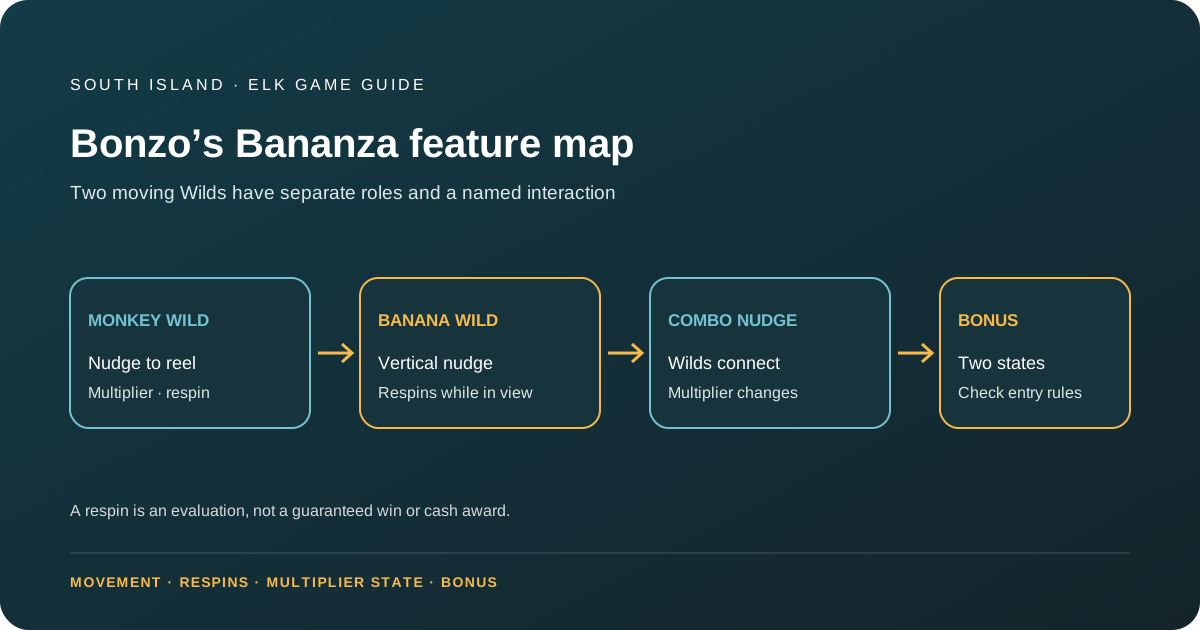
Bonzo’s Bananza is an ELK Studios slot whose published feature list centres on two moving Wild types, respins, Combo Nudge and a Bonus or Super Bonus state. ELK describes the Monkey Wild as nudging to cover a reel, receiving a random multiplier and awarding a respin. A Banana Wild is described as a two-row Wild that nudges up or down and can award further respins until it moves out of view. Combo Nudge is the interaction in which the Banana Wild connects with the Monkey Wild and raises the multiplier as it nudges.
Those descriptions make the game’s main reading task clear: follow the position and state of each Wild, distinguish one nudge from a settled win and check how a respin is awarded. They do not supply a complete active paytable or confirm the exact values on a casino build. No operator help was provided for this assignment, so this guide does not state a local RTP, volatility, bet range, maximum payout, feature price or numerical trigger count.
The game’s name and ELK’s public page do not establish that a particular operator offers it to New Zealand accounts. This page explains how to inspect the title and interpret the named mechanics without presenting a casino offer or implying that any feature can be timed, controlled or relied upon for a return.
Confirm the exact title
Use the title and supplier credit displayed by the game client, then compare them with the official Bonzo’s Bananza page and ELK’s games catalogue. The supplier page is primary evidence of ELK’s public feature vocabulary. It is not a directory of operator availability, a statement about a New Zealand account or a substitute for the paytable that appears in a loaded client.
Open the rules or help panel before starting a paid round. Record the operator, date and any version or game identifier shown. Look for separate sections on the base game, Wild symbols, respins, bonus states, optional features and payout information. Do not assume that a single information icon contains everything. Some interfaces put game rules behind one control and the settlement history behind another.
A reviewer should identify the version being described. If there is no visible version marker, say that the client version could not be identified. If the page has been translated, preserve the supplier name and the wording of the translated mechanic. A different phrase may be a translation choice rather than a different feature, but that cannot be assumed without context.
The title is sometimes rendered with a curly apostrophe in catalogue text and a plain apostrophe in URLs or third-party pages. Those typographic differences do not create a second game, but the article uses the assigned canonical path and official title. It does not create a separate bonus, demo or RTP page.
Understand the board and win evaluation
Before analysing the feature sequence, find the paytable’s basic win condition. It should explain how matching payout symbols qualify, which symbols are special, whether Wilds substitute and how an outcome is settled. The official headline description of a slot layout does not provide every detail of the operator’s active game rules.
Bonzo’s Bananza is described by ELK as a five-by-five slot. The dimensions describe the visible play area in the supplier summary; they do not answer how symbols form a win, what the paytable pays or whether a later feature changes that evaluation. Read the exact help text rather than assuming familiar rules from another ELK game.
A good observation order is: initial board, qualifying combination, any Monkey or Banana Wild event, each movement, the respin award, the following board, and the final settlement. That order helps separate a moving animation from a payout. If a feature continues through several movements, note which action added a respin and which action simply changed the symbol’s location.
Where the client includes round history, compare the visible sequence with the settled result. If the history only shows a final amount, it cannot independently confirm every intermediate mechanic. Avoid describing a hidden calculation as tested. A careful review can explain what the official rules say while marking any information unavailable from the client.
Monkey Wild: movement, multiplier and respin
ELK says each Monkey Wild nudges to cover the full reel, then adds a random multiplier and awards a respin. The sequence has several separate parts: the symbol’s initial appearance, its nudge, the reel coverage, the assigned multiplier, and the respin. A review should preserve that order and check whether the active help uses the same sequence.
Look for how the help defines “full reel.” Does the Wild expand immediately, move to cover the reel after another event or occupy all visible positions? The public overview provides the headline, but a particular build may explain the exact layout differently. Do not infer the number of positions from a resized screen or a promotional graphic.
The random multiplier is also a value attached to a feature, not a guarantee of a winning amount. Check whether it applies to every qualifying combination that includes the Wild, only to wins on that reel, or to a later settlement. Determine if the multiplier persists after the respin or only while the Wild remains in the current feature. These details must come from the help.
A respin is another evaluation under the game’s rules. It is not automatically a cash award and it does not guarantee a further combination. The client should explain whether the stake is charged again, how a respin is triggered and when the feature ends. If the user interface simply labels the event “respin,” avoid adding a financial interpretation that the help does not provide.
During a round, note whether multiple Monkey Wilds can appear or whether the feature is limited to a single symbol. The official high-level description does not answer this. Do not count an image or video as proof of a universal maximum. A reader needs the rule applicable to the current version, not a guess based on one clip.
Banana Wild: vertical nudges and exit condition
The supplier describes the Banana Wild as a two-row-high Wild that nudges either up or down and awards respins until it nudges out of screen. Its defining difference from the Monkey Wild is therefore movement along a vertical path and an exit condition. The active help should state the eligible positions, direction selection and exact point at which the feature ends.
The phrase “until it nudges out of screen” describes a possible stopping condition, not a promise that a reader will receive a fixed number of respins. The sequence depends on the game’s outcome rules. Do not imply that the symbol can be kept in view by choosing a direction or that its movement can be predicted from prior rounds.
Check whether the Banana Wild remains a Wild while it moves, whether it can participate in more than one outcome during a sequence, and how the two-row size is interpreted when it is near an edge. Look for the rule that resolves a nudge at the top or bottom of the grid. The product description does not provide every boundary case.
If an animation shows the symbol leaving and returning, determine whether the interface identifies that as a new event or a continuation. The game history is useful if it records the state, but a screenshot without the help wording is incomplete evidence. A reader should be able to tell whether an observed movement followed the published rule.
Combo Nudge: interaction rather than a separate payout
ELK describes Combo Nudge as the Banana Wild randomly connecting with a Monkey Wild, with the multiplier increasing for each nudge. That makes it an interaction between the two named symbols. It is useful to explain which symbol moves, which symbol is the reference point, what “connect” means on the grid and which multiplier changes.
The supplier summary calls the connection random. That wording should not be turned into an action a player can trigger. A reader may be able to observe the feature when it happens, but the article should not describe a strategy for bringing it about. The active help should define whether the Banana Wild connects by landing in a particular position, moving into the Monkey’s column or meeting another condition.
When the multiplier increases, check which value is being changed and where it is stored. Does the game apply it to a current result, a later result or only to a qualifying combination that includes one of the Wilds? Does the value reset at the end of the respin chain or persist into a bonus? Without the client’s help, those are open questions, not facts.
The key editorial distinction is between a feature counter and a credited win. A rising multiplier can be part of the game state without being cash in the account. The settlement panel or history has to confirm what the event paid. Never call the multiplier “banked profit” unless the rules and history support that exact description.
Respins: what the word should mean in context
Several public descriptions mention respins, but that term can conceal important differences. A respin may follow a Wild movement, keep part of the board fixed, resolve with a changed layout, or be awarded only under a specific condition. The operator help should tell a reader whether the stake is already part of the initial round and what happens to symbols between evaluations.
When the game awards a respin, observe which elements remain in place. If the Monkey Wild or Banana Wild stays visible, identify whether its position or multiplier carries forward. If ordinary symbols reset, check whether the new layout is independent of the earlier one. The animation alone cannot establish those rules.
Do not equate a respin with an extra free spin unless the help uses that term. “Free” may refer to a feature sequence rather than a general absence of cost or risk. The accounting and round history are the right places to determine what was staked and what was settled.
If several respins occur, count only what the interface or help identifies. A reviewer’s short sample is not evidence of a guaranteed sequence length. Avoid phrasing such as “the Wild will keep respinning until it wins.” The supplier description links respins to movement and a stopping condition, not to a promise of a win.
Bonus and Super Bonus
ELK lists a Bonus and Super Bonus as distinct game states. Its public page describes sticky Monkey Wilds in the bonus and a different starting condition for the Super Bonus. The exact trigger, awards, feature state, retrigger rules and symbol persistence should be read from the loaded game’s help before describing a specific casino version.
A practical rules summary should answer four questions: what starts the bonus, how the Super Bonus differs, which Wilds or multipliers remain active, and what ends the feature. The supplier description can guide the reader to those parts of the help but may not provide the complete payout or exact transition.
The word “sticky” usually means a symbol remains in place for some defined part of a feature, but the duration must be confirmed. Does the Monkey Wild stay for the whole feature, until a spin ends, or while another condition remains true? Does a respin preserve it? The rule panel should define the scope; avoid importing sticky-symbol rules from another game.
A Super Bonus label can sound like an assurance of a better outcome. It is not a guarantee of profit. It describes a different feature state with its own rules. Readers should know what is guaranteed by the rule, if anything, and what remains random. An awarded starting Wild does not guarantee a qualifying win or a particular return.
If the client includes an optional mode that enters a bonus directly, inspect its price and rules before use. That is a separate mode decision, not evidence that ordinary play is due to trigger the same state. This guide does not advise purchasing access to a feature.
RTP, volatility and payout details
The assignment did not include an active operator paytable or help panel for Bonzo’s Bananza. No configuration-specific RTP, volatility score, hit frequency, bet range, bonus cost, paytable amount or maximum payout is therefore stated in this guide. Competitor pages may list values, but that does not show which setting applies to a specific New Zealand client.
RTP, when published, is a theoretical long-run measure for a defined configuration. It is not a forecast for a short session and it does not mean an account will receive that proportion back. A value can be connected to a game mode or operator configuration. Record the mode and source alongside it.
Volatility and hit frequency should not be collapsed into one claim. A volatility label describes the shape of possible results; a hit-rate figure, if supplied, describes a defined event under a defined model. Neither tells a person when the next Monkey Wild, Banana Wild or bonus will arrive. Do not promise a “quiet stretch” will be followed by a feature.
The payout table should define how ordinary symbols, Wild-assisted results and bonus outcomes settle. A maximum-win headline, where one is shown by the supplier, is not a complete paytable or a typical result. The user’s instruction requires numerical settings from current game help; the supplier overview alone is not used here to publish them.
For a useful evidence record, capture the title and operator, date, mode name, help wording, value and currency. If there is no version marker, note that too. Leave fields blank if the interface does not state them. An honest “not confirmed” is more useful than a borrowed number that may describe a different configuration.
X-iter and optional modes
ELK links its title to X-iter information, a system of optional game modes. The existence of that link does not prove that a particular operator enables X-iter for Bonzo’s Bananza or that it is available in New Zealand. The current client must show the menu and rules.
If an optional mode is present, read its price, entry state, feature conditions and return information in the same currency and client in which it would be used. An option that begins closer to a bonus changes how a round starts and what it costs. It should not be described as a safer way to play or a method of increasing expected profit.
Do not quote mode prices from competitor pages or another casino. Mode labels can sound similar while the cost, enabled features or RTP setting differ. If the mode is not visible in the account’s client, say it was not verified. If a player cannot afford to lose the amount, they should not use a paid option.
The role of this article is to explain the terms a reader should inspect, not to recommend a feature. No mode, bonus or multiplier creates a reliable way to recover a previous loss.
Mobile layout, controls and accessibility
A supplier listing cannot confirm how a particular operator embeds Bonzo’s Bananza on a phone. The game canvas can resize, help controls can move and the history may be hidden behind a menu. Check the actual client rather than assuming desktop and mobile versions expose identical controls.
On a phone, verify that the title and provider are visible, that the rules panel can be opened and read, and that the stake or result is not hidden by browser chrome. The movement of two Wild types can make a small grid busy. A reader should be able to pause between rounds and identify which symbol moved, if the interface offers that control.
Check whether the game provides captions or text labels for feature states, a mute control and a visible way to open the paytable. A graphical symbol might be obvious to one person and ambiguous to another. If a key rule is shown only through animation, note the limitation rather than claiming full accessibility.
This article has not loaded the casino client or tested input methods. It therefore does not claim mobile support for a specific operator, screen-reader compatibility, performance quality or verified responsive behaviour. A production review would need to inspect the actual interface on the devices named in the report.
Demo and New Zealand availability
The official catalogue does not confirm that an operator offers Bonzo’s Bananza in New Zealand or that a demo is available to a reader. A demo could be provided by a supplier or casino in some context, but access and rules may vary. This guide does not link to an operator or launch a gambling product.
Where a lawful demo exists, it can help show where the help icon, history and feature labels appear. It is not proof that a production account has the same settings, RTP, mode costs or eligible features. Demo outcomes cannot be used to forecast future play or demonstrate a long-run return.
New Zealand’s Department of Internal Affairs says online casino advertising is subject to a prohibition and that obligations can cover third parties publishing or arranging advertisements. The DIA advertiser guidance identifies affiliate marketing among initial prohibited advertising decisions. This package therefore does not include an affiliate CTA or CPA button. That decision does not make any claim about whether the game is technically accessible.
This article is a game-mechanics reference rather than legal advice. Regulatory and operator information can change. Consult official New Zealand information for the legal framework and the exact client’s rules for game configuration. No public verification of a specific operator was available for this package.
Compare reviews without mixing configurations
Third-party reviews can be useful for learning which feature names to look for, but their settings should not be copied into a New Zealand-facing page without matching evidence. Compare each source’s date, operator, jurisdiction, mode and stated version. A setting without these details is difficult to interpret.
For Bonzo’s Bananza, compare descriptions of the Wild sequence: does the source distinguish the Monkey Wild’s full-reel nudge from the Banana Wild’s vertical movement? Does it explain what earns a respin? Does it say how Combo Nudge changes a multiplier? A feature list that omits these distinctions may be useful as a quick overview, but it is not a complete rules explanation.
If sources disagree about RTP, volatility or a win cap, do not average them or select the largest. They may describe separate settings, older content or editorial estimates. The active help for the loaded game is the proper source for the current operator’s configuration.
A comparison table should mark each fact as supplier-level, operator-specific or unverified. This lets a reader see whether a claim is about the game’s advertised design or the rules actually displayed in a casino session. It also prevents a demo, promotion or old screenshot from being silently treated as a live build.
Questions readers commonly ask
What is the Monkey Wild?
ELK describes it as a Wild that nudges to cover a reel, receives a random multiplier and awards a respin. The current game help should define its exact timing, scope and settlement.
How does the Banana Wild differ?
The supplier describes a two-row Wild that nudges up or down and can award respins until it moves out of view. The exact path and boundary conditions need the active help.
What does Combo Nudge do?
ELK describes the Banana Wild randomly connecting with the Monkey Wild and increasing the multiplier with each nudge. The operator rules should say exactly what counts as a connection and which result receives the multiplier.
Is a respin the same as a win?
No. It is another game evaluation under the rules; it does not guarantee a positive result. The game history should show the final settlement.
Does Super Bonus guarantee a large payout?
No. It is a named feature state, not a guaranteed financial return. Any guaranteed starting symbol or state should be described separately from the uncertain result.
What is the local RTP?
No current operator help panel was supplied, so this guide does not state a New Zealand configuration value. Check the exact game client and mode.
Can a demo show the exact real-money rules?
A demo can illustrate controls and visible features but may not match a production operator build. Use the live client’s help for applicable settings.
Is the game available to New Zealand players?
The supplier catalogue does not establish operator availability or account eligibility. Check current operator terms and official local requirements; this page does not claim access.
Sources and verification boundary
- ELK Studios: Bonzo’s Bananza — public feature descriptions, checked 6 October 2026.
- ELK Studios games catalogue — title listing, checked 6 October 2026.
- ELK Studios game assets catalogue — supplier catalogue listing, checked 6 October 2026.
- DIA: Online gambling for advertisers — New Zealand advertiser guidance, checked 6 October 2026.
- Online Casino Gambling Regulations 2026 — regulation 40(c), checked 6 October 2026.
- Competitor context checked 6 October 2026: SlotsReach, FruitySlots, CasinosInCanada, and Chase the Scatter.
Third-party settings vary and are not used as the local configuration. No current operator help or in-game client test was available. RTP, volatility, stakes, feature costs, payout cap, demo access and New Zealand operator availability remain unverified.
