ELK Studios game rules · South Island guide
Slurpy ELK Studios slot review: rules and settings
 Best casinos available in New ZealandUpdated 7 November 2026

Slurpy is an ELK Studios slot built around collectors called Slurpies. They collect matching symbols and feature symbols only when a clear path connects the symbols to the relevant collector. ELK also describes an expanding grid and persistent bonus state. No current New Zealand operator help was supplied, so RTP, volatility, cap, stake limits, mode prices and local availability are not stated as verified facts.
The short answer
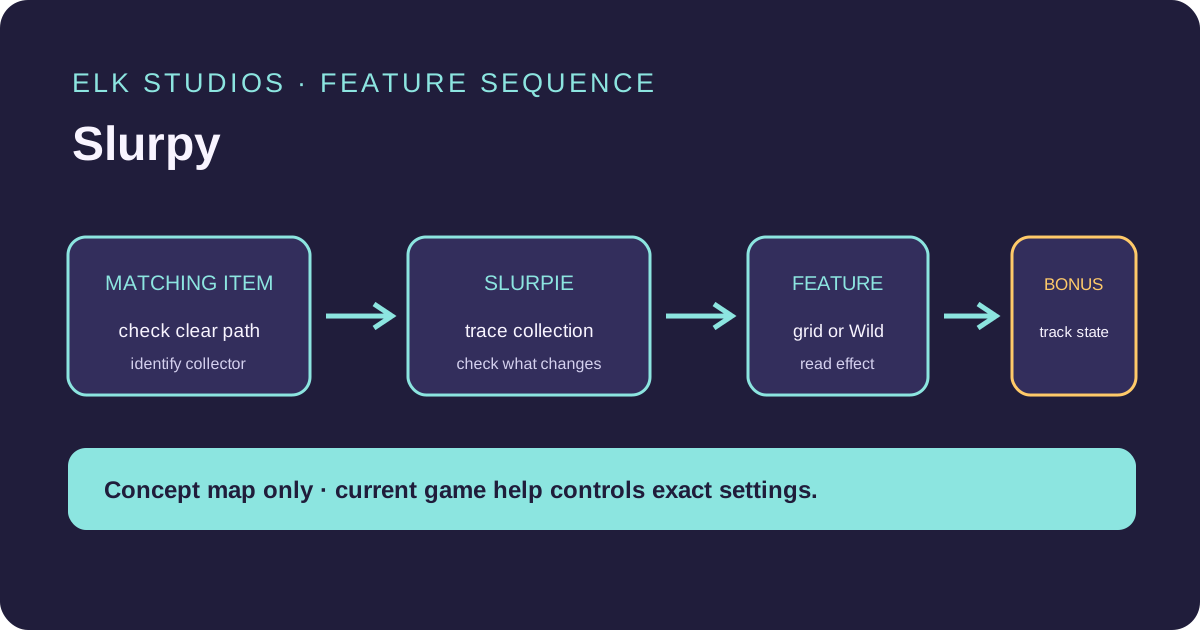
Slurpy is a collector-based slot from ELK Studios. Its Slurpies collect their corresponding symbols and feature symbols when a clear path connects them to the collector. ELK also describes Wilds, multipliers, an expanding grid and distinct Bonus and Super Bonus states. The key to understanding a round is to follow the path, the collection and the board change as separate events.
The official Slurpy product page was checked on 6 October 2026. No current New Zealand operator help or paytable was supplied. This Slurpy ELK Studios slot review therefore does not publish an RTP, possible RTP variants, volatility label, maximum payout, stake range, exact feature counts, bonus threshold or optional-mode cost. It also does not claim that a particular operator offers Slurpy to an account in New Zealand.
Confirm the exact game and its version
Begin with the full title and supplier name displayed inside the client. The official ELK catalogue lists Slurpy as a distinct game. Its visual style and collector system may invite comparisons with other titles, but similar themes or characters do not establish shared rules. The game’s own help and paytable must control each description on this page.
Record the operator, date, language, currency and any displayed version or rules identifier. A review page may describe a demo build, a market-specific configuration or a version opened through a different casino. If the title in the client is not exactly Slurpy, do not transfer this guide’s mechanic notes without checking the matching supplier page.
Supplier documentation confirms that the product exists in ELK’s catalogue and summarises its feature families. It is not an operator directory, an NZ distribution list or proof of account eligibility. A product page can be current while a particular casino does not carry the title. Keep game identity separate from local access and from the mathematical settings of the version a person can open.
The clear-path condition
ELK says Slurpies collect their corresponding symbols and feature symbols when a clear path exists between a symbol and its Slurpie. This path requirement distinguishes the collection mechanic from an ordinary cluster or line win. A symbol may be the correct colour or type and still fail the collection condition if the route is blocked under the game’s rules.
Read the active help for the exact meaning of “clear path”. It should identify which cells can block a path, whether diagonals count, whether the collector checks one route or any route, and whether another collector can interfere. The supplier summary explains the core condition but does not define every shape or edge case. Do not infer a path rule from a static screenshot.
When describing a round, start at the collector and trace a visible route to the symbol being collected. Then note whether the collector removes the symbol, changes the grid, applies a feature effect or simply stores a value. These stages may be animated together, but they are not the same rule. The operator’s help should show which action resolves first and whether another evaluation follows.
If the interface highlights a path, that can help explain a single event. It does not prove that every possible path is equally likely or that a blocked symbol will be collected later. An article should describe what the help confirms and leave undisclosed path-selection rules open.
Slurpies are collectors, not ordinary symbols
The product page describes Slurpies as collectors associated with corresponding symbols. Treat the collector as an active feature object, not automatically as a paying symbol. The paytable should explain whether a Slurpie can also substitute, how it appears, and whether its colour or other visual cue determines which symbols it can reach.
The first review task is to identify each collector type and its matching symbol family. If the game uses colour, verify whether shape or an icon also helps distinguish the type. That is useful on small screens and for players who do not distinguish similar shades. Do not rely only on a background colour or animation to explain a rule. ELK has other collector-oriented titles, including the separate World Eaters guide; shared vocabulary does not mean Slurpy’s path rule carries over.
Next, verify the collector’s timing. Does it act after symbols drop, before ordinary wins are evaluated, or only after a feature symbol activates it? Does it process one symbol and then stop, or can it continue through a connected group? ELK’s summary establishes collection through a clear path, but the operator help needs to specify the full sequence.
Avoid saying that a collector “wins” the symbols it touches. Some collected items may contribute to a feature state rather than settle as an ordinary payout. The current paytable should define each collected item and its value. If the rules do not expose that value or route, describe the visual behaviour without assigning an amount.
Matching symbols and collection order
Because the path condition is central, it is useful to distinguish a matching symbol from a reachable matching symbol. The former has the type or colour associated with a collector; the latter also satisfies the route condition. The game may display both on the board, but only the rule test determines whether collection occurs.
Check whether a collected symbol changes the path for other symbols. A first collection might clear or remove a position and open a route, or it might leave the board unchanged until the collection sequence ends. The supplier’s public description does not state how the path is recalculated after each symbol. Use the live rules for any chain behaviour.
Also check how multiple Slurpies interact. A symbol could appear reachable by more than one collector, or two collectors could be positioned so their routes overlap. The current help should say which collector has priority or whether a symbol can be assigned to only one. Do not decide this from one round if the client does not explain the rule.
For a useful example, document the starting positions, the collector selected, the path shown, the symbol collected and the resulting board. If an animation hides the intermediate state, state that the route is not fully visible in the history. A sample can illustrate sequence, but it cannot establish how often a collector activates or the long-run value of collection.
Feature symbols and their effects
ELK says that feature symbols can be collected by any Slurpie as long as a clear path is available. This means a feature symbol’s route may differ from a normal colour-matched symbol. The operator help should identify each feature icon, the collector that can reach it, the effect it activates and the state it changes.
Do not group every feature symbol under a broad label such as “bonus”. Some may create Wilds, adjust a multiplier or expand the grid, while another may be connected to bonus entry. A reader should know which item is collected and what happens next. The exact active feature list and its rules must come from the current help, not from an aggregate review written for an unidentified version.
Check whether a feature symbol must be collected to act or whether appearing on the board is enough. The clear-path rule suggests collection matters, but only the operator help can say whether other conditions also apply. Verify whether a collected feature triggers immediately, waits for the current resolution or is stored for a later stage.
If a feature changes the grid, note the new dimensions only when the current help supplies them. If it changes the multiplier, record whether the value applies to one result or persists. If it affects a Wild, identify its substitution rules. These distinctions let a review explain the feature without inflating it into a guaranteed payout.
Expanding grid and board state
The supplier describes an expanding grid. An expansion changes the space in which symbols and paths can appear, but it does not by itself establish a higher chance of winning or a larger return. The mathematical model and active paytable determine how a changed board affects outcomes.
The current rules should identify what triggers expansion, which direction the grid grows, when additional positions become active and whether the change lasts for the current round or persists into a feature. Check whether newly added cells can hold Slurpies, feature symbols and ordinary symbols, and whether they participate in the same clear-path logic as the original area.
Do not assume every visible cell is active. The client could display decorative space, an inactive position or a temporary feature area. Follow the paytable’s definition of the playable grid. If the expansion is shown as a transition, note whether existing symbols move or remain in place.
Expansion and collection may interact. A larger board can create new paths or change which symbols can reach a collector; whether it actually does so depends on the rules. Verify the order: does the grid expand before a collector checks paths, after collection or between bonus drops? If the help does not specify, describe the visible sequence only and mark the rule as unresolved.
Wilds, multipliers and value labels
ELK’s public summary names Wilds and multipliers. Those are broad terms, so the operator paytable should define which symbols a Wild can replace, whether it can form a win by itself and what the multiplier applies to. A displayed value can belong to one symbol, one cluster, the entire game state or a bonus stage; do not treat the labels as interchangeable.
Look for the order in which collection, Wild substitution and payout evaluation occur. A Slurpie might collect a symbol and thereby expose a path; a Wild may then contribute to a separate winning group. The exact client rules decide whether these events can happen in one resolution and how the final amount is calculated. Do not add multipliers manually based on an animation.
If a value persists, identify its scope and reset point. ELK says the bonus retains the global multiplier between free drops. That supplier statement does not establish that the multiplier persists between paid rounds or across separate sessions. The live rules should state when it begins, what increases it and what clears it.
Keep every monetary claim tied to a verified paytable. A feature symbol, collector or multiplier can change a state without producing a cash result. The useful explanation is what input activates the mechanic, what part of the board or calculation changes and which later condition must be met for settlement.
Bonus and Super Bonus state
ELK describes a Bonus with free drops and a Super Bonus that starts with more Slurpies and an expanded grid. It also says the global multiplier, grid size and number of Slurpies persist between free drops. These are supplier-level feature relationships; exact trigger requirements and numerical settings must come from current game help.
Read the trigger rule for the ordinary Bonus, including which collected symbols count and whether the clear-path condition applies to all of them. Check the number of drops, the treatment of further bonus symbols and whether additional drops can be awarded. This article does not state counts because an active operator help file was not available.
The Super Bonus is a separate starting state. The current help should explain the required symbol, the starting grid, the number of collectors, the initial multiplier and any difference in how a collector or feature symbol works. Do not assume that “Super” means a higher expected return. It describes a mode name, not a guarantee.
Persistence is a technical detail, not permanence. The supplier says selected values remain from one free drop to another. Verify whether a change from a collector or feature is immediately retained, whether it resets on a new bonus, and which symbols are cleared at the end. A statement such as “the game keeps the multiplier” needs the exact state boundary.
X-iter and optional entry modes
ELK lists X-iter modes for Slurpy. A mode may begin in a chosen feature state or change the chance of reaching a bonus, but the supplier page does not verify which options a casino enables, the price shown in a local currency or any territorial restriction. The current operator menu is necessary for those facts.
If the menu is visible in an authorised client, read each mode’s full name, cost, starting setup and help note. Establish whether the amount is a separate charge or replaces the ordinary stake, and whether the mode changes the mathematical configuration. A feature entry may guarantee a starting event without guaranteeing a payout greater than its price.
Keep the base game, naturally triggered bonus and optional entry in separate paragraphs. They can share a feature name while having different costs or settings. If an operator publishes a separate RTP for a mode, report the exact mode and active configuration. Do not carry a mode price or return figure from a foreign casino into an NZ guide.
This article does not recommend X-iter. Without current terms and verified return information, a claim that a mode is worthwhile is unsupported. If the price, feature effect or applicable rules are not clear before confirmation, do not proceed.
RTP, volatility, cap and available stakes
No current operator help or Slurpy paytable was supplied for this review. Therefore, no active RTP or variant, volatility label, max payout, stake range, feature cost or hit-rate claim is verified here. ELK’s product page documents the feature system but does not identify the settings used by a particular New Zealand casino.
An RTP figure is meaningful only when tied to a defined ruleset and configuration. It is a theoretical long-run calculation, not a prediction of a session or guarantee of a return. If an operator lists more than one setting, record which one is active in the client being described. Do not present the title’s most frequently repeated search-result value as universal.
Volatility labels are broad summaries of outcome distribution. They do not make a feature due, describe a reliable session length or predict a result. A maximum payout is a ceiling under its stated rules, not a likely prize. For both, verify the unit, feature mode and stake basis in the live help.
Stake limits and available currencies can vary by operator and account. A demo may have no real-money limit or may use different controls. A review in another currency cannot establish what a New Zealand account sees. If the operator does not provide a figure, say it is unverified rather than estimating from a competitor page.
How to inspect a Slurpy round
Start with the rules panel. Note the exact title, provider, operator, language, currency, help date and any configuration label. Find the base payout definition, Slurpie matching rule, clear-path condition, feature-symbol effects, Wild and multiplier rules, grid expansion, Bonus, Super Bonus and optional modes. Make a separate list of unanswered questions.
During an authorised sample, map the path from the collector to a corresponding symbol. Note whether the symbol is collected, whether the path changes and what board event follows. Then identify any feature symbol and read its effect from the help. If the grid expands or the global multiplier changes, record the state before and after without assuming the change has a specific probability or expected value.
If the round enters a bonus, start a separate state record. Note what persists between drops, which symbols remain, whether new collectors appear and when the sequence ends. Compare that sequence to the written help. Do not use the observed round as a fairness, RTP or frequency test.
When reviewing a demo, state exactly that it was a demo and identify the source. A demonstration can explain controls and visible mechanics, but it does not prove the version, real-money limits, NZ eligibility or account access of another casino. If there is no permitted demo or current operator client, say so plainly.
Mobile display and accessible instructions
Slurpy relies on a path that may cross several positions. On a small screen, check that the route is visible long enough to understand, the relevant collector can be identified and the help describes what blocks or clears the path. A sequence that is obvious on desktop may be hard to follow if labels shrink or several animations overlap.
Check the game at the phone’s normal zoom and ensure that the rules panel can be opened without losing the board state. Can the reader see whether a symbol is merely matching or actually reachable? Can the interface show which feature was collected and what changed in the grid? If the answer depends entirely on colour, sound or a fast flash, note that as a readability limitation.
Also check whether animation speed can be reduced or sound muted without removing rule information. The global multiplier and retained state should have a clear textual indicator, not only a decorative effect. A usable history helps a reader distinguish a collector event from the later payout calculation.
No mobile client was tested for this article. The guidance is a device-review checklist, not a claim that the game passed a test. A later report should name the device, operating system, browser or app, client version and date, and should separate accessibility observations from mathematical game rules.
Questions readers often ask
What does a Slurpie collect?
ELK says Slurpies collect their corresponding symbols and feature symbols when a clear path connects the symbol to the collector. The live help should define the path, matching rule and exact collection order.
Does every matching symbol get collected?
Not necessarily. The supplier description includes a clear-path condition. The active rules should explain what blocks the route, whether a symbol can have more than one possible collector and how the game resolves overlaps.
What persists during the Bonus?
ELK says the global multiplier, grid size and number of Slurpies persist between free drops. Confirm the exact start, changes and reset point in the current help; this does not establish persistence outside the bonus.
Is a demo available in New Zealand?
This page cannot confirm that. A supplier listing does not establish demo access or local operator availability. Check the actual authorised environment and its current terms.
Which Slurpy RTP applies to a local account?
No current New Zealand operator help was provided, so no setting is verified here. Foreign review figures are not used as a substitute for the client’s active configuration.
Sources and verification boundary
- ELK Studios: Slurpy — supplier feature summary, checked 6 October 2026.
- ELK Studios games catalogue — exact title cross-check, checked 6 October 2026.
- Department of Internal Affairs: information for advertisers — New Zealand advertising guidance, checked 6 October 2026.
- Competitor sample checked 6 October 2026: FruitySlots Slurpy review, SlotGods Slurpy review, BigWinBoard Slurpy review, and AboutSlots Slurpy review. These pages use market-specific numerical claims and promotional calls to action; those figures are not treated as active NZ settings.
No current operator help, NZ availability evidence, exact configuration, authorised demo or device test was supplied. The guide is limited to supplier-described mechanics and verification steps.
