ELK Studios game rules · South Island guide
Buffalo Toro slot review: walking Wilds, Matadors and bonus rules
 Best casinos available in New ZealandUpdated 7 November 2026

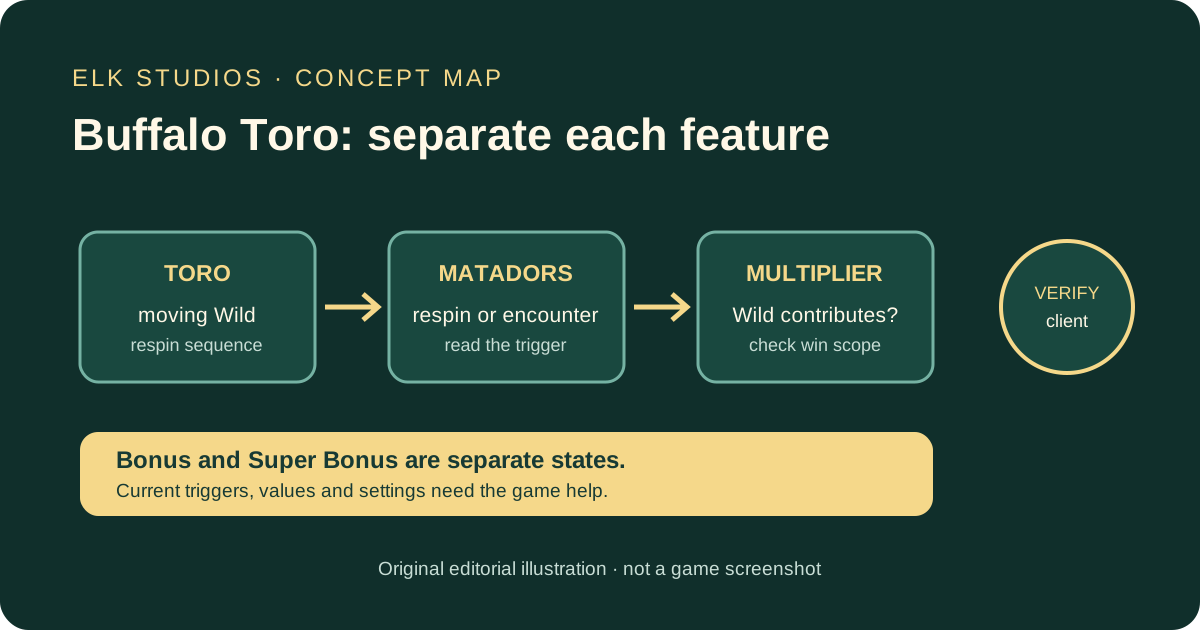
Buffalo Toro is an ELK Studios slot built around a moving Toro Wild, Matador interactions, multiplier Wilds and distinct bonus states. To follow a round, separate the Toro’s movement from the Matador Respin, Toro Goes Wild and bonus features; each has a different trigger and board effect. ELK’s public profile confirms the feature names, but current operator help is needed for exact values, RTP, volatility, caps and local availability.
The short answer
Buffalo Toro is an ELK Studios slot that brings the Toro character into a buffalo-themed setting. The supplier describes a walking Wild, a Matador Respin feature, a Toro Goes Wild feature, multiplier Wilds and separate bonus and Super Bonus states. The important reading task is not to treat every Toro or Matador animation as the same event. The symbol, trigger and result can differ depending on which feature has begun.
In the ordinary round, the player should first learn what qualifies as a standard win and which special symbols can substitute. Then read how Toro moves, what a Matador interaction does, and whether a multiplier symbol must contribute to a win before its value counts. A bonus entry is another state again. The active help should describe how those features start, what persists and how each result settles.
ELK’s official product page confirms the broad feature names and describes the Toro as a walking Wild that generates respins as it moves left. It also says a multiplier Wild awards a random multiplier when it contributes to a win. The accessible product page does not provide a current operator-specific RTP configuration, volatility label, stake range or verified cap. A linked data sheet was inaccessible in the research browser, so this review does not repeat numbers from third-party pages as current New Zealand settings.
Identify the exact title before comparing details
The official ELK catalogue has a Buffalo Toro profile. That supports the product identity and broad feature description, but it does not establish that a particular casino has enabled the game for New Zealand accounts. It also does not show which build, market configuration or optional feature controls are available in an operator’s client. Use the full title shown in the lobby and in the in-game help as the starting point.
Buffalo Toro belongs to a broader Toro theme family, but another title in that family is not automatically a rules reference for this one. A shared character or symbol design can recur while movement, respins, bonus entry and multiplier treatment change. Do not transfer rules from Wild Toro, Toro Shogun, Toro 911 or another title unless the Buffalo Toro help says the rule is shared.
Check whether the casino page links to the supplier title or merely displays a generic game name. Confirm the provider, game title, language and current help version. If a review describes a feature not present in the launched game, the review may be about another version, a separate mode or a different title. This distinction helps avoid mixing a series-level explanation with the product-specific task of understanding Buffalo Toro.
Separate the ordinary spin from feature states
The base game is the normal state before a bonus or special interaction takes over. Begin with the symbol legend and the win definition. Check how a qualifying combination is assembled, whether wins are evaluated in a particular direction, what happens to winning symbols, and whether the game uses a cascade or respin after a result. The official marketing summary does not replace these details in the current help.
Next, locate the Toro symbol and note its role. ELK describes it as a walking Wild. A Wild substitutes for eligible symbols only as the help defines; it should not be assumed to replace bonus markers or other special symbols. The movement event is separate from the resulting win: Toro can move, create a respin and leave the board in a new state, but that does not guarantee that the next arrangement forms a paid combination.
Matadors are another feature element. ELK says a qualifying group of Matadors triggers a Matador Respin. The public wording does not answer every detail about how those symbols lock, whether additional Matadors extend the feature or what ends the respin sequence. The active help must supply those rules. A player-facing guide should use the feature name precisely and avoid importing a lock-and-respin rule from a different ELK game.
The bonus states should also be separated from the base round. The official profile describes a bonus and a Super Bonus, with a different feature package in the latter. Read the entry markers, the way the rounds are awarded, any retrigger condition, and the point at which the bonus ends. Do not imply that a regular Wild event is equivalent to entering Free Spins or another bonus mode.
Toro as a walking Wild
The supplier says Toro moves leftwards and generates respins as he moves. That creates a sequence rather than a single static symbol substitution. To understand the effect, identify Toro’s starting position, the direction of movement, what happens at each step, and the rule that ends the walk. The official summary confirms the direction but does not expose every operator-help detail about movement timing or the number of respins.
A clear walkthrough treats each movement as a state change. First ask whether Toro occupies a cell and substitutes immediately. Then see whether the game resolves a win before he moves again. If a respin is awarded, note whether the symbols on other positions change while Toro remains fixed or whether the Wild advances as part of the new board. The exact order matters because it determines which symbols can combine with the Wild on each event.
When Toro leaves a Wild behind, check whether that trace is part of the Toro Goes Wild feature or a result of his ordinary movement. The official profile separately names Toro Goes Wild and says Toro leaves Wild symbols as he knocks off and defeats Matadors. The two descriptions may be connected in the live product, but the help should show the trigger and sequence. Do not describe every walking step as a Toro Goes Wild event without evidence.
The word “Wild” also has limits. A special symbol may substitute for ordinary paying symbols but not for a bonus or another character. The symbol table controls that boundary. If a Toro Wild is already active while a bonus marker appears, check whether the marker can still trigger a feature. Never infer substitution rules from artwork, colour or another game’s Wild legend.
Matador Respin and Toro Goes Wild are different features
Matador Respin is described by ELK as being triggered by a qualifying Matador combination. The live help should establish what “qualifying” means, how the Matadors behave during the respin, whether any symbols are held in place, and what event concludes the feature. A name alone does not say whether the player gets one respin or a sequence, nor whether later symbols can retrigger it.
Toro Goes Wild is a separate named feature. ELK describes Toro leaving Wild symbols as he knocks off and defeats Matadors. That suggests a character encounter with a visible sequence and persistent Wild placement, but exact board order and eligibility should be confirmed in the game help. The phrase “leaves Wild symbols” does not show how long each one remains, whether they count immediately, or whether an existing multiplier can affect them.
When reading an animation, distinguish cause and consequence. A Matador appearing may be a symbol landing; it may also be part of a triggered event. Toro appearing may be an ordinary Wild or the start of a special interaction. Follow the on-screen feature title and the written help. If the round history names a feature, compare that label with the current help instead of assuming that similar artwork proves identical settlement.
An example can clarify the separation without promising a result. Suppose a round shows Matadors and then starts a respin. Record the trigger, which symbols remain in place, what changes during the next result, and how the final win is recorded. In a different sequence, Toro may leave Wilds while a Matador is removed. That can be described as Toro Goes Wild only if the game identifies it as that feature. The same character does not make the mechanics interchangeable.
Multiplier Wilds and win settlement
ELK’s public page says the multiplier Wild receives a randomly determined value when it contributes to a win. That wording contains two conditions: the symbol must be the multiplier Wild, and it must participate in a qualifying win. Merely seeing it on screen does not establish that its value has been applied. The active help should say how a winning combination is defined and whether several multiplier Wilds combine additively, multiplicatively or through another rule.
Follow the settlement display from the symbols to the amount. Check which normal symbols formed the winning line or way, whether the Wild substituted for one of them, and which multiplier the client attached to that particular win. If multiple wins occur in one sequence, determine whether the value applies separately or to a combined total. Do not turn the word “random” into a probability claim; the public page does not publish a distribution.
The interaction between multiplier Wilds and Toro should be verified rather than guessed. Does a Toro Wild ever carry a multiplier? Can a multiplier Wild replace the Toro? Does a multiplier remain through a respin or bonus? The supplied official summary identifies a walking Toro Wild and a multiplier Wild but does not answer all cross-feature interactions. A source-conscious review names each feature and leaves the unknown boundary for the operator help.
Payout language needs the same care. “Win” can refer to a gross returned amount, a net gain, one symbol combination or the total of a feature. Read the help’s definition and any payout examples before turning an animated display into a written calculation. This guide does not state numeric multipliers, maximum win or paytable amounts because no current game-help screen or accessible official game-data sheet was supplied.
Bonus and Super Bonus states
The supplier profile distinguishes a bonus from a Super Bonus. It says the bonus uses free spins and that collecting Golden Buffalo symbols can upgrade high-value symbols to Buffalo symbols. The Super Bonus shares the symbol-collection idea and adds Rampage Reels with stacked Buffalo symbols. These are useful broad descriptions; the current help should confirm trigger combinations, feature order, persistence and the precise meaning of each symbol.
Do not merge “bonus,” “Super Bonus” and “Matador Respin” into one umbrella feature. A respin can happen in ordinary play, while the bonus has an entry condition and a distinct play state. A Super Bonus can add a different reel or symbol behaviour. Each path can have separate end conditions and settlement. A compact diagram should use separate branches so a reader can follow which rule applies after each trigger.
The Golden Buffalo collection deserves a specific check. The public page says collecting these symbols upgrades high-value symbols to Buffalo symbols. The help should show what counts as collection, whether the upgrade applies to the remaining bonus or a later event, and what happens if a collection occurs more than once. Do not infer a full paytable from the upgrade animation. The symbol value and its combination rules are a separate question.
Rampage Reels are named as part of the Super Bonus. The public summary says they include stacked Buffalo symbols. It does not establish their exact frequency, reel pattern or payout effect. Check whether a stack occupies a full reel or a specified portion of it, and how a stacked symbol interacts with Wilds and collected upgrades. Until the game help provides those answers, a review can describe the broad concept but should not invent a board diagram as if it were a verified client screenshot.
X-iter and optional feature entry
ELK lists X-iter as an optional mode that can start a game with a chosen feature state. Its presence in the supplier’s marketing description does not mean every operator exposes it, and it is not automatically part of a standard spin. The current product help should explain the available modes, their costs, the starting conditions and any separate mathematical configuration. This guide does not state a purchase price or mode-specific RTP.
Read the terms for the exact button shown in the client. Confirm whether a selection starts an ordinary round with an altered chance, begins a feature directly, or sets up a defined sequence. “Guaranteed feature” language may refer only to a particular event starting; it does not guarantee that the round will return more than it costs or deliver a positive outcome. Treat the cost as an additional stake with its own risk.
If a feature mode is absent, do not assume the casino has a broken game. Availability may vary by operator, market or account. If a mode is present, compare its help with the standard game. It might have separate rules for bonus entry, multipliers or settlement. A review of the ordinary Buffalo Toro loop should not silently use a special mode’s start state as if it were the default.
The safest explanation for a reader is procedural: find the standard game help first, understand one ordinary round, then open any optional-mode panel separately. Record the mode name, cost basis, eligibility and stated result rules. If these are not visible, do not use the mode until the operator explains them. There is no benefit in guessing at the cost or assuming that a feature purchase changes the underlying risk in a favourable way.
RTP, volatility and maximum win: what could not be confirmed
RTP describes a theoretical return over a very large number of plays for a defined game configuration. It is not a promise about one player or one session. Different operators or jurisdictions may use different settings, so a value on a review page cannot automatically be assigned to every Buffalo Toro launch. The exact displayed variant in the active help is the relevant value for that client.
The Buffalo Toro Game Data Sheet linked from the official page returned 403 in the research browser. Third-party reviews publish numeric RTP and volatility claims, but they may refer to a casino, country or version that is not the one a New Zealand account would see. This page does not adopt those figures. It also does not claim a verified maximum-win cap, hit frequency, stake range or current New Zealand setting.
Volatility describes outcome variation, not a schedule for when Toro appears or a prediction of how long a bonus will take. A “high” label, when one is supplied, does not mean a player should increase the budget. A maximum win is a theoretical ceiling, not an estimate of a typical result and not evidence that a feature is likely. Any figures should be quoted with their source, date, variant and market.
Before comparing two versions, capture the in-game help for each, including the game identity and operator. Check whether the paytable, RTP, optional features and maximum win belong to the same version. Avoid combining a cap from one page and an RTP from another. If the active client does not show a value, make that absence explicit and contact support rather than relying on an old review.
Mobile layout, history and demo access
The feature animation can occupy much of a phone display. Before playing, make sure the stake, accepted bet, feature label and result remain readable when Toro moves. Locate the paytable, Wild legend, help, history and sound controls. If the interface compresses the symbols, zoom only where supported and use the written help to distinguish ordinary Toro movement from a bonus event.
Round history is more useful for a factual review than a remembered animation. It can help identify the title, round reference, accepted stake and settled result. It cannot predict the next round. If the connection pauses during a respin or bonus, first consult the operator’s account record. Do not assume a new spin is due merely because a feature animation has stopped or a mobile browser has refreshed.
No Buffalo Toro demo or mobile client was tested for this review. A demo, if available, can demonstrate controls, feature names and a sample sequence. It does not confirm the casino’s real-money availability, local stake limits, account protections or active RTP. It might also expose an optional mode that is not available in another market. Treat it as an interface-learning tool, not as proof of operator configuration.
Accessibility is client-specific. Check whether focus indicators are visible, controls can be reached by keyboard, and feature events have text labels rather than relying only on colour or motion. The supplier’s public game page does not document every casino wrapper’s accessibility support. If the interface is hard to read or control, do not stake while trying to work around an unclear screen.
New Zealand access and responsible context
An ELK product page is evidence of a supplier listing, not proof that a New Zealand-facing casino offers Buffalo Toro. No operator lobby, account or live client was checked. This guide does not recommend a casino or say the game is locally available. Verify the operator’s current rules and eligibility directly, and do not assume that a foreign review applies to a New Zealand account.
The Department of Internal Affairs’ advertiser guidance, checked 7 October 2026, says online casino advertising is within the current regulatory framework and identifies affiliate marketing among the initial prohibited decisions. It also states that third parties publishing or arranging advertisements are covered by the rules. For that reason this local draft contains no casino referral button while qualified New Zealand compliance review is outstanding. This is a publishing hold, not a legal opinion.
Keep the feature descriptions separate from an invitation to play. A large buffalo symbol, dramatic walking Wild or bonus animation can make the game visually memorable, but none changes the fact that outcomes are uncertain. Do not chase a Matador event or a bonus after a loss. If gambling causes harm, stop and seek independent help. The site’s safer gambling support page provides New Zealand support routes.
Buffalo Toro inspection checklist
Confirm the title and provider; open the current help. Read the standard win rule and Wild substitutions before examining Toro. Follow the Toro’s movement and note when a respin occurs. Read the Matador Respin rule separately from Toro Goes Wild. Check whether a multiplier Wild must be part of a win and how its value is applied. Then read the Bonus and Super Bonus entry conditions, Golden Buffalo collection, Rampage Reels and any retriggers.
Next, identify whether X-iter is present and inspect its own cost and rules. Find the RTP, volatility and cap fields in the actual client. If the official game-data sheet or active help is unavailable, leave those facts unverified. Check the exact game version and date before using competitor information. A third-party review can provide a question to investigate, but it cannot substitute for the current operator setting.
On mobile, confirm that bet acceptance and settlement can be reviewed after a round. Record a round identifier if you need support. Set a time and spending limit before play and honour it. Do not add a stake because a feature looks close or because the last round returned less than expected. If a rule, payout or eligibility detail is unclear, stop and ask the operator before betting.
Frequently asked questions
What does Toro do in Buffalo Toro?
ELK describes Toro as a walking Wild that moves leftwards and generates respins. The exact movement, substitution and stop conditions should be read in the current game help.
Is Matador Respin the same as Toro Goes Wild?
They are separately named features in the supplier profile. Matador Respin is triggered by Matador symbols; Toro Goes Wild describes Toro leaving Wilds during Matador interactions. Check the client help for the full sequence.
How do multiplier Wilds pay?
The supplier says a multiplier Wild is assigned a random value when it contributes to a win. The current help is needed for exact values and how multiple multipliers combine.
What is the current RTP for a New Zealand player?
This review did not verify a local operator setting. The official data-sheet download could not be accessed, and third-party figures were not used as current local facts.
Does the official game page prove local availability?
No. It confirms the product profile, not a particular operator’s New Zealand catalogue or account eligibility.
What is the difference between Bonus and Super Bonus?
ELK’s profile describes separate states and names Rampage Reels as part of Super Bonus. The active help defines triggers, symbol effects and settlement details.
Sources and verification boundary
Checked 7 October 2026. ELK’s official Buffalo Toro product page and catalogue were used for title identity and broad feature descriptions. The linked Game Data Sheet returned 403 in the research browser; current RTP, volatility, cap, hit frequency, stake range and operator-specific values are not claimed. Competitor reviews differ in numeric and feature detail, so those settings were not imported. No operator client, account or demo was tested. DIA advertiser guidance was checked the same day.
- ELK Studios: Buffalo Toro
- ELK Studios: Games catalogue
- Department of Internal Affairs: Online gambling for advertisers
- Competitor pages reviewed 7 October 2026: FruitySlots: Buffalo Toro, Casino Wizard: Buffalo Toro, and Fortune Games: Buffalo Toro. Their ratings and numeric snapshots were not used as verified New Zealand settings.
