ELK Studios game guide · South Island guide
Huff N’ Puff CollectR: rules and feature guide
 Best casinos available in New ZealandUpdated 7 November 2026

Huff N’ Puff CollectR combines moving pig collectors, gems, feature symbols, a Wolf Crane and a bonus board. This guide follows each route while separating supplier-published mechanics from RTP and other operator-specific settings.
The short answer
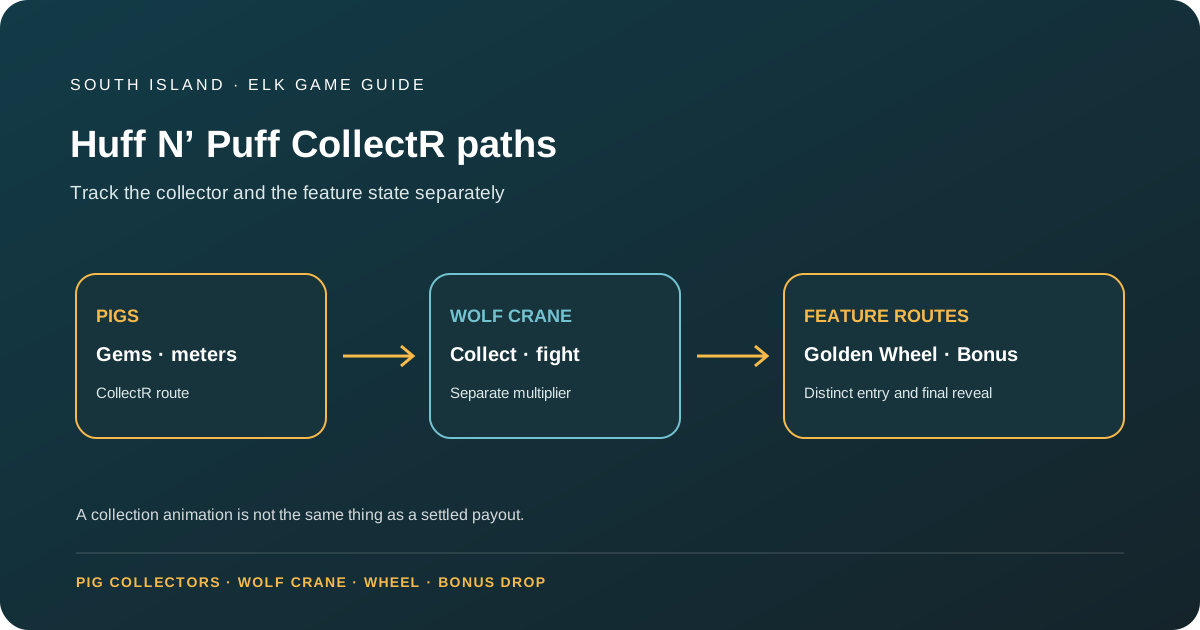
Huff N’ Puff CollectR is an ELK Studios slot with a collection-based grid rather than a conventional fixed-payline presentation. Its moving pigs collect matching-colour gems and feature symbols. A Wolf Crane can collect symbols and set up other effects, while a Golden Wheel can open different feature routes. A separate bonus-drop state can preserve parts of the grid and collection progress, then use houses and the Wolf to reveal a final result.
The useful way to understand this title is to follow each collection chain. Identify what the pigs gather, what fills a feature meter, what causes a Wolf action, and which event leads to the Golden Wheel or bonus. The supplier catalogue confirms the game’s named features, but it does not provide a complete operator paytable or New Zealand configuration. RTP variants, volatility labels, stake limits, hit rates and payout settings must come from the exact game help in the active operator build.
Confirm the exact title first
The official ELK product page for Huff N’ Puff CollectR is the primary source for its name and broad feature vocabulary. Compare that title with the name displayed by the game client. A series label, similar pig artwork or mention of a wolf is not sufficient evidence that another Huff N’ Puff game follows the same rules.
In the operator’s client, open the help or information panel and record any version or rules date shown. Note the operator name, the date checked and the exact wording used for the collection system. If the client’s help describes a feature differently from the supplier summary, report the difference rather than silently blending both descriptions.
This matters because online reviews sometimes use different game layouts or settings. Some describe an expanding grid, some quote a particular RTP or max-win figure, and some carry stake limits from an unrelated market. A supplier game page can explain the game’s intended features, but the live help is the source for the configuration actually presented by one operator.
The grid and the CollectR idea
CollectR changes what a player watches. Instead of looking only for a fixed set of paylines, the player follows collector characters moving around the grid. The pigs are linked to gems and feature symbols. When a pig collects eligible items, those items can disappear from the board and may advance other parts of the game, such as a meter or a feature state.
The official overview describes a grid that can expand and symbols that can transform. Those ideas should be kept distinct. Grid expansion changes the space available for symbols; a transformation changes what a symbol represents; collection moves or removes an item after a character reaches it. One event can lead to another, but the help must say which conditions are linked and in what order.
When reading the active help, look for the game’s actual win condition. Does a group of adjacent gems pay, or are gems collected only when a pig reaches them? Are all colours treated alike? Can a feature symbol be collected without a gem payout? The public catalogue does not provide a full paytable, so do not infer that collection itself always awards a win.
Pig collectors and coloured gems
The pigs are the main collection characters. ELK says they collect gems of a matching colour and feature symbols. That makes colour and position important parts of the visual explanation: a pig’s path determines what it can reach, while the symbol type determines whether the item contributes to a payout or a feature.
A clear walkthrough should label the pig, the colour of the gem it approaches, the item collected and the next state of the grid. If a gem changes value or colour, record the transformation before the collection is evaluated. The animation can make an event look like a single action, even though the rules may evaluate a collection, meter increase and follow-up drop separately.
Do not tell a reader that a pig can be steered or that one starting position is “better” unless the interface truly offers a choice and the help explains the consequences. A character’s route is an outcome of the game state. A player can observe it but cannot time a button press to direct the random sequence.
If several pigs move during the same result, describe each visible collection separately. A single combined sentence may obscure which pig collected which symbol. The operator’s history, when available, can help reconcile the event order. If no history exists, say that the public feature summary does not clarify the order rather than inventing a priority rule.
Feature symbols and collection meters
Feature symbols are part of the collection system as well as possible triggers for other states. The pigs can collect them and fill a meter. A filled meter may activate a feature, but the exact threshold and the eligible symbols should be read in the game help. Do not assume every pig collects every feature symbol or that collection advances all meters at once.
For each meter, note its label, what increments it, what event completes it and what follows. A screen may show a meter one step from completion, but that visual state is not a promise that the next spin will finish it. A symbol collection can also produce a feature without immediately producing a cash payout.
Feature symbols may be transformed, upgraded or moved by other effects. Check whether a transformed feature symbol retains its collection eligibility and whether a collected symbol disappears from the grid. These details affect how the subsequent board is read. If the supplier’s public page does not answer a question, leave it for the active help instead of copying from another CollectR game.
The Wolf Crane
The Wolf Crane is a distinct collection route. The supplier says that the crane can collect symbols and start features or fights; successful fights can increase a crane multiplier. This system should not be collapsed into the pig collectors. The pigs primarily collect matching gems and feature symbols; the Wolf Crane has its own interaction and escalation.
To learn it, identify how the crane enters the board, which items it can collect, and how the fight begins. If the game presents a confrontation, check whether the opponent, stake or result changes the multiplier or simply the feature state. A multiplier that grows through a fight is not automatically applied to every win in the round. The active help should tell the reader which payouts qualify.
The crane animation can cover more of the grid than an ordinary symbol. Watch whether collected items are removed, whether new symbols fall into their spaces and whether any meter changes afterward. These observations explain the interface, but a sample sequence does not establish a probability or expected return.
If a crane effect is optional or tied to a menu, record its exact label and cost from the current build. Do not describe a paid option as a free feature. The supplier overview names X-iter as a collection of feature-entry modes, but the cost and rules for each option must be checked in the menu shown to the operator’s player.
Golden Wheel: possible destinations
The Golden Wheel is a branching feature rather than one single payout. ELK says it can be triggered when the pigs or Wolf collect all symbols on the grid. The wheel can award an instant payout, Hat Mania, Mega Hat Mania, a Bonus or a Super Bonus. Because several destinations are possible, the result should be described as a selection among game states, not as one guaranteed type of bonus.
Before publishing a trigger condition, verify the word “all” in the operator help. Does it mean all symbols currently on the grid, all symbols of a type, or a defined target set? Does a collection by either the pigs or Wolf qualify on its own? The accessible catalogue summary gives a broad trigger but not every edge condition or probability.
The wheel destination matters. An instant payout, a hat feature and a bonus-drop sequence have different steps and settlement rules. A reader should be able to tell which one occurred. Use the game’s own labels in a table or feature explanation; do not label every wheel result “free spins” if the game uses another state.
Do not infer the chance of a particular wheel result from one sample. A short demo, a video or a handful of rounds cannot estimate the distribution. If the supplier does not publish weights, report that the possible outcomes are named but their probabilities are not stated in the source checked.
Hat Mania and Mega Hat Mania
Hat Mania uses hats that fall into frames. ELK’s public summary says repeated drops can upgrade the frames; once drops end, the Wolf reveals coin wins. Mega Hat Mania is named as a separate, enhanced destination. The supplied accessible description does not specify the exact frame count, upgrade values, coin values or every difference between the two versions.
The key to a useful explanation is the sequence. A hat lands in a frame; a repeated event can alter that frame; later drops may fill or upgrade other spaces; at the conclusion, the Wolf reveals the coin result. Use the active help to confirm which hats can repeat, what happens when a frame is full, and how the final coins are awarded.
Do not call an upgraded frame a guaranteed larger payout unless the game help establishes that outcome. It can be a state modifier whose value depends on the final reveal. Likewise, a coin symbol or counter might represent a feature value rather than a settled cash credit. Explain the precise moment at which the result becomes final.
If a sample feature ends with a number on the screen, compare it with the account balance or game history only if those tools are available and permitted. Do not use a screenshot from a third-party review as a complete paytable.
Bonus drops and the Super Bonus
The bonus route uses bonus symbols collected by the pigs. ELK describes a separate board and bonus drops, with a Super Bonus possible when a Super version of a trigger symbol is involved. The grid and selected collection values can persist during the bonus. This persistence gives the bonus a different structure from a normal spin, and the guide should state what carries forward and what resets.
Check the entry rule in the game help: how the bonus symbols are collected, whether they must be gathered in a particular way, and what causes the Super Bonus variant. The supplier overview does not publish every threshold or define all possible trigger combinations. Do not fill the gap with an assumption from another CollectR slot.
During the bonus, the pigs continue to interact with the collection system. Gems may upgrade, the feature meter can carry state and houses can appear in frames. At the end, the Wolf blows the houses to reveal coin wins, according to the public description. A guide should separate the house-building state from the final reveal so a reader knows that a house is not yet a settled payout.
The Super Bonus should be treated as its own state, even if it shares the same board elements. Verify whether the trigger changes the number of drops, house rules, grid persistence or another feature. Do not assume that “Super” means every outcome is larger or that the feature is profitable relative to its entry cost.
Grid expansion and symbol transformations
An expanding grid adds more space to the play area, while a symbol transformation changes the identity or value of a board item. These can interact with pigs and the Wolf Crane: more cells may create a longer collection path, and a transformed gem can change what a character can collect. The effect’s order and eligibility must come from the active rules.
For a clear analysis, note the grid before the event, the trigger, the new size or symbol, and whether collection continues on the same action. A larger grid does not by itself mean a higher probability of a feature or a greater payout. It changes the available state space; the payout still depends on the rules and random outcome.
If the help defines separate rules for a transformation, copy the exact condition. If it does not, avoid guessing based on the visual. A symbol that looks like an upgraded gem could be a feature marker, a coin or a stand-in for a later reveal. A labelled paytable is more reliable than artwork.
RTP, volatility and the limits of comparison sites
RTP is a theoretical measure over a very large volume of play, tied to a specific mathematical configuration. It is not a promise about a person’s session. An operator can offer a configured version, and a third-party review can describe another setting. Therefore, a headline RTP found in a search result is not enough to say what applies in a particular New Zealand account.
Several reviews opened for this page report different values for the RTP, volatility or board settings. Some quote a particular operator or currency; some provide a number without a clear game-help source. This is not a sound basis for an “official” value. The current in-game help must take precedence for a live build, and the value should be recorded with its displayed version and date.
Volatility labels also need context. If the help calls the game high volatility, that is a description of a model’s distribution, not a forecast that a feature will arrive or a promise that a larger win is due. A demo’s short sequence cannot confirm a long-term return. This article reports no numerical RTP, hit rate, payout cap or stake range because a current operator help sheet was not supplied.
X-iter and optional feature entry
ELK lists several X-iter modes for the title. These are optional paid routes that can alter the chance of entry or access a feature state, depending on the specific option. The accessible product page describes the existence of the menu but not a complete menu for every operator. Use the live menu and help to establish which options appear, their price and what each one guarantees.
Read a mode’s wording literally. “Higher chance” is different from “feature guaranteed.” “Bonus” is different from “Super Bonus.” A purchase price is the cost of entry, not a guarantee that the awarded feature will return more than the cost. Avoid statements that a mode is good value, a safe shortcut or a strategy for recovering losses.
If the menu charges a multiple of the selected stake, the arithmetic is simple, but the currency must match the screen. Do not convert a cost shown in euros or pounds to NZD without the operator’s current exchange and transaction terms. A guide can tell readers to inspect the price without recommending any mode.
How to inspect the help and paytable
Open the information panel before starting a round. Find the win method, gem collection rules, pig movement, meter triggers, Wolf Crane rules, Golden Wheel outcomes, bonus entry, Super Bonus condition, and any X-iter terms. Record the title and any configuration identifier shown. If the game provides a history, use it to reconstruct a feature sequence.
For every numerical field, record the exact value and currency shown in the operator help. Keep RTP, maximum payout, hit frequency, stake range, feature cost and mode rules in separate rows. A single “game stats” card often hides whether a value applies to all versions or just one build.
If the operator does not show one of these fields, label it unavailable rather than importing it from a casino review. A complete but transparent set of unknowns is preferable to a polished table that combines several markets. If a value is material to a decision and the help is ambiguous, ask the operator for written clarification.
Learning the board on a phone
This game has moving characters, gems, meters and frames, so mobile legibility is practical rather than cosmetic. Check that the colour key for gems remains readable, the help panel can be opened and the feature history is not hidden behind a menu. If the operator’s game client uses a small screen, make sure a reader can distinguish a pig collection from a Wolf Crane event before explaining what happened.
Colour should not be the only cue. Look for labels, shape differences or accessible descriptions that help distinguish the gems and feature symbols. If the game relies on animated effects and the text help is incomplete, ask the operator for a readable rules copy. A supplier’s responsive design statement does not prove the client works on every phone or browser.
A demo may be available through some supplier or operator pages, but this guide did not open one. Demo access can be restricted by location and can use a play balance, not the same configuration or account features as real-money play. It is appropriate for learning controls, not for measuring expected return or confirming the operator’s settings.
New Zealand access and affiliate placement
The ELK product page establishes that the supplier lists Huff N’ Puff CollectR. It does not prove that the game is offered by a specific operator to a New Zealand customer. Check the operator’s legal identity, current terms and local eligibility separately. An overseas demo page or review is not evidence of New Zealand availability.
The New Zealand Online Casino Gambling Regulations 2026 commenced on 3 July 2026. Regulation 3 defines an affiliate arrangement using a referral and a benefit contingent on a later outcome; regulation 40(c) prohibits advertisements involving that arrangement. The Department of Internal Affairs says the advertising rules apply to third parties that publish or arrange online casino advertisements. The assigned route in this project is an outcome-based CPA route and no compliance approval is available. This article therefore has no operator referral CTA, and the placement is marked blocked pending review.
The game is entertainment, not an income plan. Set a time and spending limit before starting, stay within money you can afford to lose and stop if the session is affecting your wellbeing. The site’s New Zealand safer gambling page lists independent support information.
A feature-tracking worksheet
Use a worksheet to make the game’s layers easier to read without turning observations into betting advice:
| Stage | Record | Why it matters |
|---|---|---|
| Opening board | Grid state, symbols and any active meter | Establishes what is present before an event |
| Pig collection | Pig, gem colour or feature symbol, and movement | Separates collector actions from other effects |
| Wolf action | Crane collection, fight or multiplier state | Keeps the Wolf route distinct from the pigs |
| Wheel destination | Exact label shown after a Golden Wheel trigger | Identifies which feature state followed |
| Bonus entry | Standard or Super label, board transition and carried values | Distinguishes a bonus from its settlement |
| Final result | The paytable basis and any displayed settled amount | Avoids confusing a meter or house with a payout |
Do not infer trigger rates from the worksheet. It is a way to understand a game round, not a substitute for a statistical study or the supplier’s math documentation. A reader should be able to explain what the interface did and still acknowledge that the next random outcome cannot be predicted.
Questions readers commonly ask
How do the pigs collect symbols?
ELK describes pigs collecting same-colour gems and feature symbols. The active game help determines which symbols qualify, how colours match and how collections affect payouts or meters.
What can the Golden Wheel award?
The supplier lists an instant payout, Hat Mania, Mega Hat Mania, Bonus or Super Bonus. The probability of each result and detailed entry rules are not supplied in the accessible product summary.
What does the Wolf Crane do?
It can collect symbols, start features or fights and increase a crane multiplier after successful fights. The active help must explain exactly which wins use that multiplier.
What RTP does the New Zealand version use?
No local operator build was supplied. Read the RTP shown in the exact game help; third-party pages may describe another configuration.
Why is there no casino link?
New Zealand regulations prohibit advertisements involving a defined outcome-based affiliate arrangement. The CPA placement has no compliance approval in this package.
Sources and verification boundary
Official pages checked 6 October 2026: ELK Studios Huff N’ Puff CollectR product page; ELK official games catalogue; DIA advertiser guidance; Online Casino Gambling Regulations 2026, regulations 3 and 40.
Competitor pages opened 6 October 2026: Casinos.com, FruitySlots, AboutSlots, Slots Simulations, iGamingToday, and OLBG. Their descriptions helped identify questions readers ask; their numeric settings conflict and were not treated as local operator facts. The iGamingToday page timed out on open, so it is included as a search result only, not a page review.
No current game-help file, paytable or operator configuration for New Zealand was supplied. This page therefore makes no claim about local availability and omits numeric RTP, volatility, hit rate, stake, feature-cost or payout-cap settings. Search-volume data was unavailable. The batch report records source-body word count; rendered count and production performance are not verified because the archived build could not complete.
