ELK Studios game guide · South Island guide
Bushido Gold: rules, features and settings to verify
 Best casinos available in New ZealandUpdated 7 November 2026

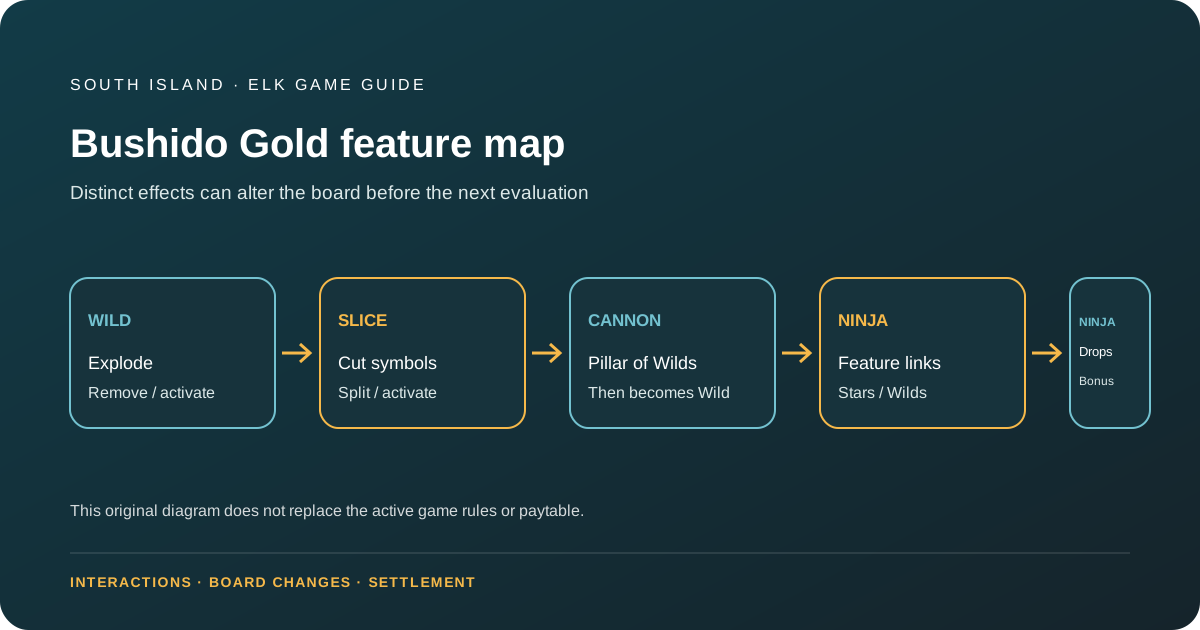
Bushido Gold combines symbol removal, Wild interactions, Slice, Cannons and a Ninja Drops bonus. ELK’s public page explains named mechanics, while the operator’s current help is needed for the exact payout configuration.
The short answer
Bushido Gold is an ELK Studios slot built around several effects that can interact during a round: Wild symbols can explode and remove or activate symbols, Slice can cut matching edge symbols, Cannons can turn into a vertical group of Wilds, and Ninja Drops is a separate bonus state. The title’s official page also identifies large symbols, stacked Wilds and symbol splits. Those names outline the design, but they do not establish the exact rules, payout table, RTP variant or stake limits on a particular casino build.
For a New Zealand reader, the practical answer is to identify the exact game client and open its information panel before relying on figures found elsewhere. The provider catalogue confirms that ELK presents Bushido Gold as a title; it does not show that a particular operator offers it in New Zealand. This guide explains how to read the published feature sequence and what to verify, while leaving all configuration-specific numbers blank until the active game help supplies them.
Confirm the title and the build
Start with the name shown in the game’s own help panel, not a casino search result. ELK’s Bushido Gold product page and official catalogue are primary references for the supplier identity and its public feature descriptions. A product entry or announcement supports the statement that ELK lists the game; it does not identify a New Zealand operator, establish a launch in every market or confirm a specific account can load it.
When a game is available through a licensed interface, open the help or rules before starting a paid round. Look for the supplier name, exact title, version or build marker, and any game-data panel. If the client provides an accessible history, make a note of the operator name and date alongside the help information. These details make a later comparison meaningful: two screenshots are not evidence of the same configuration if one is from a different casino or a different mode.
Do not use a translated title, a similarly themed Gold-series game or a user-uploaded clip as proof that rules are identical. Artwork may be reused across promotions, while the supplier can separately update a game. A reliable comparison begins with matching title and help text, then checks whether the relevant mode and setting are the same. If the client shows no version marker, state that limitation rather than inventing one.
The scope here is intentionally narrow. It covers Bushido Gold, its official feature labels, settings that a player should inspect, and access caveats. It is not a general guide to every ELK release, a comparison of all Gold games, a bonus offer page or a claim that the game can be opened from New Zealand.
How a round is evaluated
The supplier describes symbols, Wilds, symbol removal and a bonus game, but a product summary is not the full paytable. The game help should explain what counts as a win, which symbols are eligible, whether matching symbols must touch, how Wilds substitute, and when the displayed amount is settled. Read those definitions first. Animation alone is not a rules explanation.
A useful way to follow a round is to separate it into stages: the initial symbol layout, any qualifying result, the removal or transformation of affected symbols, the new symbols that arrive, the next evaluation, and the final settlement. If the game uses cascades, one paid round may contain more than one evaluation. The help should make clear whether later symbol drops are part of the original round and what events can continue the sequence.
This distinction matters when several named features appear close together. A Wild effect may alter the grid; that change may form a new group; the new result can then activate another effect. The round history, where supplied, is better evidence than a fast animation or memory. Avoid inferring a probability or promising that one feature will lead to another. A sequence can be possible without being certain.
Before treating a highlighted symbol as a win, check the game’s settlement display and history. A feature label, counter, collected item or multiplier can describe a state that influences a later outcome. It is not necessarily a cash amount already credited. The paytable controls how combinations are evaluated, while the transaction history clarifies what the round actually returned.
Exploding Wilds: removal is not the same as a payout
ELK’s public description says a Wild substitutes for payout symbols and that Wilds explode at the end of a round, removing or activating symbols. That gives a reader two distinct roles to watch: substitution during evaluation and a later board effect. Do not compress those roles into “the Wild pays twice.” The current help should state when the explosion occurs, what the game can remove, and whether the effect can reveal or trigger other features.
When an Exploding Wild appears, first note the winning group, if one has formed. Next check which Wilds remain on the board and whether the explosion affects the whole board or a defined area. Then follow the change the animation makes: removed symbols, any symbol that becomes active, and whether a refill or another evaluation follows. If no help text explains a visual detail, leave that detail undescribed rather than borrowing a rule from another game.
The word “activate” can be easy to overread. It might mean that a symbol now performs its named function; it does not automatically mean it creates a qualifying win or a positive return. The help should explain which feature symbols can be activated and what happens after activation. A careful review describes observable rule states without implying that players can steer a random outcome.
For a clear record, capture the game title and mode, the help wording for Wild substitution and removal, then the history for one example round if it is available. Do not publish personal account identifiers, balances or other private data in a screenshot. If the record cannot show the rule, mark the interaction as unconfirmed.
Slice: inspect the edge condition
Slice is described by ELK as a feature where two identical symbols at the first and last column on the same row can trigger a cut through symbols, either splitting them or activating them. The key phrase is the edge condition. It tells a reader where to look, but the accessible summary is not a complete explanation of every symbol type, timing rule or result.
The in-game help should answer whether both end symbols must be part of the same row in the same evaluation, which symbols can participate, whether Wilds count as identical symbols, and what “split” means for this build. It should also say whether the cut occurs before or after ordinary wins are evaluated. These questions affect how the board is read and should not be guessed from a promotional image.
If Slice divides a symbol, check whether the new parts become separate symbols, whether either part can form a new win, and whether the split can repeat. If Slice activates a feature symbol, identify which one and follow that feature’s own rule. A feature event can change the shape of the board without creating a payout by itself.
In a review, a short step-by-step description is more useful than calling Slice “powerful.” State the trigger condition supported by the help, describe the board change in plain language, then identify what remains unknown. If the client’s rule panel has no detail beyond a name, say that an exact rule could not be confirmed in the version checked.
Cannons and vertical Wilds
ELK describes Cannons as symbols that can interact with Exploding Wilds, Slice or other Cannons. When activated, a Cannon shoots a pillar of Wilds upward and converts itself into a Wild. That description suggests an interaction system rather than a single fixed payoff: a Cannon may become active because another feature changes it.
To understand the effect, separate the trigger from the result. First ask what activated the Cannon. Then see which cells receive Wilds and whether the Cannon’s own position changes. Finally check whether the resulting Wilds substitute in the next evaluation or apply to a group already present. The active rules need to settle that order. An image of a vertical column cannot establish its length, whether it spans all rows or how often it can appear.
Multiple Cannons can create a particularly busy screen. Count what the client actually changed and use the history if possible. If two Cannons interact, avoid asserting that they combine into a single effect unless the help says so. Likewise, do not infer that every Cannon fires whenever a Wild explodes; the trigger list and conditions belong to the exact build.
This mechanic is easiest to explain without implying player control. The player can observe whether the feature fired and what the game evaluated afterward. There is no sound basis for advising someone to wait for a particular layout, choose a timing or increase a stake to influence the sequence. The outcome rules, not a strategy narrative, are the useful part of a guide.
Ninja interactions and throwing stars
The official page says the Ninja symbol interacts with Exploding Wilds, Slice and Cannons. It also describes throwing stars hitting the grid, activating feature symbols or turning into Wilds. This places the Ninja inside the game’s wider interaction chain, but leaves important operational details to the game help: when stars are created, whether their target positions are random, how the number is selected, and what a converted Wild can affect.
When reading a Ninja event, treat the animation as a sequence rather than a single result. Record the starting state, the star impact, any feature symbol it activates, the symbol’s subsequent change, and the next board evaluation. The game history may show only a final settlement; if it does, avoid claiming more detail than the record supports.
A throwing star that lands on a feature symbol may activate it, but the effect still has to follow that feature’s conditions. A star that becomes a Wild may assist a future combination, but the Wild does not guarantee a win. Both outcomes are conditional. This is why the guide names the potential interaction while directing the reader to the exact panel for trigger order and exclusions.
If a displayed count of stars or feature symbols differs between the provider summary and an operator client, use the active client’s help for the version being described. Preserve the date, mode and wording. The provider summary can explain the intended design, while the current game rules govern the individual implementation.
Ninja Drops bonus: entry and round state
ELK calls the bonus state Ninja Drops and describes the Ninja as guaranteed in every Ninja Drop. The public product page also explains that Bonus symbols start the bonus and that additional symbols can affect the number of drops. Those supplier details help identify the intended feature, but a reader should check the game help for the precise trigger, award, retrigger rule, number of drops and settlement.
The bonus should be read as a separate state with its own sequence. Confirm what qualifies as entry, whether the feature starts immediately, which symbols or counters persist from the base round, and how an additional drop is awarded. The phrase “guaranteed Ninja” refers to a named symbol appearing according to the provider description; it does not promise that the symbol creates a win or that the bonus returns more than it costs.
During a bonus, note the start state, each drop, the appearance of the Ninja, any feature symbols activated, and the final result. This makes it possible to explain what a reader can actually observe. It also keeps a dramatic bonus animation from being mistaken for a guaranteed payout. If the client presents a summary screen, compare it with the history for the settled round.
The help should also clarify whether any bonus purchase or alternative entry mode exists in the operator build. Do not assume it exists because another market or a third-party review lists it. If an optional mode is present, its price, exact entry condition and return setting are separate questions. Do not confuse buying access to a feature state with a guarantee of winning.
Big symbols, stacked Wilds and symbol splits
ELK’s public description names big symbols, stacked Wilds and symbol splits. Each phrase refers to a different visual or mathematical property. A big symbol occupies more than a single ordinary cell; a stack places more than one Wild in a reel or column; a split changes one symbol into more than one symbol element. None of these labels alone says how the paytable evaluates the result.
Look in the help for the size of a big symbol, whether it can be partial, how it interacts with a Wild and whether a partial match has any effect. For stacked Wilds, check if every visible Wild substitutes independently, whether the stack can cover an entire reel and whether the effect is limited to a specific stage. For splits, look for the before-and-after state and whether newly created pieces take part in the current evaluation or a later one.
These distinctions matter in screenshots. A large image can obscure the cell boundaries; an apparent row of symbols may be several individual positions. When explaining a feature, use the rule panel’s description or an accessible game history, not a cropped promotional image. If the help does not expose an exact size, avoid stating one.
The visual design can make a round easier or harder to follow. On a small screen, symbols may scale down or animations can move quickly. A good test is to pause between rounds, open the rules and check the history. If there is no pause or history control, do not claim you independently verified an interaction through testing.
X-iter and optional feature modes
The official page advertises X-iter modes for Bushido Gold. These are optional, paid feature modes rather than ordinary rule descriptions. Their availability can depend on the operator, market, game build or local restrictions. The existence of an X-iter page from ELK does not prove that a particular New Zealand-facing game client enables it.
If a mode appears in the live help, read its cost in the account’s currency, what state it enters, whether the stake basis changes and which RTP or payout settings apply to that mode. A mode designed to reach a bonus changes the distribution of play and can involve a materially different cost from a standard round. It should be considered as a purchase decision, not a free shortcut or a strategy for improving expected results.
Do not quote mode prices from an overseas casino or screenshot. Currency conversion is not enough: the mode price and configuration can be operator-specific. If the menu is unavailable to a reader, say that it was not confirmed. If the game help describes a mode but the operator has not enabled it, the page should not present it as accessible.
The guide’s neutral role is to help a reader understand the label and identify the terms that matter. It does not recommend buying a feature, suggest that a mode is better value or imply that entering a bonus guarantees a return. A feature state is still governed by the game’s random outcomes and paytable.
RTP, payout table and maximum return
No current operator game-help screen was supplied for this article. For that reason, this page does not state an RTP percentage, volatility score, stake range, win cap or payout value for Bushido Gold. Numbers copied from a third-party review may refer to a different configuration, an older help panel or a mode that is not enabled for the reader.
RTP is a long-run theoretical measure for a defined game configuration. It is not a promise about one session or an amount a player should expect to get back. A value can differ between versions or modes. The operator’s information panel should identify the setting that applies to the loaded client. If it shows several values, record the option selected and the mode to which each value applies.
The paytable answers a different question: it shows how symbol combinations and feature outcomes are evaluated. Check whether a win is expressed as a multiple of a bet, whether a multi-stage feature uses a separate settlement and whether a displayed cap applies to the base game, the bonus or the full round. A top-win figure from marketing is not a complete payout table.
For a reproducible note, capture the title, operator, country or account context where appropriate, help version or date if shown, RTP or mode value, stake minimum and maximum, volatility label and any stated maximum win. If a field is missing, write “not stated in the help checked.” That is more useful than filling a blank from an unrelated casino listing.
Volatility and what it does not tell you
A volatility label, if supplied in the active help, is a description of the game’s risk profile, not a prediction that a bonus is due or that a particular stake will eventually be recovered. A higher-variance design can feel uneven over short play, but a single result cannot estimate the underlying model. Do not translate a label into a personal strategy.
If the help does not publish a volatility value, leave it unconfirmed. Reviews sometimes use their own rating scales, so a label such as “high” on one site may not be directly comparable with a number on another. A player-facing review should distinguish a supplier classification, if one exists, from an editor’s impression.
The feature architecture can help explain why outcomes may look different from spin to spin: several interactions are conditional on symbols arriving and on the game state. It cannot tell a reader how long to play or what stake to choose. In particular, an apparent pause between feature events is not evidence that the next one is more likely.
Use a preset budget and session limit that are affordable to lose before opening a game. A stop limit is a boundary, not a way to alter the game’s odds. If gambling is no longer entertainment or is affecting bills, sleep or relationships, stop and use independent support rather than trying to recover losses.
Mobile layout, controls and accessibility
ELK’s product page gives a recommended desktop aspect ratio, but that is not proof of the exact mobile behaviour of every casino client. A mobile game may scale the grid, reposition the help button or change how history is opened. The operator’s interface and the device both matter.
On a phone, check that the title and provider remain identifiable, the rules panel can be read without clipped text, the bet control does not hide the settlement and the spin button cannot be triggered accidentally while scrolling. If the interface uses sound or animation cues, check whether those can be muted or reduced. Do not infer that a game is fully accessible simply because it loads in a mobile browser.
A practical inspection should include portrait and landscape if the game permits both. Verify that the help screen still names the same version, that the whole paytable can be reached and that history entries remain legible. A responsive layout can preserve the canvas but still make an important setting difficult to find.
Readers using keyboard navigation or assistive technologies should look for labelled controls, visible focus and meaningful text alternatives. A graphics-heavy game may expose less information to a screen reader than a standard web page. If a control is inaccessible, note it rather than claiming the title passed an accessibility test. This editorial guide has not run the casino client.
Demo and New Zealand availability
The supplier catalogue and product page do not establish that a free-play demo is available through a specific casino, nor that a real-money game is available to an account in New Zealand. A demo may be absent, blocked by local rules, limited to promotional contexts or different from a production client. Availability should be checked at the operator’s current interface and terms; this page does not link to an operator or open a game.
A demo, where one is lawfully offered, can help explain controls and visible feature order. It does not prove that the account’s production version uses the same configuration. It also cannot establish future results or make a statistical sample representative. A demonstration mode should be labelled clearly and not presented as a source for real-money terms.
New Zealand’s online casino regime is in transition. The Department of Internal Affairs’ advertiser guidance says online casino advertising is prohibited under the current framework and that advertising restrictions can apply to third parties publishing or arranging advertisements. It identifies affiliate marketing as an example of an initial prohibited advertising decision. Accordingly, this page contains no affiliate offer link or casino call to action. That editorial choice is separate from whether a game is technically reachable online.
The DIA information and legislation should be checked again before a future update because the licensing and advertising regime is being staged. This article is a game-mechanics guide, not legal advice and not a statement that any operator is licensed, eligible or authorised to serve a particular reader.
A careful way to compare two Bushido Gold listings
If two pages report different settings, first compare the source dates and the setting labels, not the headline number. One source might display a default version, another a selectable RTP version, and a third a mode-specific value. The operator help for the exact loaded game is the controlling source for a reader deciding what applies to that client.
Next compare the terms behind each figure. Was it a base game, X-iter mode or test build? Was the currency or stake range stated? Did the source identify an operator, country or help date? If any of these fields is absent, the number is not a reliable match. Search snippets are especially poor evidence because they can detach a figure from the rest of a page.
Do not average two different RTP values or choose the higher one as if it applied to every account. They may describe separate configurations. The appropriate report is that sources differ and the local setting could not be verified, followed by the exact location where the reader can inspect it in the game client.
The same discipline applies to grid size, paylines, win ways, feature counts and bonus entry. If the provider summary and a casino help panel use different terminology, quote neither selectively. Explain the discrepancy and state which version the article covers. If that version cannot be identified, the article should not pretend otherwise.
Questions readers commonly ask
What is the main Bushido Gold feature?
The public supplier summary highlights Exploding Wilds, Slice, Cannons, Ninja interactions and the Ninja Drops bonus. It is better to describe the game as a group of interacting mechanics than to name one feature as the only defining part. The exact trigger order and payout are not established by the summary alone.
Does an exploding Wild guarantee a win?
No. ELK describes the Wild as a substitute and says Wilds can later remove or activate symbols. A substitution or board effect does not guarantee that a qualifying combination forms or that the final settled round is positive. Check the help and result history.
What does Slice do?
The supplier describes identical symbols at the first and last columns of the same row triggering a cut that can split or activate symbols. The current game help should define eligible symbols, timing and how the changed symbols are evaluated.
Is the Ninja Drops bonus available in New Zealand?
The provider page does not establish New Zealand operator availability. Check a relevant operator’s current lobby and terms and applicable local requirements. This guide does not provide an access link.
What is the RTP of Bushido Gold?
This page does not state a configuration-specific value because the active operator help was not supplied. The correct value, if shown, should be read from the exact game client and mode being discussed.
Is X-iter a free demo?
No conclusion like that follows from the name. ELK describes X-iter as optional game modes, and any enabled mode may have a separate cost and settings. Check the game help before using it.
Can a demo prove the live version’s payout?
No. A demo can illustrate controls or visible mechanics, but it is not evidence of production account settings or future results. Keep demo information separate from the live paytable.
Which source should I trust if review sites disagree?
For the current client, use its own rules and settings panel, then compare with ELK’s product description for the intended feature names. A third-party review can raise a question but cannot replace the active help.
Sources and verification boundary
- ELK Studios: Bushido Gold — official feature summary, checked 6 October 2026.
- ELK Studios games catalogue — title listing, checked 6 October 2026.
- DIA: Online gambling for advertisers — New Zealand advertising guidance, checked 6 October 2026.
- Online Casino Gambling Regulations 2026, regulation 40 — advertising provisions, checked 6 October 2026.
- Competitor pages reviewed for coverage context, not used as a source for local settings: Bonkku, FruitySlots, AboutSlots, and SlotCatalog, checked 6 October 2026.
Competitor listings disagree on configuration values. No operator game-help panel was available for this assignment, so RTP, volatility, stake range, payout cap and operator availability remain unverified. No in-game test was performed.
