ELK Studios game guide · South Island guide
Oxygen 3: rules, features and settings to verify
 Best casinos available in New ZealandUpdated 7 November 2026

Oxygen 3 is an ELK Studios underwater cluster slot built around cascades, position-based multiplier bubbles, Clam effects and an Oxygen Meter. This guide explains the feature sequence and leaves operator settings to the game’s current help.
The short answer
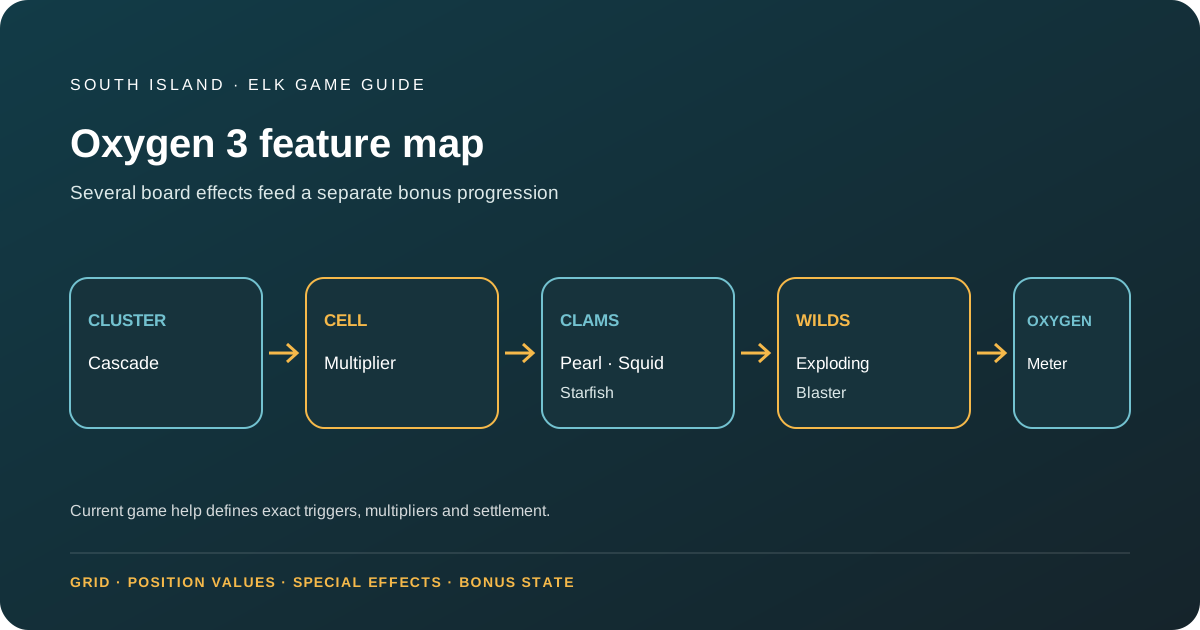
Oxygen 3 is an ELK Studios slot with a cascading grid, cluster-style wins, multipliers attached to grid positions and several special effects triggered by Clam symbols. Its named features include Pearl, Squid and Starfish effects, Exploding and Blaster Wilds, Multiplier Strike and an Oxygen Meter used in the bonus. A win can remove symbols, let new symbols fall and build a multiplier state that changes how later outcomes are evaluated.
The game is easiest to understand when its parts are kept separate: cluster condition, cascade, position multiplier, Clam effect, special Wild and bonus progression. ELK’s official product page provides a high-level description of these mechanics. It does not provide a complete active operator paytable or confirm a specific New Zealand configuration. Read the game help for the RTP version, stake range, volatility, hit rate, payout limit and mode prices, and do not copy those figures from an overseas review.
Identify the exact build
Use the official Oxygen 3 product page and ELK Studios catalogue to confirm the title and supplier feature names. If an operator offers the game, compare the title and provider credit shown by the client. Similar underwater artwork or the earlier Oxygen games do not prove that the rules are identical.
Open the information panel before play and note any rules date or version shown. Record the operator name and the date you checked. The exact client matters because operators can configure games differently, and search results may describe another build. If the help and supplier overview use different wording, preserve that difference rather than guessing which phrase controls the result.
No operator game-help file was supplied for this package. Therefore, this page explains the published supplier-level mechanics but does not state an RTP setting, bet range, probability, paytable amount or maximum payout for a New Zealand account. The source boundary is part of the answer: a reader can understand what to inspect without being shown false certainty.
The grid and cluster evaluation
Oxygen 3 uses a grid rather than a traditional fixed-payline layout. The supplier describes symbols that can form cluster wins and then cascade. A cluster rule answers which matching symbols connect and qualify; the active help should specify the minimum group and whether adjacency includes only horizontal and vertical neighbours or also diagonal cells.
After a winning cluster is evaluated, its symbols can disappear and new symbols can fall into the open positions. That is the cascade or avalanche sequence. If the new grid contains another eligible group, the round may continue with another evaluation. Describe this as a chain inside the game’s current round unless the operator help says that each drop is separately charged.
The layout’s visual proportions are not the paytable. A large board does not mean every cluster pays, and the number of cells does not establish a win probability. To read the rules, check what symbols can form clusters, how Wilds substitute, whether special symbols are included in a cluster and how the final payout is calculated.
When a sequence moves quickly, use the game history if it is available. Note the original cluster, the symbols removed, the new symbols that fell and the state of any multiplier positions. That makes a feature easier to explain and prevents a moving animation from being mistaken for a guaranteed continuation.
Position-based multiplier bubbles
Oxygen 3’s multiplier idea is tied to positions on the grid. When symbols disappear from a location, a multiplier bubble can remain or develop there. Further activity at the same position can increase that multiplier according to the game’s rules. This means the location of a later cluster can matter to its settlement, but only if that position is eligible under the active paytable.
Keep the cell state separate from the symbol state. A multiplier bubble is not itself a Wild and does not necessarily create a win. It is a modifier attached to a position, while the symbol that lands there determines whether an eligible cluster forms. Read the help to learn when the bubble appears, how it changes and whether it persists across cascades, rounds or a bonus.
The supplier overview describes multiplier positions that build through repeated wins. It does not publish a complete configuration-specific multiplier table. Do not report a maximum bubble value, a doubling schedule or a payout formula from a third-party screenshot unless the active game help confirms it. If a cell lights up after a win, record the observed event, not a universal numeric rule.
This positional design can be explained with a simple observation: track the cell, the symbol that landed there, whether it formed a qualifying cluster and what value the game applied. A reader should not be encouraged to aim at a cell or choose a spin timing. The random grid determines what appears.
Multiplier Strike
Multiplier Strike is a separate feature event that may add multiplier values to the board. The supplier description says it can occur during a drop, which means it can alter the position state while a cascade sequence is still unfolding. That timing is different from a multiplier that only grows after a particular winning cluster.
When a Strike appears, identify which cells receive a value and what the game evaluates next. Does it happen before symbols land, after a cascade or between other effects? Does the updated value apply immediately to a result already formed, or only to later evaluations? Those are rule questions for the active help.
Do not describe a Strike as a guaranteed increase to the current payout unless the game says it affects that result. A visual number appearing on the grid can be a future multiplier state rather than an amount already won. The history and paytable are the right tools for understanding settlement.
If an operator version offers different modes, check whether a Multiplier Strike is available in all of them or only in a feature state. A supplier summary naming a feature does not guarantee that an operator enables every optional mode. Report the version and mode with any claim about its behaviour.
The Clam and its three effects
The Clam is a feature symbol that can select among named effects. ELK describes Pearl, Squid and Starfish outcomes. These effects are not interchangeable, and a guide should tell a reader which one occurred before explaining how the board changed.
The Pearl effect selects a payout symbol and can redrop while the selected symbol or a Wild lands. The exact collection condition, stopping rule and settlement basis should be checked in the help. The “selected symbol” phrase should not be turned into a player choice unless the interface actually asks the player to choose it. A random feature can select a symbol without offering any control.
The Squid effect places a Wild in a position and then moves it, according to the supplier overview. That is distinct from an ordinary Wild that remains fixed. The rules should explain its starting position, direction, stopping condition and whether a trail remains. Avoid importing movement behaviour from another slot’s walking Wild.
The Starfish effect removes symbols, increases multiplier values and then becomes a Wild. These actions can be presented as a sequence: removal, multiplier change, transformation and any subsequent cascade. The accessible supplier page does not give a complete order or all exceptions. Use the operator help for that exact sequence and do not claim every Starfish activation creates a win.
Exploding Wild and Blaster Wild
Oxygen 3 also includes special Wild effects described as Exploding Wild and Blaster Wild. Their names suggest different types of board interaction, but a name does not define the exact rule. The active help should explain what triggers each symbol, what it removes or changes and how the next grid is evaluated.
For an Exploding Wild, check whether the explosion changes neighbouring symbols, all symbols in a region or a specific set of cells. For a Blaster Wild, check whether it targets positions, clears symbols or creates a follow-up effect. Do not infer a radius, direction or number of symbols from a still image. Those are numerical and operational details and need the current game help.
When a special Wild overlaps with a multiplier bubble, the result may depend on the interaction rules. Does the Wild substitute and also receive the multiplier? Does an explosion clear or preserve the position value? Does the game evaluate a cluster before or after the effect? Keep such questions unresolved unless the paytable answers them.
The distinction between feature activation and payout remains important. A Wild can help complete a cluster, but a feature animation by itself does not mean the round has paid. Check the resulting cluster and the settlement display.
Bonus entry and Oxygen Meter
The supplier describes bonus entry through special symbols, followed by a bonus or Super Bonus state. During the feature, winning activity fills the Oxygen Meter. When it fills, it upgrades a cluster of multipliers on the board. That connects the game’s core position-based system with the separate bonus progression.
The active rules should state how many symbols are needed for entry, whether the feature offers a retrigger, how many drops or spins it contains and whether the meter resets between them. Do not copy a trigger count or number of drops from another market page. The accessible product overview does not give every threshold or probability.
When the meter fills, note which cells or multiplier positions change and whether the upgrade applies before or after the next evaluation. A larger upgraded area in a Super Bonus, if confirmed by the active help, describes a board state; it does not promise a larger payout. The symbols must still form eligible wins and the configuration determines how those wins settle.
To describe the full bonus, label the states in order: trigger, entry screen, initial grid, drop or spin, meter progress, multiplier upgrade and final settlement. If a feature remains persistent between drops, state exactly what remains. A bonus animation may show both meters and multipliers, so it helps to distinguish them visually and in text.
Bonus and Super Bonus are not the same setting
The two feature names should be treated separately even if they share the same underwater theme and grid. The Super Bonus is described by the supplier as an enhanced variant that changes how the Oxygen Meter affects multiplier positions. The operator help must establish what actually differs: entry, number of drops, meter rules, persistence, multiplier area or another setting.
Do not use “super” as a synonym for an automatic larger payout. It is a feature label. A result still depends on the random symbols, the cluster rule, the cell values and the payout table. The feature may provide more ways for the multiplier state to develop, but no guide should promise that it will outperform the standard bonus.
If the game offers a feature purchase for a Super Bonus, that is a separate cost question. Verify the exact price, whether entry is guaranteed, what settings apply and whether the operator’s terms permit it. A menu can be missing or disabled in a particular market. Do not claim that every casino exposes the same feature-buy options.
The supplier summary and numeric settings
ELK’s public Oxygen 3 page supports the game’s identity and high-level mechanics: cascades, multiplier positions, Clam effects, special Wilds and the Oxygen Meter. It is not the active operator help. A reader looking for exact RTP, volatility, stake range, hit frequency, maximum payout or feature costs should open the information panel in the game version they can access.
Third-party reviews consulted during research display different RTP configurations and sometimes different labels for volatility or layout. Some list a single value while others show multiple alternatives. Those pages may be tied to local operator builds and can also repeat each other’s errors. The conflict is not resolved by averaging the reported numbers; only the relevant game help can establish the chosen configuration.
This guide therefore does not state a numerical RTP or payout ceiling. It also does not copy bet limits, probabilities, maximum multiplier values or feature purchase costs from a review. A “verified settings” guide should explain how to verify a setting and leave it blank if the primary source is missing.
How to read RTP and volatility claims
RTP is a theoretical return measured across a very large amount of play for a defined math configuration. It is not a promise that a particular session will return that percentage. A slot can have multiple RTP configurations, and the operator may select one. Always record the value shown in the exact client together with the date and version.
Volatility is a model description, not a timing signal. A high-volatility label does not say when the next win will occur, how much a person should stake or whether a bonus is “due.” If a game offers different modes, confirm whether the label applies to the base game, the mode or the whole title. Do not use an online reviewer’s label when the active help uses another term.
Hit frequency also needs careful wording. It may count any paid result, a result above stake or a specific feature. Unless the source defines the measure, a percentage can be misleading. This page does not report hit frequency because the operator-specific rules were not provided.
X-iter and optional feature modes
ELK’s product page points to X-iter, a menu of optional feature-entry modes. The exact items, costs and effects should be checked in the active game. Some modes can make a bonus more likely; others can give entry to a specified state. These are not the same promise, and the interface’s words should be reproduced accurately.
If the menu expresses a cost as a multiple of the current bet, show the arithmetic only after checking that exact cost in the client. Explain that it is a price, not an expected return. Do not recommend the most expensive mode as a shortcut to a win or call it a better-value option without primary data that supports the comparison.
The feature menu may be unavailable in a given operator build or jurisdiction. Its presence on the studio’s product page does not prove that it appears in every lobby. A guide should mention the menu’s supplier-level existence and direct readers to the active help for availability, terms and settlement.
Demo use and phone interface
A demo can be useful for learning where the help, paytable, round history and controls are located. If accessible in the reader’s region, it can illustrate a Clam effect or show how position bubbles look. It does not prove the return setting of a real-money build, a casino’s NZ eligibility or the cashier’s rules. No demo was launched for this guide.
On a phone, check that the multiplier bubbles and grid positions remain distinguishable. The Clam outcome label should be readable; feature animations should not hide the help control; and the paytable should fit or scroll within its own panel. A mobile client may be embedded by the casino and can behave differently from a supplier demonstration.
Use text help instead of trying to decode the animation alone. If the game’s interface is not accessible through keyboard navigation or its important information is not legible, seek an accessible rules copy from the operator. Do not infer a mobile performance result from a desktop product page or a short video.
New Zealand availability and advertising boundary
The supplier listing does not confirm that Oxygen 3 is offered by any particular casino to New Zealand customers. Check the operator’s legal identity, account terms and location eligibility separately. Another country’s demo or casino review cannot establish the New Zealand version.
The Online Casino Gambling Regulations 2026 came into force on 3 July 2026. Regulation 3 defines an affiliate arrangement through a referral and a benefit contingent on a later outcome; regulation 40(c) prohibits advertisements involving that kind of arrangement. DIA says online casino advertising rules apply to third parties that publish or arrange advertisements as well as operators. The site’s assigned existing route is a CPA route and no compliance approval was provided, so this page contains no casino referral button. The placement remains blocked pending qualified review.
If gambling is affecting your wellbeing, use the site’s New Zealand safer gambling resource for independent support links. Decide your time and spending limit before starting, keep within a budget you can lose and stop if you feel pressure to recover losses.
A settings checklist for readers and editors
| Item | What to inspect in the active help | What this guide can establish |
|---|---|---|
| Win method | Cluster requirement and adjacency rule | The supplier describes cluster and cascade mechanics |
| Multiplier bubbles | Position, growth, reset and payout scope | Multipliers attach to board positions |
| Clam effects | Pearl, Squid, Starfish triggers and sequence | The supplier names the three effects |
| Special Wilds | Exploding and Blaster rules and exceptions | Both are named in the supplier summary |
| Bonus | Entry symbols, meter progression and persistence | The Oxygen Meter upgrades multiplier positions |
| RTP and volatility | Exact values or labels for the selected build | No local values are asserted here |
| Stakes and cap | Currency, limits and payout ceiling | Must be verified in the operator help |
| Feature modes | Availability, price and what entry guarantees | Must be checked in the current X-iter menu |
This table is intentionally explicit about what remains unknown. If the source changes, update the row only after capturing the current game help and date. A complete record makes future corrections easier and prevents one game’s settings from drifting into another game guide.
Common misunderstandings
One misunderstanding is to treat any multiplier shown on screen as part of the current paid win. It may apply to a later cell evaluation or a feature state. Another is to treat every Clam as the same action. Pearl, Squid and Starfish have distinct effects, and the active help should define their order and limits.
A third is to assume that an operator uses the highest RTP advertised by a review site. Different figures can reflect different supplier builds, jurisdictions or stale pages. Another error is to count cascades as new paid rounds, when the game may evaluate them within one result. The client help must define the billing and settlement boundary.
Finally, do not assume that “bonus” means the player has already won a payout. It means a separate game state has begun. The symbols, position values, multiplier rules and final settlement still determine the result. A feature name cannot replace a paytable.
Questions readers commonly ask
How do Oxygen 3 wins work?
The supplier describes cluster wins and cascading symbol removal. The exact qualifying group and adjacency rule must be checked in the active game help.
What do the Clam effects do?
The supplier names Pearl, Squid and Starfish effects. They select, move or transform board elements in different ways; the active help defines the precise order and settlement.
What does the Oxygen Meter change?
The meter fills during the bonus and can upgrade a cluster of multiplier positions. The exact trigger and what state persists should be read in the current rules.
Which RTP does the New Zealand version use?
No New Zealand operator build was supplied. Check the RTP displayed in the exact game help; third-party reviews may describe another configuration.
Why is there no CPA button?
New Zealand regulations prohibit advertisements involving a defined outcome-based affiliate arrangement. This package has no compliance approval for the existing CPA placement.
Sources and verification boundary
Primary pages checked 6 October 2026: ELK Studios Oxygen 3 product page; ELK official games catalogue; DIA advertiser guidance; Online Casino Gambling Regulations 2026, regulations 3 and 40.
Competitor pages opened 6 October 2026: FruitySlots, AboutSlots, Clash of Slots, SlotGods, Gambling Zone, and BigWinBoard. Their pages supplied useful reader questions and feature explanations, but the numeric configurations differ. Those values are not treated as New Zealand operator settings.
No current in-game help, operator paytable or New Zealand account was supplied. The guide makes no local availability claim and omits numeric RTP, volatility, bet range, hit rate, feature price and win cap. Search-volume data was unavailable. Source-body count is recorded in the package report; rendered count and browser performance remain unverified because production build could not complete in this environment.
