ELK Studios game guide · South Island guide
Tropicool: rules, feature reel and settings guide
 Best casinos available in New ZealandUpdated 7 November 2026

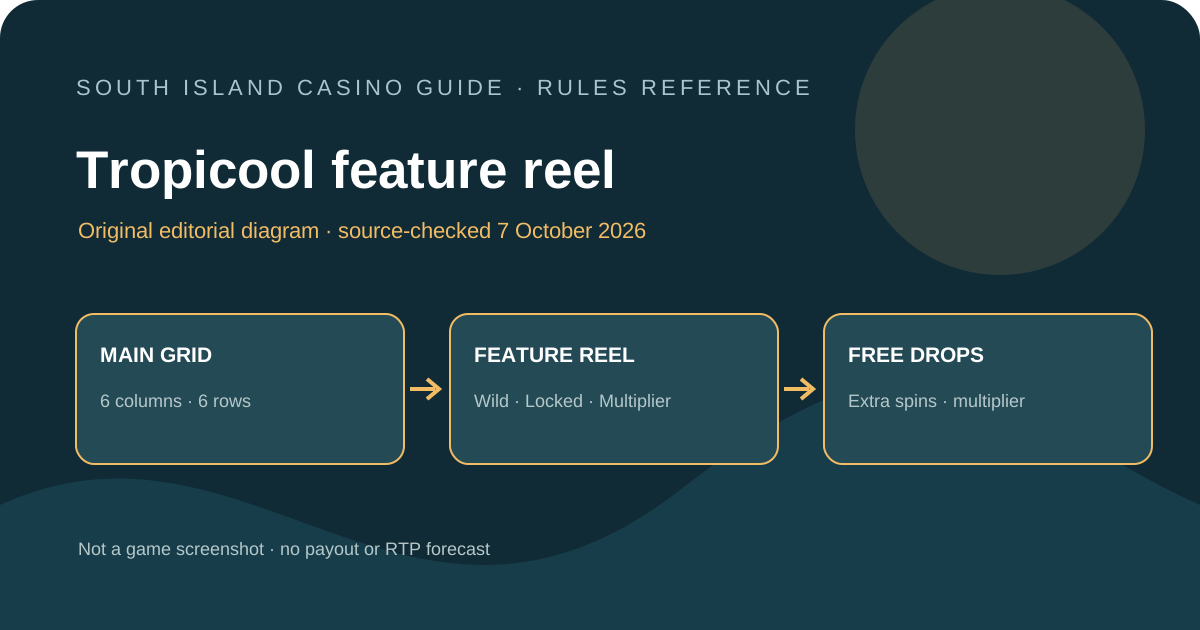
ELK describes Tropicool as a six-column, six-row slot with a separate feature reel. Winning combinations can break ice to unlock Wild, Locked Wild, Multiplier Wild or Row Swap features; three or more bonus symbols start Free Drops, where two extra feature symbols can add spins or raise the multiplier. ELK’s linked data sheet did not load during this review, so RTP, volatility, cap and stake range remain unconfirmed.
The short answer
Tropicool is an ELK Studios slot built around a six-column, six-row main grid and a separate feature reel. ELK says winning combinations break ice on that feature reel and unlock effects such as a Wild, Locked Wild, Multiplier Wild or Row Swap. Three or more Bonus symbols trigger Free Drops. In the bonus, two additional symbols can appear in the feature reel, either adding spins or increasing the win multiplier. The important reading task is to follow what is on the main grid separately from what is waiting on the feature reel, then check how the active game help resolves each feature.
The supplier page currently presents Tropicool as “Live Now” and lists its product description, but that status refers to the supplier catalogue. It does not confirm that a named online casino supplies the game, that the current build uses a particular RTP setting, or that it is accessible to a New Zealand account. ELK links a Game Data Sheet from the page, but that PDF returned HTTP 403 when opened on 7 October 2026. This guide therefore does not state an exact RTP, volatility, maximum win, stake range or operator availability.
The title is distinct from Tropicool 2, Tropicool 3 and Tropicool 5. Similar art, birds or a Cool Reel do not make their rules interchangeable. This page stays with the original Tropicool game and gives a checklist for verifying the exact configuration before relying on any number.
Confirm the title and build first
Begin at the lobby or game information panel and record the complete title, the provider name and any edition label. Then compare the name with ELK’s official Tropicool product page and official games catalogue. The product page is title-specific and currently names the 6×6 layout and feature reel. The catalogue establishes that ELK lists the title. Neither source proves that a particular operator has integrated it for New Zealand.
Open the actual game help rather than relying on a thumbnail or a search-result summary. Look for a help revision, game build, jurisdiction note and current paytable. If the casino client spells the title differently or gives a version suffix, preserve that wording. Compare the rules panel with the selected game name before staking. The same supplier can use different configuration settings at different operators, so a correct title match is necessary but still not enough to validate the RTP or maximum payout.
Keep a small record: date checked, operator display name, full game title, variant/build identifier if shown, game-help revision, RTP text if shown, currency, available stake range, enabled feature menu and whether a demo is offered. “Not displayed” is a useful observation. It is more reliable than filling blanks with a figure from an older review or another country’s game lobby.
The six-by-six grid and the separate feature reel
ELK describes the main play area as six columns by six rows and says a feature reel sits alongside it. Read those as two parts of the interface. The six-by-six grid is the area where ordinary symbols and wins are evaluated; the feature reel carries symbols or effects that can be unlocked when the ice breaks. A guide should not describe the feature reel as an extra payline or assume it pays independently. Its purpose, position and interaction should be confirmed in the game’s own help.
Before the first round, identify how the display distinguishes ordinary symbols from feature symbols. Locate the ice or locked positions, the places where the feature reel can be changed, and the symbols that trigger a state change. If a highlight or animation begins, note whether it updates a symbol on the reel, adds an effect to the grid, or changes the evaluation order. The visual effect can be quick, so a round history, if the operator provides one, may help reconstruct the order after settlement.
The supplier says winning combinations break the ice on the feature reel to unlock feature symbols. That statement connects a paid result to a possible feature opportunity, but it does not supply every condition: the available public description does not identify the full ice sequence, number of hits required, selection order or whether all feature icons become available on the same schedule. Do not infer those values from an animation or a different Tropicool edition. The live rules panel must answer them.
What “break the ice” means for a rules guide
Treat the ice as a state marker, not as a payout. The official description says wins break it to unlock features. A useful explanation should say what event changes the marker, which part of the reel changes, whether the change persists for the rest of the round and what happens after the feature has been used. Those are separate questions. If the operator help does not answer one of them, mark that part as unconfirmed rather than describing an expected sequence as a fixed rule.
For each round, follow the sequence in four steps: identify the winning combination; check the feature reel before it changes; record which feature becomes available; then read the next grid evaluation. This keeps cause and effect legible. It also prevents a common mistake: saying that every win necessarily unlocks a special symbol. ELK’s summary states that wins break ice and unlock feature symbols, but the exact mechanic may have thresholds and configuration rules that the public summary does not display.
If several features are visible at once, determine whether the game selects one, cycles through them or lets a later win release more than one. The public product summary names the available types but does not fully describe selection probability or priority. Do not call a feature “random” unless the active help uses that word or clearly documents a random selection. A descriptive diagram can show the states without pretending that it knows the hidden selection order.
Wild and Locked Wild are different states
A Wild generally substitutes for some ordinary symbols, but each title sets its own eligible symbols and exclusions. Check the Tropicool help for what its Wild can replace, whether it contributes to all matching combinations, and whether it is barred from special symbols. The supplier lists Wild as a feature-reel symbol but does not publish a complete paytable in the accessible page. Therefore a generic Wild definition is not a substitute for a title-specific payout rule.
A Locked Wild is a persistence condition. The word “locked” suggests that the symbol stays in place for a defined period, but the exact interval matters: it might last through an evaluation, a respin, an entire feature sequence or another condition stated by the game. Do not choose one interpretation without the rules. When the operator help is available, record when the lock begins, what can remove it and whether it remains during Free Drops. If a locked position participates in a Row Swap, check whether the lock follows the symbol, stays in the same cell or is unaffected.
The practical distinction helps a reader understand why two apparently similar symbols may behave differently. A regular Wild can affect the current grid evaluation, while a Locked Wild may remain for subsequent game states. The official page names both features, but its concise summary does not specify persistence duration or all interactions. This page keeps those unknowns visible instead of claiming that one Wild type guarantees extra wins.
Multiplier Wild: separate symbol, value and scope
ELK names a Multiplier Wild as another feature-reel possibility and says two extra feature symbols appear in the Free Drops bonus, one of which can increase the win multiplier. The accessible product page does not disclose a complete multiplier schedule, the values available, when a multiplier is applied, or whether it affects one win, a feature sequence or the final bonus total. Those details must come from the active help or an accessible official data sheet.
When reading the rules, find the point at which the multiplier is introduced and the point at which the payout is calculated. If it changes during multiple drops, check whether the game applies it immediately or only at settlement. Note whether the multiplier belongs to the grid, a single symbol, one win or the feature balance. This distinction matters because multiplying a single combination and multiplying an accumulated bonus total are different rules.
Do not report an exact multiplier or say that it grows by a fixed step unless the help states that behaviour. The phrase “progressive multipliers” on a supplier page can be enough to identify a feature concept, but it is not a full schedule. Treat it as a clue to inspect, not a numerical setting. A review that gives an exact maximum without an accessible primary source should be regarded as a claim to verify, not as the official result.
Row Swap: follow positions, not just the animation
Row Swap is a named feature in ELK’s description. At a general level, the name indicates a change involving rows, but the accessible product page does not define which rows move, whether symbols exchange positions, when a new win is checked, or whether locked and Wild symbols move with the rest. Those are the rules that determine how the feature affects a particular round. A guide should not import a row-swap rule from another game using the same term.
When reading the help, look for a before-and-after diagram. Note whether the feature rearranges all six rows or only selected positions, whether it is triggered from the feature reel, and whether any symbols are excluded. Then determine when the game evaluates the new arrangement. If the effect occurs after a win, does it produce another evaluation in the same paid round? If the game calls it a feature or a respin, record its own terminology rather than simplifying it to “rearranges the board”.
For a clear explanation, use a neutral example with labels rather than a promised result. For instance, describe a hypothetical row marked A and another marked B, then say that the help must show whether their positions exchange and when wins are checked. Do not invent a payout from that example. An illustration can explain the question a reader should ask without claiming a particular game result.
Stacked symbols and line evaluation
ELK’s public summary says Tropicool comes with stacked symbols. It does not, in the accessible text, state the complete symbol set, pay values, number of matching reels required or whether wins use paylines, ways or clusters. Those mechanics should be copied only from the current game help. “Stacked” describes how a symbol may appear in positions; it does not establish that it pays, fills an entire reel, or creates a particular number of winning combinations.
In the loaded paytable, start with the evaluation method and the order in which symbols are checked. Find a sample winning combination and confirm how the game counts it. Then inspect which combinations may overlap and whether a Wild substitutes. If a stacked symbol appears, check whether each visible copy counts separately or whether the entire stack is treated as one feature object. The rules may define payout by consecutive reels or by another pattern; the public overview does not settle that question.
This matters when a third-party summary uses terms such as “ways”, “lines” or “clusters”. Those labels are not interchangeable. If the game’s public description does not name a pay structure, do not assign one by comparison with another ELK title. Record what the current help says verbatim. That is especially important for a series where each numbered entry can have a different grid and evaluation process.
Free Drops and the three-symbol trigger
ELK states that three or more Bonus symbols trigger the Free Drops bonus game. This is a clear public trigger statement for the supplier-described product. The public page also says that two additional feature symbols appear on the feature reel during the bonus; one can add spins and the other can increase the win multiplier. The game help is still needed to confirm whether all eligible symbols are counted anywhere on the grid, how many drops are awarded initially, how a retrigger works and when the feature ends.
Do not rename Free Drops as Free Spins unless the active help does so. The terms can describe different evaluation sequences. A drop may mean that the board changes and is checked again, while a spin may mean a fresh reel result; the title’s own rules determine what is retained. Note which symbols stay in place, whether the feature reel is reset, and whether extra drops or multiplier changes carry forward. The accessible supplier page does not supply the complete persistence rules.
A sensible reading order is: verify the trigger count; note the awarded starting drops; observe the first bonus state; record what the two extra feature symbols do; then check the stated end condition. If a retrigger occurs, confirm whether the game adds the new award to the remaining count or replaces it. This checklist describes what the help should resolve; it does not claim a particular operator configuration or a personal test result.
X-iter modes: optional entry is not an RTP shortcut
ELK’s Tropicool page says X-iter has five game modes, ranging from a 5× bet mode with a guaranteed win to a 500× Super Bonus that starts with a 10× multiplier. Those are supplier-published examples of the product’s menu. The exact modes and costs available in an operator’s version should be checked on its live screen, and this guide does not claim that the menu is offered to New Zealand players. An entry cost is a stake multiplier, not a statement that the player receives that amount back.
ELK describes X-iter generally as game-specific predefined modes. The modes can enter a selected feature or scenario; they do not remove uncertainty from the underlying outcomes. Read the mode’s own description for what is guaranteed and what remains random. “Guaranteed win” should be interpreted in the exact terms used by the product; it is not a guarantee of net profit, return of the whole purchase cost or a specified cash award unless the rules explicitly say so.
Before considering a mode, compare its cost with a normal base game stake and check how the payout table applies. Determine whether the game’s return calculation includes or excludes the optional mode. If that information is not in the rules, do not assume that the same RTP applies unchanged. Keep a record of the displayed cost and eligibility. Avoid repeated feature purchases or using a mode to chase losses; a large up-front cost can expose a player to a larger loss in a single decision.
RTP, volatility and maximum win remain separate fields
RTP is a theoretical long-run calculation for an exact configuration. Volatility is about dispersion of outcomes; maximum win describes a limit or cap if the game publishes one. A feature list cannot establish any of these values. ELK’s accessible Tropicool page supplies a layout and feature summary, but the data-sheet link returned HTTP 403 on 7 October 2026. No operator help or NZ client was available for comparison during this review.
As a result, no exact RTP variant, volatility label, maximum return, hit frequency, minimum stake or maximum stake is stated here. Secondary review pages may display such values, but without the current product data sheet and operator configuration they cannot prove the version shown to an individual player. Where sources disagree, the correct response is to identify the disagreement and seek the primary help panel, not to select the most favourable number.
If an operator client later provides a value, record its wording and date, then check whether it changes when the game mode or market changes. Keep “published supplier value”, “operator-selected setting” and “this account’s available build” as three different evidence levels. A supplier catalogue listing is not an operator audit, and a review on a casino comparison page is not a substitute for the configuration presented in the current help.
Mobile, desktop and interface checks
ELK recommends a 1600×900 desktop browser resolution and a 16:9 ratio if scaling is needed. That recommendation is a layout note, not a claim that every phone or tablet client has been tested. On a smaller screen, inspect whether the six-by-six grid, separate feature reel and paytable all remain legible. Check if the feature reel is clipped, whether the help modal scrolls, and whether the selected row or Wild state is marked in a way that does not rely only on colour.
Before a round, locate the bet amount, total stake, spin control, auto-play setting if present, and any optional X-iter selection. Confirm that a tap on the feature reel opens rules rather than initiating a paid action. A responsive interface should keep controls separated from text and avoid horizontal overflow; however, this source review has not run the game in a browser or a New Zealand operator client, so it cannot certify mobile compatibility or input behaviour.
On a larger display, use the spare area to keep both the grid and feature reel visible, but still open the rules panel. A visually clear board does not tell you the exact settlement basis. Check if the game’s history exposes the final bet and award for the paid round. If the interface hides a material term behind a link, obtain the operator’s written help before relying on an outside review.
Demo and local availability
The official ELK page offers a PLAY link, but a supplier launch link is not evidence that a demo will open in every country, that the player can access it from New Zealand, or that the demo uses the same configuration as a casino client. The game page’s “Live Now” label is also a catalogue statement. It should not be rewritten as “available in New Zealand” without operator-specific evidence.
If a demo is exposed by an operator, check whether it is clearly play-credit only, whether the rules panel is identical to the real-money interface, and whether any settings are omitted. A demo can help a reader learn button placement and terminology; it does not validate an RTP through a small number of rounds. Do not infer that a game is approved or locally accessible because a third-party directory lists it for a country.
No demo session was played for this guide, and no operator registration was attempted. That boundary is deliberate: the article reports supplier-published mechanics and tells readers which current settings to inspect, but does not invent personal experience or claim a market-specific offer.
How to read other reviews without importing their numbers
Several third-party review pages for Tropicool discuss a feature reel, bonus drops, RTP and volatility. Their useful contribution is to surface questions a short supplier summary leaves open: what the feature reel contains during a bonus, which award categories the operator help displays, and whether the mode menu is enabled. Their numbers and markets are not evidence of the game configuration currently displayed to a New Zealand player. Some reviews may describe stake ranges or autoplay controls that differ by operator or date.
Compare a secondary source’s feature terminology with ELK’s own page. If the review says “row swap”, verify that the current help gives the same rule and not a mechanic from a later Tropicool title. If it describes 25 free drops, ask whether the claim comes from a game data sheet, an operator interface, or the review’s own test. A precise number without a visible primary source should remain a lead for verification rather than a published fact.
The strongest editorial response is to separate the facts: ELK’s page names the core feature; an operator’s current help defines the configuration; a review can suggest an unanswered question. Do not combine their statements into a false single-source certainty. This page follows that hierarchy and avoids a numeric claim the primary data file could not verify.
Responsible session planning
Feature-rich games can make it easy to lose track of how often a stake has been placed. Decide the entertainment amount and time limit before opening a game. Keep the total wager visible, particularly if a mode charges a multiple of the base stake or an automatic feature button is close to the ordinary spin control. Do not increase the stake to recover an earlier loss or to force a feature to appear.
A theoretical return is not a budget or a forecast. It cannot tell you whether a particular session will last a certain time or finish ahead. If the game’s information is incomplete, that is another reason not to treat an online review as a decision rule. Stop when your own limit is reached. If gambling is affecting finances, sleep or relationships, the site’s New Zealand safer-gambling page links support information.
New Zealand’s advertising rules for online casino gambling are changing under the Online Casino Gambling Act 2026. The Department of Internal Affairs currently says the advertising prohibition is in effect and identifies affiliate marketing among initial decisions prohibiting it. This article has no casino call-to-action. Readers should consult official DIA material for the current legal position; a game guide does not establish legal availability or operator eligibility.
A compact verification checklist
Before relying on a Tropicool review, verify: the full title is the original Tropicool; the supplier is ELK Studios; the current operator help identifies a six-column, six-row board; the feature reel is described separately; the available Wild and Row Swap rules are explicit; the Bonus-symbol count and Free Drops end conditions are clear; the paytable shows its units; and the active RTP is linked to the current configuration. Check any X-iter price and what it guarantees in exact terms. Record which items the source does not show.
Then check the interface for total stake, selected mode, help access and game history. On mobile, confirm the feature reel and help are readable; on desktop, confirm that additional controls do not obscure the total wager. If you cannot find a value or rule in the active help, do not fill the gap with a number from a neighbouring game. Use “not confirmed” and revisit the primary source when it is accessible.
The result should be a concise, reproducible note rather than a superlative review. A reader should be able to tell what ELK documents, what the operator must confirm and what has not been checked. That distinction is especially useful for a series title: the game name and art may feel familiar while its paytable, bonus state and local access remain specific to a particular build.
Questions readers ask
What is Tropicool’s exact RTP?
No exact RTP is confirmed in this review. The linked official data sheet returned HTTP 403, and no operator help panel was available. Use the percentage shown in the current game information panel and note its variant and date.
Is Tropicool the same game as Tropicool 2 or Tropicool 3?
No. ELK lists them as separate titles. Similar characters or a feature-reel idea do not establish identical grid, trigger, payout or persistence rules. Use the help for the exact title selected.
What does Row Swap do?
ELK names Row Swap as a feature, but its accessible public summary does not explain the complete movement and evaluation rule. The active game help must show which rows move, what happens to special symbols and when the next win check occurs.
How does Free Drops start?
ELK’s product summary says three or more Bonus symbols trigger the Free Drops bonus game. The accessible summary does not provide every starting-count, retrigger or end-state detail, so verify those in the active help.
Does a guaranteed-win X-iter mode guarantee a profit?
No. ELK’s public page describes a mode at a multiple of the bet as having a guaranteed win. That wording does not by itself guarantee a net profit or return of the mode’s purchase cost. Read the full operator description before any decision.
Is Tropicool available to New Zealand players?
This guide does not verify that. ELK’s catalogue listing is not proof that any specific operator carries the game or that a New Zealand account can access it. Check current operator terms and local official guidance.
Related site guides
Browse the site’s ELK Studios provider guide for other supplier-specific pages, or open the existing safer gambling guide for support and play-limit information.
Sources and verification boundary
- ELK Studios: Tropicool product page — opened 7 October 2026; title, 6×6 grid, feature reel, named features, Free Drops wording, X-iter overview and display recommendation.
- ELK Studios: games catalogue — checked 7 October 2026; catalogue listing.
- ELK Studios: Tropicool Game Data Sheet — link opened from the official page on 7 October 2026; HTTP 403.
- ELK Studios: X-iter overview — checked 7 October 2026; modes are game-specific predefined scenarios.
- New Zealand DIA advertiser guidance — checked 7 October 2026.
- Competitor sample checked 7 October 2026: SlotCatalog Tropicool, Online-Slot.co.uk Tropicool, Fortune Games Tropicool. These secondary pages describe differing values or local controls; their figures were not adopted as the active game configuration.
No operator build, live RTP selection, volatility, cap, stake limits, demo access or New Zealand availability was verified. No personal test is claimed.
