ELK Studios game guide · South Island guide
Bompers: rules, Avalanches and Bomper Wilds
 Best casinos available in New ZealandUpdated 7 November 2026

ELK describes Bompers as a tilted six-column slot that can grow to eight rows. Avalanches add rows while new wins continue; up to five sticky Bompers can charge into Wilds; a Shooting Star moves upward and creates symbols when it reaches the top; and a Mystery Bomb changes connected symbols. Three Bonus symbols start seven Free Drops with up to five Bompers. The linked official Game Data Sheet returned HTTP 403, leaving RTP, volatility, cap and stake limits unverified.
The short answer
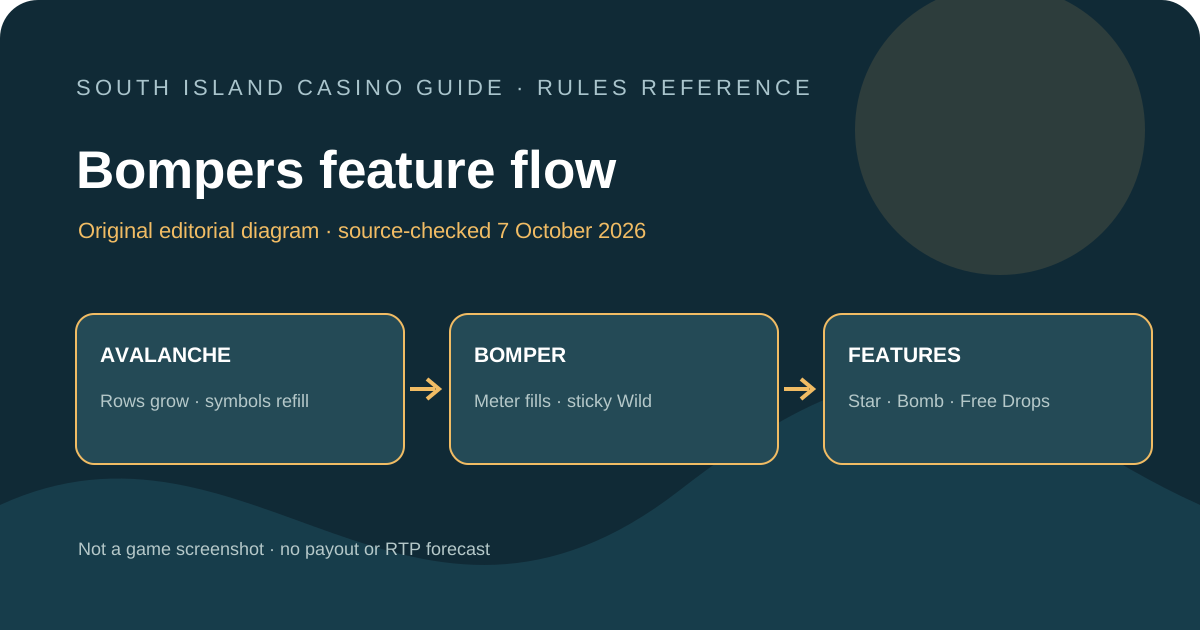
Bompers is an ELK Studios slot built around an expanding, tilted board. ELK describes six columns and a layout that can grow up to eight rows. When matching symbols win, an Avalanche can remove them, add symbols and add another row as the feature continues. Up to five Bomper symbols can appear at the beginning of a new drop; they stay in place and can charge into sticky Wilds when hit by other symbols. A Shooting Star moves upward where there is empty space and, on reaching the top, creates a mix of paying symbols and Wilds around itself. A Mystery Bomb changes connected symbols into the same random symbol; overlapping bombs turn the overlapping symbols Wild.
Three Bonus symbols trigger seven Free Drops, which start with up to five Bompers. During the feature, Bompers remain sticky throughout the bonus. Those are the main mechanics ELK documents in its public product description. The linked Game Data Sheet returned HTTP 403 when opened on 7 October 2026, so this guide does not state the exact RTP variant, volatility, maximum win, stake limits or New Zealand availability.
The game has several stateful features, so read the board in order: current row count, symbols removed in the win, symbols retained, newly added row, Bomper meter and any Shooting Star or Mystery Bomb effect. This is a rules guide to Bompers itself, not a claim that a feature guarantees a return. The official catalogue listing does not establish that a specific operator offers the game to a New Zealand player.
Confirm the Bompers title and current help
Verify the full title in the casino lobby and in the client’s information panel. ELK’s Bompers product page and official games catalogue identify the supplier’s product. They establish the title and public mechanic descriptions, but not the operator’s current integration or local access. A review using the same name can still describe a different market setting or an older help revision.
Before a round, record the operator’s display name, date, title, build or help revision, currency, RTP if shown, volatility if shown, available stakes and feature-menu options. If no build or revision appears, write that it was not displayed. The absence of a setting from a supplier marketing page is not a reason to borrow a number from a third-party table. Likewise, a “Play” link from the provider does not prove that a New Zealand account can open the game.
Do not confuse Bompers with other ELK games that use falling symbols, Wilds or a board that changes size. The terms “Avalanche”, “Bomper” and “Shooting Star” identify this title’s features. The route and page scope are limited to this one game; unrelated Gravity or cluster games have different win definitions and should have their own rules checked.
The tilted grid and row growth
ELK describes Bompers as a six-column slot with up to eight rows and a tilted presentation. The public page does not specify the exact number of rows at every point in the base game or every trigger that can expand it. Use the active help to establish the initial state and then watch how rows are added. The shape can make it harder to count positions by eye, so rely on the game’s grid markers and payout explanation rather than the background art.
The supplier says Avalanches allow a column to expand and thereby increase ways to win. A full Avalanche cycle that expands the column to eight rows can pay out 262,144 ways. That figure describes a possible ways count in the specified maximum row state; it is not an RTP, not the number of credits returned, and not a promise of 262,144 separate wins. The operator’s help should clarify how the game calculates a way and which rows are included.
When a column grows, note whether the extra row appears before or after a new symbol drop, and when the next result is evaluated. ELK’s summary says symbols are added at the end of an Avalanche cycle and another row is added. Check how the current client defines “cycle” and whether the row addition happens only if new winning combinations continue. Do not describe the screen as an eight-row grid at all times when the supplier says “up to” eight rows.
Avalanches: removal, refill and continued wins
An Avalanche begins when winning symbols are removed and the board receives new symbols. ELK’s page says the process continues as long as new winning combinations appear. It also says additional symbols drop at the end of a cycle and an extra row is added. These statements give a useful outline, but the active help should show whether all winning symbols are removed, what happens to non-winning positions and whether any special feature symbols remain in place.
Track one cycle from start to finish. First mark the winning symbols and the award shown. Then check which positions clear and which remain. Watch how the new symbols enter, whether the column grows, and whether the game checks for another win before or after adding a row. This reveals the timing without assuming that every animation is an independent paid spin. An Avalanche is part of the original round unless the game’s help says otherwise.
The phrase “ways to win” needs the paytable and grid rules. It usually refers to the number of possible symbol-position paths under a stated layout; it does not specify the chance that a given path will match or the amount a win will pay. An expanded board can offer more combinations to evaluate, but it does not make a particular outcome certain. Do not describe row growth as “more wins” without the necessary qualification.
Bompers: the sticky symbol and its meter
ELK says up to five Bomper symbols can appear randomly at the beginning of each new drop. They are sticky and remain in the same position. When other symbols hit them, the Bomper meter fills; once full, that Bomper turns into a sticky Wild that stays during wins and Avalanches. This description separates three states: the Bomper appears, it accumulates meter, and it converts to a Wild. A Bomper is therefore not automatically a Wild as soon as it lands.
Check the active help for the meter’s starting state, what counts as a hit, how many hits fill it and whether every position uses the same requirement. The supplier’s public summary does not give a charge count or a reset rule. If a symbol bounces into the Bomper during an Avalanche, the history or help should show whether one or more hits were recorded. Do not infer the exact meter value from a visual animation alone.
The phrase “sticky and stay in the same position” is a persistence rule, but its time boundary should still be read carefully. ELK says the converted Wild remains during wins and Avalanches. The current help should tell you whether it resets at the end of the paid round, stays only for a feature or interacts differently with Free Drops. If the rules describe a bonus-specific duration, keep it distinct from base-game persistence. No persistence rule should be transferred from another slot with a similar symbol.
Shooting Star: movement and symbol creation
The Shooting Star moves upwards whenever there is empty space above it. When it reaches the top row, it shoots a mix of paying symbols and Wilds around itself and turns into a paying symbol. The collection falls down into the symbol area, creating the possibility of further combinations. ELK says the Star shoots as many symbols as can fit on screen, up to seven, and that landing a Shooting Star guarantees Wilds.
The exact rules still matter: find how the Star enters the board, whether it can move more than one position in a cycle, which spaces count as empty, how its surrounding pattern is chosen and when the new symbols are evaluated. The official summary explains its broad movement and endpoint but does not show every placement possibility. A guide should not claim that a Star always reaches the top or produces a full seven-symbol group; the supplier says “up to” seven.
The word “guarantees” in the supplier text applies to Wilds being included when a Shooting Star lands, not to a winning payout. A Wild can be present without completing a paid combination. Explain the event narrowly: the landing creates some Wild symbols under the game rule; the resulting grid still has to satisfy the paytable. This avoids turning a feature description into an implied reward promise.
Mystery Bomb: connected symbols and overlap
ELK says a Mystery Bomb can appear in any drop or come from a Shooting Star. It turns all connecting symbols into the same random symbol. If two Mystery Bombs overlap, all overlapping symbols become Wilds. Those statements give the reader two interactions to follow: the bomb’s conversion of connecting symbols and the special case where two bomb areas overlap.
The help should define “connecting” and explain whether the converted symbols are evaluated immediately, after a slide, or after a further drop. It should also state whether a Mystery Bomb can change feature symbols, Bompers or already-converted Wilds. The public text does not answer every interaction. Avoid saying the feature chooses the highest-paying symbol or guarantees a specific category unless the current help expressly documents that behaviour.
When two bombs overlap, use the overlap rule as written: ELK says the overlapping symbols become Wilds. That does not mean every symbol across both full areas becomes Wild. Mark the shared positions and distinguish them from each bomb’s non-overlapping connected area. If the client uses a different visual boundary or shows a special label, preserve the exact operator wording in the record.
Free Drops: trigger, count and sticky state
ELK states that three Bonus symbols trigger Free Drops, awarding seven free drops starting with up to five Bompers. All Bompers during Free Drops stay sticky throughout the bonus game. This is a more specific statement than the general base-game Bomper rule: it says the bonus maintains the Bomper symbols for the feature’s duration. Do not call the seven drops “seven cash wins” or assume each one pays.
Read the help for the exact trigger evaluation, whether the Bonus symbols must appear in particular positions, and how the feature begins. Note how many Bompers are present at the start and whether more can appear during later drops. The supplier says the feature starts with “up to five”; it does not mean every bonus begins with exactly five. The active game should explain the circumstances that produce a lower number or any additional Bompers.
The seven-drop count is a starting feature length from the supplier summary. Check if a feature can add more drops, whether a retrigger exists, how a new award changes the remaining count and whether there is a maximum. If the operator’s help does not state a retrigger condition, do not assume one based on the general word “Free Drops”. At the end, use the game history to understand how the total bonus award was settled.
The relationship between Bompers and Wilds
A Bomper can become a Wild after its meter fills, and the Shooting Star can create Wilds. The Mystery Bomb can also turn overlapping symbols into Wilds. Those are three separate paths to Wild symbols. A clear explanation names the cause of each Wild rather than saying that the game simply “adds random Wilds”. The current help should state what ordinary symbols Wilds can substitute for and which special or Bonus symbols are excluded.
Check whether all Wilds count the same way in a cluster or way evaluation. The public Bompers page lists random and sticky Wilds as broad game features but does not display the full substitution table or payout rows in accessible text. A Wild created by a feature can carry a different duration or position rule than a Wild created by another feature. Do not merge them into one state without checking the help.
On a round record, label each Wild’s origin: converted Bomper, Shooting Star, or overlapping Mystery Bomb. Then note when it was created, whether it remained through an Avalanche and whether it participated in a win. This makes a review more useful than simply counting Wilds on a screenshot. It also exposes whether an operator build has a mechanic that is absent from the public supplier summary.
X-iter modes and how to read them
ELK says Bompers has five predefined X-iter modes. Its product page describes a range from a 1× bet standard spin and Buy Bonus to ten spins with one new Bomper awarded in each spin. ELK’s general X-iter overview says modes are game-specific and can start players in selected scenarios or features. The live operator screen is needed to know which modes and prices are currently available.
Read every mode description for the cost, the number of spins or drops included, and which feature is guaranteed. A mode that awards a Bomper does not guarantee that its meter fills or that the symbol turns into a Wild. A Buy Bonus label describes how the game enters a feature, not what it will pay. The page does not state the complete price ladder in accessible text, so this guide does not supply one.
Compare the mode’s total entry cost with the planned session limit before selecting it. If the interface expresses the price as a multiple of the base bet, multiply the base amount to determine the cash exposure. Make sure the currency and number of spins are clear. Do not interpret “one new Bomper per spin” as a predicted return; it describes an awarded symbol condition, while all subsequent feature outcomes follow the game rules.
RTP, volatility and maximum win
The accessible official Bompers page does not state an RTP variant, volatility rating, maximum win or stake range. It links a Game Data Sheet, but that PDF returned HTTP 403 on 7 October 2026. Search results and competitor reviews include numbers, but their claims are not a substitute for a currently accessible primary sheet or operator help. This page therefore leaves those fields unverified instead of attaching a plausible-looking setting to all Bompers installations.
If the operator’s current help displays an RTP, capture the exact value, any selectable variant and the date. If the operator lists multiple settings, distinguish the available range from the active one. A volatility label should be attributed to the source and scale that defines it. Do not derive volatility from the game’s tilted board, Avalanche feature or number of ways. Those are mechanics, not a published risk rating.
The same rule applies to a maximum win. A limit, if one is published, should be tied to the exact game build and expressed using the same stake basis as the paytable. An online page may show a cap that belongs to a different configuration. Without the official sheet and active client, no maximum can be stated as confirmed for a New Zealand operator.
How third-party Bompers reviews differ
The search sample includes several Bompers reviews with detailed numerical specifications and descriptions of grid size, ways, volatility and X-iter pricing. Some descriptions use terms such as “tumble” or “line” that need to be checked against the official product’s Avalanche explanation and active rules. The review pages also show stake currencies and operator controls from other markets. Those differences are exactly why a supplier’s current game help and the operator’s own panel matter.
The official Bompers page supports the specific facts used here: a six-column tilted layout up to eight rows, Avalanche row growth, Bomper meter progression, Shooting Star behaviour, Mystery Bomb conversion and Free Drops. It does not support every numerical field that appears in a third-party specification table. The official data sheet was inaccessible, and the article did not open or test the game. The competitor sample is used only to identify questions and possible points of disagreement.
When a review gives a precise percentage, maximum or bet range, look for a dated primary source and the exact variant. If the evidence is a copied database or a reviewer’s simulation, it may still be a useful lead but should not be elevated to a verified product fact. Do not average conflicting numbers or assume the one repeated most often is necessarily the current local setting.
Desktop, mobile and control checks
ELK recommends 1600×900 for desktop and a 16:9 ratio if scaling is required. Because the board is tilted and can expand vertically, check that new rows do not move the controls off screen or obscure the displayed stake. Confirm whether the paytable can be opened while an Avalanche is playing and whether the history lists the final round award after all drops finish.
On a phone, inspect if the up-to-eight-row board remains readable, whether Bomper meter states can be distinguished, and whether the help panel is scrollable. Make sure a feature button is not too close to a paid spin or X-iter selection. If symbols are small, use the text labels in the help instead of relying on colour. This guide has not performed browser testing or a device session, so it does not certify mobile operation.
Do not treat a supplier resolution recommendation as a guarantee that the interface adapts to every browser. The real client is the source for available orientations, scaling and controls. If information is clipped, avoid continuing until the rules and total wager are legible. A responsive viewport does not answer whether the operator’s terms allow access in New Zealand.
Demo availability and New Zealand scope
ELK’s product page includes a PLAY control, but that does not prove that a demo opens from every location or that a New Zealand operator carries the title. The supplier catalogue reflects ELK’s product listing. It is not a licence for a particular casino, a statement about local access, or evidence of the active RTP. No demo or real-money session was used for this review.
If a demonstration mode is available, use it to learn the symbols and sequence. Confirm that it uses play credits and that any feature-mode selection is not a paid purchase. A short demo cannot verify RTP or predict how often an Avalanche continues. Compare its help with the game’s current real-money client if one exists; the interface and available features may differ.
New Zealand’s DIA advertiser guidance currently says the online casino advertising prohibition is in effect, applies to those who publish or arrange advertisements, and identifies affiliate marketing among initial decisions. Accordingly, this guide contains no casino promotion. The advertising guidance does not decide whether a game is available to an individual account. For support, the site’s New Zealand safer-gambling page is available.
A practical Bompers round checklist
Before the paid round, identify the grid state and total stake. As symbols win, note which ones clear, where the Avalanche refills, whether a row is added and what causes the next evaluation. Track each Bomper separately: its position, any symbol hits, meter state and conversion to a sticky Wild. If a Shooting Star appears, check whether there is open space above it and whether it reaches the top before creating symbols.
For a Mystery Bomb, mark the connected area as defined in help and identify any overlap with a second Bomb. During Free Drops, record the number awarded, starting Bompers and which symbols remain sticky. Do not treat the feature count as a payout. At settlement, use the history to confirm the final award and total wager.
For an article or comparison, add a second checklist for unverified settings: RTP, volatility, maximum win, stake minimum and maximum, X-iter menu, bonus trigger and retrigger, current operator and date. Keep a link to the official product page and the help panel that confirms each statement. If no primary source is accessible, preserve the field as unknown.
Questions readers ask
How many rows can Bompers have?
ELK describes six columns and a layout that can expand up to eight rows. The exact starting row count and expansion sequence should be confirmed in the game help.
What turns a Bomper into a Wild?
ELK says other symbols hitting a sticky Bomper fill its meter; once the meter is full, it becomes a sticky Wild that remains during wins and Avalanches. The public page does not give the exact charge count.
What does a Shooting Star do?
It moves upward whenever empty space exists above it. At the top, it creates a mix of paying symbols and Wilds around itself and becomes a paying symbol. ELK says it can shoot up to seven symbols; the exact placements should be checked in help.
What happens when two Mystery Bombs overlap?
ELK states that overlapping symbols become Wilds. The active help should show which positions count as overlap and how the conversion is evaluated.
How many Free Drops does the bonus start with?
ELK’s public page says three Bonus symbols trigger seven Free Drops, starting with up to five Bompers. The help should confirm any retrigger and ending conditions.
What is Bompers’ RTP in New Zealand?
No specific New Zealand operator configuration was verified. ELK’s linked Game Data Sheet returned HTTP 403, so check the RTP displayed in the current game help and note its date.
Related site guides
The ELK Studios provider guide collects the site’s supplier-specific material; the safer gambling guide explains support resources and ways to set limits.
Sources and verification boundary
- ELK Studios: Bompers product page — opened 7 October 2026; grid, Avalanche, Bomper, Shooting Star, Mystery Bomb, Free Drops and X-iter summary.
- ELK Studios: games catalogue — checked 7 October 2026.
- ELK Studios: Bompers Game Data Sheet — opened from the official page on 7 October 2026; HTTP 403.
- ELK Studios: X-iter overview — checked 7 October 2026; modes are game-specific.
- New Zealand DIA advertiser guidance — checked 7 October 2026.
- Competitor sample checked 7 October 2026: SlotsData Bompers, MVideoSlots Bompers, Online-Slot.co.uk Bompers. Their numerical settings, grid descriptions and mode details were not adopted as current operator facts.
No operator build, RTP, volatility, max win, stake range, demo access or New Zealand availability was verified. No play session or personal test is claimed.
