ELK Studios game guide · South Island guide
Cluster Slide: sliding clusters and Feature Wilds
 Best casinos available in New ZealandUpdated 7 November 2026

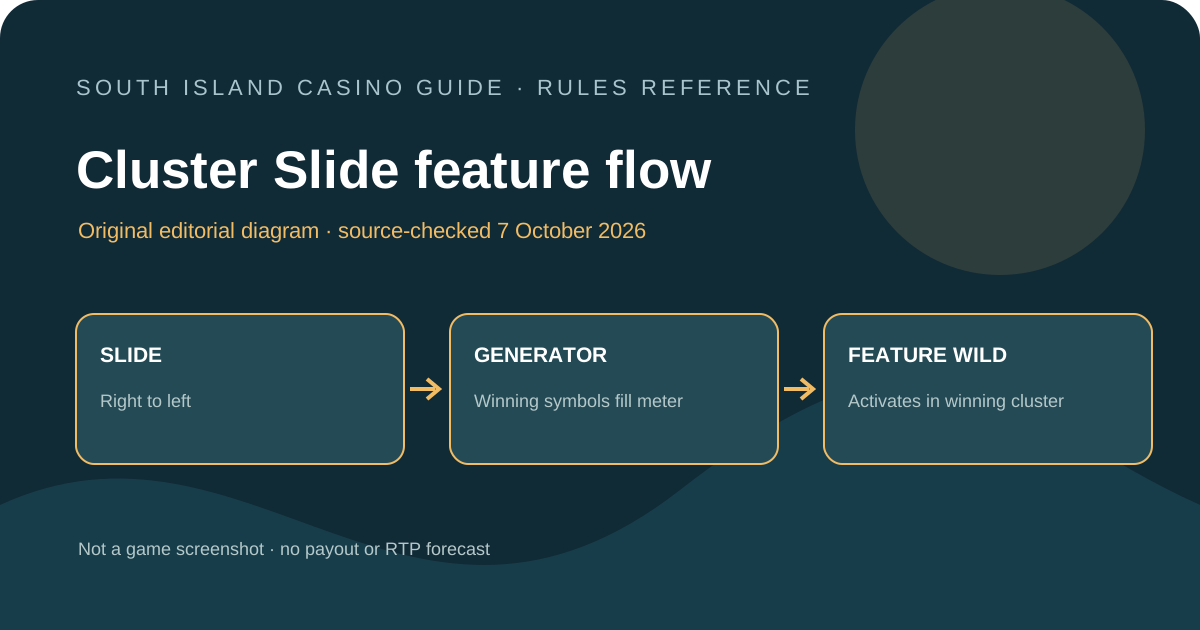
Cluster Slide is described by ELK as a seven-column, eight-row slot where symbols move right to left and clusters of five or more produce wins. Winning symbols fill a Generator that awards one of five Feature Wilds; a feature activates when its Wild is part of a winning cluster. Three Bonus symbols start three Wild Drops with specified Wild sizes. Exact RTP, volatility, cap and stakes were not confirmed because the linked official data sheet was inaccessible.
The short answer
ELK describes Cluster Slide as a seven-column, eight-row slot in which symbols slide from right to left and clusters of five or more generate wins. Winning symbols contribute to a Generator meter. When it fills, the Generator awards a Feature Wild associated with one of five effects: Multiplier, Removing, Upgrading, Random or Big Wild. A Feature Wild’s effect is released when that Wild belongs to a winning cluster. Three Bonus symbols trigger Wild Drops: the public summary describes three drops with progressively larger Wild formations, and says the bonus can retrigger.
The defining reading task is to track the board’s sideways movement separately from the feature state. A win can move symbols, fill the Generator and later activate a feature, but the order and current outcome must be read from the game help. The supplier’s public page names those stages; it does not expose a complete current RTP, volatility label, maximum win, stake range or New Zealand operator configuration. ELK’s Game Data Sheet link returned HTTP 403 when opened on 7 October 2026, so those numeric settings are left unverified.
The official page also lists five X-iter modes, with descriptions ranging from a 15× bet option involving three drops and an x5 multiplier to a 300× Super Bonus. Those are menu descriptions, not a promise of a particular net return. Use this guide for Cluster Slide only; no feature, probability or payout number is transferred from another cluster game.
Identify the exact title
Check the full lobby title and provider before reading a review. ELK’s Cluster Slide product page describes this exact title, and the supplier catalogue lists it among ELK products. Compare the loaded title, the product-page name and the game-help heading. Do not confuse a page for “Cluster Slide” with “Cluster Kingdom” or another slot that uses clusters; similar terminology does not mean the same board, threshold or feature system.
Record the date and any build, rules or help revision shown by the operator. Then look for the selected RTP, volatility, maximum win, currency and stake range. The supplier page does not show all of these in its accessible text, and a catalogue entry is not evidence that a particular casino has enabled the game for a New Zealand account. A third-party review may describe a different operator’s menu, a historic data sheet or an assumption that does not match the version loaded today.
If the game name in an account lobby differs from the product page, keep both strings in the record and find the operator’s title-specific help. A screenshot is useful for remembering the selected variant, but it cannot confirm the full rules on its own. The exact game identity is a prerequisite for a meaningful comparison of its payout schedule or feature flow.
Seven columns and eight rows
ELK calls Cluster Slide a seven-column, eight-row slot. That gives the initial description of the visible board, but the page’s short summary does not specify whether every position is occupied at every moment or how the layout changes after a symbol group clears. Read “seven by eight” as the supplier’s stated grid dimensions, then use the actual help diagram to learn how the current round fills, empties and refills its spaces.
The movement direction is unusual enough to deserve its own check. ELK says symbols slide from right to left. Observe the sequence after a win: which symbols are removed, which remain, whether existing symbols shift, and where new symbols enter. A vertical cascade description from another slot can be misleading here. If a third-party page calls the mechanic a tumble or drop, compare that word with what the official client actually shows rather than treating all refill systems as identical.
A diagram of the round should identify the initial board, the movement direction and the point at which a new cluster is evaluated. If the game history records each slide, use it to check the wording in help. The public product summary does not settle every detail of movement priority, such as how two separate empty areas close at once. Do not invent a fill order when the available official text does not show it.
What the five-symbol cluster threshold means
The supplier says clusters of five or more generate wins. This is the published threshold, but it is not a complete definition of the pattern. Check the active help for whether the symbols must touch orthogonally, diagonally or under another connectivity rule; whether one group can branch; whether one symbol can belong to more than one group; and how the game evaluates several groups of the same symbol. “Cluster” is not precise enough to answer those implementation questions without the title’s help.
When describing a win, record both the symbol count and the positions that the game’s help treats as one cluster. A group of five might be a connected shape under one game’s rules and not another’s. The accessible ELK page states the minimum count but does not define every adjacency case. A reader should therefore consult the live paytable rather than assume a standard cluster algorithm.
Also check whether the game pays one amount for each cluster, combines multiple groups, or applies an award to the total number of matching symbols. The page does not publish the paytable in its accessible text. Do not infer payout values from the number of monsters shown, from their colour or from a feature illustration. The same symbol count could settle differently depending on the paytable and active multiplier state.
Right-to-left slides versus vertical cascades
In a conventional downward cascade, empty cells are often refilled from above. Cluster Slide’s public description instead says symbols move from right to left. That simple direction changes how a reader should follow the board after a result. Track the row and column coordinates before and after the slide, not just the animation’s movement. If some symbols do not move, find the rule that makes them persistent rather than assuming they are fixed.
The critical state question is when the game checks for another cluster. Does it evaluate once after all symbols move, or during an intermediate step? The supplier page does not state this sequence in detail. The rules panel should identify whether one paid round can contain more than one winning evaluation and whether a subsequent slide can change the Generator. Do not state that every slide produces another evaluation unless the help confirms it.
For a manual reading exercise, mark five sample board positions on paper, then follow the game’s actual animation and compare the end state. This is not a prediction or a strategy; it is a way to understand spatial movement. It can show why a right-to-left refill might create a different group shape from a top-down refill without claiming that one direction is more likely to win.
The Generator: accumulation before activation
ELK says all winning symbols contribute to filling the Generator. Once its meter is full, it awards a Feature Wild. Those statements separate two events: progress toward a full meter and the award of a feature symbol. The page does not disclose the exact amount added per symbol, the number of wins needed, whether progress carries across slides, or what happens to unused meter progress at the end of a round. Those are game-help questions, not facts to extrapolate from an animation.
Look for the Generator meter’s starting state and how it changes after a paid win. Check whether winning symbols contribute individually or whether the feature uses the total number in a cluster. Confirm when the meter resets and whether a feature Wild can be awarded more than once in the same paid round. If the interface only displays a partially filled bar, do not convert its visual length into a probability or exact remaining symbol count unless the rules label that scale.
The Generator creates a useful narrative order: wins feed a meter, the full meter awards a Feature Wild, and that feature can activate when it later participates in a winning cluster. It does not mean that filling the meter immediately pays a separate prize. Read the help to learn whether the award lands on the board, goes to a defined position or follows another placement rule. The accessible product page does not explain exact placement.
Five Feature Wild types
ELK names five types: Multiplier, Removing, Upgrading, Random and Big Wild. The supplier says each Feature Wild holds one of those features, and the feature is released every time its Wild is part of a winning cluster. That activation condition matters. A Feature Wild can be present without releasing its effect if it is not part of a qualifying cluster, according to the public description. The help should explain whether the symbol still pays in that state and whether the feature remains for later evaluations.
The labels indicate broad effect categories but do not define every parameter. “Multiplier” does not state the exact value or its scope. “Removing” does not say which symbols are removed or whether the effect occurs before or after payout. “Upgrading” does not identify the next symbol tier or whether every matching symbol changes. “Random” does not reveal the possible outcomes or selection mechanism. “Big Wild” does not specify its dimensions or substitution limits. Use the in-game explanations for each one.
For a clear feature record, capture the symbol’s type, whether it joins the winning cluster, the feature description shown, which positions change and what the game displays after settlement. Keep the activation event separate from any resulting win. If multiple Feature Wilds are in a winning cluster, check whether each feature activates once, how order is determined and whether the board is re-evaluated between effects. The public summary does not give that full priority order.
Multiplier Wild and the x5 round condition
ELK states that generating five Feature Wilds in the same game round awards an x5 multiplier added to the total multiplier. It also says each activated Multiplier Wild increases the total multiplier by one. These are two separate published statements: one describes a five-Feature-Wild condition in a round, and the other describes what an activated Multiplier Wild adds. Do not combine them into a single formula without the active help’s definition of the starting multiplier, order and exact total.
Find whether “same game round” means one paid base spin and all its slides, or includes a bonus sequence. Check whether all five Feature Wild types must be generated or whether any five qualify. The product summary does not specify this nuance. Also look for a multiplier reset point and whether the total survives between cluster evaluations. A clear review should say what ELK confirms and leave unclear priority or duration unclaimed.
When the multiplier changes, note whether it applies to the next cluster, the current payout, a bonus total or a later feature. Multiplying an individual combination and multiplying a cumulative balance are different settlement rules. The active game help should show when the displayed multiplier takes effect. A screenshot taken midway through an animation may not show the final settlement state.
Wild Drops bonus: three staged awards
ELK says three Bonus symbols trigger Wild Drops and award three Wild Drops. The supplier describes the first drop as adding three 1×1 Wilds, the second as adding two 2×2 Wilds and the third as adding one 3×3 Wild. The bonus can retrigger. Those named sizes and sequence are documented on the product page; they are not a payout amount. The exact placement, eligible positions, symbol interactions, start state and retrigger award remain details to verify in game help.
Treat each drop as its own stage. First determine whether the listed Wild shapes are placed onto empty cells, replace symbols or follow another placement rule. Then check when the board is evaluated and whether a Wild formed in one stage stays in place for the next. The supplier description does not spell out every interaction. Do not assume that the three Wilds from the first drop remain sticky simply because the later drops contain larger shapes.
Retriggering also needs a precise explanation. The public text says the bonus can retrigger, but does not state how many additional drops are awarded or whether they are appended to the existing sequence. Find the trigger rule and any cap in the operator help. A bonus can add activity without guaranteeing a net award. Keep the number of drops granted separate from the amount eventually settled.
X-iter modes and entry cost
ELK says Cluster Slide has five X-iter modes and describes a range from a 15× bet mode with three drops and an x5 multiplier to a 300× Super Bonus. The product page supports those menu details, but an operator may expose a different selection or not offer the modes at all. Check the actual screen and its current price. A multiple of the base bet is the cost of entering a mode; it is not the amount that the mode will pay.
Read exactly what the 15× mode includes and whether the x5 multiplier is an initial condition or another feature. The accessible public description identifies the mode as three drops with x5, but does not explain every possible outcome from those drops. For the Super Bonus, look for its starting board, stake cost and end conditions. The label “Super” is not an RTP or win guarantee.
Before selecting a paid mode, calculate its cost in the displayed currency and compare it with the session limit already set. Do not treat a feature purchase as a recovery tool after losing. If a mode card does not show the total cost clearly, return to the ordinary help and find the operator’s documented price before proceeding. No X-iter mode was opened or tested for this review.
RTP, volatility and cap: why this page does not print figures
ELK’s accessible Cluster Slide product page does not publish an exact RTP, volatility rating, maximum win or stake range in its text. It links a Game Data Sheet, but that PDF returned HTTP 403 on 7 October 2026. Several third-party review pages provide numbers, and some use different volatility labels or describe the game with language that does not match ELK’s explicit cluster threshold. Without the official sheet and operator help, those numbers cannot be safely assigned to the current New Zealand configuration.
If the active client shows an RTP percentage, record the exact variant and date, then note whether the setting is selected by the operator. If multiple percentages appear in help, distinguish the available variants from the currently active one. Volatility requires its own source; a reviewer’s “medium-high” description is not a substitute for an official rating. A maximum win, if published, is a cap or configured ceiling rather than a likely result.
This separation prevents a specific kind of error: a paytable or feature summary can be accurate while a secondary percentage belongs to a different market. The correct source hierarchy is the current operator help for the selected build, then accessible official supplier documentation for mechanics, then secondary pages as leads only. If the configuration cannot be confirmed, say so. A blank field is more useful than a false precise value.
Contradictory descriptions in secondary reviews
The search sample contains review pages that quote RTP and maximum-win numbers, and at least one uses a “line-based” description for Cluster Slide. ELK’s official page instead expressly says that clusters of five or more generate wins. That discrepancy is a reason to inspect the operator’s help, not to repeat the less supported wording. A review may contain copied data or confuse the title with another product, and a current page can still be wrong on one mechanical detail.
Other pages describe volatility differently and sometimes claim to offer a demo or a market-specific casino list. Those statements may be useful as leads but are not proof of a New Zealand player’s access, nor do they resolve a mismatch with ELK’s help. The linked official data sheet was inaccessible during this review. No number from those competitors has been imported into the article.
When reading a review, ask whether it links the exact provider sheet, shows the complete paytable, dates its check and identifies the operator or market. If it uses a broad label such as “cluster slot”, verify the actual winning condition. This comparison approach lets a reader recognise the useful parts of a review while avoiding an unsupported claim about the build they have open.
Desktop and mobile checks
ELK recommends a desktop resolution of 1600×900 and a 16:9 ratio if scaling is necessary. In that view, verify that the full eight-row board remains visible and that any slide animation does not hide the last column. Read the Generator meter and Feature Wild labels before a round. A screenshot cropped to one part of the board cannot establish the movement direction or the number of symbols in the final state.
On a phone, check that the help modal scrolls and that the paytable can be read without horizontal page overflow. Confirm that all seven columns remain understandable and that the right-to-left slide is visible. Check that the total stake remains present while the feature animation plays. No browser or operator client was tested for this article, so these are practical checks rather than a claim that Cluster Slide is mobile-compatible.
If a display compresses the board or colours are difficult to distinguish, use the textual feature names and help description. Avoid relying only on a green/red or light/dark visual distinction. The official product summary describes named features, but the current operator should provide the rules needed to identify them accessibly.
Demo access and New Zealand context
ELK’s product page has a PLAY control, but this does not establish that a free demo is available to every visitor or that a particular operator offers the game in New Zealand. Do not assume that a supplier catalogue button is a casino availability statement. No operator account, demo or paid game was accessed for this review.
If a demo is present, use it to learn what the Generator, feature icons and Wild Drops are called. It does not let a reader test an RTP through a short run. Check that any mode or bonus selection uses play credits before selecting it. The exact configuration can differ between a demo and an operator’s real-money client; verify the help panel in the version that matters.
The Department of Internal Affairs says online casino advertising is currently prohibited and that the 2026 Act provides enforcement powers for those who publish or arrange unlawful ads. Its guidance identifies affiliate marketing among initial advertising decisions. Accordingly, this guide contains no casino promotion. DIA guidance is about advertising and does not itself confirm a game’s availability or any operator’s eligibility.
A useful round-by-round note
For one round, record the starting board and the wager, then note every winning cluster as defined by the help. Track whether symbols move right to left, which positions remain, and how much the Generator changes. If it fills, write down the Feature Wild awarded and whether it joins a qualifying cluster. If the feature activates, name the effect and describe the board change without assigning an unsupported payout value.
If three Bonus symbols trigger Wild Drops, record each of the three drop stages separately and check what stays in place. If the bonus retriggers, note the exact number of additional drops shown by the help. At settlement, compare the paid result with the history panel. This method helps separate a feature animation, a cluster win and a final award; those are related, but they are not interchangeable facts.
For a general review rather than a personal session, build the same outline from official help screenshots or text. Include the source date and title. If the operator’s rules do not describe an interaction, call it unverified. Do not invent a test, a session result, a recommendation or an expected return to make the guide appear complete.
Questions readers ask
How many symbols create a Cluster Slide win?
ELK’s public page states that clusters of five or more generate wins. It does not spell out every adjacency and settlement detail in the accessible summary, so consult the active help for the exact cluster definition.
Which way do the symbols move?
ELK says symbols slide from right to left. The exact refill and re-evaluation sequence should be checked in the game’s rules or history panel.
What are the five Feature Wilds?
The official page names Multiplier, Removing, Upgrading, Random and Big Wild. It says a feature releases when its Wild is part of a winning cluster. Exact values, positions and order require the active help.
How many Wild Drops does the bonus award?
ELK says three Bonus symbols trigger three Wild Drops. Its product summary describes one 3×1×1 Wild, then two 2×2 Wilds, then one 3×3 Wild. Placement and retrigger details still need the loaded rules.
What is Cluster Slide’s RTP?
No exact setting is confirmed here. The supplier’s linked Game Data Sheet returned HTTP 403, and no operator configuration was supplied. Check the active game’s information panel.
Is Cluster Slide available in New Zealand?
This review did not test a New Zealand operator. A supplier catalogue listing or third-party country directory does not prove account-level access. Check current operator terms and official local guidance.
Related site guides
Visit the site’s ELK Studios provider guide for its other game references. The existing safer gambling guide covers support and play-limit information.
Sources and verification boundary
- ELK Studios: Cluster Slide product page — opened 7 October 2026; grid, movement direction, cluster threshold, Generator, Feature Wilds, multipliers, Wild Drops and X-iter overview.
- ELK Studios: games catalogue — checked 7 October 2026.
- ELK Studios: Cluster Slide Game Data Sheet — opened from the official page on 7 October 2026; HTTP 403.
- New Zealand DIA advertiser guidance — checked 7 October 2026.
- Competitor sample checked 7 October 2026: BetsRank Cluster Slide, SlotCatalog Cluster Slide, Gambling.com Cluster Slide, Fortune Games Cluster Slide. The sampled pages differ in volatility wording and/or game-mechanic descriptions; numeric claims were not adopted.
No active operator build, exact RTP, volatility, maximum win, stake range, demo access or New Zealand availability was verified. No play session or device test is claimed.
