ELK Studios game guide · South Island guide
Cathedral 9: rules, features and settings to check
 Best casinos available in New ZealandUpdated 7 November 2026

Cathedral 9 links a separate feature reel with coffin effects on the main grid. ELK’s public description names Mystery Coffins, a Super Coffin, Entombed and a Holy Collect state that can persist between rounds. The current operator help is needed for exact triggers, payout rules and settings.
The short answer
Cathedral 9 is an ELK Studios game built around a feature reel and coffin effects that can alter the main grid. ELK’s public product summary says Mystery Coffins descend, a Super Coffin contributes to a global multiplier, the Entombed feature replaces grid symbols with payout symbols when its feature reel is fully covered, and Holy Collect can hold state between game rounds before adding coffins to the grid. These are useful high-level relationships, not a substitute for the full help panel inside an operator’s current version.
No current operator game-help screen was supplied for this guide. It therefore does not publish the active RTP, any RTP alternatives, volatility, stake range, feature frequency, maximum return, bonus cost or numeric trigger conditions. It does not claim Cathedral 9 is available to New Zealand accounts. The purpose here is to explain what the public supplier summary does establish, what is unknown and how to inspect the exact game without transferring figures from another market.
Confirm the correct game and version
Before comparing rules, confirm the name and supplier in the loaded client. Check ELK’s Cathedral 9 page and the official games catalogue. Those pages show the supplier’s own description of the game. They cannot prove that a particular operator lists the title, that the same version is enabled in New Zealand or that all clients expose an identical set of modes.
Record the operator, date checked, mode label and any build or help revision shown. Open the paytable before starting a round. If the client separates ordinary play, a bonus, an optional purchase mode or a demo, keep each description in its own note. A third-party page may include screenshots and a specification table, but unless it identifies the exact configuration it cannot establish which values are active in a particular casino.
The title’s religious and architectural artwork is theme, not evidence. A coffin, artefact, altar or stained-glass image may represent a symbol or decoration; only the symbol panel says what it does. Likewise, an animation of symbols descending does not fully define the timing, order or payout evaluation. Use the official terms from help rather than inferring rules from the visual setting.
Separate the feature reel from the main grid
ELK’s public overview describes a feature reel that supplies or activates coffin-related effects on the main grid. That distinction gives readers a useful starting point: one part of the interface carries feature elements, while the central grid contains symbols used in the game’s ordinary evaluation. Do not collapse the two into “the reels” if the rules distinguish them.
When inspecting the client, identify the main play area, the feature reel, any row of feature symbols and counters that track progress. Check whether the feature reel is a fixed part of the screen or a temporary state and whether its symbols move independently of the main grid. The help should explain what lands in each area and how an item on the feature reel becomes active.
Next, trace one effect. Does a coffin move from the feature area to the grid? Does it change a group of symbols, add an amount to a multiplier or cause a full-board event? Does the game evaluate a win before or after the change? These are separate questions. A title summary may name each feature without describing every transition or priority rule.
A simple event log can clarify the system without a fabricated walkthrough. Note the board state before a feature, the exact named symbol that activated, what moved or changed, whether the game performed a new evaluation and how the final result was recorded. If the help or history omits a stage, mark that stage unresolved rather than filling it from memory or a competitor’s animation.
Mystery Coffins: distinguish the symbol from its result
The official product page names Mystery Coffins as one of Cathedral 9’s feature effects. The term suggests a coffin that changes into or reveals a symbol outcome, but the exact selection and resolution rule must come from the current help. The page should not assume that every coffin reveals the same symbol, chooses from all payout symbols or acts identically across modes.
Check whether the client differentiates a standard Mystery Coffin from a Super Coffin. Compare the icon, help entry and animation. If the Super version interacts with a global multiplier, identify the precise relationship: does it add to a counter, apply to one event or affect a later total? The supplier summary gives the broad association but not every aggregation rule.
Observe when a coffin appears and when its result is resolved. It may descend from the feature reel, land on the grid, reveal symbols and then trigger an evaluation; a different sequence is also possible. The help panel and round history should establish whether this is a single event or several. The order matters because a newly placed payout symbol may be evaluated differently from a symbol revealed after an existing win check.
Do not equate mystery with unpredictability that cannot be checked. The feature may have a defined range of outcomes in the rules or paytable. If the current client explains the range, record the exact language. If it only gives a label, say that the public summary does not disclose the selection set. That limitation is more precise than borrowing an explanation from another version.
The global multiplier: follow its scope and timing
ELK says a Super Coffin adds to a global multiplier. The word “global” is important, but it still needs a title-specific definition. The help should say whether the multiplier applies to all qualifying results, only to a feature event, or to a bonus state; how it changes; and when it resets. A counter shown above the grid does not automatically answer these questions.
Record the displayed value before and after a Super Coffin event. Then look for the result history or rules text that explains how the changed value is used. A multiplier could modify an individual win, a total feature settlement or another stated amount. Do not assert that it affects every payout unless the current help says so. Do not multiply a displayed win yourself unless the game’s calculation order is explicit.
Persistence is another distinct issue. Does the multiplier continue only within an event, across a bonus, between rounds or until a named feature ends? Those are materially different states. The public source summary is not enough to answer them all. A careful review should label exactly what the supplier says and list which persistence scope remains unverified.
Avoid language that suggests the counter is stored cash or a promise of a larger result. A multiplier is a rule modifier. It needs an eligible win to have an effect, and its presence alone does not establish a payout. Explain that difference whenever a visual counter or dramatic increase could be mistaken for money already won.
Entombed: a board-wide event with a trigger to verify
The supplier describes Entombed as activating when the feature reel is covered by the Entombed symbol; the public page says all symbols on the grid are then replaced with payout symbols. This defines a broad transformation. It does not give a current operator’s exact trigger threshold, choice logic, order of operations or payout calculation, so those details are not added here.
When checking the game, look for the exact feature-reel state required before Entombed begins. Determine how the help defines “covered”: does it mean every visible position, a full set of matching symbols or another named condition? The image may make the event look clear, but a reviewer should use the wording from the rules panel. Do not infer the condition from one screenshot.
After the event begins, follow how payout symbols are selected and placed. Are all positions filled with one symbol, are several symbols selected, or does the game choose a different result per position? The supplier summary says the grid is replaced with payout symbols, but it does not answer the complete selection method. Check when the paytable evaluates the new board and whether any other modifier is carried into that evaluation.
Entombed can be described accurately without calling it a guaranteed large win. The feature changes the grid, but a payout depends on the game’s rules and resulting symbols. Keep the trigger, transformation and settlement as separate editorial facts. If a particular operator’s help is later obtained, update the article with the version, source and check date in one place.
Holy Collect and state carried between rounds
ELK’s summary says Holy Collect can trigger in an initial drop, that blockers dropping from the feature reel add to the collect, and that the collect state is kept between game rounds. When triggered, the feature adds coffins to the grid. This makes persistence the defining point to verify: the player should understand what accumulates, when it is stored and what event consumes it.
The current help should identify what a “blocker” is, how it reaches the feature reel, which event adds it to Holy Collect and what constitutes a completed collect. Do not state a required count or a specific number of coffins unless the active help supports it. The supplier’s public summary contains some numeric wording, but this assignment restricts game numbers to current help, which is unavailable.
Persistence between rounds does not mean that a player has a guaranteed bonus or a banked win. It means a stated game state may be retained according to the feature rule. Check whether it persists after a normal result, after a bonus, after a mode change or after the client closes. These are different lifecycle questions and should not be merged into “the meter saves progress” without context.
If the game history provides a sequence, verify whether Holy Collect is added before the round settles or after the next initial drop. Note whether the resulting coffins are part of the same play sequence and whether they trigger their own symbol evaluation. The visible state can make progress easy to see, but it cannot establish the odds of reaching the trigger or the return it may produce.
How the feature reel, coffins and grid relate
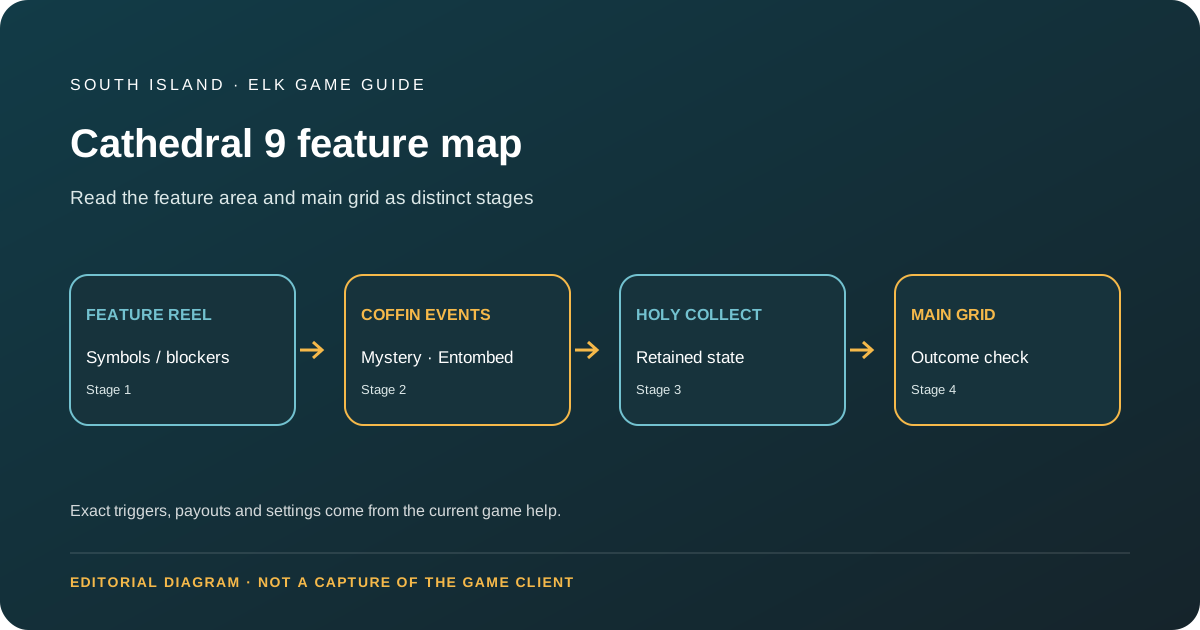
The central editorial task is to explain the direction of travel. The feature reel can contain named elements; those elements may descend or activate on the main grid; a coffin can transform symbols, modify a counter or contribute to a named event; and the grid’s payout rules determine whether a result qualifies. Each arrow in that sequence should have a source.
Make a small glossary from the actual help labels. Give each item one function: “feature reel” for the separate feature area, “Mystery Coffin” for its stated symbol-resolution role, “Super Coffin” for its multiplier relation, “Holy Collect” for retained collection state and “Entombed” for its board transformation. If the operator’s labels differ from the supplier’s public terms, note that difference rather than inventing a synonym.
Then map the order of operations. Is a blocker added before a coffin descends? Does a global multiplier change before the payout symbols are evaluated? Does the main grid settle once, or can the effect lead to another check? The answer can change the interpretation of a round, so use help or history rather than relying on a general slot convention.
If a transition is not explained, the guide can still be useful by identifying the unknown. A reader should know to check whether the feature reel is independent, which state persists and when a payout is counted. Explicit uncertainty directs the next verification step and keeps the article from pretending to offer a full operator manual.
Base-game wins and the ordinary paytable
Before concentrating on coffins, read the basic win rule. The current paytable should explain the grid, how symbols qualify, whether wins are based on lines, ways, clusters or another system, the role of Wilds and whether a result can cascade. No operator paytable was available for this review, so those base rules are not guessed from a third-party specification table.
Check how the stake relates to symbol values. A displayed amount may be a multiple of the chosen wager, a value per line or another unit. The information panel should make the basis clear. If it lists several settings, note which one the client says is active. Do not compare raw numbers across games without the same unit and configuration.
Find out how ordinary wins interact with feature events. If a Mystery Coffin appears in a sequence that already contains a win, does the feature resolve first or after that win is credited? Does Entombed replace symbols before or after other modifiers? Does Holy Collect affect the current board or a later one? These questions are not answered by the theme art and should not be left implicit in a long review.
The history panel can help distinguish a win total from a feature counter. Confirm which figures represent a settled result, which are progression state and which are multipliers. If the history only shows the total, do not reconstruct a detailed calculation from visible counters. Report what the interface makes available.
RTP, volatility and cap: no current configuration supplied
No current operator help panel for Cathedral 9 was supplied. This guide does not state a percentage for RTP, an RTP variant, volatility, hit frequency, stake range, feature-buy cost or maximum return. Review aggregators may publish numbers, and those values may be useful prompts for fact-checking, but they do not prove the setting served by a particular casino build.
RTP is a theoretical long-run measure for a specified configuration, not the expected result of one session. Volatility describes a broad outcome pattern; it does not predict how soon a feature will appear. A win cap is a ceiling, not a likely result. Each of these needs a label, a mode and a source. If the operator help lists more than one option, the active version must be distinguished from alternatives.
When the game is accessible, record the exact wording from its information panel and note when and where it was checked. Confirm that the help matches Cathedral 9 rather than another similarly named title. If a demo and a real operator client expose different values, state the difference and avoid combining them into one “official” figure.
The assigned scope includes verified RTP settings, but verified means the source must actually establish the value. Leaving an unavailable figure blank is more useful than importing a stale number. The article should be updated when a current source can be reviewed; until then the setting remains unknown.
Bonus and optional modes
The public supplier overview has limited detail about the current operator’s bonus conditions and optional feature modes. A third-party review may list free spins, a super state or paid access, but such claims need to be matched to the exact version and help panel. This article does not repeat trigger counts, starting spins or purchase prices from secondary sources.
If a bonus section is present in the client, check what begins it, which state carries over, what ends it and whether Holy Collect or the global multiplier persists. The fact that a counter persists between ordinary rounds does not establish that it persists through a bonus. Treat those lifecycle rules as separate until the help connects them.
If an X-iter or another paid mode is offered, read its full displayed cost and starting condition before selecting it. A mode that changes the entry route changes the amount at risk. It does not guarantee a win. The guide’s role is to explain the option’s terms, not to recommend a purchase or describe it as value.
Where the feature is absent or not checked, state the status precisely. “No mode was visible in the inspected client” is an observation; “this game has no mode” is a broader product claim. No client was available for this assignment, so neither is asserted here.
A verification checklist for the current build
When a legitimate client is available, verify title and provider first. Open the paytable and record the base win condition, Wild role and ordinary result unit. Locate the feature reel. Read each coffin entry separately. Check what the game means by Mystery, Super, blocker and Entombed. Note whether Holy Collect persists and where that persistence ends.
For one event, record the trigger, state change, timing, result evaluation and final settlement. Do not make a probability claim from the event. If a feature counter changes, capture its exact label and whether help calls it a multiplier, collection or win. If a round history is present, compare it with the visible sequence and resolve any mismatch before publishing a numeric example.
For every financial setting, record the source screen, operator, date, mode and unit. Keep active RTP distinct from listed alternatives. Keep stake limits separate from payout multipliers. Keep an advertised maximum separate from any observed result. If no exact help can be accessed, put the missing field in the research log and leave the copy clear.
This checklist also helps editors update a mature game page without opening extra URLs. All rules, feature, demo and RTP questions belong on the single Cathedral 9 guide assigned here. A change log can record later corrections, but it should not create a parallel owner for the same query.
Demo, mobile and accessibility
A supplier page does not guarantee that an authorised free demo is available in a given region. If a demo is offered by an operator, check whether its help panel and version identify the same build as the operator’s actual game. A demo may explain interface flow without proving the configured RTP or local account access.
Use any available no-money mode to learn the vocabulary and controls, not to estimate feature odds. Can you distinguish the feature reel from the main grid? Is a Super Coffin labelled separately? Can you see whether the global multiplier changes? Does the help explain the Holy Collect counter? These are comprehension checks, not results-based testing. No Cathedral 9 demo was opened or tested for this assignment.
On a phone, make sure the feature reel and the grid remain simultaneously understandable. If an event requires switching panels, verify whether the previous state is still visible. Check that the help modal can scroll without placing the game controls underneath it. Colour should not be the sole signal for a lit state or a special coffin; text and shape cues improve clarity.
The accompanying SVG is an original editorial diagram made for this page, not a game screenshot. It illustrates a conceptual relationship between the feature area and outcome stages. The actual client layout may be different. Width and height are declared so the image reserves space before it loads, and the alt text conveys its purpose to screen-reader users.
What other reviews do well and where this guide differs
The competitor sample includes specification-led pages, feature walkthroughs and demo-first reviews. Some explain the coffin effects with substantial detail, while others place an RTP and volatility table near the top. That presentation can be convenient, but it does not establish whether a figure belongs to the same operator, jurisdiction, mode or game revision that a New Zealand visitor would see.
The practical gap this page addresses is source hierarchy. It helps a reader understand the feature reel, the named coffin effects and persistent collection state, while clearly separating those supplier-level mechanics from configuration-specific values. It does not reuse review scores, personal win stories, local offer cards or unqualified claims about access.
Secondary reviews can still help an editor identify missing questions. If a reviewer describes a feature order or demo mode not present in the official summary, put that item in a verification list. Do not convert it into fact until the current game help confirms it. If two sources disagree, retain each source’s date and context rather than trying to average them.
The official product page remains the primary reference for ELK’s public feature description. An operator’s current game help should control the settings and complete game rules for that client. Those sources answer different questions and should not be blended together.
New Zealand availability and advertising boundary
An ELK catalogue entry does not confirm that a casino offers Cathedral 9 in New Zealand. Availability has to be checked against a named operator’s current lobby and terms, and may depend on account or location conditions. No specific operator was assigned, so local access remains unverified. A database’s country table or another market’s demo cannot be used as a blanket assurance.
New Zealand’s Department of Internal Affairs currently says online-casino advertising is prohibited, the advertising and marketing rules apply to third parties, and affiliate marketing is among the initial prohibited advertising decisions. This package therefore omits the requested CPA buttons and does not substitute a direct casino URL. The existing /go/south/south-cashdesk-8a14.php route was not followed or modified; publication is held for compliance review.
That limitation does not change the guide’s descriptive purpose. Readers can understand the publicly documented feature names without a commercial referral. Do not add an operator card, bonus promise or implied endorsement to make up for the missing link. Revisit commercial placement only after an appropriate compliance determination and current legal guidance.
A reader’s decision checklist
Before deciding whether the game is understandable, confirm the exact title, read the base paytable and find the help entries for feature reel, Mystery Coffin, Super Coffin, Entombed and Holy Collect. Make sure the help defines what persists between rounds and how a feature result becomes a settled payout. If the terms are ambiguous, you do not need to infer them from an animation.
Next, check the configuration displayed by the client: RTP or alternatives, volatility, stake range, mode pricing and maximum return. Make sure every number names a mode and a unit. If you cannot see the current information, treat the value as unknown. A supplier summary or secondary database can help you know what to ask, but it does not fill an operator-specific gap.
Consider personal limits independently of a persistent collector or rising multiplier. A visible state may make progress feel tangible, but it is still a game rule, not funds set aside for you. If gambling is lawful and chosen, decide on time and spending limits before starting. Do not raise them to wait for a coffin or recover a loss. The site’s New Zealand safer-gambling page lists support resources.
Frequently asked questions
What is Cathedral 9’s feature reel?
ELK’s public summary describes a feature reel associated with coffin effects that can change the main grid. The exact symbol positions, timing and complete rule sequence require the active game help.
What does Entombed do?
The supplier says Entombed activates when its symbol covers the feature reel and replaces grid symbols with payout symbols. The exact selection and settlement method must be checked in the current client.
Does Holy Collect reset after every round?
The public ELK summary says its state is kept between game rounds. It does not establish every boundary, such as how the state behaves through a bonus or mode change; consult current help.
What is Cathedral 9’s RTP?
No current operator configuration was available, so this page does not provide a percentage. Check the exact game help and record the operator, active mode and date.
Is the game available in New Zealand?
That has not been confirmed for a named operator. A supplier listing or third-party availability database does not establish a particular account’s access.
Sources and verification boundary
- ELK Studios: Cathedral 9 — official public feature summary, checked 6 October 2026.
- ELK Studios: games catalogue — catalogue identity, checked 6 October 2026.
- Competitor sample and retrieval notes:
research/batch13/SOURCE-REVIEW.md, checked 6 October 2026. - New Zealand DIA guidance for advertisers, checked 6 October 2026.
No active operator help, named local game build or demo was available. Numeric settings, exact trigger conditions, payout calculations, mode costs and local availability remain unverified. The requested affiliate buttons are withheld pending compliance review; the existing route was not opened or changed.
