ELK Studios game rules · South Island guide
Cygnus 4 slot review: multiplier pillar, Free Drops and RTP
 Best casinos available in New ZealandUpdated 7 November 2026

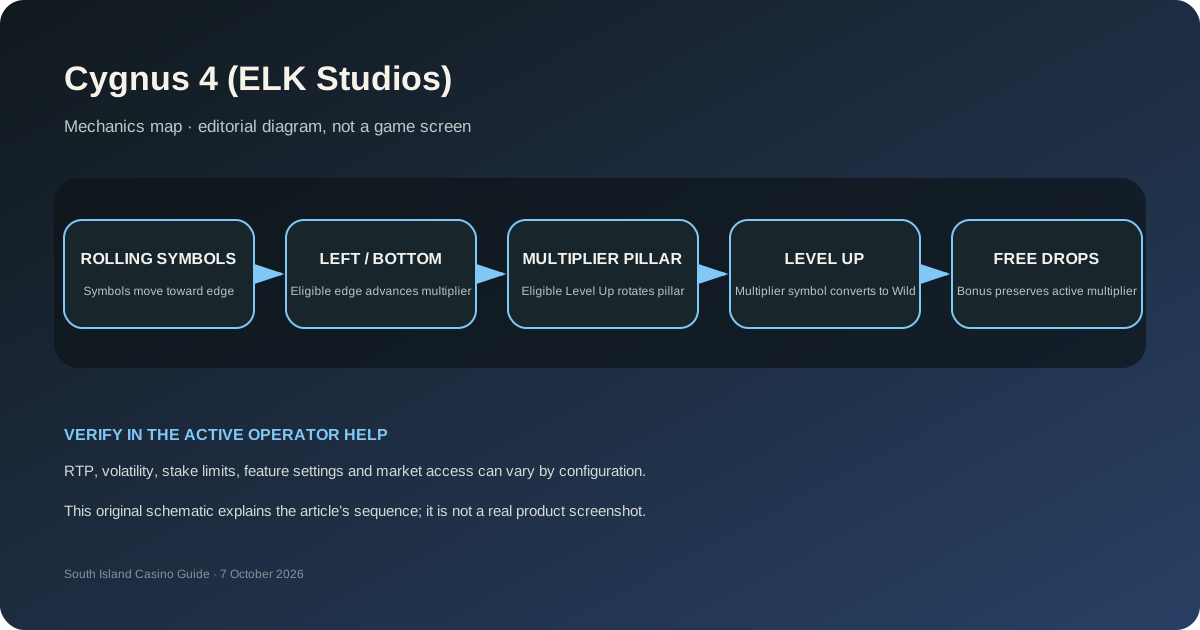
Cygnus 4 is a six-reel ELK Studios slot that starts with four rows and can expand. Multiplier and Level Up symbols change a central multiplier pillar when they reach the leftmost column or bottom row; they then turn into Wilds. A Bonus symbol reaching the leftmost column starts Free Drops, where the active multiplier persists and additional drops can trigger.
The short answer
Cygnus 4 is a six-reel slot from ELK Studios with a four-row starting layout, rolling symbols, expanding rows and a multiplier pillar. A Multiplier symbol that reaches the leftmost column or the bottom row increases the active value along the pillar and then turns into a Wild. A Level Up symbol reaching either of those positions advances the pillar immediately, rotates it one step to expose a higher scale, and also turns into a Wild. Ordinary Wilds substitute for eligible symbols but not for Bonus, Level Up or Multiplier symbols.
A Bonus symbol reaching the leftmost column triggers the Free Drops bonus. The active multiplier persists during those drops, and additional Free Drops can be triggered. ELK’s public summary states potential up to 50,000 times the bet and says the maximum is awarded when the multiplier pillar reaches its top on the third level. It also lists five X-iter modes, including a 500x Super Bonus where Multiplier symbols are also Wilds.
The accessible official product page confirms these mechanics and the maximum potential, but it does not publish an RTP percentage, variant table or volatility label in its text. A current data-sheet link needs to be checked for the exact value; the supplier’s public page alone does not verify the configuration selected by a casino. This guide therefore leaves those numbers unconfirmed, makes no claim that any New Zealand operator carries the title, and contains no affiliate offer button pending qualified review of current NZ advertising rules.
Confirm the exact title and version
The supplier’s name is Cygnus 4. The “4” matters: it is a specific sequel in a series, not shorthand for every game that uses the Cygnus name. A general series review can discuss the shared theme, but its grid, multiplier, release state and payout math should not be transferred to this particular title unless the exact help says they are shared. Even where two games reuse an icon, that symbol can have different triggers and settlement rules.
Start with the title displayed in the launched game, the supplier name and the in-game information page. If a casino lobby lists “Cygnus” without the sequel number, open the game’s own paytable and verify which title it is. Reviews sometimes shorten names in headings or use screenshots from a different instalment. The official page checked for this review identifies Cygnus 4, its six-reel, four-row opening layout and its pillar system.
ELK’s catalogue presents a current product page and identifies the title as part of its games list. That confirms the supplier’s listing, not every casino where a player might search. An operator may or may not include the game; access may vary by jurisdiction, account and product configuration. A supplier licence statement does not prove that a consumer-facing casino is licensed locally or that an individual account is eligible.
The art uses an eighteenth-century London setting. That story and visual style do not affect the symbols’ mathematical roles. The useful questions are structural: where can a special symbol trigger, what state changes, what substitutes, which multiplier persists, when does a bonus begin and how is the final result settled? Keeping those questions separate avoids mixing narrative copy with game rules.
Read the six-reel starting grid and expanding rows
ELK describes Cygnus 4 as a six-reel, four-row game. The rows can expand as play develops, according to the public feature description. A reader should distinguish the initial display from the expanded state. The starting grid is not necessarily the largest grid that can appear during a round, but the public product page does not list every possible row count in the accessible text checked here. Use the current help for the expansion trigger and maximum configuration.
The game also uses “rolling symbols.” That phrase signals that some symbols can move through or across the play area, but the precise movement pattern matters. A symbol can travel to the leftmost column, drop to the bottom row or follow another route before it is evaluated. The location where it arrives can determine whether its multiplier or level-up ability activates. Do not treat “rolling” as equivalent to a random Wild or an automatic paying combination.
The board can be read using a simple position map. Identify the leftmost column, the bottom row and the current multiplier pillar level. Then watch each special symbol’s route. If a Multiplier symbol arrives at a qualifying position, the pillar changes before that symbol becomes a Wild. If a Level Up reaches one of those positions, the pillar advances and rotates before the Level Up symbol becomes a Wild. That order is specifically useful because an animation may show the trigger and transformation almost together.
Grid expansion can change which positions are available. A bottom-row condition should be interpreted relative to the current active grid and the rules’ definition of “bottom.” If another row becomes active, check whether the relevant boundary changes at once, only on a later spin, or when the round resets. The short official summary does not settle that edge case, so it belongs to the operator’s exact help.
The Multiplier pillar: trigger, increase, conversion
The Multiplier symbol has a three-part description in ELK’s public rules. First, the symbol reaches the leftmost column or the bottom row. Second, the active multiplier value increases along the pillar. Third, the symbol turns into a Wild. That order tells a reader the Multiplier symbol does not simply remain as a multiplier icon after its trigger; it changes role once the pillar has been affected.
The phrase “active multiplier value along the multiplier pillar” refers to a displayed state, but the accessible product summary does not list each numerical value or say how many steps are in each scale. Read the pillar itself and the paytable. Note the starting level, the current active value, the next step and whether there is a cap. Do not assume the step sizes are evenly spaced or that a single symbol always increases the same amount regardless of position.
The symbol’s later Wild form also needs careful interpretation. ELK’s page says Wilds substitute for any symbol except Bonus, Level Up and Multiplier. That exclusion list is important: once a Multiplier becomes a Wild, it may substitute under ordinary Wild rules, while the original Multiplier symbol itself is not a substitute before the trigger. The help should clarify whether the resulting Wild can be part of a win immediately or only in a subsequent evaluation.
The multiplier’s target is a separate question. Does it apply to a win containing the symbol? To the next eligible result? To all wins while active? To Free Drops as well? The supplier page separately confirms that the active multiplier persists during the Free Drops bonus. That is a specific persistence statement. Do not generalise it to every possible game state or assume the multiplier applies to unrelated features without the help’s wording.
An accurate walkthrough records the pillar before and after each qualifying symbol reaches the trigger position. If the displayed win is multiplied, record which base amount was multiplied and how the result panel presents it. A multiplier animation can be visually impressive while the payout is calculated according to a more specific rule than “multiply everything.”
Level Up symbols are not just larger multipliers
Level Up symbols share the leftmost-column or bottom-row trigger positions with Multiplier symbols, but they perform a different state change. ELK says the Level Up symbol immediately advances the multiplier pillar; the pillar rotates one step and activates a higher scale. The Level Up symbol then turns into a Wild. This is a progression event rather than merely another increment on the current scale.
The distinction can be stated simply. A Multiplier symbol increases the active multiplier along the current pillar before becoming a Wild. A Level Up symbol advances the pillar and brings a higher scale into play before becoming a Wild. If a review calls both “multiplier symbols,” it loses the rule that tells a reader whether a value changed within a level or the level itself changed.
The public summary does not state every boundary condition. Check whether the pillar has a fixed number of rotations, whether it can revisit a previous scale, how a Level Up interacts with the top level, and whether the symbol can trigger while a bonus is active. Also check whether the bottom-row and leftmost-column conditions are alternatives or whether one has a special precedence when both are reached during the same movement. Those are worthwhile questions because the animation can cross multiple positions quickly.
The Level Up becoming a Wild may affect a subsequent cluster or ways evaluation, depending on the game’s sequence. A reader should verify whether a newly converted Wild is evaluated immediately in the same drop or on a later state. The supplier page establishes the conversion but does not publish a complete frame-by-frame settlement order in the text accessed here.
Wild substitution and excluded symbols
ELK says a Wild can substitute for any symbol except Bonus, Level Up and Multiplier. That is a concrete rule boundary. A standard Wild can help complete eligible symbol patterns, but it cannot stand in for the three excluded types. This matters when a Bonus symbol must reach the leftmost column, or when a special symbol needs to trigger its own pillar effect. A Wild appearing beside one of those icons does not replace the trigger condition.
The help may include additional qualifications, such as whether a Wild can substitute for a high-value symbol, whether it has a size or position restriction, whether a special version acts differently, and what combinations it can help complete. The supplier’s simple summary is enough to establish the three named exclusions, but it should not be stretched into a complete symbol-paytable. Check the exact rule text for any other exceptions.
Keep the Wild’s two stages apart when explaining a special symbol. A Multiplier symbol is not a Wild before it reaches its qualifying location; after its multiplier action, it becomes one. A Level Up symbol first advances the pillar, then becomes a Wild. The converted Wild might have the same icon as an ordinary Wild, but that visual convergence does not erase the different trigger history or the multiplier state already changed.
If a win occurs immediately after a special symbol converts, use the settlement panel to confirm whether the converted Wild participated in that win. Avoid reconstructing the award by simply counting visible symbols. The game may have a defined sequence for movement, trigger, conversion, symbol removal and multiplier application. That sequence belongs in the official help and paytable.
Free Drops: bonus entry and persistent multiplier
The Free Drops bonus begins when a Bonus symbol reaches the leftmost column. This is a position-based trigger, not merely a statement that a Bonus symbol appears somewhere on the grid. The same Bonus icon can be visible before it reaches the condition. Track its movement and the column it reaches before concluding that the bonus has started.
Once the Free Drops bonus begins, ELK says the active multiplier persists during the bonus. That is an important feature because the pillar’s state is carried into a separate round mode rather than automatically reset at entry. Additional Free Drops can be triggered. The supplier summary does not state the initial drop count, the exact retrigger trigger, whether each retrigger adds the same number of drops or how the multiplier changes during a retrigger; consult the current help for those details.
The word “persists” should be read narrowly: the active multiplier remains during the Free Drops game as described. It does not say that the multiplier survives the end of the bonus into the next paid spin. It also does not mean the multiplier must affect every prize or every symbol. The help should say how an active value is applied to bonus wins and when it resets.
Build a bonus-state checklist: entry trigger position; multiplier value at entry; initial free-drop count; whether the pillar can still advance; what symbols can retrigger; which symbols stay or reset between drops; final settlement; and reset after the bonus ends. This makes the feature understandable without inventing a spin count. If the game displays a counter, use that value as the active number and check the help for its source.
Super Bonus and X-iter modes
ELK’s public page lists a Super Bonus and five X-iter modes. It says the 500x Super Bonus mode makes Multiplier symbols Wilds as well. This is a separate mode rule from the base game description, where Multiplier symbols first increase the pillar and then become Wilds after reaching a qualifying position. The precise Super Bonus setup, trigger, multipliers and other mode rules should be read in the X-iter screen for the version being considered.
The public summary describes a range from a 3x bet mode with more than double the chance to trigger the bonus to the 500x Super Bonus. It does not list all five mode names or every intermediate cost in the accessible text. A mode costing 500 times the selected bet is an entry cost relative to that bet, not a payout promise. “More than double the chance” describes trigger probability relative to the supplier’s comparison basis; it does not say that the expected cash return doubles or that an award will exceed the purchase price.
Before selecting a mode, verify the currency amount and the total cost shown on the confirmation screen. Check whether the mode changes the starting pillar level, Wild behaviour, bonus count or only entry into a feature. A guarantee about the starting state is not a guarantee about a win. If the mode is unavailable in a given jurisdiction, respect the restriction and do not attempt to bypass it.
The page’s 50,000x cap should not be used to evaluate an X-iter mode in isolation. A mode price and a maximum potential are different figures. A high ceiling does not show how often a result occurs, what a feature typically returns or whether paying to enter it fits a fixed entertainment budget.
The 50,000x maximum and its actual condition
ELK states that reaching the top of the multiplier pillar on the third level awards the maximum win of 50,000 times the bet. That is more specific than a general “up to 50,000x” headline because it identifies a pillar condition. The accessible page describes the third-level top as the endpoint. It does not state the probability of arriving there, how frequently the condition occurs or whether an operator version applies any additional limit.
Think of the top award as a boundary rather than a forecast. It does not tell a reader that a run of multiplier symbols will reach the endpoint, that every X-iter bonus can reach it or that the wager amount should be increased. A maximum in multiples of the bet is easiest to compare when the basis is clear: the bet used for the qualifying game event, the currency, and any mode cost. Do not convert the cap into a fixed cash prize unless all those fields are verified.
When reading a result, verify that the pillar is at the stated level and top position, then inspect the settlement summary. A big multiplier icon on the screen is not necessarily the max-win state. Likewise, a top-level pillar shown in a marketing image may illustrate a possible state rather than a live round. The help and accepted bet record are the right sources for the actual result.
The cap is only one part of a review. It does not replace RTP, variance, stakes, feature costs or game availability. A useful description lists what is confirmed and leaves the probability or configuration unknown where the evidence is missing.
RTP, volatility and version checks
The official Cygnus 4 page checked for this article describes the mechanics and 50,000x maximum but does not show an RTP percentage or volatility field in the accessible text. The product page does link to downloads; the exact game-data document should be opened and matched to the title and current configuration before publishing a number. Third-party reviews frequently state 94%, and one review describes that as a fixed setting; another source may show a different figure for the game or a market-specific menu. Those claims are not treated here as proof of an exact New Zealand operator version.
Check the game information panel for RTP and any setting/version note. If an operator publishes several RTP configurations, note which one is selected or listed. If the panel does not state a value, do not use a review page’s figure as though it were the operator’s setting. Record source, date and exact game name. An RTP can be tied to a version or market; it is not a personal promise for the next session.
Volatility is not interchangeable with RTP. A volatility label, if the official help provides one, says something about the variability of outcomes. It does not guarantee how long a bonus will take or how large the next payout will be. If the supplier does not publish a label in the source you can access, report that field as unconfirmed. Do not infer “high” only from a large max-win ceiling; a top potential by itself does not describe the whole distribution.
A demo run cannot establish an RTP or variance. A handful of free rounds is too small to verify long-run mathematics and may not use the same mode, market or configuration. Use official documentation for theoretical fields and the operator’s own terms for availability, stakes and account eligibility. This article does not claim that any operator in New Zealand has verified the game.
A neutral example of a multiplier sequence
Imagine the game begins at its six-reel, four-row state. A Multiplier symbol rolls toward the leftmost column. Before it arrives, it is still the special Multiplier symbol. When it reaches the designated location, it increases the active value along the pillar and then transforms into a Wild. A reader records the pillar before and after the event, then checks whether the new Wild participates in the next evaluation under the current help.
Later, a Level Up reaches the bottom row. The rule says that this triggers an immediate level-up, rotates the pillar one step, activates a higher scale and turns the symbol into a Wild. The reader should record this as a level transition, not merely another increment. If the page help shows a distinct direction or sequence, use it instead of assuming the pillar rotates in a particular visual direction.
Now a Bonus symbol reaches the leftmost column. Free Drops begin with the active multiplier persisting. Another drop may trigger additional Free Drops. The user tracks the multiplier and remaining-drop count separately; if the help says the pillar can continue advancing, note that as a bonus-phase interaction. When the feature ends, confirm which state resets before a new paid round.
This example only demonstrates how to interpret known triggers. It does not claim that a particular symbol will reach a location, that a level will advance a certain number of times, or that a feature will produce a positive return. Those would be claims about probability or a tested game session and are not supported by the illustration.
Mobile display, demo and help-panel checklist
ELK’s public game page recommends 1600×900 for the desktop experience and a 16:9 aspect ratio when scaling. That is not a guarantee for a particular mobile operator app. On a smaller screen, check whether the leftmost column and bottom row remain obvious, whether the multiplier pillar is readable, and whether its current level and value stay visible during symbol movement. Expanding rows can make the play area taller; confirm that the bet panel and rules control remain accessible.
If a demo is available, use it to learn the interface only where access is allowed. Evolution’s public demo terms state that freeplay and features can vary by jurisdiction; an operator may likewise restrict a particular title. A demo does not prove cash-game availability or settings. This review did not launch a demo, place wagers or test mobile rendering.
Use the “?” or paytable control to verify: the starting grid; symbol movement; row expansion; qualifying Multiplier/Level Up positions; pillar values and rotation; Wild exclusions; Free Drops trigger; active multiplier persistence; retrigger rules; Super Bonus-specific Wild behaviour; max-win condition; X-iter costs; RTP and any variant; volatility label; bet range; and local availability. Note unknown fields. If the interface is too small to read a value, do not guess from an animation or a cropped image.
The helpful result of this review is a rules map, not a claim of having tested an operator’s phone experience. Actual accessibility, load time and controls vary by site and device. Verify the live interface directly before relying on any usability statement.
How to judge whether the format fits your preferences
Cygnus 4 asks the player to follow position-dependent symbols and a multiplier state. Someone who enjoys watching an effect develop across a pillar may find that structure engaging. A reader who wants one fixed wager and a simple one-step payout may prefer to learn the help carefully before deciding whether it is a suitable entertainment choice. Neither preference changes the probability of a result.
The most useful quality test is clarity. Does the interface show the exact current pillar level? Can you tell why a multiplier or Level Up symbol transformed? Is it clear whether the multiplier persisted into Free Drops? Does the Super Bonus help explain its special Wild rule? These questions matter more than promotional adjectives because they help the user understand what a stake can and cannot do.
For financial decision-making, verify the bet range and mode costs first. Do not use the maximum potential as a reason to spend beyond a fixed budget. An X-iter mode that starts directly in a feature can concentrate more of the session’s budget into one attempt. Set a loss limit and stopping time in advance, and do not chase a loss. For New Zealand support and break resources, see our safer gambling guide.
Questions readers ask
What starts Cygnus 4 Free Drops?
ELK says a Bonus symbol reaching the leftmost column triggers Free Drops. The active multiplier persists during the bonus, and additional free drops can trigger. The exact count and retrigger rule should be confirmed in the current game help.
What happens when a Multiplier symbol reaches a trigger position?
When it reaches the leftmost column or bottom row, it increases the active multiplier value along the pillar and then turns into a Wild, according to ELK’s public summary.
How is a Level Up symbol different?
It immediately advances the pillar when it reaches the leftmost column or bottom row, rotates the pillar to activate a higher scale and then turns into a Wild. It is not merely another ordinary multiplier increase.
What can a Wild substitute for?
ELK says Wilds substitute for any symbol except Bonus, Level Up and Multiplier. Consult the active paytable for any further qualifications.
What is the maximum win?
ELK states 50,000x bet. Its page says the top is awarded when the multiplier pillar reaches the top on the third level. This is a maximum condition, not a likely outcome.
What is Cygnus 4’s RTP?
The accessible supplier page checked here does not publish a current RTP figure. Third-party reviews state values, but that does not verify the operator’s exact configuration. Check the active game help or a matched official data sheet.
Is Cygnus 4 the same as the original Cygnus?
No. It is a separate sequel with its own multiplier pillar, expanding rows and Free Drops. Do not transfer the original title’s settings or rules to Cygnus 4.
Sources and date checked
Checked 7 October 2026. Primary source: ELK Studios’ Cygnus 4 page and the ELK games catalogue. Competitor pages reviewed: CasinoWizard, Fruity Slots, Gambling Zone and Big Win Board. They describe similar feature flow, but their RTP/volatility claims are third-party market-specific claims and are not treated here as verified for the current operator build. Separate New Zealand search-volume data was not supplied. DIA advertiser guidance checked 7 October 2026.
