ELK Studios game rules · South Island guide
Gritty Kitty slot review: rules, Assassin Spins and RTP checks
 Best casinos available in New ZealandUpdated 7 November 2026

Gritty Kitty of Nitropolis is an ELK Studios slot with a 6-reel, 4-row main grid and a separate 6-reel, 3-row Feature Reel above it. Symbols from the Feature Reel become active when they drop into the main grid. Nitro Reels and expanding rows can persist in Free Drops, while Assassin Spins have a different trigger, counter and Golden Shuriken collection rule.
The short answer
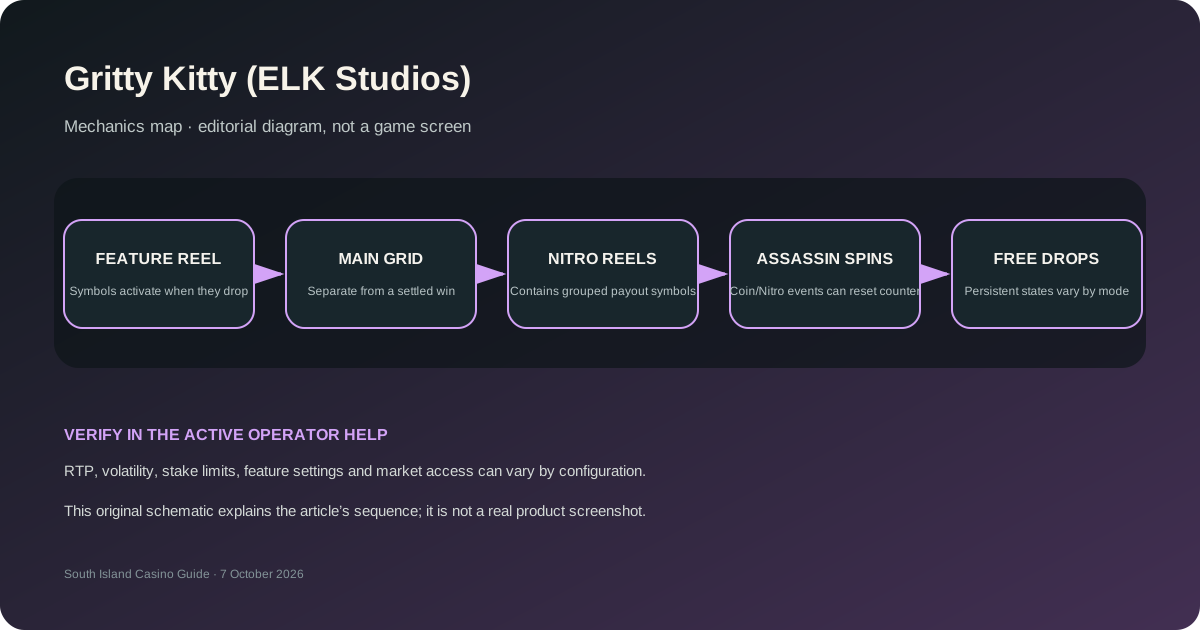
Gritty Kitty of Nitropolis is a 6-reel, 4-row ELK Studios slot with a separate Feature Reel above the main grid. The Feature Reel is described as six reels by three rows, and its symbols become active after they drop into the main grid. ELK’s summary names Nitro Reels, larger Big Nitro Reels, row expansions, an instant max-win coin and two bonus routes. Free Drops begin when three or more Bonus Symbols trigger the bonus; Nitro Reels and row expansions remain persistent during that bonus, which can retrigger.
Assassin Spins work differently. When an Assassin symbol covers the entire Feature Reel, three spins are awarded. Coin symbols or Nitro Reels reset the spin counter, and the Golden Shuriken collects the values of all coins currently on the game grid. The supplier page says a max-win coin covering the entire Feature Reel awards the stated 25,000x maximum potential. Its public summary does not display a current RTP, volatility setting or market-specific operator configuration.
The detailed mechanics are useful to understand, but numeric claims need the active help. The official game-data link returned 403 during this review on 7 October 2026. Third-party pages contain additional numbers, but they are not sufficient to verify a particular New Zealand operator build. This article makes no local-availability claim and does not include an operator offer or affiliate button while current DIA advertising restrictions await qualified legal review.
Separate the main grid from the Feature Reel
The main game area is described by ELK as six reels and four rows. Above it sits a 6-reel, 3-row Feature Reel. These are related display areas, but they are not one interchangeable grid. The Feature Reel’s symbols become active only once they drop into the main grid, according to the supplier description. That timing is central to reading the feature: seeing a symbol in the upper row does not necessarily mean it has already changed the main game or settled a payout.
When a win occurs, watch the path of the relevant symbol. Is it on the Feature Reel, or has it entered the main grid? Does the game identify it as active only after a drop? Does it expand rows, become a Wild, add a Nitro symbol, create a bonus symbol or do something else? ELK’s public summary confirms that the Feature Reel contains symbols that become active on entry, but it does not provide the complete symbol legend in the accessible text. Use the exact game help for every feature name and effect.
The grid dimensions help a reader orient themselves but do not independently define the ways-to-win calculation. Third-party descriptions sometimes quote payway ranges or maximum expanded row counts. Those values should not be imported unless the current supplier sheet or operator help states them. The public page says “6 reel, 4 rows” and separately describes the 6-by-3 Feature Reel; it does not provide the complete paytable in the page text checked here.
A clean way to inspect an animation is to note three moments: initial Feature Reel symbols; symbols that drop into the main grid; and the final evaluated state. If a feature appears only after a drop, record that sequence rather than saying the upper symbol paid immediately. If a payout appears, compare the settlement breakdown with the paytable. The animation tells you what was shown; the help tells you how the game interprets it.
Nitro Reels and Big Nitro Reels
ELK states that Nitro Reels can contain up to twelve 1×1 payout symbols and Big Nitro Reels can contain up to six 2×2 payout symbols. The distinction is about the symbol arrangement and footprint. A regular Nitro Reel and a Big Nitro Reel should not be reduced to “more symbols” without checking how the paytable counts the cells or evaluates the payout. The larger size can alter the board geometry, but the exact treatment belongs to the active rules.
When a Nitro Reel appears, verify how many symbol cells it contains in the version you are viewing, whether all positions show the same payout symbol, and which line or ways logic includes them. When a Big Nitro Reel appears, check how its 2×2 symbols occupy the grid. A multi-cell symbol can look like several ordinary icons, but it may count as one special symbol or a defined block. Do not calculate its value by multiplying the number of visible cells unless the paytable explicitly instructs that method.
The supplier also describes expanding rows. This is a separate state from a Nitro Reel: row expansion changes the board height, while a Nitro Reel occupies an area with payout symbols. In Free Drops, both Nitro Reels and row expansions are stated to persist for the remainder of the bonus. That persistence does not mean they carry into a later paid spin or a new bonus. The public summary only confirms the Free Drops state; look for the reset boundary in the in-game help.
The two types can make screenshots difficult to read because the feature area and main grid are visually connected. Use row and reel labels if the game displays them, and note whether an apparent expansion is a new row or a symbol block. That distinction matters when deciding what symbol positions are available for a qualifying win and whether the game has changed the evaluation area.
Feature symbols become active on entry
The Feature Reel is not just decoration. Its symbols become active when they drop into the main grid. That establishes a state transition: the symbol is first displayed above, then moves to the play area, and then its effect may be evaluated. The page’s broad summary does not enumerate every possible active symbol, so the help panel should supply the official symbol names and rules.
For each symbol type, ask whether it affects the current spin only, triggers a separate feature, modifies other symbols, changes the number of rows, creates a Bonus Symbol or remains on the board. The result can vary. A Wild’s substitution rule is not automatically the same as a Nitro Reel’s payout arrangement; a bonus symbol’s trigger count is not necessarily an award; and an instant coin win is distinct from a collected coin total in Assassin Spins.
This is why an article should avoid making a long generic symbol list from secondary reviews when the official page does not provide the details. Competitor pages reviewed for this guide use varying terminology for Wilds, feature activations and the Assassin sequence. One review describes the counter in terms of “lives,” while ELK describes three spins and a reset when Coins or Nitro Reels land. The supplier wording is the primary description used here. If the operator’s help uses different language, explain it from that exact interface.
If the game presents several features in a single cascade, separate them by trigger. A win can move symbols; those symbols may activate after entering the grid; a Nitro Reel may contribute payout positions; a row may expand; then a bonus trigger might be evaluated. Do not treat the entire animation as one event. A sequential note helps the reader understand which feature caused the changed screen and where the eventual credit came from.
Assassin Spins and the Golden Shuriken
Assassin Spins begin when the Assassin symbol covers the entire Feature Reel. The supplier says three spins are awarded. During this sequence, a Coin Symbol or a Nitro Reel resets the spin counter. The Golden Shuriken collects the values of all coins currently on the game grid. That is a distinct collection feature with its own state and timing, separate from the Free Drops bonus.
Track the counter as a sequence rather than calling the mechanic an ordinary three-spin bonus. Start with the count at entry. After each spin, identify whether a qualifying Coin or Nitro Reel reset occurs. Then determine whether the Golden Shuriken appears and which coins are in view or on the game grid when it collects. The supplier text says it collects all coin values currently on the grid; it does not specify in the public summary whether a coin can be collected more than once or how an empty collection settles. The exact help should answer those edge cases.
The use of “resets the spin counter” means a qualifying event changes the remaining-spin state. It does not mean the counter necessarily increases by a fixed amount, nor does it show the expected duration of a round. Use the actual on-screen rule to see how much the counter resets to and whether more than one reset can occur. This review does not state an exact spin limit beyond the initial three spins in the supplier description.
The Golden Shuriken is the collection symbol in the described Assassin sequence. Do not conflate it with the separate max-win coin. One collects values of coins currently on the grid; the other can award the max win when it covers the entire Feature Reel, according to the supplier. These features have different triggers and outcomes. If a third-party review uses “collector” or “max win” loosely, confirm which symbol is actually shown in the exact help.
The game’s public description also labels one X-iter entry as a 500x Assassin Bonus. This is the cost multiplier associated with that mode, not the prize amount. A feature-entry mode can start an Assassin phase but cannot guarantee that coins accumulate or that the total exceeds the purchase cost.
Free Drops and retriggers
Three or more Bonus Symbols trigger the Free Drops bonus game. ELK says all Nitro Reels and row expansions remain persistent throughout the bonus, and that the bonus can retrigger. Persistence helps explain the state between free drops: if a Nitro Reel or expanded row is active, it stays in the described state for the remaining bonus rounds instead of immediately resetting after each drop.
The accessible public summary does not state how many Free Drops are initially awarded, whether every retrigger adds the same amount, whether there is a maximum bonus length or what exact symbol count is needed for each retrigger. Those fields need the actual help. Third-party reviews often supply counts, but the product page is the primary source for the general feature relationship and does not confirm every operator configuration.
Separate the ways the bonus can evolve. A new Bonus Symbol may retrigger; a Nitro Reel may persist; a row expansion may remain; and another feature symbol may alter the next evaluation. These are not all the same type of state. A retrigger affects the number of remaining drops, while persistence affects the board configuration. The help should explain whether the two can happen in the same event and how the order of evaluation works.
When the bonus ends, find the reset point. Does the game clear the Nitro Reels and expanded rows immediately? Does it settle the total in one amount or display component wins? Are any coin values collected separately? A precise guide should state only what the help says. It should not assume that a board state carries into the next paid round because it persisted through one bonus.
The max-win condition and what a cap tells you
ELK’s page states potential up to 25,000x bet for Gritty Kitty. It further says a max-win coin covering the entire Feature Reel awards the maximum win. Those are direct source claims about the ceiling and a named condition. The statement does not say how likely the symbol is, whether another path can reach the cap or what stake limit an operator applies.
A cap should be understood as the game’s upper payout boundary for the configured rules. It is not a promise that every maximum stake produces a certain amount, and it does not make a high stake sensible. If the game help expresses the ceiling in multiples of the bet, keep that expression as the primary fact. Converting it into a currency amount requires an actual stake and an operator-specific currency; do not publish a converted prize without that context.
The “coin covers entire Feature Reel” condition can be checked visually: identify the Feature Reel dimensions shown by the supplier, then read how the game help defines full coverage. If a screenshot seems to show a coin on every cell, that alone may not establish that the rules’ full-cover pattern has been reached. The help may define positions, a special symbol shape or an animation condition. Use the rule description as the arbiter.
Maximum-win headlines are common in reviews because they are easy to compare. Their usefulness is limited: they say little about base-game pacing, average feature frequency, or the amount of money a user may lose before a bonus. Treat the cap as one technical parameter, not a recommendation or a measure of quality.
RTP variants and volatility: do not borrow another site’s number
The accessible ELK product page does not show an RTP percentage or volatility classification. Its linked Game Data Sheet could not be fetched in this research view on 7 October 2026. This guide therefore does not confirm a particular Gritty Kitty RTP or assert that the title has one fixed setting. Some competitor pages publish 94% and call the game either medium or high variance; that disagreement is not enough to certify current settings for any particular operator.
To verify RTP, open the exact game’s information panel and find the disclosed theoretical return. If the operator help lists several settings or variants, record which one applies to the current build. If no value appears, ask whether the operator publishes it in the game rules or official data sheet. Do not treat “94%” from a review as universal; an article may be old, tied to another country, or based on a different build. A game’s visual appearance can remain unchanged while its mathematical configuration differs.
RTP and volatility answer different questions. RTP concerns long-run theoretical return under the stated configuration; volatility concerns how variable the outcomes are. A high RTP does not guarantee frequent winning spins, and a “medium” label does not predict that one user will see a regular stream of small wins. A demo or short play session cannot empirically verify a theoretical percentage.
An honest review can still be useful when the exact value is unavailable. It can explain what the supplier has confirmed, state that the accessible official summary omits the field, describe how to check the active version and avoid publishing an unsupported figure. That is better than adding a number for apparent completeness.
X-iter modes and cost awareness
ELK’s public page describes five Buggin X-iter modes, from a 3x-bet option with more than triple the chance to trigger the bonus to a 500x-bet Super Bonus with prefilled Feature Wilds. The summary does not name all five modes in the accessible text, nor does it supply every intervening price or exact probability. Use the mode menu and current help for the complete list.
Read the “x bet” multiplier as a mode cost relative to the selected wager, not as an expected return. If the ordinary base amount were hypothetically $1, a 3x entry would represent a $3 mode cost under that definition; the exact operator interface and denomination decide the real amount. A 500x entry can consume a large share of a pre-set budget at once. Confirm whether the mode charges one lump sum, how it changes the game state and what happens if the feature produces no win.
“More than triple the chance to trigger the bonus” is not a claim that the feature pays three times as much or that the player’s expected return triples. Chance of entry, award distribution and cost are separate pieces. To compare a mode, record all three if disclosed. If an X-iter mode is unavailable, do not assume a regional restriction or a technical error without checking the operator’s terms and in-game help.
Any claim that a feature-buy mode is offered to a New Zealand player requires current legal and operator verification. The presence of a mode in the supplier’s catalogue does not prove local consumer access. This article explains the supplier-described mode structure without directing readers to an operator.
A neutral example of reading one feature chain
Imagine a hypothetical base round begins with the 6×4 main grid and the separate Feature Reel above it. A symbol is visible in the feature area. The reader does not count it as active until it drops into the main grid, which follows ELK’s stated rule. Once a cluster qualifies under the paytable, the game settles that group and adds progress to the meter. A Wild appears from the winning cluster. This is recorded as the next state rather than as a separate guaranteed cash prize.
Suppose additional wins fill the progress meter. A Feature Wild is collected and waits until wins stop. The help panel describes that Feature Wild’s effect, and the reader notes whether it affects symbol substitution, size, position or another game property. If multiple Wilds in a later qualifying cluster merge into a multiplier Wild, the reader checks which award it multiplies. No multiplier value should be estimated from a fast animation.
If an Assassin symbol covers the Feature Reel, the Assassin Spins sequence begins with three spins. A Coin Symbol or Nitro Reel resets the displayed counter according to the game rule. A Golden Shuriken then collects coin values on the grid. The reader keeps this sequence separate from Free Drops so that “three Assassin Spins” is not confused with “seven free drops.”
In another round, three Bonus Symbols start Free Drops. Nitro Reels and row expansions persist during that bonus, and a retrigger can extend it. If the max-win coin covers the Feature Reel, the supplier states that the cap is awarded. Each step is a source-described condition; none tells the reader how frequently it will occur. This walkthrough is a way to interpret help and screens, not a play test or a predicted result.
Mobile, demo and exact-help checklist
The official page’s accessible text recommends a 1600×900 desktop display and a 16:9 ratio when scaling. That is a supplier’s layout recommendation, not proof of how an operator has implemented the game on a phone. On a smaller screen, check whether the 6×4 grid and 6×3 Feature Reel remain distinguishable; whether a large Nitro Reel obscures important symbols; and whether the help button, wager amount and mode cost stay visible.
Use a demo only where the supplier or operator makes it lawfully available. A demo can teach the Feature Reel drop, Wild display and bonus transition. It cannot prove a cash-game RTP, the user’s account eligibility or the exact operator’s stake range. The help in a demo might also differ from the exact current real-money build. No demo or real-money session was launched for this guide.
Before relying on a claim, use this checklist: exact title and provider; base grid size; Feature Reel size; when symbols become active; Nitro Reel and Big Nitro Reel counting; row expansion; Assassin trigger and counter reset; Golden Shuriken collection; Free Drops trigger and persistence; retrigger rule; max-win condition; X-iter costs; displayed RTP and volatility; current operator availability and local terms. Record “not shown” for any unanswered field.
What the mechanics say about play style—and what they do not
Gritty Kitty’s feature design asks the reader to follow two visual layers and several state changes. It may suit someone who enjoys checking which symbols have moved from the Feature Reel into the main grid, seeing a board expand or tracking a separate Assassin sequence. A player who prefers simple fixed-payline rules may want to read the help slowly before making a stake. That is a preference about complexity, not a statement about who will win.
The structure can make a session feel active because a symbol drop may trigger another named feature. More activity does not mean a better expected return. A long animation can settle to a small prize, and a quiet sequence can still include a valid result. Evaluate the game by clarity of help, readable controls, disclosed limits and the entertainment value within a fixed budget—not by counting how many feature labels appear in a promotional description.
If you choose to play any casino game, decide an amount you can afford to lose before beginning and stop at the preset limit. A 25,000x ceiling or a 500x feature-entry option should never be used as a reason to increase spending. The New Zealand safer gambling guide lists support and break resources. This article has no offer button while the legal status of affiliate promotion in the current NZ regime awaits qualified review.
Questions readers ask
What is the Feature Reel?
It is a 6-reel, 3-row area above the main grid. ELK says symbols become active once they drop into the main grid. The exact symbols and effects should be read in the game help.
How do Assassin Spins start?
ELK says the Assassin symbol must cover the entire Feature Reel. Three spins are awarded. Coin Symbols or Nitro Reels reset the spin counter, and the Golden Shuriken collects coin values currently on the grid.
How do Free Drops start?
Three or more Bonus Symbols trigger the Free Drops bonus. ELK says Nitro Reels and row expansions persist during it, and the bonus can retrigger. The exact initial drop count and retrigger rule should be confirmed in the active help.
What is the maximum win?
The supplier page states potential up to 25,000x bet and says a max-win coin covering the entire Feature Reel awards that maximum. It is a cap condition, not a typical or guaranteed outcome.
What is Gritty Kitty’s RTP?
The accessible ELK page does not publish a current RTP value. Its linked data sheet returned 403 during this check. Third-party values are not treated as verified for a specific operator version.
Are Gritty Kitty and Nitropolis the same game?
They share the Nitropolis setting, but they are separate ELK titles with different mechanics. Use Gritty Kitty’s own game help instead of transferring rules from another Nitropolis game.
Sources and date checked
Checked 7 October 2026. Primary source: ELK Studios’ Gritty Kitty page and ELK’s game catalogue. Its linked Game Data Sheet returned HTTP 403 in this research view. Competitor pages reviewed: OLBG, Slot Gods, Gambling.com, and Sister Slots. They provide extra description but vary in feature terminology and market framing; their numbers are not treated as proof of a New Zealand operator setting. Separate New Zealand search-volume data was not supplied. DIA advertiser guidance checked 7 October 2026.
