ELK Studios game rules · South Island guide
Coba slot review: cluster rules, Snake Meter and multiplier Wilds
 Best casinos available in New ZealandUpdated 7 November 2026

Coba is ELK Studios’ original snake-themed cluster slot. The supplier describes a Snake Meter advanced by wins, snakes that eat matching-colour symbols and grow, and multiplier Wilds created where snake paths cross. The main task is to follow how a winning cluster changes the meter and board, then separate that feature flow from settings that only the active game help can verify. Coba is distinct from the later title Coba Reborn.
The short answer
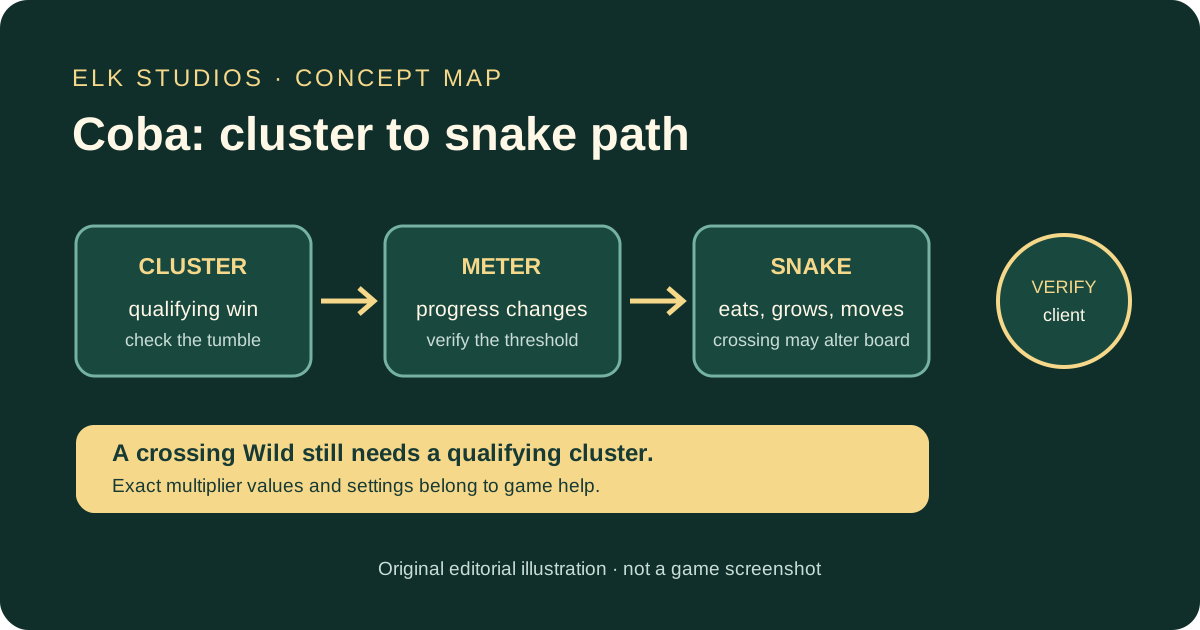
Coba is an ELK Studios slot whose central idea is a cluster board connected to a Snake Meter. ELK’s public page says wins contribute to the meter, which progresses through feature levels and releases snakes. The snakes move through the grid, eat symbols of the same colour and grow; when paths cross, they leave a multiplier Wild. A cluster win, meter advance, snake movement and Wild multiplier are related, but they are not the same event.
To understand a round, read it as a chain: a winning group is evaluated, progress is added to the meter, a feature state may follow, and symbols or snakes change the board. The next cluster still has to meet the game’s win rules. A moving snake or visible multiplier Wild does not by itself guarantee a payout. The active game help should define cluster adjacency, meter progression, snake movement, symbol selection, Wild scope and feature persistence.
The official Coba profile is marked Live Now and confirms the broad mechanics. Its linked game-data sheet returned HTTP 403 in the research browser. Therefore this review does not repeat RTP, volatility, cap, hit-frequency or stake-limit numbers found in third-party pages. It also does not claim that any casino has enabled Coba for New Zealand accounts. Supplier product status and operator availability are different questions.
Confirm the original Coba, not Coba Reborn
ELK has an original game called Coba and a later separate title called Coba Reborn. This article is about the original Coba. The two titles share a name and snake theme, but a sequel can change the board, feature symbols, meters, multiplier rules and bonus states. Similar artwork is not evidence that the rules are interchangeable.
Check the exact title in the operator lobby and inside the help panel. If the heading says Coba Reborn, use that title’s own guide instead of carrying the original game’s meter or path rules across. The site has a separate Coba Reborn guide because it has a distinct title-level intent. This Coba page does not repeat that article’s Orchid-specific features.
The official supplier catalogue helps identify which products exist. The individual product page confirms the broad feature description for the named title. The game client then explains the configuration actually launched by an operator. A third-party review may use a demo or casino from another market. Use it to identify questions, not to assume the current New Zealand version or settings.
This separation is especially important for numerical specifications. The original and sequel may have different RTP, volatility or maximum-win values even when their names are closely related. Do not copy a figure from a Coba Reborn review and label it Coba, and do not treat an original Coba data sheet as a current configuration for a later title. Record the exact title and source beside every figure.
Read the cluster board before the features
ELK describes Coba as a cluster slot with a tumble mechanic. A cluster game generally evaluates neighbouring matching symbols under a defined adjacency rule rather than requiring a fixed payline. The exact qualifying group size, directions that count, Wild substitution, payout-symbol list and clearing order must be confirmed in the current help. The public summary establishes the cluster format but is not a complete paytable.
When a group qualifies, the game may remove its symbols and let other symbols settle or new symbols enter. This is the tumble loop. A single paid round can contain several board evaluations without becoming several separate wagers. The client should show the round’s total and any intermediate feature changes. For a clear explanation, track the symbols that won, what disappeared, what moved into the gaps and whether the next layout produced another win.
Cluster adjacency is a rule, not a visual impression. Two symbols may appear close but fail the game’s connection condition; diagonally touching symbols may or may not count. The paytable or help should contain a diagram or sentence that defines the relationship. Do not transfer a cluster rule from another ELK game. Two slots can both use clusters and still differ in the required shape or how Wilds join a group.
Separate the ordinary cluster result from the Snake Meter. A winning cluster may add progress, but the meter is a feature counter, not a direct payout display. The help should say what counts toward it, whether the amount depends on the size or value of a win, and when the meter advances. A player should not infer these details from the length of a bar or the colour of an animation.
Snake Meter progression
The supplier says every win contributes to a level-up and that higher meter stages release more snakes. This broad relationship is enough to explain why the meter sits beside the cluster board, but not enough to state the exact progress thresholds or number of snakes awarded. ELK’s accessible public profile describes the stages and general direction; the user-specified requirement is to source exact numbers only from the active game help, which was unavailable in this research session.
When inspecting a meter, write down its state before a win, what the winning group did, how the display changed and what happened at the next stage. This method distinguishes progress from feature entry. A partially filled meter might simply be a count toward a threshold. It is not evidence that the next paid spin will finish the bar, nor does it predict the size of any later result.
The reset boundary matters. Does the meter carry from one spin into another, or reset after the round? Does the bonus use the same meter as ordinary play? Does releasing a snake consume meter progress? The supplier summary does not answer every one of these questions. A reader should use the help panel’s feature description and any example sequence to determine what persists and what restarts.
The Snake Meter is a way to describe the game’s feature progression, not a bankroll or a promise. If the bar has advanced, that visual state belongs to the round or feature rule as written. It does not make a particular event “due.” Do not raise a stake to chase a meter stage. A guide should clearly state that the meter explains mechanics, not future probabilities.
How snakes select symbols and grow
ELK says snakes eat symbols of the same colour and grow longer, which can create larger clusters. This makes a snake a moving board feature rather than a normal payout symbol. To follow it, identify where it enters, what colour or symbol it is seeking, which tiles it can consume and what happens to its length after an interaction. The active help should define the path and the conditions that stop it.
The word “grow” describes a change in the snake’s visible path, but the player still needs to know how that change affects the game. A longer path may touch additional positions or make another cluster possible. It should not be described as a higher win unless the game produces a qualifying group and settles it. A snake may move without creating a win, and a newly formed cluster may still fail the rule or have no payout under the table.
Watch the order of events. Does the snake move before the next symbol drop, after a cluster clears, or as part of the same animation? Can the snake consume a symbol that has just entered? Does the movement happen once or continue while matching symbols remain? The public supplier page confirms the eat-and-grow idea but does not provide a complete event tree for every interaction.
If several snakes occupy the board, follow each path separately. The help should say whether snakes act independently, whether they can select the same colour, and what occurs when their routes cross. A review should not assume that one snake inherits another’s state or that two feature events resolve in a particular order just because they are displayed together.
Path crossings and multiplier Wilds
The public Coba profile says that when snakes move across one another, they leave a multiplier Wild at the crossing. It also describes the multiplier as increasing with additional crossings and says multiplier Wilds within a cluster combine according to the game’s rule. The exact numeric value, cap, combination order and eligible win scope must be verified in active help before publication; none is asserted here.
The distinction between a crossing and a win is essential. A crossing can create a feature symbol. That Wild still needs to contribute to a qualifying cluster before it affects a settlement. A player should note where the Wild appears, which matching symbols connect to it, and whether the Wild belongs to the same cluster that the game evaluates. A multiplier outside the winning group may not apply to that result.
When multiple multiplier Wilds appear, the combination rule controls the result. The public page says they are multiplied within a cluster, but the current help should clarify which values are in scope and when they are applied. Do not add the values together unless the game tells you to; do not assume they affect all wins on the board. A multiplier can be local to a cluster rather than global to the entire round.
An accounting review should keep three items separate: the ordinary value of a qualifying cluster, the multipliers that participate in that same cluster, and the final settlement shown by the client. If the game has a bonus state, check whether multiplier Wilds carry forward or reset. A screenshot showing a large value does not establish the feature’s probability or typical result.
Bonus states and X-iter
ELK’s Coba page describes feature levels and optional X-iter modes, including a mode that begins closer to a later feature state. That describes a broad product option, but it does not tell the reader which modes a given operator enables, how they are priced, or how each setting settles. The exact menu and help should be opened in the active client before discussing it as locally available.
Keep the standard base game separate from a mode that starts with an altered feature state. The base-game guide explains how the meter and snakes work as they arise in a regular round. An optional mode can change the starting point or feature conditions. It should have its own cost, eligibility wording and help. Its inclusion in the supplier profile does not mean it appears in every casino client.
Do not infer the bonus trigger from a feature label. A Snake Meter level may release snakes, but that does not automatically mean the game has entered a distinct free-play bonus. If a bonus is offered, read its entry symbol, start state, event count, retrigger and end condition. The accessible product summary did not supply complete bonus terms, so this review does not claim exact thresholds or awards.
A feature purchase or X-iter selection is still gambling with uncertainty. A starting feature does not promise that the result will exceed its cost, and a mode that increases the chance of a feature is not a guarantee of a return. Read the mode’s own terms and do not use it to recover losses. The New Zealand safer gambling guide links to support and break options.
RTP, volatility and the missing game-data sheet
RTP is a theoretical return over a large number of plays under a specific configuration. It cannot predict an individual result or a short session. If the original Coba offers multiple RTP variants, the active game help should identify the one used by the operator. A third-party review may show a different version, and a supplier page that lists the game is not proof of a particular account’s configuration.
The official ELK Coba page was accessible and marked the title Live Now, but its linked Game Data Sheet returned 403 in the research browser. Search results and review pages list numerical specifications, yet their values are tied to their own sources, dates or operator builds. Some market pages use a generic figure without showing the active client. This guide therefore leaves RTP, volatility, maximum win, hit frequency and stake limits unverified.
Volatility is a description of result variation, not a schedule for when the Snake Meter will fill. A label such as “medium” or “high” cannot tell a player the next round’s outcome. Maximum win is a theoretical ceiling, not a typical result or a promise. The current help should say whether a cap applies to a round, a feature or an optional mode, and whether the displayed amount includes the original stake.
When a current operator help panel is available, record the exact title, version, setting label, date and market. Confirm that RTP, cap, volatility and stake limits all refer to the same configuration. Do not combine a maximum win from an old product sheet with an RTP from another casino. If the value is absent, retain it as unknown and seek the operator’s written answer.
Coba and Coba Reborn: keep the evidence separate
The original Coba and Coba Reborn are different entities, each with a distinct supplier product page. This page follows the original title’s Snake Meter, snakes and path-crossing Wilds. The sequel has its own later mechanics and should be reviewed from its own current help. The related link is useful for a reader who intentionally wants the other title, but it does not make the two pages duplicates.
When comparison is necessary, compare only verified high-level facts: title identity, public supplier description and source date. Do not claim that a meter, threshold, multiplier or RTP is “the same as” the other game without evidence. A franchise relationship may explain art or terminology, but it does not substitute for rule documentation.
This separation also helps a player search the lobby accurately. If the operator lists both names, opening the wrong help page could lead to a wrong assumption about symbols or settings. Confirm the title on screen before entering a stake. If the list is ambiguous, ask the operator to identify the exact product rather than deciding from the thumbnail.
Mobile layout, history and demo limitations
On a phone, snake paths can be harder to track than on a larger display because the game has many positions and moving symbols. Locate the help icon, symbol guide, meter and round history before play. Make sure that paths do not become indistinguishable when the board scales down. If colour is used to mark a snake’s target, check whether the game also gives it a symbol or text label.
Use the history panel to reconstruct an event if the animation was fast. Check what the accepted stake was, which symbols qualified, whether the meter moved, and how the client recorded the final result. History is a record of past events, not a forecasting tool. A feature that has not appeared in recent rounds is not more likely solely because a player has waited.
No demo or operator’s mobile client was launched for this article. A demo can help someone locate controls or see a sample snake path, but it may be unavailable locally and may not use the same settings as real-money play. It cannot establish the current RTP, the operator’s stake range or whether Coba is offered to a New Zealand account.
Accessibility features also belong to the launched client. Check visible keyboard focus, readable contrast and clear text alternatives for motion-based feature events. The supplier’s product page does not guarantee that every operator wrapper exposes the same controls. If the interface hides the accepted stake or makes a rule unreadable, stop rather than trying to infer the result while playing.
New Zealand availability and responsible context
ELK’s public Coba profile is marked Live Now, which establishes the supplier’s product status at the time checked. It does not prove availability at a particular New Zealand operator. No casino lobby, account or live client was checked, so local access and operator configuration remain unknown. This article explains mechanics; it does not recommend a casino or promise a return.
The Department of Internal Affairs advertiser guidance checked 7 October 2026 says the current online casino advertising framework applies to third parties and identifies affiliate marketing among the initial prohibited advertising decisions. Accordingly, this local draft includes no casino referral button while qualified New Zealand compliance review is outstanding. This is an editorial hold pending specialist review, not a legal opinion.
Snake movement, cluster growth and a partially filled meter are game states, not cues to keep playing. They do not promise that another win, multiplier or feature will follow. Set a limit before a session and stop at it. If gambling affects a person’s finances, work, sleep or relationships, take a break and seek independent support through the site’s New Zealand safer gambling guide.
Original Coba inspection checklist
Confirm the game says Coba, not Coba Reborn. Read the cluster rule, adjacency, Wild substitutions, symbol clearing and tumble sequence. Then locate the Snake Meter and determine what advances it, what each stage changes and when progress resets. Follow a snake’s path, target symbol, growth condition and stopping rule. Check how a path crossing creates a multiplier Wild and exactly which cluster can use it.
If a bonus or X-iter control appears, open its separate help. Record its starting state, cost, trigger and settlement. Do not treat a meter level as proof of bonus entry. Check RTP, volatility, maximum win and stake limits in the active game help; if unavailable, do not substitute a competitor value. Record the title version and date for any future data update.
Before playing on mobile, ensure the meter, symbols and accepted stake are visible. Review the round history if an event is unclear. Decide in advance how much time and money you can afford to spend and stop at that point. Do not increase a stake because a snake is near a matching symbol or because the meter appears close to a new stage. Those displays describe rules, not future results.
Frequently asked questions
What is the Snake Meter?
ELK describes it as a progress feature advanced by wins, with later stages releasing more snakes. The current game help is required for exact thresholds and persistence.
What do snakes do in the original Coba?
The supplier says snakes eat same-colour symbols and grow, which can contribute to larger clusters. The help should define target selection, movement and stopping conditions.
Do crossing paths guarantee a win?
No. The public description says crossings create multiplier Wilds. A Wild must still participate in a qualifying cluster under the current rules before it affects settlement.
Is original Coba the same as Coba Reborn?
No. They are separate titles with separate product pages and rule sets. Confirm the exact name in the game client.
What is Coba’s current RTP in New Zealand?
This review does not verify a current local setting. ELK’s linked Game Data Sheet returned 403 and no active operator help was supplied.
Does the supplier’s Live Now label prove my casino offers it?
No. It describes the supplier’s product profile, not a particular casino’s New Zealand lobby or account eligibility.
Sources and verification boundary
Checked 7 October 2026. ELK’s official original Coba profile was used for the broad cluster, Snake Meter, snake growth, path-crossing multiplier Wild and X-iter descriptions, and currently displays Live Now. The linked official Game Data Sheet returned 403 to the research browser. RTP variants, volatility, cap, hit frequency, stake limits and operator-specific settings are therefore not asserted. Competitor numerical claims were not adopted; their pages are snapshots rather than evidence of a New Zealand client. No game, demo or operator account was tested. DIA advertiser guidance was checked the same day.
- ELK Studios: original Coba
- ELK Studios: Coba Reborn — used only to distinguish the separate title.
- ELK Studios: games catalogue
- Department of Internal Affairs: Online gambling for advertisers
- Competitor pages reviewed 7 October 2026: Lucky Mobile Slots: Coba, Online-Slot: Coba, FruitySlots: Coba, and Casinos.com: Coba. Their numerical claims were not used as current operator settings.
