ELK Studios game rules · South Island guide
Cygnus 2 slot review: rolling symbols, Rising Multiplier and Free Drops
 Best casinos available in New ZealandUpdated 7 November 2026

Cygnus 2 is an ELK Studios slot whose public profile describes rolling symbols, a Rising Multiplier, Wild conversion and Free Drops. A multiplier symbol becomes active when it reaches the leftmost column, then changes into a Wild; a Bonus symbol reaching that edge triggers the bonus. The supplier currently marks its profile Live Now, but this does not prove New Zealand operator access or confirm the RTP configuration used by a particular casino.
The short answer
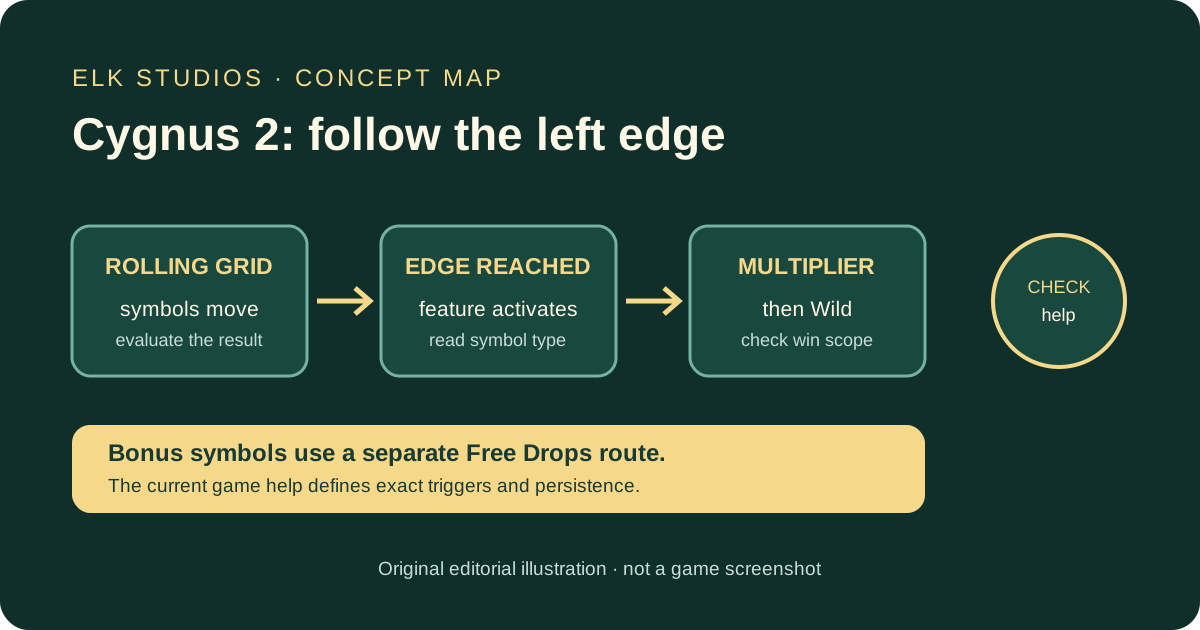
Cygnus 2 is an ELK Studios space-themed slot built around symbols that move across a changing grid. Its official profile describes a Rising Multiplier: a multiplier symbol becomes active when it reaches the leftmost column, increases the currently active multiplier and then turns into a Wild. A Bonus symbol that reaches that same edge starts Free Drops. The Wild symbol substitutes for eligible symbols, while the public rule excludes Bonus and multiplier symbols from substitution.
The feature is easiest to understand as a sequence of states. First, symbols land and the game evaluates eligible wins. Winning symbols may be removed and the remaining symbols roll or shift. A multiplier symbol is not active merely because it has appeared; the supplier says it has to reach the defined edge. Once it does, the multiplier changes the round state and the symbol itself changes role. Free Drops use a separate bonus state, so their persistence and retrigger details should be read from the current help.
ELK’s official page currently labels Cygnus 2 “Live Now” and lists the product features. The accessible game-data sheet returned HTTP 403 in the research browser. For that reason, this guide does not state a current RTP variant, volatility rating, maximum-win value, stake limits or local operator settings. The official listing confirms a supplier product, not availability to a New Zealand account.
Confirm that the game is Cygnus 2
The title includes a number, and that number is part of the product identity. Cygnus, Cygnus 2, Cygnus 3 and later entries are separate releases. A review for the original Cygnus may describe a different grid, feature condition, multiplier behaviour or bonus structure. Do not transfer those rules just because the background, astronomy theme or supplier logo looks similar.
The first verification step is the game lobby title and the in-game help heading. Confirm the provider is ELK Studios and that the loaded title reads Cygnus 2. Then open the symbol legend and compare the active terms with the official product page. The supplier’s public product page is helpful for broad mechanics and current product status. It does not identify which casino build is running, whether a local operator supports the title or what mathematical configuration is active.
An operator may use a game launcher or a catalogue tile that truncates the name. In that case, use the help panel, the loading screen or the round history to confirm the full title. Do not rely on an image search result or a generic “Cygnus slot” label. A wrong identity can lead to an article that gives accurate rules for another game, which is still misleading to the person trying to use the current interface.
It is also useful to note the client language and date. Help wording can change and a market-specific operator may hide or disable optional features. Record the exact client text when the feature boundary matters. If the interface differs from the supplier summary, the discrepancy should be investigated rather than silently resolved by choosing whichever description sounds familiar.
Read the rolling grid and changing board
The supplier describes Cygnus 2 as a grid-based slot with rolling symbols. The game therefore asks a reader to follow more than the first arrangement on screen. A result can clear winning symbols, create space, shift remaining symbols and produce another evaluation. The exact mechanics for gravity, symbol drop order, row expansion and win qualification should be checked in the active game help.
When reviewing a round, separate four moments: the initial symbol layout, the symbols that qualify, the removal or movement after that evaluation, and the next symbol arrangement. A single paid action can contain more than one visible resolution step. That does not mean each step is a new paid spin. Read the result history to see whether the client treats the sequence as one round and how it totals the wins.
The leftmost column is central to the public feature description. The screen’s orientation should make clear which side is left, but a mobile rotation or mirrored illustration can make this less obvious. Confirm the direction from the actual interface and the help diagram. The edge condition is not merely an art detail: it controls when the multiplier activates and when a Bonus symbol can begin Free Drops.
If the board expands or changes shape, ask which positions are eligible at each stage. Are new rows active in the current sequence or only after a level change? Do symbol wins use positions from the entire visible grid? Does a bonus state begin with a different layout? The public summary does not establish every state boundary. A reliable explanation includes only what the help confirms and marks the rest for verification.
Avoid describing the rolling grid as a source of predictable opportunities. A symbol’s movement is a rule outcome, not a signal that another special symbol is due. A round that has already accumulated a multiplier does not tell the player what the next paid round will do. The history helps reconstruct what happened; it does not forecast what comes next.
How Rising Multiplier works
ELK’s page says a multiplier symbol must reach the leftmost column before the Rising Multiplier feature activates. At that point, the active multiplier increases and the symbol turns into a Wild. This is a two-part state change: a value is applied to the round, and the symbol changes its role. A player should follow both parts instead of assuming that every multiplier symbol displayed is already active.
The current game help should explain when the multiplier symbol can appear, whether it can move through the board in a drop sequence, and what happens if it stops short of the left edge. The supplier summary gives the activation point but not every movement path. The exact interface can include a meter or display that shows an active value; the help defines whether that value applies to a single win, the running total or later results in the same round.
Once the symbol becomes a Wild, the public page says that the Wild substitutes for any symbol except Bonus and multiplier symbols. This is an important exclusion. A transformed Wild should not be assumed to trigger the feature that requires a Bonus symbol or to stand in for another multiplier marker. The substitution rule is not the same as a universal wildcard. Check for any further exclusions in the active legend.
The phrase “increases the current active multiplier” also deserves careful reading. It does not by itself reveal whether successive values add, multiply or follow a pre-defined ladder. The game help and payout example should answer how the value is calculated. A reviewer should not infer arithmetic from the animation, from a third-party calculator or from another Cygnus title.
Try to trace one event in the round history. Note the original multiplier symbol, the movement that brought it to the edge, the updated multiplier display, the conversion to Wild, and the win to which the value was applied. If the result screen uses terms such as base win, feature win or total win, keep those fields separate. That makes the feature understandable without claiming a typical return or expected outcome.
Wilds and symbol exclusions
A Wild symbol can help complete eligible winning combinations by substituting for regular symbols. In Cygnus 2, ELK’s public description specifically says it does not substitute for the Bonus or multiplier symbols. This prevents a frequent misreading: the transformed symbol has a Wild role for wins, but it is not a replacement for every symbol in the game.
Read the help legend for any additional symbol classes. A game might have regular paying symbols, feature markers, scatters, multipliers, Wilds and other special items. Their artwork may use a similar colour palette but their rules differ. The active table should state which symbols form ordinary wins, which ones start a feature, and which ones change the multiplier state.
There can also be a difference between the original multiplier symbol and the Wild it becomes. The original marker may be excluded from substitution because it has a feature function. Once it reaches the edge and transforms, it may participate in ordinary wins as a Wild. That distinction explains why the same position can have two meanings at different moments in a round.
If the game shows a multiplier symbol beside a Wild, do not assume the Wild has inherited the multiplier unless the help says so. The supplier summary says the multiplier symbol turns into a Wild after activating the current multiplier. That does not necessarily mean the Wild itself retains a visible numeric label or can retrigger the same event. Check the display and the written rules before describing any persistence.
Free Drops trigger and bonus flow
The supplier’s public page says a Bonus symbol reaching the leftmost column triggers Free Drops. It also says additional triggered Bonus symbols award extra Free Drops. These facts establish the edge-based trigger and a retrigger concept. The exact number of symbols required, how many drops are awarded, what counts as an additional trigger and the precise end condition should be taken from the active game help, which was not provided for this review.
The Bonus symbol has a different role from the multiplier marker. Both may use the left edge as an activation point, but they do not activate the same feature. A Bonus symbol begins the Free Drops state; a multiplier symbol changes the active multiplier and becomes a Wild. Do not describe the two as interchangeable or say that any special symbol touching the edge starts the bonus.
At bonus entry, check which parts of the base round carry forward. Does the active multiplier survive? Does the grid retain its current shape? Are transformed Wilds held in place? The supplier summary establishes the trigger but does not answer all persistence questions. Use the game help or its displayed example to identify the start state and what resets when the feature ends.
During Free Drops, separate an awarded extra drop from a new paid round. The game may update a counter, run another sequence and then settle a final total. The help should define whether a new Bonus symbol can retrigger and how the counter changes. A reviewer should not state that a feature can continue indefinitely or that it has a fixed length without current support.
Use a simple state log when learning the feature: entry trigger, starting multiplier, starting board, each change that affects the bonus, any added drops, final settlement and reset. This record makes the rules easier to explain and reduces the chance of confusing a base-game event with a bonus-only rule. It is a way to understand the client, not a prediction of how often the feature will occur.
X-iter modes and optional feature settings
ELK describes X-iter as a set of optional game modes. The Cygnus 2 profile mentions different ways to enter the action, including a mode where multiplier symbols also function as Wilds. The available modes, their cost and eligibility may vary by operator or market, so this description should not be treated as proof that every mode appears in a New Zealand-facing client.
Open the mode details in the active game before selecting an option. Confirm the cost basis, starting state, how a feature is guaranteed or modified, whether the mode has a separate RTP disclosure and how a result is settled. A feature-entry mode changes the sequence, not the underlying uncertainty. The word “guaranteed” can apply to a starting feature, not a positive return or a profitable session.
Keep X-iter separate from the ordinary game guide. A reader may encounter a title with the mode disabled; the base rules still apply. A reader who sees the option should treat its panel as an additional rule set and decide whether to use it only after understanding the standard feature. Do not transfer a special mode’s multiplier Wild condition into the normal base game.
The official supplier profile is the correct source for the existence of X-iter as a product feature. The live operator help is needed for the current mode list and conditions. ELK’s linked game-data sheet was inaccessible to the research browser, so no option costs or numerical settings are reported here.
RTP variants, volatility and maximum win
RTP is a long-term theoretical return associated with a defined mathematical configuration. It does not describe a guaranteed return in a short session. If a title offers multiple RTP variants, the relevant one is the setting exposed by the operator’s current client. A figure from a game catalogue, third-party page or different country may describe another configuration.
For Cygnus 2, the official product profile confirms the title and features but the official linked game-data sheet returned 403 when opened for research. The page does not provide a verifiable current New Zealand RTP variant, volatility classification or active cap. Competitor pages present numerical snapshots, and not all agree. This guide does not select one as authoritative without a matching help screen or accessible data sheet.
Volatility describes how outcomes are distributed, not the timing of a bonus or the chance of the next multiplier symbol. It is not a signal that a quiet sequence is about to end. A maximum-win figure describes a theoretical upper bound, not a likely result. Both fields must be read with their version and source, and neither is a reason to increase a stake.
When you have access to the client, check the title, game-help version, displayed RTP and the wording around the cap. Note whether optional feature modes use a different configuration. If any value is missing, write “not displayed” rather than copying an old review. This is especially important when an operator’s local limits or settings are not the same as a site reviewed in another country.
Cygnus 2 versus the original and later titles
The official ELK catalogue lists Cygnus 2 as a named game and marks its profile Live Now. The original Cygnus has a separate supplier page and its own feature description. Later numbered games also have their own product pages. The shared theme does not collapse the series into one ruleset. A review should match its H1, canonical route and help source to the exact title.
The series can use familiar vocabulary such as rolling symbols, multipliers, Wilds and Free Drops. Those shared words do not prove that the trigger, sequence or payout is the same. For example, an edge condition may be defined similarly but award a different state, or a transformed multiplier may behave differently in a later release. The current client is the deciding reference.
This separation also protects search intent. A person looking for Cygnus 2 wants that game’s specific multiplier transformation and bonus boundary, not a general Cygnus franchise page. This article keeps the review on one URL and does not split off separate RTP, demo, bonus or rules pages for the same title. A related guide may link to another sequel for comparison, but it should not repeat this article’s full task.
Avoid using a headline that promises a “Cygnus series” overview if the content only describes Cygnus 2. Similarly, a screenshot from the original title should not illustrate the sequel unless it is clearly labelled as a comparison. Exact entity and image labels reduce confusion for both readers and search engines.
Mobile, help controls and demo caveats
Cygnus 2’s changing board can be harder to follow on a phone if the help panel, multiplier display or symbol legend is hidden behind a menu. Locate the help icon, paytable, history, stake selector and round control before starting. Confirm that the left edge remains visually obvious when the screen scales, since that edge controls the public activation rule for both multiplier and Bonus symbols.
If the animation moves symbols quickly, use the round history or a replay if the operator provides one. Review the event order rather than relying on a paused frame. A multiplier marker may be inactive before it reaches the trigger column; a transformed Wild may appear only after the game applies the state change. Check the written legend if a colour or animation is not enough to distinguish these stages.
No Cygnus 2 demo or mobile casino client was launched for this review. A demo, if offered, may be blocked in a location or may use different settings from real-money play. It can help someone learn where buttons and help text sit, but it cannot establish New Zealand availability, an operator’s current RTP, the exact account limits or a client’s bonus eligibility.
Accessibility also depends on the operator’s wrapper. Look for keyboard focus, adequate contrast, readable text and text labels for important state changes. Motion alone may be difficult to follow. If the help cannot be read or the stake state is unclear, do not bet while trying to infer what the interface did.
New Zealand availability and responsible use
ELK’s page identifies Cygnus 2 and currently labels the supplier profile Live Now. That status is about the supplier’s product listing; it is not confirmation that a particular online casino has the game enabled for a New Zealand account. No NZ operator lobby, login or live client was inspected. Availability and local rules remain unverified.
The Department of Internal Affairs advertiser guidance, checked 7 October 2026, says the current online casino advertising framework covers third parties and lists affiliate marketing among the initial prohibited advertising decisions. This page therefore contains no casino referral button while qualified New Zealand compliance review is outstanding. It is an informational guide to the game’s rules, not an invitation or operator recommendation.
Feature progression should not be treated as a reason to continue playing. A multiplier already active in one round does not predict the next round, and a Bonus symbol moving toward an edge does not promise a trigger. Set a time and spending boundary before playing and stop at that boundary. If gambling creates difficulty, use the independent New Zealand support links in the site’s safer gambling guide.
Cygnus 2 inspection checklist
Confirm the full title and open the matching help. Read how a normal win is formed, how symbols roll and what the leftmost column means. Check the multiplier activation rule, the increase to the current state and the Wild conversion. Verify which symbols Wilds cannot replace. Then read the Bonus symbol trigger, Free Drops entry, any added drops, the bonus end condition and what carries forward.
If an X-iter mode is visible, inspect its cost and rules separately from the base game. Find the RTP, volatility and cap in the active help. If the official game-data sheet is unavailable and the operator does not display the fields, leave them unknown. Record the client version and date for any numeric figure before comparing it with a review.
On mobile, make sure the edge, meter, stake and accepted result remain legible. Use history to check a disputed round. Do not interpret a multiplier, past result or nearly triggered feature as a forecast. If any rule or settlement is unclear, stop and ask the operator before staking. The aim of this checklist is to help you understand the rules, not to suggest a betting strategy.
Frequently asked questions
What activates the Rising Multiplier?
ELK says a multiplier symbol reaching the leftmost column increases the active multiplier and then turns into a Wild. The current help controls the exact sequence and settlement.
What starts Free Drops?
The supplier says a Bonus symbol reaching the leftmost column triggers Free Drops, and additional triggered Bonus symbols can add drops. Exact counts and current rules need the active game help.
Can a Wild replace a Bonus symbol?
The public product page says the Wild substitutes for symbols except Bonus and multiplier symbols. Check the current client legend for any additional exclusions.
Is Cygnus 2 the same as Cygnus or Cygnus 3?
No. They are separate titles with separate product pages and potentially different features. Confirm the full name in the game help.
What is Cygnus 2’s current RTP in New Zealand?
This review does not verify a current local RTP. The linked official data sheet returned 403, and third-party settings are not used as proof of a New Zealand operator configuration.
Does “Live Now” mean it is available at every casino?
No. That is the supplier’s product status, not a casino-specific availability check. Confirm the game in the operator’s current lobby and terms.
Sources and verification boundary
Checked 7 October 2026. ELK’s official Cygnus 2 page confirms the title, its current “Live Now” product status, rolling-symbol feature description, Rising Multiplier activation at the leftmost column, Wild exclusions and Free Drops trigger. The linked Game Data Sheet returned 403 in the research browser; no current RTP variant, volatility, cap, stake range or local operator setting is asserted. Competitor pages were reviewed for search-result coverage but conflicting numerical snapshots were not adopted. No demo, mobile client or New Zealand operator account was tested. DIA advertiser guidance was checked on the same date.
- ELK Studios: Cygnus 2
- ELK Studios: original Cygnus — consulted to keep the sequel’s scope distinct.
- ELK Studios: games catalogue
- Department of Internal Affairs: Online gambling for advertisers
- Competitor pages reviewed 7 October 2026: BetsRank: Cygnus 2, Hideous Slots: Cygnus 2, DemoSlot: Cygnus 2. Their numeric and experience-based claims were not treated as current operator facts.
