ELK Studios game rules · South Island guide
Miss Wildfire review: rules, features and RTP checks
 Best casinos available in New ZealandUpdated 7 November 2026

Miss Wildfire is a six-reel, four-row ELK Studios slot built around logs that can become Wilds, two walking Miss Wildfire states and a Free Spins feature that upgrades symbols as logs fill a meter. This guide explains how the described states fit together, and where an operator’s current help must supply the exact RTP, volatility, cap and settings.
The short answer
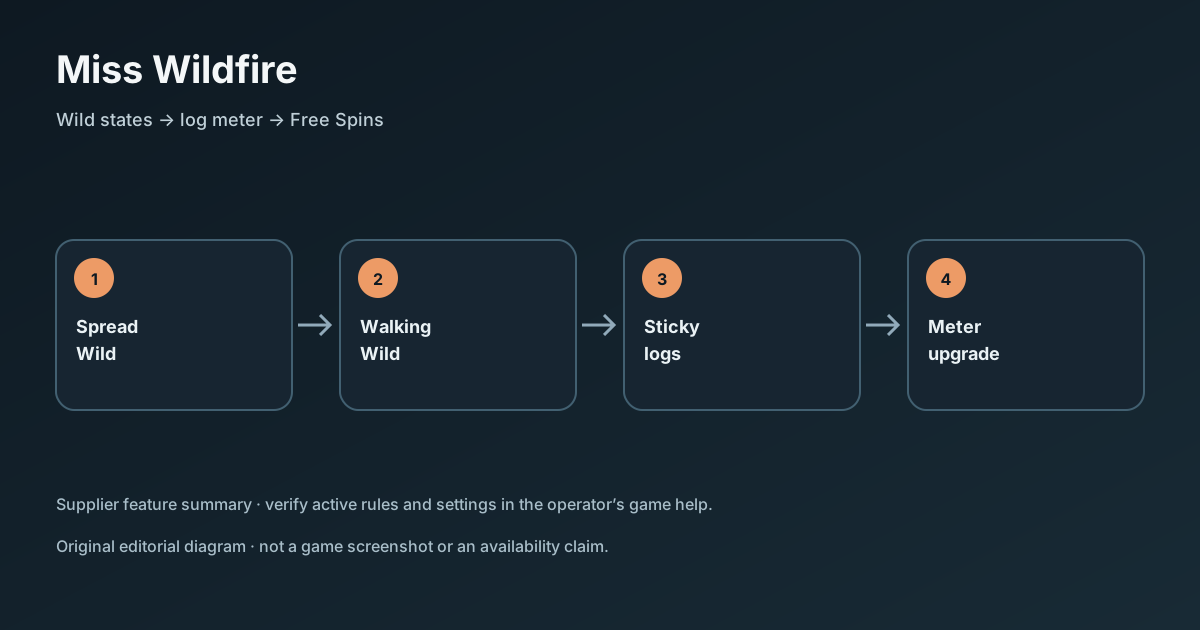
Miss Wildfire’s public ELK Studios description identifies a six-reel, four-row game in which ordinary Wilds can spread through nearby logs, a red Miss Wildfire moves left and turns adjacent logs into Wilds, and a Super Miss Wildfire state keeps unlit logs in place during its respins. Three or more Bonus symbols start Free Spins. Logs collected in that feature fill a meter; when it completes, a low symbol is upgraded and another group of Miss Wildfires is added. Those are separate events with different triggers, so the clearest way to understand the game is to follow each change in order rather than call every animation a respin or a win.
That public summary is useful for mechanics, but it is not the complete mathematical configuration. The official Game Data Sheet link was inaccessible when checked on 7 October 2026, and no New Zealand operator’s live game help was supplied. I therefore do not state an active RTP, volatility rating, maximum win, bet range, demo status or New Zealand availability. Those fields must be read from the exact operator build. The page is an explanatory guide, not a claim that the game has been played or tested.
Identify the exact title before reading a review
Start with the name on the game’s loading screen and information menu. The ELK catalogue lists Miss Wildfire as its own title; a shortened lobby label may omit the studio or a platform may display a logo instead of a full name. Record the exact title, supplier, visible version or help date, and the name of the rules panel. If a casino lists only “Wildfire”, do not assume that it is this product. A close label or matching artwork is not enough to transfer another game’s payout table or features.
The identification step matters because search pages often combine an official description, user tracking data, and settings copied from one casino into a single summary. Those records have different meanings. The supplier page can document a named feature, but an operator’s information panel identifies the configuration the account would actually receive. A third-party statistic page may describe the results tracked by its own users. Keep those categories separate in notes, especially when the numbers conflict.
If the game is not available to inspect, say so. Do not infer a release or operator launch from the existence of the supplier page, an old review, or a play button in a catalogue. The guide covers how the publicly described mechanics work and how to verify the rest; it does not certify distribution in New Zealand.
Read the grid and the win condition as two different things
ELK describes a six-reel, four-row layout. A grid size tells you how many symbol positions are visible; it does not, by itself, tell you how a paying combination is formed. The accessible supplier summary does not set out every paytable row or the full connection rule. The live help must explain whether a result needs a left-to-right route, a connected path, or another condition, and whether the same symbol can connect diagonally. Do not import a “ways” count or line rule from a review of another ELK title.
When reading a result, separate three questions: which symbols changed, whether the new arrangement qualifies under the game’s win rule, and what amount the game credited. A Wild transformation may make a combination possible, but it does not promise one. A log becoming Wild is a state change; the settlement still depends on the paying symbol, the required pattern, the stake unit and the paytable value. This distinction helps explain why a feature can activate without producing a large award.
Use the game’s history panel if available. Compare the initial grid with the final grid after all feature changes. Look for the displayed win result and whether the sequence belongs to the original paid action. Animated steps may look like separate spins even when they are part of a single feature resolution. The current rules, not the animation’s pace, determine when a new wager is taken.
Logs are feature material, not automatic payouts
Logs have a dual role in the public feature description: they are symbols that can be affected by Wild features, and they are collected during Free Spins to progress a meter. Treat these two uses separately. In the base game, ask which Wild can ignite a log, whether that effect applies to adjacent positions only, and whether newly ignited logs can continue a chain. In the bonus, check what counts toward the meter and precisely when a full meter upgrades a symbol.
ELK says a standard Wild can spread through nearby logs. The word “nearby” should not be stretched into an unsupported diagonal rule. The operator’s help should define whether adjacency is horizontal, vertical, or both and whether a newly converted Wild can continue the same spread. If an image illustrates one chain, it shows that example state, not every possible chain. A reader should be able to tell where the source Wild was and which log positions changed before describing the outcome.
The meter is a progression counter, not a cash balance. A log entering the meter does not itself mean that the displayed amount has been won. Record the meter’s unit, what causes it to advance, and whether it resets after the upgrade. If a feature adds a fresh group of Miss Wildfires after an upgrade, that addition changes the bonus grid’s potential, but it is not a guarantee that a new Wild will make a paying path.
The ordinary Wild and the spreading sequence
The supplier describes a Wildfire symbol that can turn adjacent logs into Wilds. To read the effect carefully, begin with the initial position and observe the order in which the game evaluates the neighbouring logs. If more than one log touches the Wild, a sequence may reveal several transformations. A transformed symbol may become a Wild and qualify in a later evaluation, but the help should state whether the evaluation is repeated after each transformation or only after the feature completes.
For a useful written explanation, describe the trigger, the scope and the end condition. The trigger is the Wild landing or activating. Scope is the set of positions it can affect. The end condition is the point at which no further log is eligible or the feature’s rule otherwise stops. These details are more informative than calling the effect “explosive” or “high potential”. Do not invent a guaranteed number of converted symbols from a single screenshot.
Also distinguish the Wild’s own substitution rule from its spreading action. The help may exclude Bonus symbols from substitution, while the fire effect may target only logs. Those are separate restrictions. Check whether a Wild can occupy a position that would otherwise be a log, and whether transformed logs remain Wild for the current evaluation only. Unless the rules specify persistence across a future paid spin, do not suggest that the board carries the Wild state into the next round.
Red Miss Wildfire: movement and adjacent logs
ELK’s summary describes the red Miss Wildfire as moving left during respins and turning adjacent logs into Wilds. The key terms are movement, respin and adjacency. Verify the starting reel, direction, how far the symbol moves, what ends its movement, and whether it can leave the grid. A walking Wild is not the same as a Wild that teleports or moves by a player decision. If the help describes one step per respin, retain that condition in the explanation rather than presenting the movement as a guaranteed number of reels per paid spin.
The red state should also be kept distinct from the Super Miss state. The ordinary walking effect changes position and interacts with nearby logs. A review that collapses all Miss Wildfire symbols into one generic walking Wild can miss a meaningful rule difference. The game’s symbol colour or label may be the quickest way to identify the state, but the written help is the authority when colours are hard to distinguish on a small display.
When the walking Wild encounters a log, note whether the log has to land beside the symbol during that respin or can already be on the grid. Check if the effect can spread from the converted log. Then observe what the game counts as a completed respin and whether the original action has ended. Describing those conditions gives readers a way to audit an animation without implying a special strategy or predicting where the Wild will appear.
Super Miss Wildfire and sticky logs
The public description says the Super Miss Wildfire makes unlit logs sticky. “Sticky” refers to a symbol remaining in a position for a defined feature interval, but the interval itself matters. Does the log remain only through the current set of respins, until it is used, or for another specified period? The public marketing text does not expose every operational detail, so a current help panel is needed before reporting the complete lock rule. Avoid converting the word “sticky” into a promise that the symbol persists indefinitely.
The feature is best understood as a sequence of opportunities: a log remains on the grid, a Miss Wildfire moves, and the game checks whether the log is in the affected range. If the log is ignited and becomes a Wild, its later status should follow the help’s rule for transformed symbols. If it is not reached, it may remain available for a later step, depending on the rules. That possible persistence is what makes the Super state structurally different; it does not establish a positive expected return.
For a practical audit, record the start of the feature, each respin counter change, the position of the Miss symbol, and the status of every sticky log. The game history may summarize this sequence, while a phone screen may show fewer details at once. If the counter or reset timing is not clear, do not estimate it from a short play session. Request the operator’s help text or an official game-data explanation.
Free Spins: entry, meter and changing symbols
ELK’s public page says that three or more Bonus symbols trigger the Free Spins feature, with at least seven free spins, and that the feature starts with up to four Miss Wildfires. Check the active help for the exact award by trigger count, whether the symbols must land in particular positions, and what happens if more Bonus symbols appear after entry. “At least” in a supplier summary should not be turned into a universal number for each trigger or every operator build.
During the feature, logs fill a gauge. ELK says a full gauge upgrades the lowest symbol to a log and adds one or more Miss Wildfires. This means the bonus changes over time: there may be more logs to interact with and new Miss Wildfires entering the grid after a progression event. The reader should track the meter and symbol upgrades as separate state variables. A fuller meter is not a payout; it changes what can appear or how later events may resolve.
The help should say whether the upgrade proceeds through a fixed symbol sequence, when the gauge resets and whether the feature can repeat an upgrade. Check whether the additional Miss Wildfires enter at a named location or are placed by another rule. If the feature adds Wilds as a result of the meter, distinguish that scripted addition from a naturally landing Wild. The interaction between an extra Wild and a log may create a more complex sequence, but exact ordering belongs to the rules.
The official page also describes the bonus as a mode where Wilds can continue to move and logs can be collected. Do not assume that every base-game respin rule carries into the bonus unchanged. Some games preserve a feature name while changing the trigger or reset behaviour. Compare the help sections for base game and Free Spins line by line before claiming the same rule operates in both.
One round, step by step
Imagine a paid base-game action lands a Wild next to two logs. The game may first detect the feature, then convert eligible logs, and then evaluate the resulting grid. If a red Miss Wildfire state is active, the movement rule may create an additional stage. The careful description is: a Wild activated, the named logs changed, the game checked the configured win rule, and the credited amount appeared in the history. It would be inaccurate to call the two converted logs “two wins” unless the interface actually settles two separate awards.
Now consider a Free Spins action. Bonus symbols meet the trigger defined in help, the game awards a displayed number of spins, and an initial group of Miss Wildfires appears. A log lands and advances the meter. Later the meter completes, a low symbol changes to a log, and another Wild group is added. The next grid evaluation may or may not produce a win. The value of this example is that it identifies state transitions; it does not predict a result, frequency or total return.
If the feature display presents an accumulated total, compare that total with the round history rather than adding visible event amounts by hand. Some games show intermediate awards before a final settlement; others show a single accumulated amount. Check the currency and decimal precision. If the displayed total changes after a respin, the change should be explained by the interface, not assumed to be a separate bet or an extra bonus.
RTP: what can be stated and what must be checked
RTP is a theoretical long-run return expressed as a percentage of stakes under a particular game configuration and calculation model. It is not a promise for one session, and it cannot identify the version loaded in an account unless the source ties that figure to that version. The ELK public page accessible on 7 October 2026 describes Miss Wildfire’s mechanics but does not provide a verified active operator RTP in its readable summary. Its Game Data Sheet link was not accessible. This guide therefore does not publish an RTP number as current or universal.
Secondary pages publish figures, but they do not all measure the same thing. One community tracker page labels a user-observed statistic as community RTP and dates its snapshot to September 2024; that is not a theoretical certified configuration. Another review describes 96.10%, while that cannot establish that a particular New Zealand-facing operator has selected the same setting. User data can be useful as a sample description, but it cannot replace the operator’s selected RTP field.
To check the active configuration, open the operator’s rules or paytable panel and locate the theoretical return. Record the displayed value exactly, along with the game title, operator, access date and mode. If the value is absent, ask support where it is documented. Do not estimate a return from wins, a handful of spins, the presence of a bonus, or a supplier’s generic game family. If several values are listed, report the one explicitly marked active; do not imply that all listed variants are available to the account.
Volatility, hit rate and win cap are separate fields
Volatility describes the distribution of outcomes over time, but labels such as low, medium or high may depend on a supplier’s scale or a reviewer’s method. A feature with many stages does not prove high volatility; frequent animations do not prove frequent cash awards. The accessible ELK description does not publish a volatility classification for this page. If a casino help screen or official data sheet gives a rating, copy the exact rating and explain who published it. Otherwise mark it unverified.
Hit frequency is different again. A hit may mean any credited award or only a specified event, and sources do not always define the term consistently. A user tracker’s short-window hit rate is not the same as a theoretical probability. Do not use one to estimate future timing, bonus likelihood, or the chance that a log effect will produce a win. A game’s math is not forecast by a streak.
A maximum win or cap is the highest permitted award under specified game rules, if the provider publishes one. The accessible supplier page does not state a maximum win for Miss Wildfire. A number repeated by a review is not enough to confirm the current operator’s cap. Check whether a cap is expressed as a multiple of a spin stake, a total round stake, or a currency amount. If a feature ends when the cap is reached, verify whether remaining spins are cancelled and how the final award is settled.
What competing reviews do and do not establish
The search sample checked on 7 October 2026 included Gambling.com, SlotTracker, GMBLRS and Bigwinboard pages, alongside the official product page. The editorial strength of these reviews is that they give readers a quick orientation to the grid, Wilds and Free Spins. Some show numerical fields and screenshots that can help locate a paytable panel. They are useful as discovery sources, not as a substitute for the exact current help inside the operator’s build.
The sample also illustrates a verification problem. SlotTracker’s page explicitly presents a community sample and reports a statistic dated September 2024; its result is not the game’s selected theoretical RTP. Gambling.com and GMBLRS show matching rounded theoretical figures, while other tracking figures differ. Such differences may come from market variants, dates or unlike measurement methods. Without the operator identifier and current help, a reader cannot tell which figure applies to them. This page separates those possibilities instead of selecting the most attractive number.
The supplier’s own feature summary is the dependable source for the named mechanics discussed here. The current paytable and game data are required for payout amounts and mathematical settings. No sampled competitor source establishes New Zealand availability, nor does an international casino list establish that a particular New Zealand account can access the title. A review should make that boundary visible rather than imply a local recommendation.
Mobile, desktop and demo checks
ELK recommends a desktop browser resolution of 1600×900, with a 16:9 ratio if scaling is required. That is a presentation recommendation, not a minimum device specification or a statement that every operator supports every phone. On a wide screen, check that all six reels and the rules control remain visible. The feature diagrams should not obscure the bet controls or cut off the respin counter.
On a phone, rotate only if the game’s own help recommends it; do not assume a landscape layout is mandatory. Check that the information panel can scroll, the full game name and stake are readable, and no button sits under a browser edge or system bar. When the help opens, verify that it overlays the game accessibly and has a clear close control. These are things a user can inspect in the actual operator interface; this article did not run a game client or test a device.
A supplier catalogue page or an external “play” button does not prove that a free demo is available to New Zealand visitors. A demo may be geo-limited, removed, or configured differently from real-money play. If a permitted demo appears, treat it as a way to learn labels and feature sequence only. A small number of demo rounds cannot verify RTP, volatility or bonus frequency. This page did not open a demo and does not claim one is available.
Availability and New Zealand context
No operator lobby or account was checked for this article, so the presence of Miss Wildfire at any New Zealand-facing service is unverified. The supplier catalogue proves that ELK documents the title; it does not prove distribution, licensing, player eligibility or a New Zealand release. Before describing availability, match the operator’s exact title label with current rules and verify the relevant local status from official records. Do not turn a third-party casino directory into a local availability claim.
New Zealand’s Department of Internal Affairs states that online casino gambling advertising is prohibited during the transition, and its advertiser guidance says rules apply to third parties who publish or arrange advertisements. The DIA also identifies affiliate marketing among initial advertising decisions. For that reason, this article has no casino offer link or CPA button. This is an editorial compliance hold, not a statement about the legality of reading neutral game information or an individual reader’s circumstances. The owner should obtain suitable advice before any promotional wording is added.
A repeatable checklist for an operator’s help panel
First, verify the title and provider. Second, record the date and version of the help panel. Third, find the grid, qualifying pattern and any exceptions to substitution. Fourth, record the ordinary Wild’s spread scope, the red Miss Wildfire’s movement and the Super Miss sticky rule separately. Fifth, locate the Free Spins entry condition, spin award, initial Wild count, log-meter unit, upgrade order and reset rule. Do not fill a missing item from memory or from another ELK slot.
Then inspect the math fields. Record the selected theoretical RTP, publisher, volatility scale, hit-rate definition if supplied, cap and stake range. Keep the game mode and currency with each value. If X-iter or a bonus purchase appears, check its total price, whether it is enabled and whether its rules change the math setting. Do not include a mode cost as if it were an ordinary spin or compare a bonus mode’s return with base play without a stated method.
Finally, check the display and history. Confirm the paytable can be opened, the full rules are readable, the round history separates a feature stage from a new wager, and the settlement is visible. If any term is ambiguous, save the exact wording and ask the operator to identify the rule. A guide should identify uncertainty precisely, so a reader knows what is confirmed and what still needs a direct answer.
Common misreadings
One common mistake is treating every Wild effect as identical. The ordinary Wild spreads through logs; the red Miss Wildfire moves; and the Super Miss state affects how logs remain on the grid. Another is treating a full meter as money already awarded. It advances a bonus state, while the paying result is determined by a later grid and the paytable. A third is assuming that a bonus spin, drop or respin means a new paid action. The interface and rules must clarify whether the sequence belongs to the initial wager.
Another error is transferring a number from a review without its source date or measurement type. “RTP” can mean a theoretical setting, a user-observed sample, or an outdated operator value. “Maximum win” can use different stake bases, and a volatility label can use different scales. Make the source and exact wording visible. If a number cannot be tied to a title build and market, leave it blank rather than turn uncertainty into an editorial fact.
Finally, do not call a game “available in NZ” because the supplier page opens or a review lists a casino. Availability is an operator and jurisdiction question. A feature explanation does not need an affiliate link to be useful. Readers can understand a mechanic, identify what to check and stop before an unverified claim.
Safer play and limits
Walking Wilds and a bonus meter can create a long sequence of visual events, but an animation is not evidence that a stake has become safer or that a feature is due. Decide in advance whether to use real money, set a firm spend and time limit, and stop when either limit is reached. Do not raise the stake to recover a previous result, and do not use a tracker or a short sample to predict the next round.
If a feature appears, remember the amount of the original wager and read the final settlement in the history. Optional modes, if present, may use a larger multiple of that stake; inspect the full amount before selecting anything. If play becomes difficult to control, pause and use independent support. The site’s New Zealand safer-gambling page provides support links and ways to take a break.
Questions readers ask
What starts Miss Wildfire Free Spins?
ELK’s accessible product summary says that three or more Bonus symbols start the feature and that the award is at least seven Free Spins. Check the operator’s current help for the exact count-to-award ladder and any positional conditions.
How does the red Miss Wildfire differ from Super Miss Wildfire?
The public description assigns the red version a left-moving Wild effect and says the Super state makes unlit logs sticky. The exact movement, respin and lock duration should be confirmed in the active help.
Is Miss Wildfire’s RTP 96.10%?
That figure appears in secondary reviews, but no current New Zealand operator configuration or official accessible Game Data Sheet was verified here. Use the value shown for the exact build in the operator’s help.
Does a log filling the meter pay an award?
The supplier describes logs filling a progression meter that upgrades symbols and adds Miss Wildfires. That is a feature-state change; any cash award still depends on the game’s evaluated result and paytable.
Can I play a free demo in New Zealand?
This guide did not test a demo and has not verified local availability. A catalogue link is not proof that a demo or real-money version is enabled for a specific visitor.
Where can I check the official feature names?
Use the ELK Studios provider guide to reach the supplier catalogue, then match the exact title. The operator’s own help is still needed for its active settings.
Related references
This page is one title-specific explanation, not a complete ELK catalogue. The ELK Studios provider guide helps distinguish supplier information from operator-specific fields. The safer-gambling guide contains support information. Neither page confirms access to Miss Wildfire.
Sources and verification boundary
- ELK Studios: Miss Wildfire product page — checked 7 October 2026; grid, Wildfire, walking Wild, Super Miss, Free Spins and log-meter summary.
- ELK Studios: Games catalogue — checked 7 October 2026; title identification.
- ELK Studios Game Data Sheet linked from the official product page — opened 7 October 2026; HTTP 403, so exact RTP, volatility and cap were not verified.
- New Zealand DIA: Online gambling for advertisers — checked 7 October 2026; advertising prohibition, third-party obligations and affiliate marketing context.
- Competitor sample checked 7 October 2026: Gambling.com, SlotTracker, GMBLRS, Bigwinboard. Their dated or user-derived numerical claims were not adopted as the active New Zealand configuration.
No live operator, game client, demo, mobile layout or account settings were tested. New Zealand game availability, current operator RTP, volatility, cap, stake limits and interface accessibility remain unverified. This page contains no CPA button because the current DIA advertising guidance requires an owner compliance review before affiliate promotion.
