ELK Studios game guide · South Island guide
DeadEye: rules, features and settings to verify
 Best casinos available in New ZealandUpdated 7 November 2026

DeadEye is ELK Studios’ Western-themed slot built around character duels, a feature row, wilds, multipliers and a bullet-based bonus. ELK’s current product page describes the main feature relationships and confirms the title is in its catalogue. It does not publish the operator-specific RTP, volatility, stake limits or full payout settings needed to verify a particular casino build.
The short answer
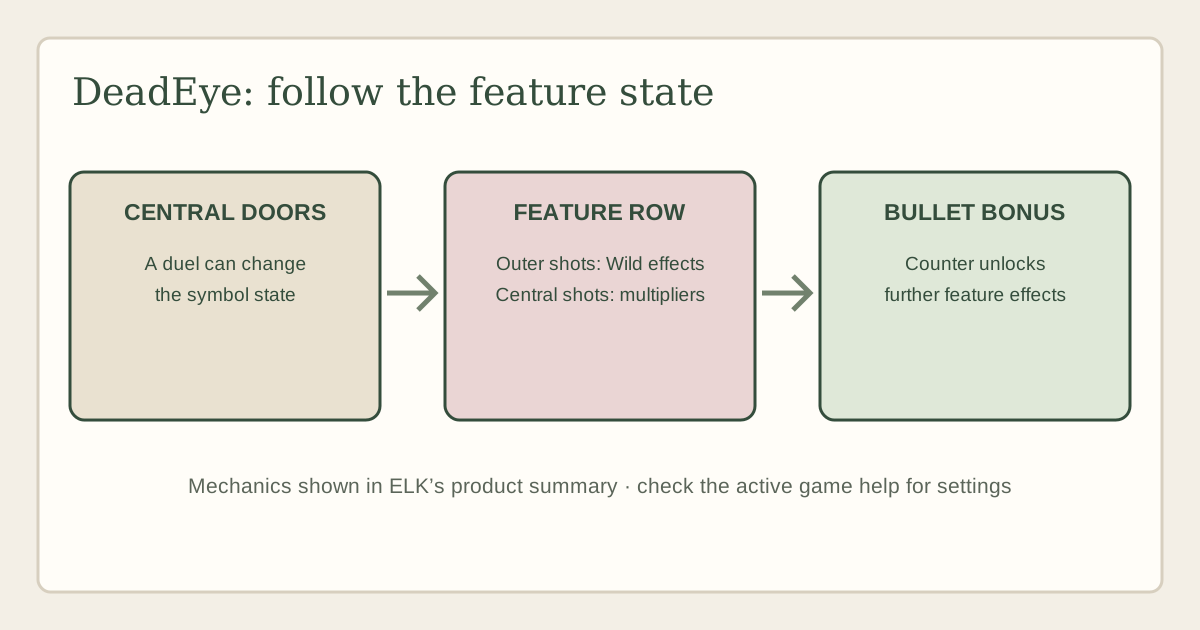
DeadEye is an ELK Studios slot whose visible identity is a saloon-door duel between character symbols. ELK’s public game page says that saloon doors appearing together on the central reels trigger a duel. The feature row can also fire shots that reveal wild effects on the outside reels or multipliers on the central reels. A bonus round uses bullets collected from bonus symbols to unlock further feature effects. Those mechanics can be described from the supplier’s current product page; exact payout values and operator settings cannot be inferred from the theme or from another review.
This guide stays with DeadEye as one game. It explains the supplier-published feature sequence, separates a duel from the bonus, and gives a checklist for confirming the version in a casino client. No current operator help screen was available for this assignment. Accordingly, the page does not publish a numeric RTP, RTP variant, volatility rating, stake range, hit rate, win cap or X-iter price as a verified setting. It also does not claim the game is available to New Zealand accounts or that a demo can be opened from New Zealand.
ELK’s product page describes DeadEye as a six-reel, four-row duelling slot and names the character duels, feature row, wilds, multipliers, big symbols, mystery boxes, coin wins and bonus modes. These labels are a useful map of what to inspect. The loaded game’s rules and paytable still control how a specific operator version evaluates a symbol, settles a win or labels an optional mode.
Confirm the exact DeadEye build
Start by checking the title shown in the game client and the supplier name in its information panel. The spelling on ELK’s public catalogue is “Deadeye”; the assigned search phrase uses “DeadEye”. That casing difference does not indicate a different game. Compare the listed feature names and the visual motif with ELK’s Deadeye product page and the official ELK catalogue. Do not rely on artwork alone if the client has a similar Western theme.
Record what is actually shown: operator, game title, provider, mode, jurisdiction notice, currency, game-help date or version label if present, and the date checked. A casino lobby card can be out of date or may show the series logo rather than a configuration. The information panel should identify who supplies the software; the operator’s terms identify the account provider. These are separate facts.
ELK’s catalogue confirms a supplier product page, not the availability of every build in every country. A supplier may distribute its game to licensed partners in multiple markets, while an individual operator chooses its own catalogue and jurisdiction rules. No New Zealand casino listing was checked here. A reader should check the actual operator’s game lobby and local terms rather than assuming that an official supplier link means the game is available to an account in New Zealand.
If the casino uses a short display title, match several identifiers before treating it as DeadEye: supplier name, game information panel, duel feature description, and a compatible rules or paytable. If the name or mechanics do not match, stop and do not transfer this guide’s feature notes to the other product. Similar saloon art is not proof of the same software.
Read the board before the first spin
The supplier describes a six-reel, four-row layout with a feature row. The board therefore has two visual areas to track: the main symbol area, where ordinary wins and character placements appear, and the row above it, where random shots can reveal feature effects. Keep these areas distinct when reading an animation. A shot result may change a symbol or attach a multiplier without being a separate settled payout.
The public page does not provide a complete paytable or all base-game evaluation conditions. Before playing, open the information panel and check how matching symbols form a win, whether symbols need to start from a particular side, what counts as adjacent, how big symbols occupy positions and whether wilds substitute for every paying symbol. Do not copy those details from a different ELK game just because it uses a similar layout.
A useful first-spin observation is not “did it pay?” but “what changed, and when?” Note the initial board, the feature row, the appearance of a saloon door, any shot effect, and the final win display. If several animations run in sequence, check the history or rules panel to see which event produced the settlement. This gives a clearer explanation than calling every movement a multiplier or every highlighted symbol a win.
The product sheet uses terms such as “big symbols”, “mystery boxes” and “coin wins”. Each can refer to a specific game object or feature state. A big symbol may occupy a larger area of the reel grid; a mystery box may hide an outcome until activated; a coin win may be presented as a value. The public page names these features but does not fully define each operator client’s presentation. Use the in-game help to distinguish a symbol that contributes to a combination from an object that changes the next state.
How the duel is described
The supplier says the duel feature triggers when saloon-door symbols land on the two central reels at the same time. A review should state that trigger narrowly. One door by itself, doors on another reel or a door-like background animation should not be described as the trigger unless the current help confirms it. The central pair sets up the duel sequence between characters shown behind the doors.
ELK’s public explanation says that the character who wins a duel expands into a two-by-three symbol. If both characters die, they are transformed into a two-by-three wild. That is a material difference in the result: a surviving character and a shared wild are not the same event, even though both occupy a large area. The active client’s help should explain how the duel outcome is determined, how the expanded symbol is evaluated and whether an existing multiplier is attached to it.
Watch the event in order. First identify the two doors and the characters associated with them. Then follow the duel animation to its resolution. Next check the reel grid for the surviving or transformed symbol. Finally read the win presentation and determine whether the symbol contributed to a normal combination, whether a multiplier changed it, or whether the round ended without a payout. The order matters because the animation may include shots, character changes and symbol expansion before the final result is shown.
A duel is a feature event, not a guarantee of a winning combination. If the resulting character or wild does not connect with useful symbols under the game’s paytable, the visual event may not create a payout. A guide should not label every duel as a “win” or say that it improves the expected return. It changes the game state; the final result still depends on the client’s rules and the symbols in that round.
The game’s theme can make a duel look like a player choice, but the supplier summary describes it as a triggered feature. Do not tell readers to choose the winning gunslinger or imply that a betting position controls the duel. Only use language about player choice if the active help explicitly describes a decision that changes the result. The facts publicly supported here concern the appearance of doors, a duel outcome and the resulting large symbol.
Feature row: shots, wilds and multipliers
ELK describes random shots on the feature row. On the outer reels, the shots can unlock a wild feature that turns character symbols into wilds. On the central reels, a shot can unlock multipliers that are added to characters landing behind saloon doors. The visual row is therefore not one generic bonus meter: its position indicates which type of effect is being described.
When a shot animation appears, check the exact target and result. Does a character turn into a wild? Does a multiplier appear behind a character? Is the effect attached to the next spin, the current spin or a later duel? The supplier’s summary identifies the relationship between outer-reel shots and wilds, and between central-reel shots and multipliers, but it does not provide every persistence or timing rule. The help panel should settle those details for the loaded build.
Wilds and multipliers have different jobs. A wild may substitute for another symbol to help form a combination, if the paytable permits it. A multiplier modifies a qualifying payout according to its stated rule. A symbol behind a saloon door can be visually linked to a multiplier, but that does not tell the player whether the multiplier applies to the whole win, to a particular character, or to a bonus event. Do not assume a multiplier is global unless the game help says so.
The outside and central reel labels are useful when mapping a screenshot or explaining a sequence. They are not a reason to assert that a particular shot has a known probability. ELK’s public product page calls the shots random; it does not publish the probability for each target. A practical guide can explain the visible effect and leave the likelihood unquantified.
If a shot appears during a bonus, check whether the bonus uses the same feature-row rules as the base game. A mode can preserve, alter or suppress a feature. The supplier’s summary says bullets can unlock wilds, multipliers or extra spins in the bonus, so do not automatically apply base-game timing to that mode. Record what the client help says about carryover and reset points.
Bonus round and the bullet counter
The supplier’s current summary says that three or more bonus symbols trigger the Bonus game. Each bonus symbol landing inside the bonus can carry bullets. When the bullet collection reaches the stated threshold, the game adds a free spin and fires the bullets to unlock wilds, multipliers or extra spins. These are the supplier-published high-level rules; the current game help should be consulted for exact symbol handling, whether a symbol can carry different bullet amounts and the order in which effects resolve.
Read the bullet counter as a feature resource, not as cash. A bullet is not a credited prize merely because it appears on the screen. The supplier describes bullets as unlocking further effects. To understand a completed bonus, follow the counter from the symbol that adds to it, through the threshold event, to the feature row effect and then the eventual settlement. If an extra spin is awarded, confirm whether that spin is part of the existing bonus or a new round.
A bonus can include several possible branches. Shots may unlock wilds, multipliers or additional spins; the visual presentation may make these happen close together. Check whether an effect is additive, replaces a symbol, attaches a modifier or changes the number of remaining spins. This is how to explain the feature without turning the animation into a vague “more chances” claim.
The distinction between Bonus and Super Bonus matters. ELK lists both on the public page and describes a set of X-iter modes, but the full entry conditions and differences belong to the active help. Do not state that Super Bonus can trigger naturally, must be purchased or is unavailable in a region unless the client’s rules and local operator availability establish that point. An optional feature-buy menu is not evidence that the same mode can or cannot occur through ordinary play.
Do not use a short sequence of demo results to estimate how frequently the Bonus appears. A small set of spins cannot verify a long-run probability, and a few screenshots cannot establish the version’s RTP. The readable information is the rule, not a prediction about when the feature will arrive.
X-iter and optional feature modes
ELK says X-iter can offer several predefined ways into a game’s action. Its DeadEye page lists multiple modes ranging from a bonus-hunt option to a Super Bonus. That description does not establish the current mode menu, price, RTP, access or permitted feature set for every operator and jurisdiction. Before describing any option, open the current client’s own X-iter information and record the mode name, displayed price basis, rules and any restrictions.
A mode that increases the chance of a feature is still a paid wager with an uncertain result. “More than three times the chance” on the supplier page is a comparison of feature-trigger chance for a particular mode, not a guarantee of a profitable session or a guaranteed bonus payout. A purchase price can be many times a regular spin’s stake. The reader should compare the total cost to the entertainment budget, not treat feature access as a shortcut to recovering earlier losses.
If the menu offers guaranteed entry into a feature, that means the round begins in the described feature state. It does not mean the feature returns the mode price, delivers a win or reaches a particular result. Read whether the feature modifies the initial state, what remains random and how the payout is settled. A compelling mode name is not a substitute for the rules text.
Feature-buy permissions can vary by jurisdiction. A supplier page may describe a capability without confirming that a particular casino exposes it to a New Zealand account. Do not tell a reader that X-iter is available locally unless the operator’s current listing and applicable access rules confirm it. This guide does not test or launch the mode.
RTP, volatility, cap and stake settings
A numerical setting is useful only when it refers to the same title, version and mode the reader is considering. ELK’s public DeadEye page provides feature descriptions and general product information, but the current operator game-help panel was not available for this review. As a result, no exact RTP, variant range, volatility label, hit frequency, stake limit, win cap or X-iter price is verified here. The figures on affiliate or review sites can describe a particular market or may have been copied from an earlier build; they are not evidence of the current setting in an unspecified operator client.
To verify RTP, look for the value in the loaded game’s help, information or paytable screen. Record whether it applies to the base mode, a bonus mode or an optional X-iter mode. If the client lists multiple settings, preserve the exact value and label rather than collapsing the set to the largest number. A casino’s generic supplier page or a site-wide “ELK RTP” claim is not a substitute for the game-specific value.
Volatility is not a promise about a session. If the client gives a volatility classification, quote the label and source, then explain that it describes the distribution of outcomes rather than predicting when a win will occur. Do not translate “high” into a guaranteed long dry spell or “medium” into regular returns. If no active help screen supplies the rating, report it as unverified.
A maximum win or payout cap also needs a precise basis. Check whether the value is stated as a multiple of the selected total stake, a currency amount or a feature-specific cap. Find out whether a cap ends the current mode, limits one result or changes the rest of the round. Do not transfer a publicly advertised potential to a different game edition or operator build without the matching help.
Stake limits can differ by currency, age rule, market and operator. Read the minimum and maximum total wager in the current client rather than converting a value copied in euros or pounds into New Zealand dollars. If the display uses a currency unfamiliar to the player, convert the exposure before betting and include every selected position or saved combination.
Mobile, help and demo checks
ELK’s product page recommends a desktop display format for DeadEye. That is a supplier recommendation, not proof that every casino’s mobile presentation has been tested or that every operator exposes the game on a phone. A reader can check whether the game information panel remains usable in the actual browser, whether the feature row stays visible, whether the betting controls can be reached without overlaying the board, and whether the game pauses safely if the connection drops.
Do not assume that a demo is available because a review site embeds one. Some sites offer a demo only after an age gate; some operator clients require an account; some jurisdictions restrict access; and a demo may not use the same configuration as a cash game. This assignment did not launch a demo or a real-money client. If a legitimate practice mode is offered to the reader, use its terms and age controls and treat it as a way to learn the interface, not as evidence of a win rate or RTP.
The help screen is most useful when read before the game starts. Open the paytable, base-game rules, duel description, feature-row description, bonus rules, X-iter menu and technical information separately. Save the date and mode label so that any later comparison uses the same build. If an operator changes the title or menu, repeat the check rather than carrying forward old values.
For a mobile review, rotate the device only if the interface allows it, check text scaling and sound controls, and verify that the feature row is not hidden behind the bet panel. Make sure the spin button and balance remain visible when a duel animation starts. These are usability observations, not claims that a mobile mode changes the game maths. If the controls are cramped, do not raise the stake just to reduce the number of taps.
Who may find DeadEye’s feature structure readable?
The duel gives the game a clear centrepiece: identify two doors, watch the characters, then see whether a large symbol or wild enters the grid. The feature row adds a second layer because shots on different reels can lead to different effects. The bonus adds its own counter and branch of shots. A player who likes tracking state changes may find this structure easier to follow than a slot where several hidden meters move without an obvious trigger.
That description is about interface structure, not a recommendation to play. The same animations can be difficult to interpret if they overlap or if the help panel is terse. A useful personal test is to explain one completed feature in plain language: what appeared, what rule it triggered, what symbol changed, what effect was added and what the final settlement showed. If that sequence remains unclear, pause and consult help rather than increasing the stake to see what happens.
Someone looking for a simple, fixed-payline game may prefer a product with fewer feature steps. Someone curious about duels should still separate the theme from the mathematics: a dramatic win animation does not establish a good return, and a quiet spin does not mean the next one is due. The right question is whether the mechanics and the uncertainty are understandable within a pre-set entertainment budget.
A short verification checklist
Before relying on any DeadEye review, confirm each of these items in the same operator build:
- The client identifies ELK Studios and the title DeadEye or Deadeye.
- The duel trigger matches the active help, including the saloon-door positions.
- The help explains how the duel outcome changes the grid and how multipliers settle.
- The feature-row rules distinguish wild effects from multiplier effects.
- The Bonus and Super Bonus rules identify what the bullet counter does and when it resets.
- RTP, volatility, stake range, win cap and optional mode costs are captured only if the current client publishes them.
- The listing’s access terms apply to the reader’s account and jurisdiction.
- Any demo is lawful and age-gated; it has not been mistaken for a verified real-money configuration.
If one of these fields is absent, mark it as not confirmed. A precise gap is more useful than a guessed number. It also makes a future update straightforward: replace the missing item only when a current supplier or operator source can be checked.
Frequently asked questions
What is the main DeadEye feature?
The main feature is the duel triggered by the simultaneous appearance of saloon doors on the central reels, as described by ELK. The outcome changes character symbols into a large symbol or a wild according to the supplier summary. Check the current game help for the exact evaluation and settlement.
How does the feature row work?
ELK describes random shots on the feature row. Shots on the outer reels can unlock wild effects that turn character symbols into wilds; shots on the central reels can unlock multipliers added to characters behind saloon doors. The active game help should explain when the effect applies and whether it persists.
How does the bullet bonus work?
The supplier says bonus symbols start the Bonus game and may carry bullets. The bullet collection can unlock a free spin and fire to reveal wilds, multipliers or extra spins. Use the loaded client’s help for exact counter rules and the difference between Bonus and Super Bonus.
What is DeadEye’s RTP or volatility?
No current operator help panel was available to verify a numeric RTP or volatility value for the specific build. Treat numbers on third-party pages as unconfirmed until they match the current client’s information screen and mode.
Is DeadEye available in New Zealand?
This guide does not confirm a New Zealand operator listing. ELK’s supplier catalogue establishes that the game is part of its product catalogue, not that a particular operator offers it to New Zealand accounts. Check the operator’s current lobby and eligibility terms.
Can I play DeadEye on mobile or in demo mode?
The supplier page includes a desktop display recommendation, but no New Zealand operator’s mobile client or demo was tested for this article. Check the actual client and its age, access and demo terms. A demo, if available, is not proof of the real-money game’s local availability or settings.
Does a guaranteed X-iter mode guarantee a win?
No. A mode may guarantee entry into a named feature state, but it does not guarantee a positive result or return of the purchase price. Read the exact mode rules and cost in the active game client before deciding whether it fits an entertainment budget.
Sources and verification boundary
Primary sources reviewed 6 October 2026: ELK Studios’ Deadeye product page for the published duel, feature-row, bonus and X-iter summaries; ELK Studios’ catalogue for supplier listing; and New Zealand DIA advertiser guidance for the current advertising transition. The supplier product page is the basis for the qualitative mechanics described above.
The current operator game-help panel and any New Zealand operator listing were not available to verify. Therefore RTP variants, volatility, hit frequency, stake limits, payout tables, win cap, X-iter prices, exact client version, mobile support and local access are not asserted. No demo or CPA route was opened. Recheck the operator’s current rules before a public update.
