ELK Studios game guide · South Island guide
Oxygen: ELK Studios rules, features and RTP checks
 Best casinos available in New ZealandUpdated 7 November 2026

Oxygen is ELK Studios’ 6×7 grid slot built around position-linked Oxygen Bubbles, Collectors, a directional Dealer, two distinct Wild effects and separate Bonus and Super Bonus conditions. The supplier publishes a 25,000× maximum-win potential, but the active RTP, volatility and detailed settlement rules must be checked in the game help for the version an operator actually provides.
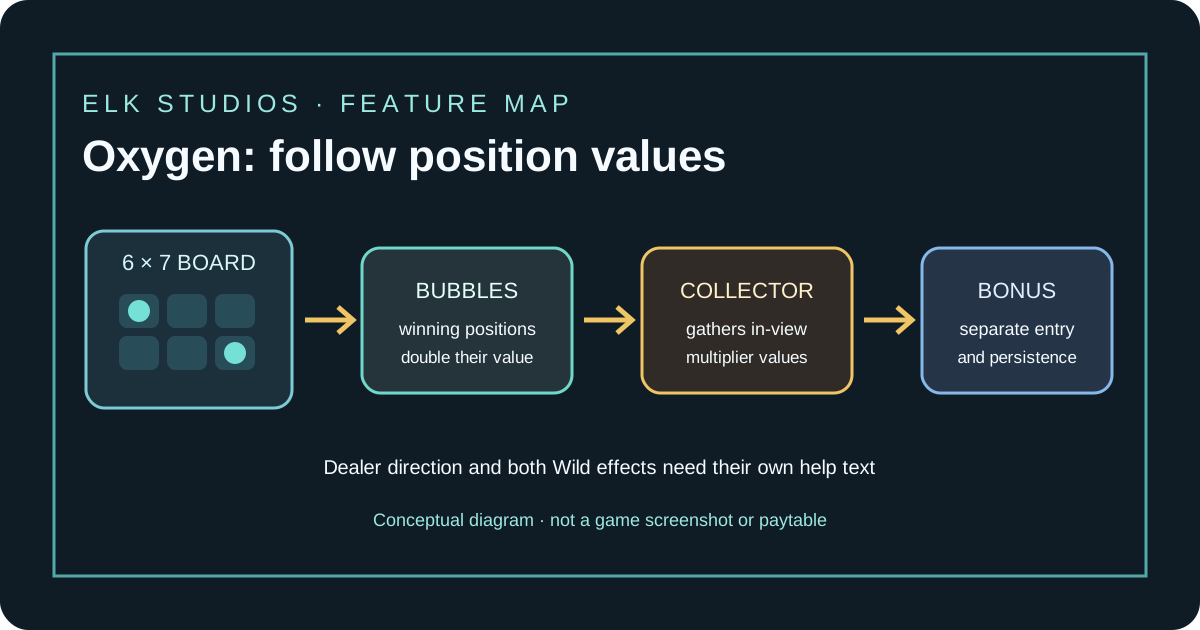
The short answer
Oxygen is an ELK Studios slot played on a 6×7 grid. Its defining idea is that a win can change multiplier values attached to board positions, while Collectors and a directional Dealer can interact with those values. X-Blaster Wild and Exploding Wild have different board effects, and the supplier describes a standard Bonus Game and a Super Bonus with an additional entry condition. The official product page lists a maximum-win potential of 25,000 times the bet.
Those facts explain the feature map; they do not identify the return or configuration used by a particular casino. ELK’s public page does not give a full operator paytable, exact RTP version, volatility value, hit frequency, wager limits, or every bonus setting. Check the live information panel before relying on any number from a third-party review. No statement here establishes that Oxygen is offered to New Zealand accounts or that a demo is available in a particular jurisdiction.
Quick facts: what the public source establishes
| Item | Supplier-published detail | What still needs the active game help |
|---|---|---|
| Provider and title | ELK Studios; Oxygen | Confirm the provider label and title in the loaded client |
| Board | 6 columns by 7 rows | How a qualifying cluster or combination is defined |
| Core feature | Oxygen Bubbles; wins double the multiplier at winning symbol positions | Starting values, caps, reset timing and precise win application |
| Bonus | Three bonus symbols trigger the Bonus Game; three plus a persistent multiplier symbol trigger Super Bonus | Drop count, retriggers, restrictions and settlement order |
| Wilds | X-Blaster and Exploding Wild have separate effects | Substitution rules and exact event order |
| Potential ceiling | Up to 25,000× the bet | Probability, cap handling and the operator’s displayed stake unit |
| RTP and volatility | Not stated on the public product page | Active percentage or variants, volatility label, date and client version |
Treat the right-hand column as an inspection list, not missing details to fill from another ELK game. Similar titles can share a mechanic name while using different trigger conditions or payout rules.
Identify the exact Oxygen game first
The name matters because Oxygen belongs to a small series. This page is about the original title whose official description calls it a 6×7 bubble slot and names the Dealer, Collector, X-Blaster Wild and Exploding Wild. It is not the sequel Oxygen 2, nor Oxygen 3. The later games have their own pages and distinct feature sets; a shared underwater setting or the word “Oxygen” does not make their rules interchangeable.
When a game opens, read the title and provider from its own help screen, not only the casino lobby tile. A lobby can shorten names, use a promotional image, or present multiple entries from the same supplier close together. If the title or version shown in the help does not match the game you intended to inspect, stop and resolve that mismatch before using any RTP figure or feature guide.
The ELK Studios Oxygen product page is the primary public reference for the board size and named feature descriptions. The ELK games catalogue helps distinguish the original from later entries. Neither public page proves that a New Zealand-facing operator offers a specific build.
Read the 6×7 board without assuming paylines
The supplier describes Oxygen as a 6×7 slot, which means six columns and seven positions in each column. That is a board description, not a complete explanation of how winning symbols connect. The public product page refers to a “winning combination” and “winning symbol positions,” but does not spell out the minimum symbol count, adjacency rule, symbol values, or whether every symbol group is evaluated in the same way.
Open the client’s paytable and identify the base-game win condition before looking at multipliers. If the help calls the game cluster-based, confirm whether diagonal neighbours count. If it lists symbol quantities rather than paylines, note how it groups matching icons. Do not import a five-symbol threshold from a review unless that exact rule is visible in the active help. The visual grid alone cannot answer it.
A useful way to make the rule readable is to follow one ordinary win from left to right in the help illustrations: first mark the matching positions, then note which positions qualify, then track what disappears or remains, and only then read how a multiplier changes the settlement. Keeping those stages separate prevents the multiplier animation from obscuring the base condition.
Oxygen Bubbles: the value belongs to a position
ELK says every winning combination doubles the multiplier value on each winning symbol position. The important unit in that sentence is “position.” A multiplier attached to a cell is not necessarily a permanent multiplier on the whole bet or on every later win. When you inspect the help, find out whether an Oxygen Bubble starts at a stated value, whether an empty cell can retain it, and how the game decides whether a later winning symbol occupies that cell.
For a simple example, imagine a symbol win covering three cells. The supplier’s summary says those winning positions have their bubble values doubled. It does not tell us whether all three positions share one multiplier, whether they can hold different values, or what happens when the same cascade triggers another win across only two of them. The help animation or rule text must establish those details for the live build.
This position-based model is different from a single multiplier displayed beside the total bet. A cell can matter because a future drop may place a qualifying symbol in that location. That does not mean the future outcome can be predicted. The board’s animation is a record of the current game state, not a signal that the next spin is due to win.
Collector and Dealer: two different jobs
The Collector gathers all multiplier values currently in view, and ELK says it can appear as a persistent version. That gives the symbol a collection role: it interacts with values already present on the board. The public summary does not specify the destination of the collected total, whether each value is added or otherwise combined, or what “persistent” means in each game state. Check those points in the help rather than translating the name into a payout formula.
The Dealer has a directional role. The supplier says it multiplies all multipliers in the direction indicated by the radar and can also be persistent. For a first read, locate the radar indicator and trace only the positions it points towards. Then check whether the feature changes a displayed bubble value, applies an extra factor at settlement, or affects a later sequence. These are mechanically different possibilities even though a quick animation may make them look similar.
Do not treat Collector and Dealer as synonyms. One gathers visible multiplier values; the other modifies multiplier values along a direction. A persistent Collector and a persistent Dealer are also separate states. The in-game explanation should say how long each remains, when it leaves, and whether either can appear in the standard bonus or only in a specific mode.
The two Wild effects are not interchangeable
X-Blaster Wild selects a random payout symbol or a Wild and replaces payout symbols in an X-shape. This description establishes a transformation effect across a cross-shaped area. It does not say which symbols count as payout symbols, whether the selected Wild may itself be selected, how the centre and diagonals are treated, or how new wins are evaluated after replacement. Those details belong in the live help.
Exploding Wild is described differently: it removes payout symbols within an X-shape above and below itself. The supplier’s wording does not describe the same replacement action as X-Blaster. Do not collapse both into a generic “explosion” in notes or an explanation. For each one, record its name, trigger, affected positions, what happens to the affected symbols, and whether a further evaluation follows.
When several effects appear together, the sequence can determine the result. For example, a Wild may alter a pattern before a win is checked, while a removal effect may create empty positions that are filled later. Unless the active help explicitly provides a sequence, this guide does not infer which effect resolves first. Watch the help examples frame by frame, or use a permitted demo to learn the interface without staking money.
Bonus Game and Super Bonus: separate entry conditions
Three bonus symbols trigger the free-drop Bonus Game, according to ELK. The supplier also says multiplier values persist throughout that bonus. “Persist” means the state is retained across the described bonus sequence; it does not establish that every multiplier is guaranteed to increase, that a bonus will be profitable, or that values carry into a later paid round.
Super Bonus has an additional stated condition: three bonus symbols together with at least one persistent multiplier symbol. This is a meaningful distinction from the ordinary bonus. A reader should check which exact icon or feature state counts as the required persistent multiplier, whether the symbols must arrive in one evaluation, and how the interface signals the upgraded entry. The public page does not provide a complete trigger diagram.
Before starting a feature, look for four practical fields in the help: the number of initial drops, the rule for extra drops, the end condition, and the multiplier reset rule. If one field is absent from the public marketing page, do not borrow it from Oxygen 2 or Oxygen 3. The sequel guides describe separate games, and their bonus names do not prove common settings.
What RTP, volatility and 25,000× do—and do not—tell you
RTP is a theoretical return percentage calculated over a very large number of game rounds. It is not a promise for one session and does not say when a bonus will arrive. Volatility is a separate description of how results can be distributed over time; a label such as “high” is not a payout schedule. The 25,000× figure on ELK’s Oxygen page is a maximum-win potential, not a typical return, target or likely outcome.
The official public page reviewed for this guide does not state Oxygen’s RTP or volatility. Third-party review pages list figures, but they are not proof of the configuration used by a specific operator, account, or country. If the active game help displays a percentage, record it exactly with the title, operator, currency, date and any build identifier. A percentage without that context can be misapplied to another version.
If the client gives an RTP range or multiple modes, note whether it says the value changes by jurisdiction or operator. Compare the displayed game help with the operator’s terms. If the number is absent or contradictory, do not assume a commonly repeated review figure is the correct one. In New Zealand, the availability of an overseas casino listing is not the same as a verified current operator offering.
X-iter: understand the paid mode before selecting it
ELK describes X-iter as a menu with five game modes. Its public Oxygen page gives two endpoints: a 3× bet mode that increases the chance of triggering the bonus by more than three times, and a 500× bet Super Bonus with a guaranteed persistent multiplier symbol. The other mode names, prices and conditions should be read in the exact client rather than guessed from another supplier title.
A cost stated as a multiple of the normal bet is an immediate additional stake. It is not a discount, a cash advance, or a guarantee that the feature will return that amount. A “guaranteed” symbol means the described symbol condition is present; it does not mean a win, profit, or maximum payout is guaranteed. Before choosing any paid feature, confirm the full cost, applicable stake, RTP disclosure, and whether a mode changes the ordinary round.
If you do not want to evaluate those terms, leave the X-iter menu unused. The base game and bonus explanation can still be understood through the help panel. Set a session limit before opening any game and stop when that limit is reached. Do not increase a stake because a bonus feels overdue: random outcomes do not remember how long you have been waiting.
A practical checklist for the live help screen
Use the same short sequence whenever a version of Oxygen is available to inspect:
- Confirm the title and ELK provider credit. Distinguish original Oxygen from Oxygen 2 and Oxygen 3.
- Record the displayed currency and base stake range. Do not translate another country’s limits into NZD.
- Read the ordinary win condition and symbol table before studying the feature names.
- Find the RTP or theoretical return line and note whether the help lists one value or several.
- Find any volatility description and preserve the exact wording; do not convert a label into a hit-rate claim.
- Check Oxygen Bubble scope, Collector settlement and the Dealer’s direction rule.
- Read both Wild entries independently, then look for their order in the help examples.
- Confirm the bonus trigger, initial drops, retrigger conditions, persistence and end condition.
- Inspect X-iter’s complete menu and cost before selecting a mode.
- Save the date and version context if the interface provides it.
This list helps catch mismatches; it does not certify a casino or make an unavailable game accessible. If the help screen cannot be opened before registration or a deposit, do not assume a public review has verified those fields.
Mobile, browser and demo checks
ELK recommends 1600×900 resolution for the desktop experience and a 16:9 ratio if scaling is needed. That is a desktop sizing recommendation, not a statement that every mobile browser, device or operator wrapper has been tested. On a smaller screen, check that the paytable text, feature names, stake control and full cost of any paid mode are readable before interacting with the game.
If a demo is offered by an operator or in an official product environment, verify the title on its own screen and whether the demo uses the same visible help as the real-money build. A demo can teach the board, icon meanings and menu layout. It cannot establish the RTP configuration of an operator account, and a short sample cannot measure long-run volatility.
Do not download a game file from an unrelated review page or rely on an embedded play button without checking who provides it. This guide does not link to a casino, open an affiliate route, or claim a playable New Zealand demo. Access and eligibility need to be confirmed directly from a provider’s current information, subject to local rules.
How Oxygen differs from the later titles
Oxygen 2 and Oxygen 3 are related by name and underwater imagery, but each has separate mechanics. The original Oxygen page identifies a 6×7 board, Oxygen Bubbles, Collector, Dealer, X-Blaster Wild, Exploding Wild, Bonus Game and Super Bonus. Oxygen 2’s guide covers its own Octopus and Jellyfish effects, while Oxygen 3 has its own cascade and Oxygen Meter vocabulary.
If your screen shows “Oxygen 2” or “Oxygen 3,” use that title’s guide rather than mapping its feature names onto the original. The Oxygen 2 guide and Oxygen 3 guide deliberately keep those rules separate. That separation is especially useful when a casino search results page groups the series under one provider or artwork family.
Is this game a fit for the way you read slot rules?
Oxygen is easier to follow if you enjoy tracing board state: where a winning symbol lands, what multiplier sits at that position, how a Collector gathers the visible values and which way the Dealer acts. Someone who wants a simple payline chart may need more time with the help screen. Neither preference predicts whether a player will win.
Before deciding whether to continue, try explaining one feature back in plain language without relying on its animation. For example: “the Collector gathers the visible multiplier values,” or “the Exploding Wild removes payout symbols in a particular X-shaped area.” If you cannot tell which cells are affected or when a value settles, the help is not yet clear enough to make a settings comparison.
This is also a useful point to stop. A maximum-win headline and a rich feature menu can make the game look more predictable than it is. The published ceiling describes an upper bound; it does not make that result likely. If uncertainty around cost or rules is uncomfortable, do not select a paid mode. Reading the guide is not a reason to start a session.
Frequently asked questions
What is Oxygen by ELK Studios?
It is the original ELK Studios slot described publicly as a 6×7 grid game with Oxygen Bubbles, Collector, Dealer, two Wild effects and two bonus tiers. The current operator help is needed for full payout and configuration details.
How do Oxygen Bubbles work?
ELK says each winning combination doubles the multiplier value on the winning symbol positions. The help for the live version should clarify starting values, caps, resets and how the multiplier applies to a later win.
What is the difference between Collector and Dealer?
The Collector gathers multiplier values visible on the grid and may be persistent. The Dealer multiplies values in the direction shown by the radar and may also be persistent. Their exact settlement and duration require the in-game rules.
How does the Super Bonus trigger?
The supplier says three bonus symbols plus at least one persistent multiplier symbol trigger the Super Bonus. Check the active help to identify the qualifying persistent symbol and its timing.
What is Oxygen’s RTP?
The public supplier page reviewed here does not publish an RTP percentage or variant list. Use the game help in the exact operator build. Do not treat a number on a review site as proof of a New Zealand configuration.
Is Oxygen available to play in New Zealand?
This guide cannot confirm that. A supplier catalogue or third-party availability tracker does not establish current account eligibility. Check current operator information and local requirements; do not infer access from another country’s listing.
Does Oxygen have an X-iter option?
ELK’s public page describes five X-iter modes and identifies a 3× Bonus Hunt example and a 500× Super Bonus example. Confirm every mode’s full price and terms in the active client. A purchased feature is not a guaranteed payout.
Sources and scope
- Primary source reviewed 7 October 2026: ELK Studios Oxygen product page, for the 6×7 board, feature descriptions, bonus conditions, 25,000× potential and desktop sizing recommendation.
- Catalogue context: ELK Studios games catalogue.
- New Zealand advertising context: DIA guidance for advertisers.
- Competitor pages reviewed 7 October 2026: CasinoWizard, Casinos.com, Online-Slot, and SlotCatalog. They explain common reader questions and mechanics, but display market-specific figures and occasional differing labels; none is used as a verified NZ operator setting.
No operator help file, New Zealand account view, RTP variant data, search-volume data or public release confirmation for an NZ operator was supplied. The guide reports those gaps rather than filling them with estimates.
