ELK Studios game guide · South Island guide
Fate of Fortune: ELK Studios rules, features and setting checks
 Best casinos available in New ZealandUpdated 7 November 2026

Fate of Fortune is ELK Studios’ five-reel slot with Mystery symbols, several Wild types, Fortune’s Favor and Free Spins with a progressive multiplier. Three or more Bonus symbols trigger the bonus according to the supplier. Its public page describes feature relationships, not an operator’s active RTP, volatility or New Zealand availability.
The short answer
Fate of Fortune is a slot from ELK Studios whose feature system combines Mystery symbols, several distinct Wild effects, Fortune’s Favor and a Free Spins round. The provider says three or more Bonus symbols trigger Free Spins, where a progressive multiplier increases on each spin and the round continues while Mystery symbols remain on the reels. Fortune’s Favor can add one of several feature effects, including a Symbol Swap, a Walking Wild, a Locked Wild or a win multiplier. The order and terms in the client help matter because these effects are not interchangeable.
ELK’s public product page is the primary source for that broad feature map. It does not verify which RTP setting, volatility, cap, hit frequency or stake range a New Zealand operator uses. The linked Game Data Sheet returned HTTP 403 during the research check, and no operator help panel was provided. This article therefore explains the mechanics the supplier publicly describes and gives a checklist for settings that remain unverified. It does not say the game is available to NZ accounts.
Start with the exact title
The ELK catalogue labels Fate of Fortune “Live Now”. This indicates a supplier catalogue status; it does not prove an individual casino carries the game or allows a New Zealand account to access it. Confirm the full title and developer in the lobby and the game’s information panel. Search snippets can omit “of”, shorten the name to Fate, or attach a demo link for a different title. Similar words are not sufficient to establish identity.
Use the official Fate of Fortune product page for ELK’s public feature description and the ELK Studios hub for a provider-level catalogue. The site’s game guide index links this one game separately from other ELK releases. Supplier documentation can explain what the provider says the game contains, but only an operator’s current client can show the version and settings presented to that account.
For a careful note, record the title, provider, help date or version if visible, jurisdiction, currency and source of each number. If comparing an aggregator page with the game, separate the facts into two columns: supplier-described mechanics and operator-displayed configuration. This avoids turning an old review into current proof simply because both pages show the same title artwork.
The reel layout and paytable questions
ELK’s public summary describes five reels and a changing reel pattern. A game layout is not merely decorative: it determines which symbol positions are present and how combinations are evaluated. The product page does not disclose every payline or symbol value in the text reviewed here. For that reason, this guide does not repeat a fixed line count or payout table from a third party as though it were the NZ configuration.
Open the paytable and identify the regular paying symbols, Bonus symbol, Mystery symbol and each Wild form separately. Check whether the game evaluates combinations in one direction or more than one direction, whether it uses lines or ways, and whether a feature modifies the number of eligible positions. A 5-reel image by itself does not answer these questions. The paytable examples and rules animation are the useful evidence.
If a game-information panel lists an RTP or volatility, note whether it refers to the currently selected configuration or a list of alternatives. A title can support multiple certified settings while a casino deploys only one. Do not assume that a review page’s headline number applies to every market, especially where the source omits a version date or operator.
Mystery symbols: one visible group, one rule to verify
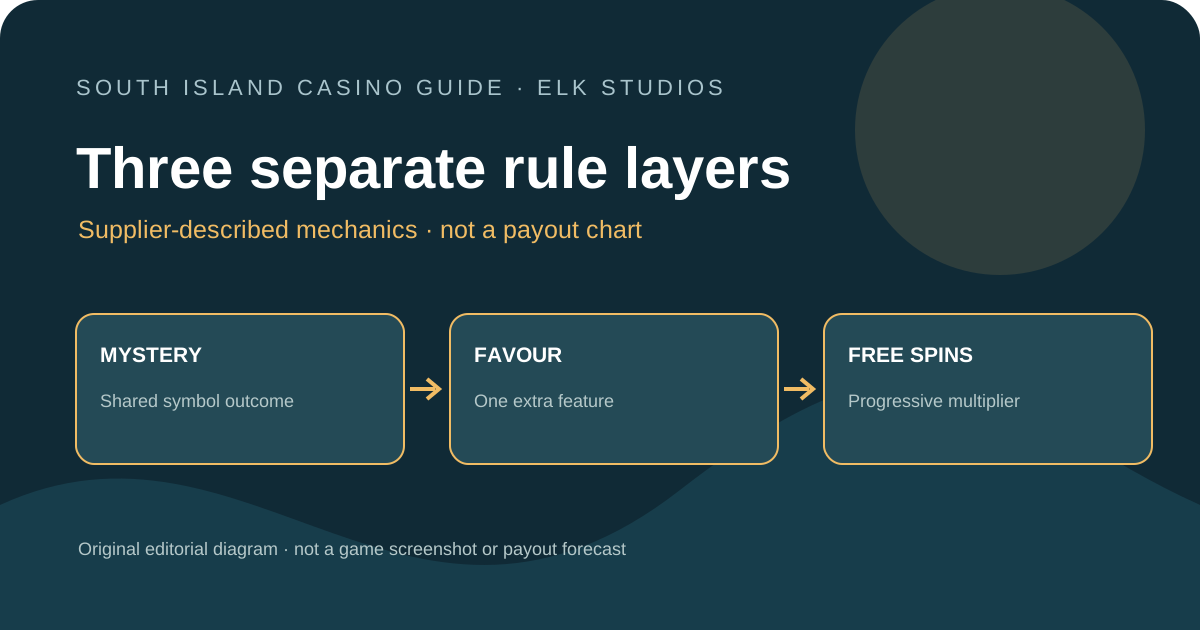
ELK describes stacked Mystery symbols that can transform into the same paying symbol. The practical reading is that several visible mystery positions are resolved together under the feature rule, rather than each displaying an independently selected symbol from the start. The public summary establishes the shared outcome concept, but it does not fully specify which reels can hold them in every mode, what symbols are eligible, or whether a Wild can be selected.
Use the active help to distinguish the mystery transformation from an ordinary symbol replacement. Ask when the transformation occurs, what it can turn into, whether it is limited to the paying symbols, and how it is evaluated alongside a Wild or a feature multiplier. If several groups appear, check whether each group resolves independently or as one set. A short animation may show one example; the written rule defines the broader conditions.
The word “mystery” should not imply that a player can control the outcome or identify the next symbol from a pattern. The function is a game modifier. It changes how the symbols are resolved under a defined rule; it does not reveal future spins or create a reliable prediction method. A reviewer can explain the transformation without claiming that a mystery symbol is more likely to become a premium symbol.
Four kinds of Wild effect
The supplier’s page describes four Wild effect categories, including ordinary substitution and feature Wilds. Among the named effects are Symbol Swap, Walking Wild and Locked Wild, while Fortune’s Favor can enable one additional feature. The key task is to keep the effects distinct: substitution completes eligible combinations; a walking symbol changes position; a locked symbol persists; a swap changes symbol identity or location according to its own rule.
Read the help screen’s icon for each Wild and write down its trigger and duration. Does a Walking Wild move once, repeatedly, or only during a bonus? What is locked and for how long? When does a swap happen, and which symbols can be exchanged? Does the additional feature appear in a normal spin, on the Fortune’s Favor trigger, or inside Free Spins? These questions should be answered by the title-specific instructions.
Do not import a “sticky Wild” or “expanding Wild” rule from a different ELK game just because the icon looks familiar. An operator may also have animation settings that make two distinct effects look similar. If the wording is not clear, compare the feature name with the illustrated sequence and the game history. A complete review should say what is confirmed and identify any unresolved timing detail.
Fortune’s Favor as a feature selector
ELK describes Fortune’s Favor as enabling one extra feature from a set that includes Symbol Swap, Walking Wild, Locked Wild and a win multiplier. It is useful to think of this as a selection or modifier event, not as a second name for the whole bonus. The supplier summary says one extra feature is enabled; it does not publish the probability of each option or say that a preferred outcome can be selected by the player.
When Fortune’s Favor appears, note how the game signals the selected effect and when that effect acts. A Symbol Swap might change a set of positions; a Walking Wild changes location; a Locked Wild remains on the screen; a win multiplier modifies an eligible payout. The exact sequence matters, especially when a Mystery transformation also occurs in the same round. The help should explain precedence or show an example.
Do not interpret “favor” as an indicator that the game has become more generous. It is a feature name, not a promise about the result. A randomly assigned modifier can make one round look different from another, but it does not tell you whether the next spin will win. Avoid betting more because the feature appeared or because one option looks stronger in a particular animation.
Free Spins trigger and progression
The public product description says three or more Bonus symbols trigger Free Spins. The round has a progressive multiplier that increases with each spin. ELK also says spins continue while Mystery symbols remain on the reels. That establishes an interaction between the Mystery state and the feature’s continuation, but the accessible page does not include a complete bonus rule table or the exact starting number of spins.
In the operator help, check the initial spin count, whether Bonus symbols can retrigger, how Mystery symbols extend the round, and the stopping condition. Does the game award another spin when at least one Mystery symbol remains, when a qualifying group remains, or through another defined event? Does the progressive multiplier rise on every spin regardless of a win? The public summary does not answer every operational detail, so avoid translating “while Mystery symbols remain” into an unverified counter rule.
The multiplier is a feature state; it is not the same as an actual payout. A larger displayed value can increase a qualifying win if the rules apply it, but it cannot create a win when no eligible combination forms. Check whether the multiplier applies to all wins, only specific feature wins, or the final total. Keep its start, increment and reset conditions separate in your notes.
How stacked Mystery symbols and Free Spins interact
The feature combination is one of the game’s most important reading tasks. The supplier says stacked Mystery symbols transform into a common paying symbol, and says the Free Spins round can continue while Mystery symbols remain. The public summary does not fully specify whether a transformed stack still counts as Mystery for continuation, when the transformation takes place, or whether the same symbols can serve both the continuation and payout rules.
This ambiguity is exactly why a reviewer should use the live rule animation instead of guessing. Track the symbol through three moments: before transformation, after the paying symbol appears, and when the feature’s remaining spins are recalculated. If the client help says the Mystery symbol itself persists, follow that wording. If it does not, report the uncertainty and ask the operator rather than borrowing a rule from another game with sticky symbols.
When a win multiplier or another Fortune’s Favor effect also occurs, verify whether the game applies it before or after the Mystery result. Two displayed modifiers do not necessarily multiply one another. ELK’s public page indicates that up to three different multipliers can multiply if simultaneously visible, but the precise qualifying conditions and symbols must be read from the active help. Never assume that every number on the screen is combined automatically.
X-iter and the cost of an optional entry
ELK’s page lists five X-iter modes, with options that introduce feature states or begin a bonus-type round. Some modes are described by their multiplier price and by a guaranteed feature condition. Those statements tell you how the provider labels the options; they do not prove that every operator offers each option in New Zealand or that the exact conditions match a third-party review.
If the menu appears in your client, open each option’s information panel without confirming it. Note the total amount charged, the unit it multiplies, what event is guaranteed, and whether it changes the RTP or payout cap. A mode can guarantee that a round enters a feature while still producing a result below the amount paid for access. No X-iter option guarantees profit or a particular bonus outcome beyond the specific trigger described.
The base game can be understood without buying a mode. If your purpose is to learn how Wilds, Mystery symbols and Fortune’s Favor work, use the help screens first and a permitted demo if available. Do not treat a feature-buy menu as an educational prerequisite or a means of recovering prior losses. If the price or rule is unclear, decline the purchase.
RTP, volatility, maximum win and what remains unknown
The product page accessed for this review does not confirm an RTP percentage, volatility label or active setting for a New Zealand operator. ELK’s linked Game Data Sheet returned HTTP 403 on 7 October 2026, and no live operator help was supplied. Consequently, this guide does not repeat a numerical RTP or max win from a review site, even where several pages publish the same figure. Those pages may refer to a particular build or jurisdiction.
RTP is a theoretical long-run statistic for one game configuration. It is not a guaranteed return for a session, and it does not tell you when Mystery symbols or Free Spins will appear. Volatility describes the distribution of outcomes; it does not provide a schedule. A maximum-win value is a cap or potential boundary, not a typical prize or a probability estimate.
If a casino help screen shows several RTP variants, record the currently selected value and any related build note. Also check whether a feature mode uses a different RTP or cap. Verify the currency and definition of “bet” before translating a multiple into money. If no value is shown, mark it as not confirmed. A review page with a convenient fact box cannot replace operator help when the local variant is the question.
Paytable, settlement and a round log
For each symbol, note the combination size, number of reels or positions required, payout unit and whether a Wild substitutes. Then read the rules for stacked Mystery groups, Bonus symbols and the four Wild effects. If the paytable refers to “ways” or “lines”, follow the client’s definition. The same visual grid can be evaluated in different ways across games, so do not assume that five reels automatically means a standard line system.
After a round, the history panel can help explain a settlement. Look for the starting stake, base-game win, modifier, bonus multiplier and total credited result. If the feature runs through several spins, see whether the history shows intermediate values or only a total. The log can help resolve how one particular round was settled, but a single sequence is not a sample large enough to estimate the game’s return or feature frequency.
When comparing help versions, use a written record with columns for “supplier page”, “operator help”, “date checked” and “unverified”. This prevents a copied review figure from appearing equivalent to a currently selected setting. It also gives customer support a precise question if two panels disagree: identify the title and field rather than saying only that the slot “looks different”.
Comparisons with other ELK releases
Fate of Fortune belongs to a broad catalogue that includes games with Wilds, multipliers, X-iter options and Free Spins. Shared vocabulary does not establish shared rules. Another ELK title may also use walking Wilds or Mystery-like symbols, but its trigger, duration, payout unit and eligible combinations can differ. Keep this article limited to Fate of Fortune rather than turning it into a provider ranking.
If you compare two releases, do so on a feature-by-feature basis. Record grid, evaluation system, bonus trigger, feature sequence, RTP in the active help, volatility, cap and stake range. Do not compare one game’s current operator RTP with another game’s supplier headline. Do not use review ratings as a substitute for configuration evidence, and do not treat a high maximum as proof that the game suits a particular budget.
The ELK provider guide and games index help distinguish each assigned route. The separate page should answer the task for the exact game name. This guide does not cover an unrelated Fate-branded title, a standalone RTP explainer, an X-iter page or a demo landing page.
Device and demo considerations
No mobile or desktop gameplay test was carried out for this page. If the game is offered by an operator to your account, check that the paytable, spin control, stake display and help button remain usable at the screen size you intend to use. Mystery effects, multiple Wild types and a progressive multiplier can all place information on screen at once. You should be able to pause and distinguish which feature is active before continuing.
Look for written labels as well as colour and animation. If a Wild type is identified only by a colour, an accessible legend becomes important. Check whether the operator offers sound and animation controls and whether the game history remains available after the feature closes. These are interface questions, not evidence about the game’s mathematical settings.
A demo, if an operator supplies one in a permitted market, can teach the button layout and feature sequence. It cannot establish the RTP variant in a real-money game at another casino, and it does not prove NZ account eligibility. This page’s image is an original editorial diagram. It is not a screenshot and does not claim to reproduce the game client’s colours, buttons or responsive behaviour.
New Zealand access and commercial links
This page does not assert that Fate of Fortune is available to New Zealand players. A catalogue listing or a casino’s overseas review is not enough to establish access. Check current local information and the operator’s terms before relying on any availability statement. The status of online casino regulation and marketing is evolving, so use current primary sources rather than a stale page.
The Department of Internal Affairs advertiser guidance says the online casino advertising prohibition is in effect and third parties that publish or arrange advertisements can be covered; its current page also describes affiliate-marketing restrictions in initial decisions. This review therefore has no in-text commercial casino button. The notice is an editorial safeguard, not legal advice.
No operator link has been substituted. Readers can use the factual help checklist and the site’s existing safer gambling information without following a commercial route. A CPA placement requires qualified compliance review before it is inserted into a New Zealand article.
A practical game-help checklist
First confirm the full title and developer. Read the basic reel and combination rule. Identify every Wild, Bonus and Mystery symbol by its own label. Then record the trigger for Fortune’s Favor, the available effect categories, how the selected effect resolves, and whether it can overlap with a Mystery or Bonus event. Use the rule animation to understand sequence; do not infer a trigger rate from a few observed rounds.
For Free Spins, note the entry condition, starting count, progressive-multiplier rule, Mystery continuation condition, retriggers and final settlement. If the help says the round continues while Mystery symbols remain, check how that rule interacts with a transformed stack. Ask whether a displayed multiplier applies to every qualifying win and how it resets. Keep unknown timing rules marked unknown until the active client resolves them.
Finally verify RTP, variant, volatility, cap, bet range, currency and X-iter costs in the operator help. If the game help cannot be opened or omits a value, do not infer it from an aggregator. Set a personal spend and time limit before a session and do not increase it to chase a feature or a previous result. A game’s rules explain settlement; they do not provide a way to predict outcomes.
Frequently asked questions
What starts Fate of Fortune Free Spins?
ELK says three or more Bonus symbols trigger the feature. The starting spin count, retriggers and exact end conditions need to be checked in the active game help.
What does Fortune’s Favor do?
The supplier says it enables one additional effect, including Symbol Swap, Walking Wild, Locked Wild or a win multiplier. The exact selection and timing are client rules; the page does not publish the probabilities of each choice.
Do Mystery symbols guarantee a win?
No. They transform under the game’s rules into the same paying symbol, but a payout still depends on a qualifying combination and paytable. The transformation is not a guarantee of a profitable round.
What is the game’s RTP in New Zealand?
It was not verified. The official data sheet could not be accessed and no New Zealand operator help was supplied. Check the configuration shown by the operator.
Is X-iter available to every player?
The supplier describes X-iter modes, but the availability and price may depend on the operator and jurisdiction. Read the current client menu; do not infer availability from another review.
Sources and verification boundary
Checked 7 October 2026. Primary sources: ELK Studios, Fate of Fortune and the ELK games catalogue. The linked Game Data Sheet returned HTTP 403, and no NZ operator game help was supplied, so numeric RTP variants, volatility, max-win cap, hit frequency, stake limits and local availability remain unverified. Competitor sample: FruitySlots, AskGamblers, BigWinBoard, AboutSlots. Their operator/configuration figures were not used as NZ evidence. DIA, Online gambling for advertisers, checked the same date. No keyword-volume data was provided.
