Game supplier catalogue · South Island guide
ELK Studios games guide: catalogue and formats
 Best casinos available in New ZealandUpdated 7 November 2026

This guide helps readers navigate ELK Studios’ official catalogue and distinguish a game title, a feature label, a rules page and a market-specific offer. It does not claim that a particular title or operator is available in New Zealand.
The short answer: use three records, not one
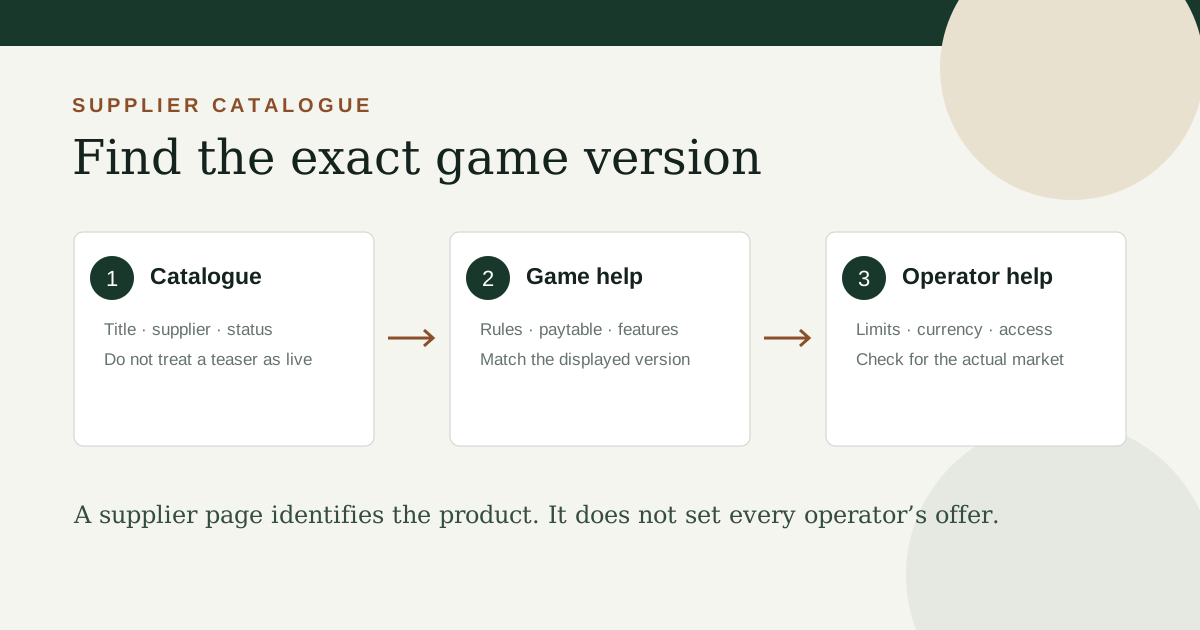
The most reliable way to research an ELK Studios game is to move through three separate records: the supplier’s catalogue, the individual game’s help or information sheet, and the casino operator’s current game screen. The supplier catalogue helps identify the product and its broad features. The game’s own help explains how that version works. The operator’s display supplies the local currency, available limits, eligibility and other details that apply to the actual account.
Those records answer different questions. A title being visible in a supplier catalogue does not prove that every casino carries it. A feature name in a marketing card is not a payout table. A setting shown in one operator’s version does not automatically apply to another operator or market. This distinction matters for games with selectable modes or multiple published versions.
This page is a catalogue guide, not a set of full reviews for individual slots. It shows how to move through the official information, what to compare, and where a reader should stop short of making an assumption. No personal play, test session or account access is claimed here.
What ELK’s catalogue can tell you
ELK’s official games page is the primary catalogue for the supplier’s own titles. On 6 October 2026, it showed titles such as Bamboo Pandits, Concrete Cowboys, Grizzly Stampede, Langley Street 23, Quackers, Pirots 5, Heist Guys 2, Boomberries, Spark of Creation, Wild Toro 3, Deadcode, Huff N’ Puff CollectR and Oxygen 3, alongside a longer back catalogue. The page can change as titles are added or promoted, so treat this list as a dated snapshot rather than a permanent inventory.
The catalogue is useful for name matching. A reader can check whether a title is styled with punctuation, a sequel number or a subtitle, then follow the supplier’s information link for the relevant item. That prevents a common research mistake: combining a title with a similar name, a later sequel or a different provider’s game and assuming they share rules.
The catalogue is not an account directory. It does not show which casino has signed a distribution agreement, whether a game is active in a particular country, which currencies the operator supports, or what that operator’s stake limits are. Those questions require the operator’s own current information.
Separate available, upcoming and historical listings
A catalogue may mix different kinds of listing. A current game card, an upcoming release notice, a studio news item and a retired title are not interchangeable. Check the exact label and date before describing a game as available.
For example, ELK’s homepage displayed Propaganda 2 with a stated release date of 22 October 2026 when this page was checked on 6 October. That is a future announcement at the time of this snapshot, not evidence that the game was already live. A release date may move, a title may be delayed, and access through a casino may begin after a supplier announcement. Verify the status again before publication or account-specific claims.
It is also useful to record the date you checked. If the supplier replaces the landing page or changes its featured titles, an old screenshot may still identify a past catalogue state but cannot confirm today’s availability. Keep the page’s URL and access date with your editorial notes, then re-open the current official page before refreshing a volatile fact.
Read names and versions carefully
Game names often contain more information than a simple brand label. A number may signal a sequel, “CollectR” may be part of the displayed product name, and a subtitle may distinguish a variant from an earlier release. Preserve the official spelling when linking or recording a title. Do not collapse different titles into a single product just because their artwork or theme appears related.
When the operator opens a game, compare the title on the loading screen or information menu with the title in the supplier catalogue. If the names differ, look for the game identifier, version, rules date or game-help heading. Ask the operator’s support team when a mismatch affects the rules or settlement. A search result snippet is not enough to resolve the difference.
This name check is especially important when a page discusses RTP, maximum win, a bonus-buy feature or a mode name. A number copied from a different sequel can look plausible while being wrong for the game actually offered. The safest article records the exact title and the source for every number rather than assigning a single value to the studio.
A theme is not a format
Artwork and title words are quick clues, but they do not fully describe how a game works. A reader needs to identify the basic format from the help page: for example, a reel game, a cluster-style game, a game with a board-like progression, or a game that offers selectable feature modes. This is a navigation aid, not a claim that every ELK title belongs to one fixed category.
Start by asking what creates a completed round. Does the game resolve after a fixed set of reels or symbols? Does a feature continue across several steps? Does the game offer a selection before the main action? The answer changes which rules to inspect. For a feature mode, check its cost and rules separately from the ordinary base game. For a feature that changes the board or reel layout, check whether its displayed RTP or cap differs.
Do not infer mechanics from screenshots alone. An image may show a bonus state, a sample animation or a marketing mock-up. The information sheet and in-game paytable are the controlling descriptions for a specific version. If they do not explain a detail, leave it open rather than filling the gap with a description from another title.
How to read X-iter
ELK describes X-iter as a set of predefined, game-specific modes that can take a player into selected parts of a slot. The supplier says modes can include a guaranteed base-game feature, spins with growing multipliers, or direct entry to a bonus game. It also says a title can have up to five modes and that X-iter is available only with games that offer it.
That wording gives a useful checklist. First, confirm that the exact game has X-iter. Second, open the mode menu and read each option’s own description. Third, note the price or stake multiple before choosing anything. Fourth, read the mode’s payout information and compare it with the base game’s help. Do not assume that one mode list, mode price or RTP applies to every ELK game.
“Predefined” does not mean risk-free or guaranteed profit. A mode may guarantee that a feature appears, but the resulting round can still lose or pay less than its cost. A guaranteed feature is a statement about which game state begins; it is not a promise about the outcome of the state. Treat any mode price as an additional stake decision and include it in the amount you are willing to lose.
The supplier’s X-iter page gives a high-level description rather than a universal menu. The operator’s game screen or the exact game help must answer the title-specific questions: which modes exist, how much each costs, whether the selection can be made every round, and which return figure applies to each option.
CollectR and other feature labels
A label such as CollectR may appear in an official title name or information card. Treat the label as a cue to open that game’s own help, not as a full explanation by itself. The supplier’s game page should explain what a symbol or feature does, when it activates, whether it can be retriggered and how any collected value is used in settlement.
This page deliberately does not turn a feature label into a general rule for the whole catalogue. Similar names can appear on different games while representing different symbol conditions or prize calculations. If a summary says “collect,” check what is collected, what ends the collection period and whether values add, multiply or remain separate. Those details change the practical meaning of the feature.
The same caution applies to named bonus rounds, special reels, growing multipliers and game-specific symbols. Record the exact wording from the game’s help and the version date. If the help does not specify whether two modifiers combine, do not invent a formula. Describe the missing information and direct readers to the current operator screen for the rules that control the game they can actually access.
What “verified settings” means
A useful settings check is a short record of the title and version, the rules or paytable date, any displayed RTP figure, the stake range, maximum payout language, special feature costs, and whether a demo is available. These are separate fields. A page that confirms one field does not confirm the others.
RTP is a theoretical long-run calculation for a defined configuration. It is not a promise about a short session, a sequence of spins or the result of a feature round. For a simple illustration only, a displayed 96% RTP would mean a theoretical return of 96 units per 100 units wagered across a very large modelled volume under that configuration. It would not mean that a person who stakes $100 will receive $96 back, or that the next 100 spins will produce that result.
Stake limits and maximum payout are also version-specific. A supplier might publish a game description without showing the operator’s currency or table limits. An operator may make a title available with settings that differ by jurisdiction. If an article cannot point to the exact help sheet or current screen, it should say “not published in the source checked” rather than substitute a figure from a casino review or another sequel.
Compare one mode with another without mixing the numbers
When a game offers more than one mode, make a small comparison table with one row per mode. Record the cost, entry state, rule source, theoretical return if actually displayed, payout cap if actually displayed and any restriction written in the help. Keep the base-game line separate. This makes an important difference visible: the same title can have multiple ways to enter and more than one mathematical configuration.
Use units rather than a particular currency when explaining how a cost multiple works. If a menu states that a mode costs a multiple of the selected base stake, the arithmetic is “base stake × displayed multiple.” Do not convert that into a New Zealand dollar amount unless the operator screen shows NZD. A foreign currency example can mislead a reader about the amount they will be charged.
If a mode’s description is unclear, do not treat it as equivalent to a bonus buy at another studio. The interface may share a broad purpose while its triggers, price and settlement are unique. Explain only the common navigation idea and link to the supplier’s actual help for the title-specific rule.
Mobile screens and readable information
A responsive page can make buttons fit a phone without making the rule text easy to inspect. On a narrow screen, locate the help, paytable, history and settings controls before beginning a round. Check whether a table can scroll horizontally, whether labels are clipped, and whether the game can be turned to landscape. These observations describe interface usability; they do not confirm that an operator offers a mobile app or supports every device.
Use the in-game information icon rather than relying on a search snippet captured on another screen size. If a small print field is difficult to read, zoom the page or ask the operator for the same rules in text form. Do not place a stake until the visible version and its required conditions are clear.
A static supplier page can support the research even when the game interface is unavailable, but it cannot confirm a casino’s mobile performance. This guide has not tested a live session, device, deposit, withdrawal or app. Any statement about speed, load time, ease of play or a particular phone would need a dated test record and explicit permission to conduct it.
Demo access is conditional
Some supplier pages offer a video or freeplay demonstration. The Evolution Games pages, for example, state that freeplay mode and individual game features can depend on jurisdiction. That is a useful reminder for any game supplier: a demo may be withheld or changed by location, and a video may show a sample without proving that the same game is playable through a particular operator.
Do not call a demo a real-money test. A demo does not establish the operator’s stake range, cashier terms, game settings or account eligibility. It can help a reader recognise the interface and understand the sequence of an illustrative round, but the operator’s in-game help remains the relevant source for its version.
For this page, no demo was launched and no restricted game access was attempted. Readers should not use a VPN or another workaround to bypass a regional block. If a supplier page says a feature is limited by jurisdiction, respect that limitation and use the publicly available rule text instead.
Supplier, casino operator and regulator have different roles
ELK Studios is the supplier named on its catalogue. The online casino is a separate service that decides which titles it carries, manages the account and displays market-specific conditions. A supplier’s corporate or business-to-business permissions do not prove that a specific consumer-facing operator may accept a New Zealand customer.
When checking a casino, identify the legal operator and the exact brand, not just the game supplier logo. Verify the operator in the regulator’s current public information for the country where the customer is located. Then read the operator’s own terms for age, eligibility, limits, responsible-play tools, account requirements and support. A platform’s statement that it is “international” is not a substitute for those checks.
New Zealand’s online casino framework is in a staged transition. As of 6 October 2026, the Department of Internal Affairs says online casino advertising is prohibited and its advertiser guidance says the restrictions can apply to third parties that publish or arrange advertisements. It also describes later licensing steps. This editorial guide therefore contains no affiliate offer buttons and does not direct readers to an operator.
A practical research workflow
- Search the supplier’s official catalogue for the exact title and record the checked date.
- Open the title’s information page and note its official name, status and any link to game help.
- Open the exact help or paytable for the version in question; record its date and configuration.
- Record the displayed RTP, mode cost, payout cap and limits only if the source states them.
- Separate base-game rules from X-iter or other feature modes.
- Confirm that any operator-specific statement comes from that operator’s current terms or in-game help.
- Keep New Zealand legal status, operator eligibility and supplier title availability as separate checks.
- If a field has no primary source, label it unverified and leave the value blank.
This sequence avoids turning a supplier catalogue into a casino ranking. It also gives an editor a repeatable evidence trail: a reader can see which official page supports the claim, what the source does not say and when the information should be checked again.
Questions readers ask
Does the supplier catalogue show every casino that offers an ELK game?
No. It is a supplier catalogue, not a live directory of casino operators. A title in the supplier list confirms that ELK presents the title in its own catalogue at the time checked. It does not prove that a particular operator carries it, that the title is enabled in a particular country or that an individual account can open it. Check the operator’s current lobby and terms separately.
Is X-iter available in every ELK game?
The supplier says X-iter is available only in games that offer it and that modes are tailored to individual games. A title can have up to five modes, but that does not mean every title has five. Look at the exact game’s menu and help page for its mode names, costs, rules and displayed return information.
Does a guaranteed feature mean a guaranteed win?
No. A feature-entry mode describes how a round begins or which feature state is reached. It does not promise that the feature produces a positive result or returns the price paid. Read the cost and settlement rules before making a decision, and do not interpret “guaranteed feature” as a financial guarantee.
Can I use one RTP value for the whole ELK catalogue?
No. RTP belongs to a specific game version or mode when a value is published. It is not a studio-wide figure. A sequel or feature mode may have its own settings. If the supplier or operator does not publish the exact number for the version you are viewing, report that it was not confirmed in the source checked.
Does ELK’s supplier licence mean a casino is locally licensed?
No. Supplier approvals and consumer-facing casino permissions are different things. Identify the operator that holds the customer account and check that operator against the regulator’s information for the customer’s jurisdiction. Do not use a game supplier logo or a supplier’s corporate licensing page as proof of operator eligibility.
Is every title visible on the homepage already released?
Not necessarily. A catalogue can display upcoming titles alongside current games. On 6 October 2026, ELK’s homepage showed Propaganda 2 with a future release date of 22 October. That dated notice did not establish that the title was already playable. Recheck the supplier and the operator before making a live-availability claim.
For New Zealand support options and ways to take a break, see our safer gambling guide.
Selected ELK game references
These title-specific pages use ELK’s public summaries to explain each mechanic and identify settings that need the active operator help. They are separate guides, not extra catalogue claims; no New Zealand casino access is inferred.
-
Bamboo Pandits rules and feature guide — Pandit collectibles, the bonus grid and X-iter fields.
-
Concrete Cowboys rules and feature guide — Collectors, Building Time and the Heaven state.
-
Grizzly Stampede rules and feature guide — same-row Stampede, Totem and token bonus.
-
Langley Street 23 rules and feature guide — sticky start, Wild features and Surveillance TV.
-
Quackers rules and feature guide — duck modifiers, the Coin Game and Quack Drops.
-
Pirots 5 rules and feature guide — CollectR birds, the Secret Door, Catacombs and Cursed Temple.
-
Heist Guys 2 rules and feature guide — Super Wild, State Jar and the separate Heist Game.
-
Boomberries rules and feature guide — Hot Zones, Wild effects, Collector and Dealer.
-
Spark of Creation rules and feature guide — evolving creatures, position bubbles and bonus persistence.
-
Wild Toro 3 rules and feature guide — Toro, Toritos, Matadors and the separate mode paths.
-
Deadcode rules and feature guide — clusters, Collectors, Subroutines and Breach.
-
Huff N’ Puff CollectR rules and feature guide — pig collectors, Wolf Crane, Golden Wheel and bonus drops.
-
Oxygen 3 rules and feature guide — position multipliers, Clams and the Oxygen Meter.
-
Bushido Gold rules and feature guide — Exploding Wilds, Slice, Cannons and Ninja Drops.
-
Ryze 2 rules and feature guide — Multiplier Wilds, coin wins and Orb features.
-
Bonzo’s Bananza rules and feature guide — Monkey and Banana Wilds, respins and Combo Nudge.
-
Arcanum rules and feature guide — Wizard Wilds, spell inventory and bonus routes.
-
Tropicool 5 rules and feature guide — Cool Reel, Mystery Crocodile, Wild Eggs and Elmo Drop.
-
Ice Wolf 2 rules and feature guide — ice state, feature row, wolf effects and bonus rules.
-
Cygnus 6 rules and feature guide — constellation stars, Starlight, Cygnus Realm and bonus entry.
-
World Eaters rules and feature guide — Collector paths, worlds, Piggy Bank and Ultra Beast.
-
Toro 911 rules and feature guide — Toro, Matadors, Diaz and Clean the Streets.
-
Skibblings rules and feature guide — lantern states, hero effects, cannon collection and mystery symbols.
-
Giraffalot rules and feature guide — Spreading Wilds, expanding states, respins and SuperSpin.
-
Cathedral 9 rules and feature guide — feature reel, coffin events, Holy Collect and grid settlement.
-
Crescendo rules and feature guide — card-hand evaluation, feature inventory and respins.
-
Pirots 4 – Inferno rules and feature guide — Inferno’s CollectR board, Fire Minions and Charlie.
-
DeadEye rules and feature guide — central-reel duels, feature-row shots and the bullet bonus.
-
Avalon X rules and feature guide — cluster grid, Mystery Boxes, Global Multiplier and free drops.
-
Pirots 4 – Frozen Fury rules and feature guide — Frozen Fury edition, bird collection, Yeti and its coin feature; separate from Inferno.
-
Fish and Bird rules and feature guide — Collector, Super Collector, Diver, Prize Fish and multiplier flow.
-
Phoenix Graveyard II rules and feature guide — Feature Row, moving Phoenix and Reaper Wilds, symbol splits and bonus-state boundaries.
-
Pirots 4 parent-level rules guide — CollectR vocabulary and route to separate Inferno and Frozen Fury edition guides.
-
Rex Stampede rules and feature guide — Wild roles, symbol upgrades, stacks, Stampede and bonus states.
-
Heist Guys rules and feature guide — original-title grid, Super Wild, Kicker, big symbols and map bonus; separate from Heist Guys 2.
-
Nightmaker rules and feature guide — Feature Row, big symbols, splits, multipliers, Wilds and Beast Spins.
-
Mine Defender rules and feature guide — Hero, enemy movement, Mass Attack and boss-state boundaries.
-
ZapLab rules and feature guide — charged clusters, Zappy, Monster Meter and Shockwaves.
-
Knight Fight rules and feature guide — colour-matched CollectR crests, upgrades and retained bonus state.
-
In the Zone rules and feature guide — Bigways, linked reels, nudging Wilds and bonus multiplier timing.
-
The Grand Galore rules and feature guide — expanding reels, stacked and synced respins, and Free Spins.
-
Diablo Reels rules and feature guide — paired reel sets, Nudging Wilds, stacked Wilds and the bonus.
-
Dreamzone rules and feature guide — adjacent clusters, Dream Features and Free Drops progression.
-
Io rules and feature guide — Gravity movement, row growth, Laser and Wild modifiers.
-
Orbitfall rules and feature guide — clusters, blockers, level progression, Lazer and Alien Attack.
-
Oxygen 2 rules and feature guide — Oxygen Bubbles, Octopus, Jellyfish and Wild effects.
-
Nitropolis TV rules and feature guide — Nitro Reels, Match Up, Both Ways and distinct bonus states.
-
Tropicool 4 rules and feature guide — Cool Reel, character effects and persistence; separate from Tropicool 5.
-
Tinkerbot rules and feature guide — Botboxes, feature releases, grid expansion and bonus state.
-
Cygnus 5 rules and feature guide — rolling symbols, Prism transformations, multiplier state and Free Drops.
-
Shadow Shifter rules and feature guide — column pushers, multiplier scope, expanding rows and bonus persistence.
-
Reindeer Royale rules and feature guide — ammunition caches, reindeer collections, respins and sticky bonus symbols.
-
Catemple rules and feature guide — Golden Coins, Mystery symbols, the Collect Zone and bonus progression.
-
Ryze rules and feature guide — cluster-created Multiplier Wilds, coin merge, The Burst and retained bonus symbols.
-
Pirots X rules and feature guide — colour-matched collection, cluster Wilds, multiplier sequence and bonus state.
-
Cluster Kingdom rules and feature guide — King, Queen and Princess effects, sticky redrops and connected bonus triggers.
-
Thoro rules and feature guide — Lightning paytable changes, Mjolnir, walking Wilds, respins and Thunder Strike.
-
Slurpy rules and feature guide — clear paths, Slurpie collectors, feature symbols and retained bonus state.
-
Squeeze rules and feature guide — coloured Feature Meters, Bounce Back and distinct bonus states.
-
Nitropolis 5 rules and feature guide — Nitro Reels, Holding Cells, Booster outcomes and Boss Battle.
-
Man vs Gator rules and feature guide — character Wild movement, multiplier features and sticky bonus state.
-
Pirots 3 rules and feature guide — bird collection, Bandit, Train Heist and Coin Game paths.
-
Ashoka Eternal rules and feature guide — cluster grid, charged Wilds, multiplier wheel and bonus states.
-
Pug Thugs of Nitropolis rules and feature guide — four-edge connections, Nitro Reels and feature screens.
-
Tropicool 3 rules and feature guide — COOL Reel, Avalanche, Elmo’s Revenge and bonus persistence.
-
Dirty Dawgs of Nitropolis rules and feature guide — Nitro Wild Reels, Feature Box and Nitro Raffle.
-
Frogblox rules and feature guide — Feature Shelf, frog collection, blockers and bonus state.
-
Rogue Rats rules and feature guide — vehicle colour, CollectR grid, Nitro Fuel, feature symbols and Super Bonus.
-
Buggin rules and feature guide — cluster wins, Feature Wild meter, redrops, Wild merge and free drops.
-
Gritty Kitty rules and feature guide — Feature Reel, Nitro Reels, Assassin Spins and Free Drops.
-
Cygnus 4 rules and feature guide — multiplier pillar, Level Up symbols, Wild conversion and bonus persistence.
-
Oxygen rules and feature guide — position multipliers, Collector, Dealer, two Wild effects and bonus thresholds.
-
Dam Beavers rules and feature guide — board progression, Feature Meter, card/pie effects and bonus drops.
-
Gladiatoro rules and feature guide — Toro, Matador and Diaz, coin interactions and bonus settlement.
-
Pirots 2 rules and feature guide — colour-matched CollectR, amber payout levels, feature chests and persistence.
-
Jeff & Scully rules and feature guide — Area Wins, distinct character effects, multipliers and bonus tiers.
-
J-POP rules and feature guide — grid changes, Wild effects, bonus progression and settings to verify.
-
Valhall Gold rules and feature guide — Loki’s four feature types, symbol effects and bonus persistence.
-
Hula Balua rules and feature guide — large symbols, merging, redrops and Elmo effects.
-
Coba Reborn rules and feature guide — Snake Meter progression, paths, multiplier Wilds and Orchids.
-
Cygnus 3 rules and feature guide — Cygnus Wheel, multiplier Wilds, changing rows, free drops and fixed-jackpot rules.
-
Original Cygnus rules and feature guide — six-column starting grid, gravity-driven avalanches, bottom-row multiplier activation and Free Drops.
-
Toro Shōgun rules and feature guide — Changing grid, walking Wilds, Both Ways condition and separate bonus modes.
-
Dead Man’s Gold rules and feature guide — Treasure Targets, cannonballs, Pirate’s Cannons, Bottomless Chest and bonus persistence.
-
Ashoka rules and feature guide — Original Ashoka scatter-pay rules, Wild footprints, multiplier order and free drops.
-
Rabbit Royale rules and feature guide — Carrot collection, Rabbit Respins, Wild-to-Carrot, Super Collect and sticky bonus rabbits.
-
Katmandu X rules and feature guide — six-by-six clusters, multiplier persistence, Big Symbols and Wild effects.
-
Pirots original rules and feature guide — colour-matched CollectR, feature meter, three chests and bonus entry.
-
Nitropolis 4 rules and feature guide — Nitro Booster effects, sticky Nitro Reels and distinct bonus states.
-
Tropicool 2 rules and feature guide — Triple Cool Reel outcomes, Elmo respins, bird Wilds and free drops.
-
Book of Sam rules and feature guide — Electric Treats, character effects, book symbols and Free Spins.
-
Sumo Sumo rules and feature guide — Wild Sumo Stacks, Speedboat Bonus and Free Spins.
-
Avalon Gold rules and feature guide — Mystery Boxes, Big Symbols, expanding Wilds and Free Drops.
-
Freeway 7 rules and feature guide — Road Block Nudge, outer-reel movement and bonus features.
-
Propaganda rules and feature guide — cluster multiplier, Wild Strike, Wild Merge and Wild Split.
-
Dropz rules and feature guide — chocolate blockers, expanding rows, Pair Matching and Free Dropz.
-
Buffalo Toro rules and feature guide — walking Toro Wild, Matador interactions and separate bonus states.
-
Cygnus 2 rules and feature guide — left-edge Rising Multiplier, Wild conversion and Free Drops.
-
Coba rules and feature guide — cluster wins, Snake Meter, growing snakes and multiplier Wilds.
-
Taco Brothers Deralied rules and feature guide — Walking brother Wilds, respins, a multiplier Wild and character-driven bonus states.
-
Phoenix Graveyard rules and feature guide — Separate the Grim Reaper and Phoenix Wilds, battles, expanding ways and Free Spins.
-
Nitropolis 3 rules and feature guide — Small and Big Nitro Reels, Green Nitro, redrops and two distinct bonus states.
-
Pacific Gold rules and feature guide — Ghost Box collection, Pacific Wave Free Drops and Power Stack progression.
-
Illogicool rules and feature guide — Cool Reel activation, sticky Troubles, Double Trouble and Free Drop state.
-
Mystic Orbs rules and feature guide — Feature Orbs, charged states, the feature reel and five X-iter modes.
-
Stars of Orion rules and feature guide — Gravity clusters, Symbol Swap, Super Symbols, the Magic Meter and Free Drops.
-
Toro 7s rules and feature guide — Matador and Toro Wilds, locked respins, Free Spins and Lucky Sevens.
-
Book of Toro rules and feature guide — Book-triggered Free Spins, whole-reel expansions, Walking Wilds and Mummy Respins.
-
Illogicool rules and feature guide — Cool Reel activation, sticky Troubles, Double Trouble and Free Drop state.
Sources and date checked
- ELK Studios official games catalogue
- ELK Studios official X-iter explanation
- Department of Internal Affairs guidance for online gambling advertisers
- New Zealand DIA: information for online casino customers
Official pages reviewed 7 October 2026. Catalogue entries, release notices and legal guidance may change; recheck them before a public refresh.
Additional title-specific guides
- Wild Toro II rules and feature guide — Expanding rows, Silver and Gold Matadors, Toro Goes Berserk and X-iter checks.
- Zulu Gold rules and feature guide — Falling symbols, Zulu Stacks, Wild Walker, Charged Wild and Multiplier Free Drops.
- Fate of Fortune rules and feature guide — Mystery symbols, Wild effects, Fortune’s Favor and progressive Free Spins.
- Night Trax rules and feature guide — Arrow endpoints, Trax Respins, diagonal Splits and multiplier transfers.
- Dream Diver rules and feature guide — Pick Me outcomes, six bonus levels, the Dream Wheel and stacked Wild respins.
Batch 32 title-specific guides
- Tropicool rules and feature guide — Feature Reel, Wild states, Row Swap, Free Drops and the limits of the published rules summary.
- Nitropolis 2 rules and feature guide — Nitro Booster scope, variable Nitro Reels, winning respins and locked bonus state.
- Cluster Slide rules and feature guide — Right-to-left clusters, Generator, Feature Wild activation and staged Wild Drops.
- Bompers rules and feature guide — Avalanche row growth, charged Bomper Wilds, Shooting Star and Mystery Bomb.
Batch 33 title-specific guides
- Miss Wildfire rules and feature guide — Spreading logs, walking Wilds, Super Miss and Free Spins meter.
- Knockout Diamonds rules and feature guide — One-line trigger, Knockout Spins, Ringside Rumble and the published win cap.
- Katmandu Gold rules and feature guide — Avalanche rows, Big Symbols, Ice Climber and Multiplier Free Drops.
- Original Nitropolis rules and feature guide — Original Nitro Reels and bonus rules, separate from the numbered sequels.
- Visitors rules and feature guide — The base grid, spaceship bonus walls and respin feature modes.
Batch 35 title-specific guides
- Black River Gold rules and feature guide — Avalanches, the Revolver, Wild Compass and Free Drops; active operator math remains unverified.
- Blood Lust rules and feature guide — Mystery stacks, Boosted Respin, placement-based free spins and symbol meters.
- Crusader rules and feature guide — Partial end-reel Wilds, the full-view bonus trigger and expansion rows.
- Micro Knights rules and feature guide — Cluster evaluation, the symbol queue, three knights and Feature Flags.
- Hit It Hard rules and feature guide — Multiplier Wilds, the dice board, pachinko-style features and the Bank’s coin ceiling.
