ELK Studios game guide · South Island guide
Fish and Bird: rules, features and settings to verify
 Best casinos available in New ZealandUpdated 7 November 2026

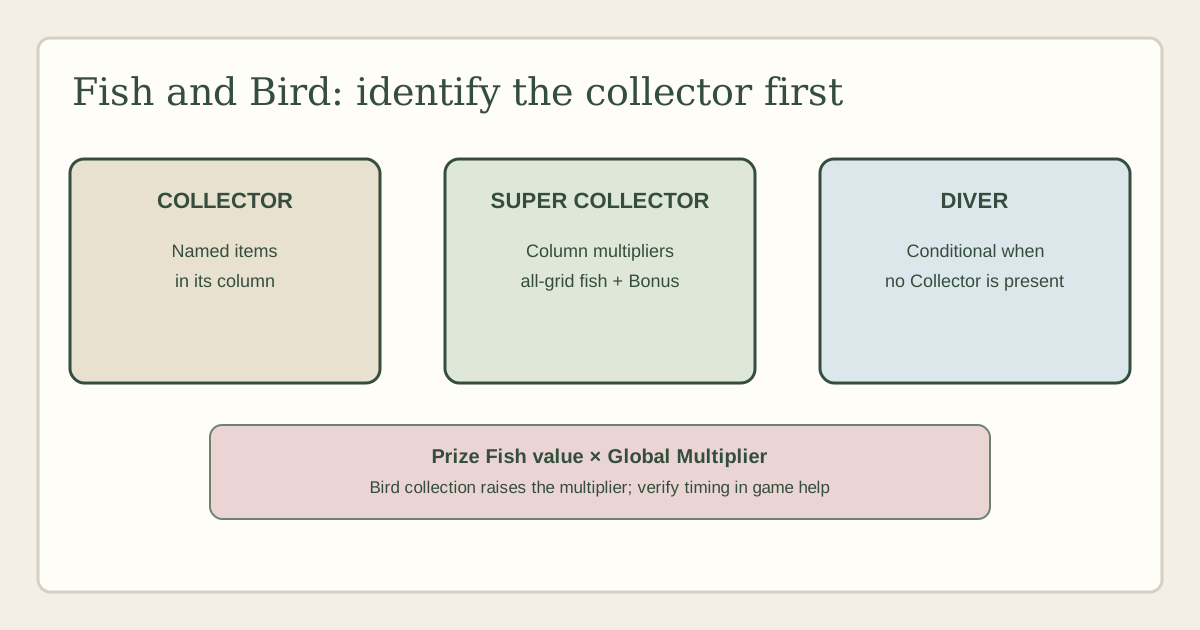
Fish and Bird is a four-reel, four-row ELK Studios slot centred on collectors, Prize Fish, birds and spreading Wilds. ELK distinguishes a Collector that gathers items in its column, a Super Collector that can gather same-column multipliers and all fish and Bonus symbols on the grid, and a Diver that can appear when a Prize Fish or Bonus is present without a Collector. Those named mechanics explain the feature map, but the active operator help is needed to verify every value and setting.
The short answer
Fish and Bird is an ELK Studios game built around a compact four-reel, four-row layout, collection symbols and multiplier effects. ELK’s public product page describes a Collector, a Super Collector, a Diver, Prize Fish, Bonus symbols, spreading Wilds and Bonus or Super Bonus modes. The key to reading it is to separate who collects, which objects are in range, and how a value is settled.
The Collector gathers multipliers, Prize Fish and Bonus symbols in the same column. The Super Collector is described as collecting multipliers in its column and all fish and Bonus symbols across the grid. The Diver can appear when a Prize Fish or Bonus is visible but no Collector is present; it collects the relevant item in the same column. ELK also says Prize Fish pay their value multiplied by the Global Multiplier, while collected birds raise that multiplier. Wilds can spread horizontally or vertically.
Those rules make the collector types materially different. A Collector’s reach is column-based; a Super Collector can affect all fish and Bonus symbols on the grid; and a Diver has a conditional appearance route. The current client’s help should be read for the exact trigger, order, values, persistence and payout formula. The public supplier page is a feature summary, not a complete paytable for every operator build.
No current operator game-help screen was available for this review. This page therefore does not assert a numeric RTP or RTP variant, volatility, hit frequency, stake range, win cap, X-iter cost, demo access or New Zealand availability. ELK’s catalogue establishes the supplier listing only. A named operator’s lobby and terms are needed to confirm that a particular account can play a particular configuration.
Confirm the exact title and build
Open the game’s information panel and confirm that it identifies Fish and Bird and ELK Studios. Then compare the feature names with ELK’s Fish and Bird product page and the official ELK catalogue. The fishing theme and animal symbols are not enough to identify a software build: another slot can use similar art while following different rules.
For a useful record, note the operator, account region, displayed currency, game mode, title, provider, date, and any version or help-panel date. If the operator gives a regional rule notice, include that too. A supplier can publish one set of product features while the operator selects an available configuration, sets limits or restricts access according to jurisdiction.
Keep separate the fact that a supplier lists a game, the fact that an operator lists it, and the fact that a person can access it from a particular country. The first can be checked at ELK’s catalogue. The other two depend on the operator’s current lobby, account eligibility and terms. This guide does not identify a New Zealand operator listing and does not claim local availability.
If the lobby shortens the title, use the in-game panel and several mechanics to confirm the match. A four-by-four board plus the named Collector, Super Collector and Diver sequence is more informative than a fish icon. If the panel is inaccessible or the rules do not match, do not apply these notes to that title.
The four-by-four layout
ELK describes a board with four reels and four rows. The smaller grid makes the collector’s position important: a symbol in one column may interact with other items in that column, while a Super Collector’s reach can extend to all fish and Bonus symbols across the grid. The exact row evaluation, paying combinations and ordinary symbol values still come from the active paytable.
Before playing, confirm how ordinary wins form. Check whether matching symbols pay by a line, a cluster, adjacent positions or another rule. The supplier page gives the broad feature list but does not publish the full symbol table in its product summary. Do not infer that a four-reel format uses the same win direction, count or symbol values as another ELK game.
Pay attention to where a Collector lands relative to multipliers, fish and Bonus symbols. The supplier says it collects the named items in the same column. “Same column” is a positional rule, not a statement that everything across the grid is collected. A Super Collector is different because ELK says it can gather all fish and Bonus symbols on the grid, while its multiplier collection is tied to its column. Preserve that distinction when describing a round.
If a collector animation moves across the board, check whether the game first identifies qualifying items, then adds them, then settles values. A collector object is not itself proof of a payout. It may gather a multiplier, a fish value or a Bonus symbol, and each can have a different role. Use the information panel to decide which items are counted and what happens when several are visible.
Collector, Super Collector and Diver
The three collection characters should not be treated as interchangeable. A normal Collector gathers multipliers, Prize Fish and Bonus symbols in its own column. A Super Collector gathers multipliers in its column, plus all fish and Bonus symbols across the whole grid. A Diver is a conditional substitute path: ELK says it can appear when a Prize Fish or Bonus symbol is present but no Collector is on the grid, and it gathers the relevant item in the same column.
This rule can be turned into a simple reading order. First ask whether a Collector is visible. If so, identify its column and the eligible objects there. If no Collector is present, check whether a Prize Fish or Bonus symbol is visible; that is the condition ELK lists for a Diver to appear. If the collector is a Super Collector, read the all-grid reach for fish and Bonus symbols separately from the same-column multiplier rule.
Do not assume the Diver collects every object simply because it appears. ELK says it collects the relevant item in the same column. The current client’s help should explain whether the relevant item is the fish, a Bonus symbol or another specified object, and whether one Diver can collect more than one. If the game presents multiple possible items, observe which one the help identifies as eligible.
The order of events matters when a Collector and several objects appear. A multiplier collected first may affect a later value under one rule, but it may be stored for a future settlement under another. The public summary does not state every timing edge case. Check whether the game history shows a collection total, a multiplier change and a cash award as separate steps. Avoid merging them into a single “collector win” if the interface treats them separately.
A Super Collector’s larger reach does not mean every symbol on the grid is collected. The supplier specifically names multipliers in its column and all fish and Bonus symbols on the board. That is narrower than “collects everything”. Regular paying symbols, Wilds or other objects should not be included unless the current help explicitly expands the list.
Prize Fish, birds and the Global Multiplier
ELK says a Prize Fish pays its displayed value multiplied by the Global Multiplier. That is a two-part calculation: the fish provides a value and the multiplier modifies that value according to the game’s stated rule. Before quoting an amount, check the unit, the displayed multiplier, and whether the game’s help gives a worked example. A picture of a fish with a number is not a verified cash payout unless the client identifies the currency and formula.
The supplier also says that collecting birds raises the Global Multiplier. A bird collection and a Prize Fish payout are therefore linked through the multiplier but are not the same action. One may change the factor used by a later value; the other supplies a value to be multiplied. Check when the factor changes, whether the increase applies immediately or on a later collection, and when the multiplier resets.
If multiple birds are visible, do not assume each one changes the multiplier by the same amount or that the factor increases without limit. The product summary does not establish the increment, maximum or persistence. Those details should be read from the active game help. If the help shows a step or cap, preserve the exact label and the version checked.
The Global Multiplier can make a feature display more exciting, but a multiplier does not create a payout on its own. A qualifying value or win must still occur and the applicable rule must settle it. Similarly, a fish’s value multiplied by a factor is not a guaranteed amount if the value, currency, feature state or cap has not been verified.
For a clear example, suppose the game help itself displays a Prize Fish value and a Global Multiplier. Record both values exactly as shown, apply the formula only if the rules state it, and compare the computed result with the credit shown in the client. Do not insert made-up sample amounts or extrapolate from a third-party image. If an example is hypothetical, label it as arithmetic only and not as a game configuration.
Spreading Wilds and symbol interactions
ELK describes Wilds that can spread vertically or horizontally. Direction is part of the feature rule: a vertical spread affects positions along a column, while a horizontal spread affects positions across a row. The client’s paytable should say when the spread happens, which cells are eligible, and whether the Wild substitutes for every ordinary paying symbol or excludes particular feature symbols.
Observe a spread as a state change before assigning it a monetary outcome. A new Wild may complete a paying combination, connect to an existing group or fail to create a qualifying result under the game’s evaluation rules. The number of transformed cells alone does not tell the player what has been paid. Check the final win display and, if available, the round history.
Wilds can also interact with collectors, but the public product summary does not fully document every possible combination. Do not say a collector spreads a Wild, or that a Wild can substitute for a Collector, unless the active help states it. The name “Wild” has a conventional meaning in slots but individual games can impose exclusions or feature-specific conditions.
When comparing Wild behaviour with another game, specify the dimension: direction of spread, timing, substitution eligibility, persistence, or payout calculation. A broad claim such as “Fish and Bird has expanding Wilds” can blur a fixed spread rule with a growing symbol. The verified supplier wording here is that Wilds spread horizontally or vertically; more detailed language needs the loaded client’s rule text.
Bonus and Super Bonus
The supplier page identifies Bonus and Super Bonus modes. It says the Bonus symbol triggers the Bonus, while the Super Bonus symbol triggers a Super Bonus with only Super Collectors. ELK also says Bonus symbols can substitute for paying symbols. That substitution rule is noteworthy because a feature trigger symbol may have a second role in ordinary symbol evaluation.
Read the paytable for the exact trigger count and whether the bonus starts immediately or after a round settles. The supplier summary names the symbol and mode but does not publish every trigger threshold, number of spins, retrigger rule or end condition for each operator configuration. If the help provides a specific count, state it with the game version and date; otherwise mark the count as unverified.
The Super Bonus description says only Super Collectors appear in that mode. Do not turn that phrase into a promise that the mode includes a particular number of collectors or that it pays more than the ordinary Bonus. It identifies an object type; the game help is needed for the start state, duration and settlement. A feature title is not a measure of expected value.
Keep track of bonus state separately from the base game. Note which multiplier is carried, whether the bird collection changes during the mode, which collector type is present and what happens to uncollected symbols. Find the reset point after the bonus. The public supplier page does not specify all persistence rules, so the current help panel should be consulted before claiming that a value carries over.
Bonus symbols serving as substitutes also need context. Check whether they substitute for all paying symbols, only certain ones, or only outside a bonus trigger. If they can contribute to a normal combination and also help start a feature, the help may explain priority or settlement order. Do not assume the same symbol can count twice in one outcome unless the rules say so.
RTP, volatility, hit rate, stake and cap
No current operator help panel was provided for this assignment, so Fish and Bird’s numeric RTP and RTP variants are not verified here. Find the value in the loaded game’s information or paytable screen, and note whether it applies to the base game, Bonus, Super Bonus or an optional mode. If several values appear, retain each exact label and identify which setting the operator has enabled.
Volatility and hit rate need the same source discipline. If the current help panel publishes a volatility classification, quote that label and explain that it describes the distribution of outcomes rather than a prediction for a particular session. If no rating or hit-frequency value appears, do not import one from another page. A user review, affiliate list or search snippet may refer to a different version.
Confirm the stake minimum and maximum in the currency shown to the account. The total stake can be more than one chip if the interface allows multiple positions. A saved layout or a feature purchase may change exposure; add those costs before deciding whether the game fits a pre-set entertainment budget. Do not copy a converted amount without a rate and date.
For a win cap, identify the denominator and the scope. Is it a multiple of total stake, a fixed currency amount, or a cap limited to a named feature? Does it apply to one round or a combined sequence? The supplier summary reviewed here does not provide a verified cap for a current operator build. If an operator help screen publishes one, keep the exact wording and mode.
RTP is a theoretical figure over a very large number of game outcomes. It is not a refund rate on one deposit and does not predict what a session will return. Volatility does not tell a player when the next Bonus will trigger. A high multiplier display, a collected Prize Fish or a near-trigger state does not change those limits.
Mobile use, demo and New Zealand access
The supplier’s feature page does not confirm mobile support for every operator build. If an eligible operator lists Fish and Bird, check the actual game client on the device in use. Make sure the four-by-four grid, collector columns, fish values, multiplier display and help button remain legible. Confirm that the stake and account balance are visible before each round and that a feature animation does not cover the important status text.
The compact grid may fit a phone screen, but that does not prove the collection path is easy to follow. Check whether the client makes the collector’s column clear, whether the Super Collector’s wider reach is explained, and whether a horizontal or vertical Wild spread can be distinguished. If text is too small or a rule is hidden, stop and open the full help rather than trying to infer mechanics from motion.
This page did not open a demo. Demo access can depend on the operator, country, age gate and account status, and its configuration may not match the cash game. If a lawful practice mode is made available, use it to locate controls and understand the sequence. Do not use a short run of demo spins as evidence of RTP, feature frequency or expected return.
No New Zealand operator listing was verified. ELK’s catalogue establishes that the supplier documents a game; it does not establish that any casino currently offers Fish and Bird to an account located in New Zealand. Check the current operator’s lobby and regional eligibility terms. Do not rely on an old article or a foreign casino screenshot to establish local access.
If a game session is interrupted, check the operator’s terms for round recovery, dispute handling and history. Use any round reference shown in the client and keep the date and mode details. A connection problem should be handled through the operator’s support process; a paused animation is not by itself proof of an altered outcome.
How to evaluate the feature map
Fish and Bird is easiest to understand when divided into four questions. First, what symbol or group creates an ordinary win? Second, which collector appears and what objects can it reach? Third, does the Global Multiplier change, and when? Fourth, has a Bonus or Super Bonus state begun? Reading those in order prevents one animation from being mistaken for several unrelated payouts.
For a Collector event, mark the column and list the eligible multipliers, fish and Bonus symbols. For a Super Collector, note the same-column multipliers separately from fish and Bonus symbols anywhere on the grid. For a Diver, check the no-Collector condition and the eligible same-column item. This small map makes the rule differences visible even if the screen animates quickly.
Then follow values. A Prize Fish has a displayed value; a bird collection raises the Global Multiplier; the relevant rule says how the factor applies. Record which event changes the factor and which event creates the value. If the client’s history shows a credit after both, compare the displayed formula with the actual settlement. Without that help, do not make a numerical claim.
An informative review should also state uncertainty plainly. “The supplier says the Diver may appear in this condition” is a documented feature statement. “The feature triggers frequently” is a probability claim and needs evidence. “This build uses a particular RTP” is a configuration claim and requires the loaded operator help. Keep those categories separate.
A practical verification checklist
Before relying on a Fish and Bird review, confirm each item in the same operator build:
- The game panel identifies Fish and Bird and ELK Studios.
- The board layout and ordinary win-evaluation rules are clear.
- The Collector’s same-column reach matches the active help.
- The Super Collector rule distinguishes same-column multipliers from all-grid fish and Bonus symbols.
- The Diver’s appearance condition and same-column collection rule are explicit.
- The Prize Fish value and Global Multiplier formula are shown in the paytable.
- The bird collection’s multiplier change, timing, persistence and reset are documented.
- Wild spread direction, trigger, substitutions and persistence match the loaded version.
- Bonus and Super Bonus trigger counts, duration, retriggers and reset point are verified.
- RTP, volatility, hit rate, stake range and win cap are quoted only if the current help displays them.
- The operator’s terms confirm access in the relevant account region; any demo or mobile support was checked on that client.
Write down the date and source next to every value. If the information panel does not show one, mark it as not confirmed. This prevents a supplier page from being overstated as a market-specific configuration and makes future updates simple.
Frequently asked questions
What does the Collector collect?
ELK says the Collector gathers multipliers, Prize Fish and Bonus symbols in its own column. The current client help should define exact timing and whether multiple objects can be gathered in one event.
How is a Super Collector different?
ELK describes the Super Collector as collecting multipliers in its column and all fish and Bonus symbols on the grid. That is a broader reach for those named symbols, not a rule that it collects everything.
When can the Diver appear?
The supplier says the Diver can appear when a Prize Fish or Bonus symbol is visible but no Collector is present. It collects the relevant item in the same column. Check the active help for exact eligibility and resolution order.
How do Prize Fish values use the multiplier?
ELK says a Prize Fish pays its value multiplied by the Global Multiplier. The live game’s help should show the formula, currency and when bird collection changes that multiplier.
What are Fish and Bird’s RTP and volatility?
No current operator help panel was available for this assignment. Numeric RTP, RTP variant and volatility remain unverified until they are checked in the loaded game’s information screen.
Is Fish and Bird available in New Zealand or on mobile?
This review does not confirm a New Zealand listing or test an operator’s mobile client. Check the operator’s current regional lobby and terms for the account in question.
Does a Super Bonus guarantee a larger payout?
No. The label describes a feature mode. It does not guarantee a particular outcome or a positive return; the active rules and game result determine settlement.
Sources and verification boundary
Primary sources reviewed 6 October 2026: ELK Studios’ Fish and Bird page for the four-by-four layout, Collector, Super Collector, Diver, fish, multiplier, Wild and bonus descriptions; ELK Studios’ official catalogue for the product listing; and New Zealand DIA advertiser guidance for the current advertising transition. The supplier page supports the qualitative mechanic descriptions above.
The current operator game-help panel and a New Zealand operator listing were not available for verification. Numeric RTP, variants, volatility, hit frequency, stake range, maximum win, optional-mode price, demo and mobile availability are not asserted. No demo or CPA route was opened. Recheck current operator rules before any public update.
