ELK Studios slot rules · South Island guide
Valhall Gold slot review: rules, Loki features and RTP checks
 Best casinos available in New ZealandUpdated 7 November 2026

Valhall Gold is an ELK Studios slot whose public rules describe a changing reel grid, several symbol effects and a Loki feature that can alter a winning sequence. The useful review question is how those mechanics interact: whether an effect is local or persistent, what is retained during a bonus, and which state ends at settlement. RTP variants, volatility, stake limits and the cap must be checked in the current operator help; a supplier overview does not prove a New Zealand casino’s installed settings.
The short answer
Valhall Gold is a feature-rich ELK Studios slot set around a Norse mythology theme. Its public game page describes an expanding reel arrangement, big symbols, sticky Wilds, symbol upgrades and a bonus with a Super Bonus route. The named Trickster Loki can activate one of several effects when a win occurs; ELK lists Multiplier, Both Ways, Spike Storm and Axe Fury. Understanding what each effect changes is more useful than treating the group as one generic bonus.
The provider page also identifies other features, including Thor, Odin’s Ravens and Spike symbols. The active game help should explain exact triggers, symbol interactions and persistence. It is also the source to check for RTP variant, volatility, wager range and maximum win. Third-party reviews may report values from a particular regional casino build; they do not establish what a New Zealand operator currently offers.
This guide maps the public feature descriptions to practical questions. It does not claim a locally available game, quote unverified game-help values, or recommend an optional feature-entry purchase. Before evaluating any round, identify the title and help version, learn the base evaluation direction, and note whether the animation changed the reel state or only applied a multiplier.
Start with the title and active help
Confirm that the game name shown in the lobby and the help panel is Valhall Gold. ELK’s public catalogue and a casino’s game client are different sources: the catalogue documents the supplier’s product, while the client tells you which rules, settings and controls the operator has loaded. A search result, preview clip or another casino’s paytable is not a substitute for the latter.
Open the help before interpreting the artwork. The theme has several named characters and feature frames, so it can be tempting to infer a rule from an animation. Instead, use the symbol legend, feature help and settlement example. Identify which symbols are ordinary payout symbols, which are Wilds, which trigger Loki, and which are blockers or modifiers. The help should explain how a win is evaluated and whether the grid can expand during a sequence.
Record the basic game state separately from an optional mode. If an X-iter menu appears, its choices may alter the starting feature state or the entry cost. That means its help should be read as a distinct mode description, not as a shortcut that proves how a regular spin works. Availability depends on the loaded product and the jurisdiction. No local availability or permission is confirmed by a supplier page.
When a value is uncertain, keep it in a “verify” note instead of filling it with a figure from an old review. This applies to the current RTP, the volatility label, the maximum return, stake limits, feature-trigger thresholds and the cost of any optional mode. A reliable guide can still explain how to locate and interpret those values without pretending they were checked in a game client that was not accessible.
The base board and changing reel state
ELK describes Valhall Gold as a reel slot with expanding rows and ways to win. That public description signals that the visible board can change shape after a qualifying event. It does not mean every round begins in the same state or that every additional position is an independent reward. The active help should say what begins a row expansion, how long it continues and how the resulting arrangements are evaluated.
Follow a normal round in stages. First, identify the starting grid and the order in which symbols are read. Then watch which symbols form a win and whether they are removed, retained or upgraded. Finally, note whether new symbols fall into the open positions and whether the grid expands before the next evaluation. This sequence determines how one initial arrangement can lead into a chain of later states.
An “expanding row” is a board-state change; a “ways” count is a summary of possible symbol paths under the game’s evaluation rule. They are related, but not interchangeable. A larger arrangement can create more potential paths without guaranteeing that any path pays. The paytable defines which symbols qualify, and the help defines whether the same symbol can participate in several combinations or whether a highest-combination rule applies.
The game may also contain large symbols. The provider’s overview says different sizes can appear, but the precise coverage rule belongs to the current help. Check whether a large symbol occupies one connected block, whether it can be partly cropped by the display, and how it contributes when a matching symbol lands beside it. Do not assume a big icon pays as a fixed multiplier unless the paytable says so.
Loki’s role in a winning sequence
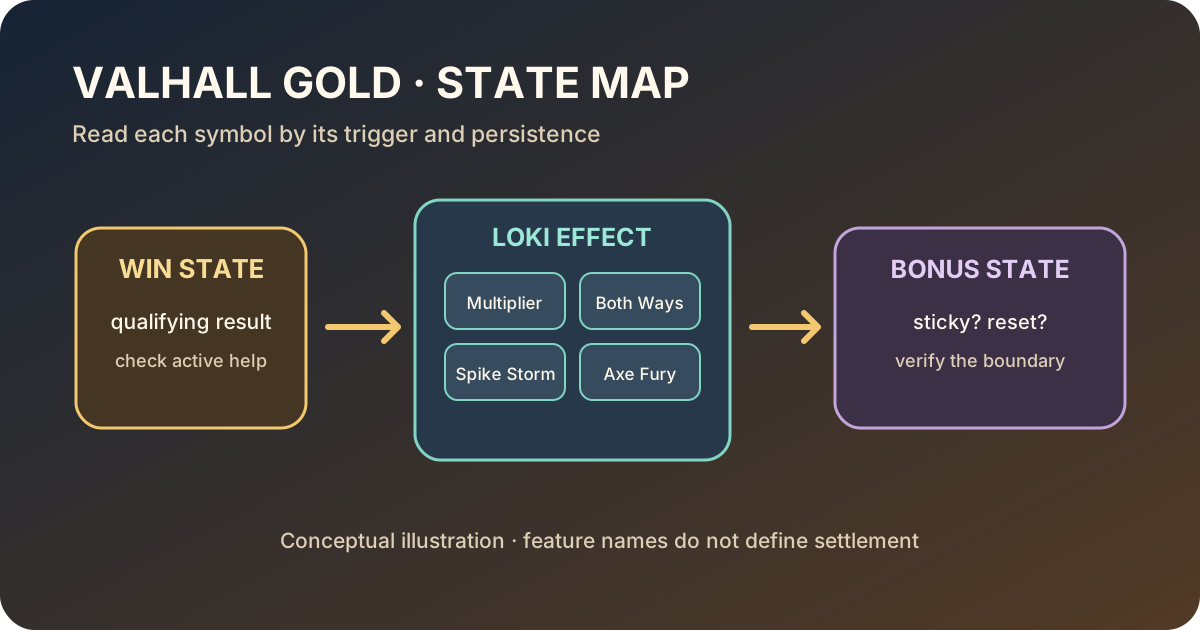
ELK’s page says a Loki symbol in view activates on a win and can trigger one of four named features: Multiplier, Both Ways, Spike Storm or Axe Fury. This makes Loki a conditional feature symbol. The appearance of Loki alone may not be enough; the public description ties activation to a win. The active help should identify what counts as a qualifying win and when the feature is selected.
Read each Loki effect as a different transformation. A Multiplier effect changes a value applied to a win under its stated scope. Both Ways may alter the direction in which the board is evaluated. Spike Storm and Axe Fury have their own symbol or board effects; the labels should be matched to the help’s exact explanation rather than assumed from theme art. If the help says an effect occurs at a particular stage, note whether it is before symbol removal, after a refill or at final settlement.
The supplier states that a later win with the same Loki feature can make that feature sticky for the remaining free drops and that Loki multipliers are additive. “Sticky” describes persistence within a stated mode, not necessarily permanence through every round. “Additive” distinguishes a sum of values from multiplying them together, but the active help must still show which wins those values affect and whether the rule applies outside the bonus.
Use a simple ledger to follow the feature: the current mode, the Loki effect displayed, whether a win qualified, whether the same effect returned, what became sticky, and when the state reset. This is especially helpful when an animation contains both a changing grid and a feature multiplier. It prevents a viewer from counting an effect twice or assigning it to a win that did not qualify.
Spike symbols and intersecting evaluations
The official page describes Spike frames around paying or Wild symbols. A Spike symbol that contributes to a win can replicate in the direction of its spike, and the supplier notes that intersecting combinations may create additional evaluations. This is not the same as a generic expansion. The orientation and participation of the symbol matter, and the game’s help should define how the replicated result is scored.
When a Spike effect appears, first identify the original symbol and the direction of its frame. Then check whether the symbol is part of a winning combination. If it is, observe the replication step and determine whether the new symbol is evaluated immediately or in the next drop. At an intersection, the screen may show more than one line or path. The help should state whether these are separate evaluations, overlapping ways or an illustrative animation.
Do not automatically add two displayed wins together without checking the settlement panel. A board can animate multiple paths while the payout rule groups them or applies a cap. Conversely, a symbol may generate several separately counted combinations if the feature rules allow it. The game’s displayed history and round total are the evidence for what was settled; a still screenshot of the grid is not enough to reconstruct the math model.
If the mobile interface makes the direction difficult to see, open the feature explanation in a larger layout or use an official replay if available. Avoid inferring the direction from colour or the character’s position. A useful mechanic diagram should show the actual directional condition, not merely a decorative burst around a symbol.
Thor, Odin’s Ravens and big symbols
ELK describes Almighty Thor as a Wild that remains sticky during a single drop. That wording defines a limited lifetime: the relevant drop sequence. It does not say that Thor remains for the entire feature or across separate spins. Check the help for the exact symbol footprint, what it substitutes for and whether its persistence ends immediately at settlement or after the current sequence completes.
Odin’s Ravens have a different condition. The official page says a qualifying group of Ravens can turn into Wilds. The number of symbols and any other conditions should be verified in the live help before quoting a threshold. When the conversion occurs, identify whether all Ravens change at once, whether they substitute for the same set of symbols, and whether the resulting Wilds can participate in a later cascade.
Big symbols occupy more than a standard position and may change the available paths. The public product page names Super, Mega and Epic sizes. For a player-facing review, the important questions are how these sizes are displayed, whether the symbol is one object spanning positions, and how the paytable credits a win involving it. If the board expands upward, note whether a big symbol triggers or merely uses the expanded space.
Keep the roles separate: Thor is a Wild with a defined persistence window; Ravens are conversion symbols; Big Symbols change the shape of a symbol on the board; and Spike frames modify a win path. When several appear in one animation, describe the resolution order from the help rather than describing the whole screen as “a big Wild feature.”
Bonus and Super Bonus progression
The provider describes a bonus game started by Bonus symbols and a Super Bonus route. Loki can affect a win during the bonus, and a repeated Loki effect may be retained for the remaining free drops. These concepts suggest a progression system, but the exact trigger threshold, number of awarded drops, re-trigger rule and safety levels must come from the active game help.
The ordinary bonus and Super Bonus should be compared by their initial state and persistence rules. Which symbols can be present at entry? Does the Super Bonus guarantee a feature state, or does it merely improve the chance of one? Does it start with a stored effect? Does a re-trigger add more free drops, alter the grid or reset a feature? The help should answer each question separately. A marketing phrase such as “Super Bonus” is not an explanation of the math or expected result.
During a bonus, pay attention to which state is retained between drops. A sticky Loki effect may remain while a Thor Wild only persists for a drop. A grid expansion may remain for the bonus, or it may reset when the next free drop begins. The player-facing screen should indicate these states; the symbols themselves do not always make the time boundary obvious.
If the feature ends, review the final settlement panel and then compare it with the base wager. An accumulated feature total may be expressed differently from the original stake, and a bonus entry may have its own cost if purchased. Keep the stake basis and gross-return wording visible. This avoids confusing “times stake,” total return and profit-only figures.
X-iter and mode-specific disclosures
ELK presents X-iter as a menu of predefined modes for entering action. A mode may increase the chance of reaching a bonus, begin from a prepared state, or start a Super Bonus. These are optional product mechanics where permitted. They do not make a future win certain, and they should not be described as a strategy for beating the game.
If an X-iter control is visible, read the cost, the feature being selected, any guaranteed starting element, and the mode-specific help. Compare the resulting game state to the ordinary base game. If the interface does not show an RTP or terms for a selected mode, do not assume it shares the base game’s figure. A distinct entry path can use a different mathematical configuration.
Jurisdiction is part of the rule. The same product may expose different mode options or hide them entirely depending on operator and local requirements. A review video filmed at a foreign casino is evidence that a control existed in that version at that time, not evidence that it should appear in a New Zealand screen today. Use the operator help currently visible to the user.
For reader safety, keep optional modes separate from the feature description. Someone who wants to understand the base game should not have to buy or trigger a mode to learn the rules. The rules should be understandable from help, and the expected cost should be clear before any optional selection is made.
RTP, volatility and maximum win
RTP estimates a theoretical long-run return for a specific math model. It is not an amount owed to a player, a session target, or a forecast for a short run. The current value can vary by configuration or jurisdiction, so a figure reported by a comparison site is not automatically the value in the selected operator’s client.
Volatility describes how results vary around the game’s underlying return. It cannot tell you that a feature is due or that a session will recover losses. If Valhall Gold’s help assigns a label, report it as the client’s displayed classification and distinguish that from a numerical hit rate. A volatility category should not be translated into a personal bankroll recommendation.
The maximum-win rule is independent. The help should state the cap and whether it applies to a round, a feature, or a particular mode. It should also say whether a cap includes the initial stake and what happens if a calculated result exceeds it. The provider’s public marketing page contains potential-win language, but the exact active cap remains unverified without the current client help.
To verify the configuration, open game information, find the return and math details, and note any variant marker. Then compare ordinary play with optional modes. If there are multiple return values, record which modes they describe. Do not cite a monthly casino payout report as RTP: actual observed payouts over a limited period are not the same thing as a theoretical return setting.
Mobile and accessibility checks
ELK recommends a desktop display ratio on its public page. That recommendation is not a guarantee that every phone will render the game comfortably or that a mobile version is supported by a particular operator. Check the actual client for readable symbols, working help controls, stake visibility and a settlement summary that does not disappear behind the feature animation.
On a smaller screen, a changing grid can make it harder to compare a symbol’s old and new position. If a replay or round-history panel exists, use it to inspect the sequence. Confirm that the accessibility controls, if any, remain available after a bonus begins. If the game announces results through audio only or colour only, consult the operator’s accessibility documentation and support rather than assuming the visual page is sufficient.
Before a round, locate the help icon, stake field, mode menu, sound control and exit or pause option. Determine whether autoplay or turbo features exist only if they are part of the active client; do not promise they are available. A proper review should explain how to stop and find help, not simply describe a feature animation.
No local game access, demo availability or New Zealand operator listing was verified for this article. The official ELK page can show that the supplier documents a product. It does not prove that a New Zealand user can launch it at any operator.
A compact review checklist
Use these questions to test a Valhall Gold explanation:
- Does it distinguish Loki’s four effects rather than combine them into one feature?
- Does it state when a qualifying win is needed to activate Loki?
- Does it say which state becomes sticky and exactly for how long?
- Does it distinguish a Spike replication from an ordinary Big Symbol?
- Does it describe Thor’s persistence boundary separately from bonus persistence?
- Does it identify the Raven conversion condition from the active help?
- Does it separate the base game from bonus and Super Bonus?
- Are exact RTP, volatility, maximum win, limits and mode costs taken from the current help?
- Does it avoid claiming New Zealand access without operator evidence?
If two sources disagree, write down what each actually supports. The supplier page is useful for official feature names. An operator’s client help controls the loaded table. A third-party review can surface a question or show how one implementation behaves, but it should not override the current game rules.
Frequently asked questions
What does Loki do in Valhall Gold?
The ELK page says a Loki symbol can activate one of four feature types when a win occurs. The exact trigger and effect scope should be checked in the operator help.
Is the Loki multiplier sticky?
The supplier says a repeat of the same Loki feature can become sticky for the remaining Free Drops. That wording is limited to a stated feature phase; the active help defines the exact boundary.
Do Odin’s Ravens always turn into Wilds?
No. The supplier describes a condition for conversion. Verify the required combination and what happens after conversion in the current help.
What is Valhall Gold’s current RTP in New Zealand?
This review does not verify a New Zealand operator configuration. Check the RTP line in the active game help and note which mode it applies to.
Does the official catalogue prove the game is available locally?
No. A supplier catalogue proves that the supplier documents a product, not that a specific operator has it enabled for a particular territory.
What should I check before using an X-iter mode?
Read its cost, starting state, mode-specific rules and any separate return disclosure. Availability depends on the product build and jurisdiction.
Sources and scope
- Official ELK page checked 7 October 2026: Valhall Gold. Used for public feature names and descriptions; not a substitute for operator help.
- Official ELK catalogue checked 7 October 2026: Games.
- Competitor sample checked 7 October 2026: FruitySlots Valhall Gold review and SlotGods Valhall Gold review. Their numerical claims are treated as snapshots, not proof of a current New Zealand setting.
- Internal navigation: ELK Studios catalogue and selected game guides.
- New Zealand advertising context: Department of Internal Affairs guidance, checked 7 October 2026.
