ELK Studios slot rules · South Island guide
J-POP slot review: rules, features and RTP settings to verify
 Best casinos available in New ZealandUpdated 7 November 2026

J-POP is an ELK Studios slot built around an expanding grid, large symbols, several kinds of Wild, and separate bonus modes. The useful way to assess it is to follow how each feature changes the board, how a Wild’s effect ends, and what the operator’s help says about RTP, volatility and the active version. ELK’s public page documents the feature names, but it does not replace the rule sheet in a specific New Zealand operator client.
The short answer
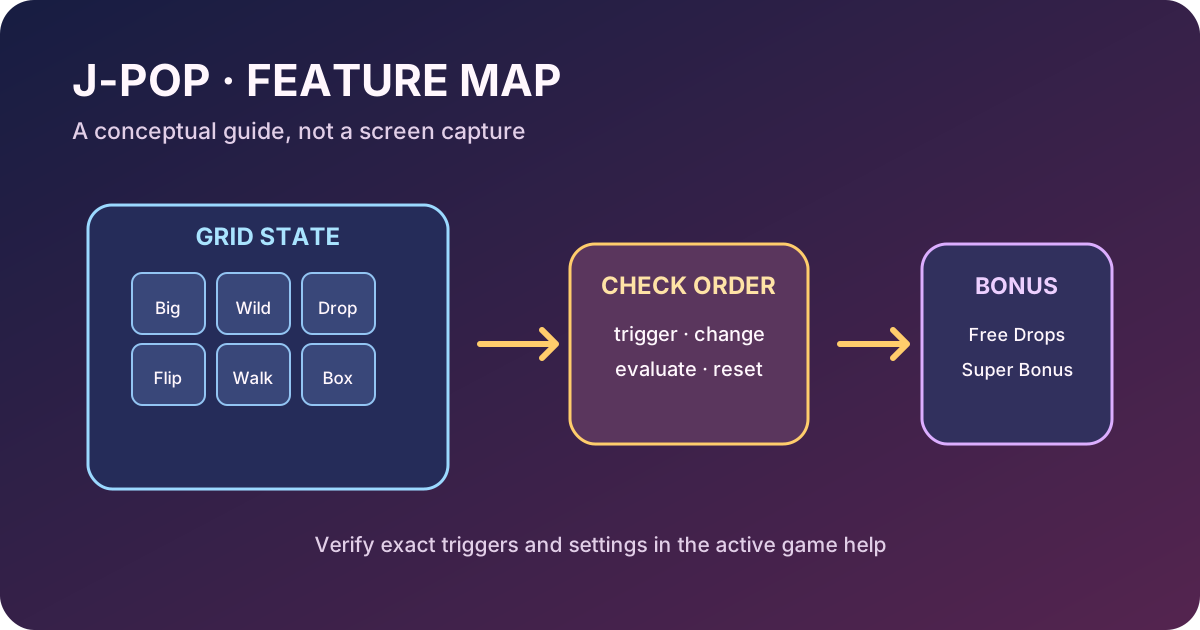
J-POP is a feature-led slot from ELK Studios. Its official description presents a grid that can change shape, Big Symbols, Grid Flip, Big Drop, Walking Wild, Wild Box, and a Bonus Game with a Super Bonus route. Those elements affect different parts of the round: some reshape the board, some substitute for ordinary symbols, and some alter the bonus state. The rules are easier to follow when each effect is checked separately instead of treating every animation as a generic Wild.
The public ELK page identifies the title as live and describes its features, but the operator’s current game help is needed for exact RTP variant, volatility, maximum return, stake limits and the settings attached to a particular client. Search results and review sites publish figures that may describe a regional build or older snapshot. None verifies what a New Zealand operator currently offers. This guide therefore explains the mechanics to inspect and keeps unconfirmed settings explicit.
For a quick first read, check the base grid, how wins are evaluated, what can expand it, whether Grid Flip changes the evaluation direction, and what the game means by safety levels during its bonus. Then use the help screen to determine when each Wild is created and removed. A display that says “Walking Wild” does not by itself define movement, multiplier scope or whether the symbol persists across drops.
Identify the exact game and mode
Start with the full title shown in the game lobby and in the help panel. A title page can confirm which supplier owns the product, but it cannot confirm that a particular casino has installed the same version, region-specific math model, or controls. Record the game name as displayed, the help page’s rule version if one appears, and whether the screen is in a standard base mode or an optional feature mode.
J-POP’s official description places it in a music-themed setting and lists a family of grid and Wild features. For rule reading, the theme is secondary. The useful questions are operational: what counts as a win, which reels or rows can change, what triggers each feature, and how the game displays accumulated wins. If the paytable uses a compact icon instead of a written explanation, open the symbol legend and look for a feature diagram or animation replay.
The title’s user interface may present optional X-iter choices. The supplier describes these as predefined modes that change how a round begins, including modes that target a feature. Whether a given option appears depends on the product build and local rules. A button on a supplier page or a review video is not evidence that the option appears at a New Zealand operator. Read the live help for price basis, mode-specific return and availability before considering it. This guide does not recommend buying features.
The difference between a standard round and an X-iter mode is not merely visual. A mode may have its own entry cost and altered starting state, so the underlying wager and expected-return disclosure can be distinct. If a screen offers multiple modes, compare their descriptions without assuming they are interchangeable or that an advertised feature entry represents the same random process as a standard spin.
How to read the grid and expanding rows
ELK describes J-POP as a reel slot whose rows can expand. That means the visible play area may not remain in one fixed shape throughout every sequence. The grid state matters because it determines where symbols can appear, which combinations are evaluated and how many positions are involved in a later drop. The current help should define the actual bounds and the condition that changes the grid.
Read the base game in this order: locate the reels and visible rows, learn what constitutes a winning combination, see whether winning symbols are removed, and then identify how new symbols enter the board. If the grid expands, ask whether the change happens before or after a win evaluation and whether it applies to every reel or only specific columns. The public summary describes expanding rows and a bonus safety-level progression, but the exact action order should be read from the current client.
A ways-based display can change when the grid changes. Do not interpret a larger number of visible positions as an independent extra prize. It changes the set of potential symbol arrangements; the paytable and game help still decide which combinations count and how each is settled. The same applies to a big symbol that covers more than one cell: learn whether the symbol contributes once, by covered position, or under another stated evaluation rule.
When reviewing a round, pause at each state transition. The first frame after a spin may show the original arrangement. A later frame may show removed symbols, an expanded row, or replacement symbols. These are different moments in the resolution sequence. A short replay can help map them, but it cannot establish the mathematical likelihood of a particular chain.
Big Symbols and Big Drop
Big Symbols change the board footprint of a symbol. ELK’s public description identifies them as part of J-POP’s feature set. To understand their effect, inspect whether they can be ordinary payout symbols, Wilds, or both; how their covered cells are treated during evaluation; and whether a symbol can be partially visible at the edge of a reel. These details should appear in the symbol help or illustrated examples.
Big Drop is a separate named event. The supplier says it introduces large symbols, removes small one-cell payout symbols and then becomes a Wild. That sequence contains three decisions: which symbols are removed, what symbols are added, and what state the feature symbol has after its action. It is useful to note the order because a Wild that appears after a board change may contribute to a subsequent evaluation rather than the one that triggered the feature.
Do not assume the term “Big Drop” means every large symbol is a guaranteed win. A large symbol can increase the number of positions it occupies, but it still has to satisfy the title’s evaluation conditions or act under the rule explicitly stated for that symbol. Likewise, “crushes” or “removes” is a feature description, not a promise that the replacement will form a new cluster or combination.
On mobile, the game may animate the feature quickly or zoom the grid to keep the interface readable. If the screen is too small to track which positions were replaced, use the history or replay control if the client provides one. Verify that the replay preserves the actual round sequence and not just a decorative animation. The help panel should remain reachable without losing the selected stake display.
Grid Flip and what “other direction” means
Grid Flip is the feature most likely to be misread from its name. ELK says it flips the entire grid horizontally and then becomes a Wild. A horizontal flip changes the visual orientation, but the player needs the help text to know exactly which side begins the evaluation after the flip, whether existing results are replayed, and how the feature icon is treated after the board transformation.
Consider three separate states: the first evaluation of the round, the subsequent evaluation after the flip, and the final symbol state once the feature converts. If the game evaluates a new sequence after flipping, wins from the first and second sequence may have distinct settlement steps. The help should clarify whether the same symbols can be included twice, whether the flip only occurs when the first sequence ends, and whether conversion happens before or after the second evaluation.
The correct interpretation is not “wins are paid from both ends” unless the rules say so. Some games evaluate from one side, some allow both directions, and a named flip feature may temporarily alter the board. A short visual description can omit these details. The safest method is to use the in-game example and follow one symbol path from the first arrangement through the state change to settlement.
If a third-party guide describes the feature as a guaranteed reverse-direction payout, compare that wording against the official game help. The supplier’s public page says the grid flips and becomes Wild; it does not publish every interaction in the text visible during this review. The official help should be preferred for the actual rule, while the third-party explanation can be treated as a question to verify.
Walking Wild and Wild Box
Walking Wild is a moving symbol with a win-linked effect. ELK’s page states that it can move to an adjacent symbol position and increase its multiplier when involved in a win. The operator help should specify what counts as adjacent, whether diagonal positions qualify, whether the symbol moves before or after replacement symbols fall, and what happens if its destination is occupied. Do not substitute a general slot convention for the title-specific rule.
Multiplier wording also needs a scope. The value may affect only combinations containing the Walking Wild, all wins in the current sequence, or some other subset. Read whether the multiplier resets after the spin, survives into another drop, or remains for a bonus stage. A symbol can move and have a multiplier without affecting every win on the screen. The feature diagram should connect the multiplier to the exact line, way or symbol combination to which it applies.
Wild Box has a different job. The supplier describes it as placing a random number of Wilds on the grid. It is a placement feature rather than a moving symbol. The help should explain where Wilds can appear, whether the box can land on occupied positions, and whether a box can trigger a further drop or settle the round. These details matter more than the visual animation of the box opening.
If multiple Wild features can appear in one round, read the order in which they resolve. A Grid Flip symbol could change orientation while a Walking Wild has a current position; a Big Drop could remove some symbols before it converts. A feature chain can therefore depend on state order. Avoid adding together every multiplier seen in the animation unless the rules explicitly say they are cumulative.
Bonus Game, Super Bonus and safety levels
The official page says Bonus symbols trigger the Bonus Game and that free drops can be retriggered. It also describes safety levels that allow the play area to progress, with the public summary referring to an upper grid state. Exact trigger thresholds, awards, and the maximum configuration should be verified in the active help; they should not be assumed from an old review.
The practical distinction is between entry, progress and retriggering. Entry determines when the bonus mode begins. Progress describes how the state changes as the feature continues. Retriggering means a new qualifying event extends or restarts something, but the rule should identify what is awarded and whether a cap exists. A Free Drop icon can mean a free action, a safety-level step or a bonus retrigger depending on the stage. Read its role in the help rather than giving every symbol the same meaning.
The Super Bonus is a distinct mode named in the official feature description. A reader should check how it differs from the ordinary bonus: its starting state, guaranteed symbols if any, possible entry routes, and how the game reports the mode’s return. If the interface offers a purchased entry, its cost, permissions and math disclosure need the same scrutiny as any other optional mode. The mode is not a promise of a better outcome.
The safety-level idea is useful because it communicates retained progress or a changed minimum board state. It does not imply that a bonus guarantees a win. Track what is saved between drops: rows, Wilds, multipliers, symbols, or a combination. Then track what resets between separate rounds. If the help does not identify the boundary, do not infer that a feature persists beyond its displayed phase.
RTP, variants, volatility and maximum win
RTP is a long-run theoretical statistic. It does not predict a short session, identify the outcome of the next spin, or tell you how often a particular J-POP feature will appear. A page title may promise “verified RTP settings,” but the figure belongs to the exact game version and math configuration displayed in the current operator’s help. The provider page available for this review describes features but does not expose a New Zealand operator’s live setting.
Volatility describes the distribution and variation of results in a broad way. It is not a guarantee about how often the game will win, how much a session will return, or whether a feature is due. If the operator help assigns a label or scale, record it as the operator’s displayed classification and do not translate it into a precise hit rate unless that rate is separately published.
The maximum-win cap is a separate rule from RTP and volatility. It may cap a round or feature at a stated multiple of the wager. Confirm the exact number, whether it includes the stake, and what happens if an unrounded calculation exceeds the cap. The ELK public page markets a top-level potential, but the cap cited for a locally played version should be confirmed in its own help before quoting it as current.
When checking variants, search for a small game-info panel, an RTP or “return” line, and mode-specific detail. If several percentages appear, note whether they refer to standard play, an optional feature buy or a jurisdiction. Do not assume the default setting from a casino review written elsewhere. If no live help is accessible, say the value is not verified rather than substituting a competitor’s figure.
Mobile, help and a practical inspection checklist
The supplier recommends a desktop aspect ratio on its public page, but that is not proof of mobile availability or compatibility at a specific New Zealand operator. Check the loaded client on the intended device, and confirm that the grid, stake control, help button and result summary all remain readable. A game can render in a browser while still having controls or text that are difficult to use on a small screen.
Before assessing a round, locate the stake control, spin control, autoplay or turbo setting if present, audio control and help menu. Availability of these controls depends on the operator and jurisdiction. Make sure that a selected stake is visible before starting, and that the result panel is distinguishable from the feature animation. If the screen scrolls horizontally, rotate or resize only if the game’s own instructions recommend it; do not mistake a cropped grid for a different rule.
An orderly review can use this checklist:
- Is the loaded title exactly J-POP, and does the help panel identify the relevant version?
- What symbol combinations are paid, and how do they form on the starting grid?
- Which symbol expands the grid, and when does the expansion happen?
- How do Big Drop and Grid Flip change the current sequence?
- What makes each Wild different, and what wins does its multiplier affect?
- How does the bonus start, what is retained, and what resets?
- What RTP, volatility label, cap and stake range appear in the current help?
- Does the client expose a practice mode, and is its availability actually local?
Write down answers rather than relying on a memory of a fast animation. If two public explanations disagree, preserve the conflict and give priority to the live help. If the help is missing or incomplete, that is a limitation in what can be verified; it is not a reason to guess.
Reading feature sequences without chasing them
The design of J-POP invites attention to a chain: a symbol appears, the grid changes, a Wild moves or a box opens, then another evaluation occurs. Describing that sequence is more helpful than calling every symbol “a bonus.” The reader should know what state each feature changes and what evidence in the help supports the description.
However, knowing the sequence does not let someone control a random outcome. A feature may be named and its trigger condition documented, but the next symbol arrangement is not made predictable by past rounds. A paytable tells you how a qualified outcome is resolved, not when it will happen. This distinction is important for any feature-heavy slot, especially one with optional entry modes that visually frame a feature as a selectable destination.
If the game includes a demo in a particular client, use it only to learn the buttons and observe the order of displayed features. A demo can use a different balance or simulated play and is not evidence of real-money availability or a particular operator RTP. The supplier’s “Play” link may be a separate service and may not work in New Zealand. No NZ availability or demo accessibility is confirmed here.
Frequently asked questions
What makes J-POP different from a basic reel slot?
Its supplier-described feature set includes an expanding grid, Big Symbols, Grid Flip, Big Drop, a moving Wild, Wild Box and bonus modes. The key distinction is how each changes the board or symbol state; the current help defines their precise order.
Can I treat the official headline as the RTP at every casino?
No. The exact RTP variant must be checked in the active operator help. A supplier overview and a third-party review do not prove which math configuration a particular operator has loaded.
Does Grid Flip pay in both directions?
The supplier describes a horizontal flip and a conversion to Wild, but the full evaluation order needs the in-game explanation. Do not infer a universal both-ways rule from the feature’s name.
What does a Walking Wild multiplier affect?
The scope should be shown in the help: it may be limited to particular winning combinations or a stated phase. Confirm when it moves, how it grows and when it resets.
Does a bonus guarantee a return?
No. A bonus changes the game state; it does not guarantee a win. Entry conditions, retriggers, safety progress and settlement all need to be read separately.
Is J-POP available to play in New Zealand?
This guide does not confirm that. A title being listed on a supplier site or found in another market does not establish local operator availability.
Sources and scope
- Official ELK page checked 7 October 2026: J-POP. Used for the public feature descriptions and current supplier page status; it does not verify an operator’s New Zealand settings.
- Official ELK catalogue checked 7 October 2026: Games.
- Competitor sample checked 7 October 2026: SlotJava J-POP review, Hideous Slots J-POP review and FruitySlots J-POP review. Their published RTP, volatility and mode figures are not treated as New Zealand operator settings.
- Internal navigation: ELK Studios catalogue and selected game guides.
- New Zealand advertising context: Department of Internal Affairs guidance, checked 7 October 2026.
