ELK Studios game guide · South Island guide
Giraffalot: rules, features and settings to check
 Best casinos available in New ZealandUpdated 7 November 2026

Giraffalot’s public feature summary describes several Wild behaviours and a SuperSpin effect that can remove low-value symbols. The useful review question is how each effect changes the grid and what triggers the next evaluation. Exact RTP, mode availability, payout rules and local access must come from the current operator help.
The short answer
Giraffalot is an ELK Studios slot whose public product page describes a Wild-led feature system. Spreading Wilds can convert a high-value symbol to Wilds, increase a multiplier on converted Wilds or create an Expanding Wild. The feature can retrigger during the same round and reactivate during respins. The supplier also describes a Wild-only winning combination and a SuperSpin that may remove low-value symbols before a spin or respin. Those statements explain the feature vocabulary, but the current operator game help is still required for exact rules and settings.
No active Giraffalot client or operator help panel was supplied for this assignment. This page does not publish RTP variants, volatility, stake limits, probabilities, a win cap, mode costs or a claimed bonus frequency. It also does not say that a New Zealand operator currently offers the game. Read the article as a mechanics and verification guide: use it to know what to inspect, then use the help in the exact build for any figures that may affect a decision.
Confirm the title and client version
Begin with the exact title and provider credit shown by the game. Compare those details with ELK’s Giraffalot product page and the official catalogue. A supplier listing establishes catalogue documentation. It does not identify a particular casino distribution, prove that all markets have the same version or show which optional features the operator has enabled.
Record the operator, the date inspected, the label used for the mode and any help revision or build identifier. Look for the information button before starting a round. If the menu distinguishes base play, bonus play and an optional X-iter feature, keep those entries separate in your notes. The same title can have a different presentation or configuration across operators, so an old review is a prompt for questions rather than a substitute for the current client.
The visual theme may feature animal characters and a fantasy setting, but artwork is not a rule. A giraffe, knight, castle or colour cue can help identify a symbol but cannot establish whether it is a Wild, a multiplier, a trigger or a decorative element. Use the exact symbol names and help text when describing the game.
Start with a grid-state reading method
For any Wild-heavy slot, explain the board as a sequence of states. First identify the ordinary symbols and the paytable condition. Then identify the Wild symbols and any attached state, such as expanded positions or a multiplier marker. Next note whether a feature changes the grid before or after a result is evaluated. Finally, check whether a respin follows and which symbols remain in place.
This method matters in Giraffalot because its feature descriptions use different verbs. “Convert” changes a symbol’s role. “Increase” modifies a multiplier. “Expand” changes the Wild’s footprint. “Remove” clears a class of symbols before a new spin or respin. If a review compresses all of these into “the Wilds grow”, the reader loses the distinction between what occupies a cell, what changes payout treatment and what happens next.
When a feature animation starts, use the client’s history if it is available. Compare the initial grid with the grid after the change. Note whether a symbol was replaced, whether a Wild covered a reel or part of one, and whether a new evaluation occurred. The animation can be fast; a short state log is more dependable than memory and does not require a claim about personal play.
Do not assume that two effects appearing in the same visual sequence are simultaneous. A Spreading Wild might transform a symbol and then an Expanding Wild might cover positions, or the game might apply them in another order. Only the exact help or a clearly itemised round history can confirm priority. If it is not shown, call the ordering unresolved.
Spreading Wilds: understand the three described outcomes
ELK’s public page says a Spreading Wild can do one of several things: convert a high-value symbol into Wilds, increase the multiplier on converted Wilds or create an Expanding Wild. This makes the feature more than a single symbol substitution. It has branches that can change a symbol, adjust a modifier or create a different Wild state. The help panel should define the conditions and tell the player how each branch is displayed.
When a high-value symbol is converted, check whether all eligible symbols of that type change or only selected positions. “Convert a high-value symbol to Wilds” can be visually compact wording; it does not necessarily tell you how target selection works. The active rules should also explain whether the original symbol’s payout value is replaced by the Wild rule and whether any multiplier remains attached.
The multiplier branch requires a separate explanation. Find out which Wilds are “converted Wilds”, what state they have before the increase and whether the multiplier applies to the current evaluation or a later one. Do not infer that a larger displayed multiplier affects every payout on the screen. A specific Wild may apply only to outcomes involving its covered position or to a feature result described in help.
The Expanding Wild branch should be treated as its own event. Check what triggers expansion, how much of the grid it covers and whether expansion initiates a respin. The supplier summary identifies the feature type but does not set out every condition, screen position or settlement rule. Keep the explanation at the public-summary level until the exact current help is available.
Expanding Wilds and respin timing
An Expanding Wild changes the amount of the grid occupied by a Wild. ELK’s public Giraffalot page associates Expanding Wilds with respins. The important reader question is not only “how large is it?” but “what is held constant while the next result is produced?” The rules should say whether other positions respin, whether the expanded symbol remains and what event ends the sequence.
If the interface shows a respin, inspect whether the game labels it as part of the current paid round. A respin does not necessarily use a new stake, but the exact stake accounting must be stated by the game. The history should make it possible to see whether the original wager generated the whole feature sequence or a separate action was confirmed. Avoid implying that a respin is free unless the help clearly establishes that treatment.
The timing of win evaluation matters. A Wild can appear before a result is checked, after a conversion or during a later respin. If it expands over positions that already formed a win, the rules should say whether the new state creates a second evaluation or only changes the next one. A guide should explain the order in plain language and should not treat animation speed as evidence.
Also check whether the Wild can be overlapped by another feature or whether its expansion is limited by the reel edge. The public page gives the name “Expanding Wild” but is not a complete client manual. Any exact footprint, exception or special position should be sourced from the loaded game help rather than an illustrative image from another site.
SuperSpin: a changed symbol pool, not a promise
ELK describes SuperSpin as an effect that may activate at the start of a spin or respin and remove low-value symbols for that event. This is useful because it identifies both a possible timing point and the type of symbols affected. It does not guarantee that the remaining symbols will form a qualifying combination, nor does it establish that SuperSpin appears on every eligible action.
The current help should clarify what “low-value” means in the paytable and whether the removal is complete or limited. Look for an explicit list, a visual legend or a mode-specific description. If a symbol is absent from one observed round, that observation alone does not show that it was removed by SuperSpin; it may simply not have landed. The feature indicator should establish when the effect actually occurred.
Check how SuperSpin interacts with Wilds, bonus symbols and any multiplier features. Are those symbols retained while low-value symbols are removed? Does the effect run before a Spreading Wild acts? Does it change the respin’s symbol pool or only the initial spin? These are meaningful distinctions for understanding the board. The supplier summary does not answer all of them.
An explanation should avoid phrases such as “clears the bad symbols” or “boosts your chances” unless the current rules define what is removed and quantify the comparison. “Low-value symbols may be removed” is a faithful description of the public summary. The resulting outcome remains random and should not be framed as a guaranteed improvement to a session.
Wild-only outcomes and the paytable
The official product summary mentions a winning combination made only from Wild symbols. That is a title-specific detail worth checking in the paytable. The help should define which Wild types count, whether their positions must meet the usual connection rule and how the game calculates the result. No payout amount is stated here because the active operator paytable was unavailable.
Do not assume the Wild-only condition applies to every Wild shape or every feature state. An Expanding Wild might cover several positions, while a Spreading Wild may have a multiplier or conversion state. The help needs to tell the reader whether those variants are treated identically for a Wild-only win. If a multiplier is displayed, find out whether it modifies the Wild-only outcome and which value the game uses.
The paytable should also establish the ordinary result rule. Is a win based on matching symbols across a specified path, a cluster or another arrangement? What does the Wild substitute for? Are there symbols it cannot replace? If the interface offers several rows of symbol values, check whether those values use the selected stake, a line stake or another basis before comparing them.
A result can look impressive without explaining its settlement. If the game history presents base win, multiplier and total separately, describe each label accurately. Do not add displayed figures together unless the rules say they are additive. Where no breakdown is provided, say so and avoid a reconstructed result.
Bonus features and the limits of the public summary
Competitor pages describe bonus modes and respin behaviour in more detail than the supplier’s short summary captured for this assignment. Those descriptions can be useful research leads, but they may reflect different operator builds or a review author’s demo. No exact current operator help was supplied, so this guide does not assert a trigger count, initial number of spins, retrigger rule, sticky-symbol duration or bonus-buy price.
If the client exposes a bonus section, read the trigger and settlement rules separately from the general Wild descriptions. Check what state carries into the bonus, whether Wilds or multipliers persist between events, what a retrigger adds and what ends the bonus. A phrase such as “super bonus” can have a specific label and configuration; do not import that phrase or behaviour from a similarly themed slot.
The bonus state should be compared with the base game by rule, not by colour or music. A feature may become more frequent, may retain a modifier or may use a different board; each claim needs the rules. If the operator help does not describe the transition, mark it unknown. A careful gap statement is more informative than a polished but unsupported walkthrough.
The article boundary remains one Giraffalot URL. The main page can answer rules, feature, settings and access questions together. There is no need to split the bonus into a separate page or create a second URL to target a narrower variation of the same search task.
RTP, volatility and other numerical settings
No current operator game-help screen was available for this package. The article therefore does not give an RTP value or variant, volatility label, stake limits, feature probability, hit frequency, payout cap or optional-mode cost. Aggregators and review sites may list numbers, but without a current build identifier and operator context they do not establish which settings apply to a New Zealand reader.
RTP describes a theoretical return over a very large number of rounds for one defined configuration. It does not forecast an individual session. Volatility is a broad description of how outcomes may be distributed, not a timetable for feature entry. A win cap is a ceiling rather than an expected result. If a game has alternative settings, the active one must be clearly separated from other available versions.
When the exact client is available, open the paytable or information panel and copy values with their labels, currency or stake units, mode and date. Verify whether the help lists alternatives or only an active setting. If a demo and casino client expose different information, do not choose whichever figure seems more favourable; report the discrepancy and ask the operator which configuration is served.
Search-volume and performance data were not supplied for this page. The assigned query and intent are preserved, but the article does not invent demand, popularity or ranking evidence. A fact-check record should be updated only when primary game-help material becomes available.
Optional X-iter modes
ELK’s broader game ecosystem uses X-iter for optional modes in some releases. A general supplier page or a third-party menu cannot establish which options are present in the Giraffalot client a reader can open. Check the exact menu, if one appears, and note each mode’s name, price basis, starting state and any warning or confirmation screen.
An option that changes feature likelihood differs from one that begins a bonus immediately. Both change the wager context, but not in the same way. The reader should compare the total cost, the state it starts from and the rules that apply after selection. Never describe a mode as an investment, a safe shortcut or a way to guarantee a positive return.
If a mode is not visible in the client, the honest status is “not available in the inspected build” or “not checked”, depending on what was actually observed. Do not assume that a region-wide prohibition, operator policy or account setting is responsible without evidence. A title-specific help panel remains the appropriate source.
This page does not recommend one mode or offer a buying strategy. It explains what information to verify. A reader can understand Giraffalot’s core Wild vocabulary without selecting an optional paid feature.
An inspection worksheet for one complete event
When an authorised client is available, use one event as a fact-checking exercise rather than a performance sample. Record the starting symbols and any feature indicator. If a SuperSpin appears, note whether the game labels it before the spin or respin. If a Spreading Wild acts, record whether it transforms, modifies a multiplier or creates an Expanding Wild. Then note any respin, retained positions and the final paytable evaluation.
The worksheet should distinguish observation from rule. “The symbol changed in this event” is an observation. “The symbol always changes when this Wild lands” is a rule claim and needs the help panel. “The result paid” is an observed settlement. “This feature usually pays” is a probability claim and cannot be inferred from one event. Keeping those categories separate prevents a personal session from becoming false evidence.
For each stage, capture four questions: what triggered it, what state changed, when the next evaluation occurred and where the total was settled. Include exact labels from the client. If a field is unclear, keep a question mark in the working notes and omit the conclusion from the public article until verified.
At the end, compare the client information with the operator lobby. The lobby can establish whether a title is presented in that account; the game help controls the rules displayed for that version. A review aggregator can point to a missing question, but it should not replace either source.
Demo access and what it can demonstrate
An official catalogue listing does not guarantee a free-play mode. If an operator or licensed demo host offers one, confirm what its credits represent and whether the help panel identifies the same game build as the operator’s live version. A demo can show interface labels and feature sequence, but it may have different settings or no configuration metadata.
Use a demo to learn the vocabulary: which Wild is spreading, what an expanding state looks like and where SuperSpin is signalled. Do not use a short sample to estimate the chance of a bonus or a likely return. Random outcomes vary, and a demonstration is not a statistical test. Avoid recording a demo session as personal experience unless it was genuinely opened and the limits are stated.
If the client includes an optional mode, leave it unselected while learning the base interface. An unusual display could come from that mode rather than the standard game. Read the price and state changes before any selection, and stop if the information is unclear. No demo or operator client was supplied for this review, so none is claimed to have been tested.
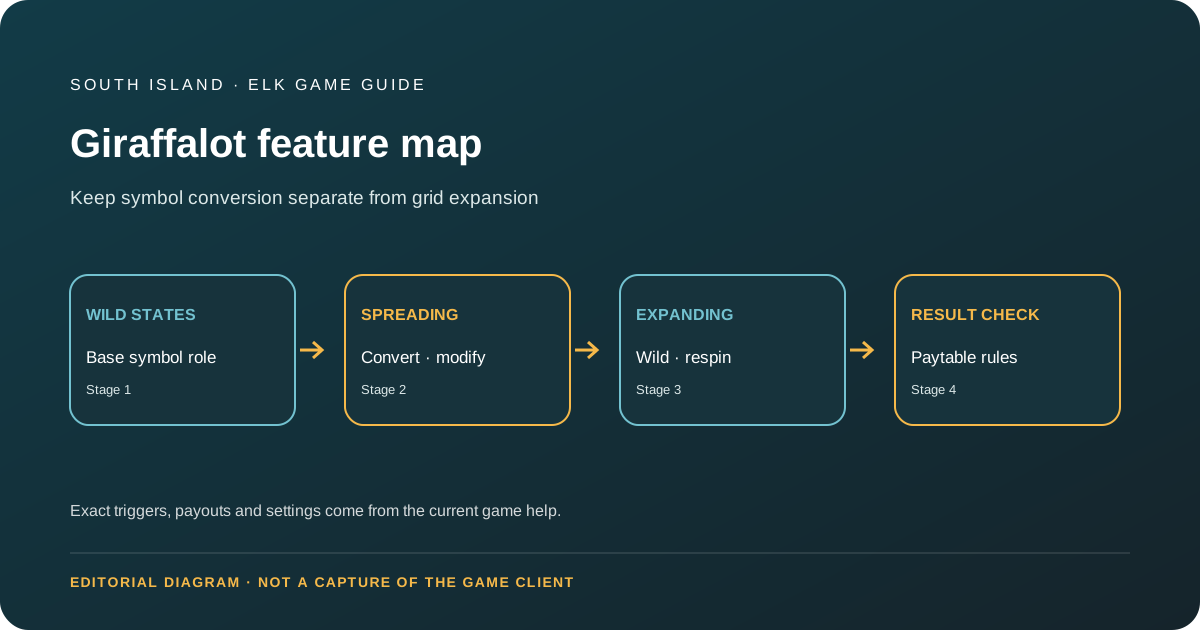
The page’s feature map is original artwork made for this guide. It is a conceptual diagram, not a screenshot, a game asset or evidence that a specific client displays the features in this order. That distinction prevents an editorial illustration from being mistaken for verified product footage.
Mobile presentation and accessibility
On a phone, check whether a Wild’s footprint and any multiplier marker remain readable when the game scales down. The key visual test is whether the board makes it clear which positions are covered by a Wild and which positions respin. A cut-off edge or hidden counter can make the event hard to follow. The page makes no claim about mobile performance because no exact operator client was available.
Check whether help content can be reached without closing the game, whether it scrolls independently and whether the player can return to the same round state. Buttons should be large enough to identify, not hidden behind the game canvas, and keyboard focus should remain visible when the interface supports keyboard use. If colour distinguishes a normal, converted or multiplied Wild, look for a text label or another cue as well.
Sound should not be the only signal for SuperSpin or a feature transition. A clear visual state and accessible help text make the rules easier to understand with audio disabled. If a feature is only explained in a fast animation, the paytable or history should provide a calmer way to review it.
These are checks for a future, lawful inspection, not results of a test. Keep that distinction visible in any revision. A page can tell readers what good mobile communication would look like without claiming that it passed a device test.
How competing reviews handle Giraffalot
The reviewed competitor sample includes feature-led reviews, demo pages and specification tables. Several pages are useful for seeing how reviewers distinguish spreading from expanding Wilds or explain a SuperSpin. Some also combine those mechanics with a single numerical configuration, a rating or a casino offer. Such details may apply to the reviewer’s own market or client, not a New Zealand operator build.
The gap this page addresses is the boundary between feature vocabulary and verified configuration. It explains how a reader can follow conversions, multiplier changes, expansions and respins, then identifies which timing and settlement questions still require current help. It does not claim a personal test, repeat a reviewer’s figure or copy a promotional verdict.
The official product page is the primary source for supplier-named features. If a competitor describes a specific trigger or mode not present in the supplier summary, that detail should be treated as a question to verify, not silently added as fact. If different reviews disagree, record their dates and operator context rather than averaging their values.
This does not make third-party reviews useless. They can surface a confusing term, show likely reader questions and help an editor build a checklist. Their role is discovery; the exact game help is where a current operator rule should be confirmed.
Availability and New Zealand publication context
The supplier catalogue does not prove local access. Availability depends on whether a particular operator lists the title and what its current terms say for a person’s account and location. No operator was named for this assignment, so Giraffalot’s New Zealand availability is unverified. Do not use a foreign demo, search snippet or casino comparison listing to make a local access claim.
The Department of Internal Affairs says New Zealand’s online-casino advertising prohibition is in effect. Its advertiser guidance says third parties are covered by the advertising and marketing rules and identifies affiliate marketing among the initial prohibited advertising decisions. This package therefore contains no CPA button pair and no alternate operator link. The existing /go/south/south-cashdesk-8a14.php route was not opened, followed or edited.
That publication hold is distinct from the factual game review. The game’s supplier-described features can be documented, while commercial referral placement remains blocked pending a competent compliance decision. Do not turn an informational feature guide into an indirect sales message or add an unverified operator name to compensate for the missing CPA link.
Deciding what to verify before reading further
If you are evaluating the game, first confirm the title and supplier, then find the paytable. Read the ordinary win condition before the feature panel. After that, check how the help distinguishes Spreading Wild, Expanding Wild and any multiplier state. Find the SuperSpin trigger and its effect on the next spin or respin. Finish by locating the active RTP, volatility and stake information.
If any of those values is missing, note the gap. A setting printed in a third-party database without an operator or mode label does not answer which configuration you would receive. If the help panel is not accessible until a game loads, do not assume that a product page or lobby card contains the complete rules. Ask the operator for current information if the question affects your decision.
Consider your limits independently of the feature design. A spreading effect can look like accumulating progress, but it does not store money or predict the next outcome. If gambling is lawful and you choose to take part, decide a time and spending limit in advance, avoid increasing it to chase a feature and stop if the activity is causing stress. The site’s New Zealand safer-gambling page lists support information.
Frequently asked questions
What is the main Giraffalot feature?
ELK’s public summary highlights Spreading Wilds, Expanding Wilds, respins, a Wild-only winning combination and SuperSpin. The exact triggers and settlement rules should be read in the current game help.
What can a Spreading Wild do?
The supplier says it can convert a high-value symbol to Wilds, increase a multiplier on converted Wilds or create an Expanding Wild. The operator help is needed to understand conditions and order.
Does SuperSpin guarantee a win?
No. The public description says it may remove low-value symbols at the start of a spin or respin. It does not establish a qualifying result or a payout.
What are the RTP and volatility settings?
They are not stated here because no current operator help panel was supplied. Check the exact client’s information screen and record the active mode and date.
Is Giraffalot available in New Zealand?
That has not been verified for a named operator. A studio listing or a review site’s casino list is not proof of local access.
Sources and verification boundary
- ELK Studios: Giraffalot — official public feature summary, checked 6 October 2026.
- ELK Studios: games catalogue — catalogue identity, checked 6 October 2026.
- Competitor sample and retrieval notes:
research/batch13/SOURCE-REVIEW.md, checked 6 October 2026. - New Zealand DIA guidance for advertisers, checked 6 October 2026.
No current operator game-help sheet, named NZ operator build or demo was available. Numerical settings, probabilities, feature-mode pricing and local availability remain unverified. Requested CPA buttons are withheld pending compliance review; the existing affiliate route was not opened or modified.
