ELK Studios game rules · South Island guide
In the Zone: rules, features and settings to verify
 Best casinos available in New ZealandUpdated 7 November 2026

In the Zone is ELK Studios’ classic-style slot with Bigways, nudging Wilds, linked reels, multipliers, respins and a free-spin bonus. Bigways changes reel heights and therefore the available connection patterns; linked spins coordinate reel symbols; nudging Wilds move through a reel with respins; and the bonus has a global multiplier that rises during its sequence. The current RTP variant, volatility, stake range and cap remain operator-build details that require the loaded game’s help.
The short answer
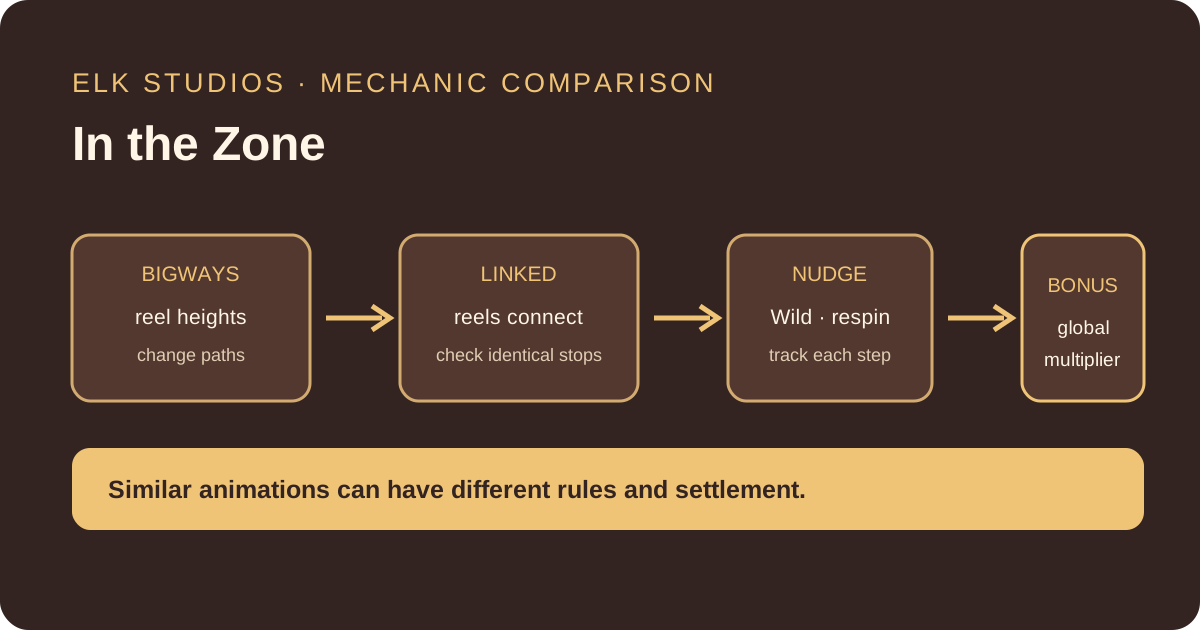
In the Zone is ELK Studios’ classic-style slot that combines a compact reel presentation with several ways to change the board. The official page names Bigways, nudging Wilds, linked reels, multipliers, respins and a bonus game. Bigways changes the height of the reels; the linked-spin feature can connect reels so they stop with matching symbols; a Wild can nudge down its reel and prompt respins; and the free-spin bonus uses a global multiplier that increases during the feature.
Those mechanics are related but not interchangeable. Bigways changes the set of possible symbol paths. Linked reels coordinate the symbols that land. Nudging Wilds move through a reel and can keep other reels in play. A multiplier changes the value of an eligible result. The bonus is a separate state with its own free spins and increasing global value. Following each mechanism separately makes the outcome easier to understand than treating every animation as one generic “re-spin.”
The supplier page describes the feature structure and broad game identity. It does not provide the current operator build’s RTP variants, volatility, hit frequency, wager limits or selected payout cap. The task requires numerical settings to be checked against current game help, and no such operator help screen was supplied. For that reason, this guide does not publish numeric RTP, volatility or cap claims from third-party reviews. It does not claim that the slot or a demo is available to New Zealand accounts.
A modern classic: how to read the reels
The visual idea is a traditional fruit-machine style presented through a modern software game. That theme tells a player what the symbols may look like, but does not explain how wins connect. The first job is to find the paytable’s definition of a line or way, any left-to-right requirement, and whether a symbol needs to appear on every reel involved. Do not assume that the familiar fruit symbols mean a fixed classic payline system.
ELK calls the changing reel-height feature Bigways. The supplier explains that reels can stop with different numbers of symbols, creating a variable number of ways to win. Since the exact counts are numerical game data and the current help is not available, this article does not repeat those figures as a verified operator setting. The practical point is that a new spin can have a different visible number of symbol positions and therefore a different set of possible connections.
On a changing-height reel game, inspect the entire arrangement before evaluating a win. A symbol at the top or bottom of one reel may connect diagonally or horizontally depending on the rule. A payline illustration from a conventional fixed-height slot may not explain Bigways. The active help should show which adjacent positions connect and whether the same symbol can use more than one path in the same result.
The game may show an animated highlight across symbols when a win is detected. That highlight is useful feedback, but the paytable defines the actual qualifying pattern. If several paths overlap, the rules explain whether those ways are counted once or separately. The displayed total then settles according to the stake and symbol values. A player should not calculate the award by counting every visible fruit without checking the game’s connection rule.
Bigways and changing reel heights
Bigways changes the number of positions shown on the reels before a result is evaluated. ELK describes the feature as reels stopping with different symbol counts, which changes the available ways to win. In practical terms, the same two symbols on the first two reels may have more than one possible path to a matching symbol on the next reel. A larger visible reel is not automatically a win; a complete eligible connection is still required.
Check whether the paytable uses “ways,” “connecting ways” or “lines,” and follow the definition printed in the client. Those terms are not always used identically by different studios. A win may require matching symbols on consecutive reels starting from a particular direction, and a symbol might connect horizontally or diagonally. The official In the Zone product page states that reel height varies and the ways can vary as a result, but the current client must establish exactly how each result is evaluated.
Bigways changes the geometry, while multipliers change value. If both appear in a round, determine the connection first and then see which multiplier positions are included. A reel-height change does not necessarily move a multiplier, and a multiplier does not necessarily apply to every path through its cell. The help should say whether the multiplier belongs to a symbol, a position, a winning path or a wider game state.
When a reel displays fewer symbols on one spin, that does not indicate that the game is “cold” or less likely to pay. It is a state generated by the game. Likewise, a fuller grid does not guarantee more wins; it only changes the possible arrangements. A player should avoid reading patterns into recent reel heights. Past boards do not establish the next board unless the official rules describe a persistent state.
Linked reels
ELK’s linked-spin feature can connect two or more reels and stop them with identical symbols, according to the supplier description. This mechanic changes the relationship between reels rather than simply adding an extra card or moving a single Wild. The player should notice which reels are linked, what symbols are being matched and whether the linked state lasts for one spin or a sequence of respins.
The term “identical symbols” should be read as the supplier uses it in the active game. A link may require the same symbol to appear across the linked reels; it does not automatically mean every paytable condition is satisfied. The symbols still need to form a qualifying connection under the game’s win rule. If a multiplier appears in one linked position, check whether it remains attached to that position through the next stop and whether it modifies the combined result.
Linked reels can produce a different visual sequence from a normal spin. Look for a clear indicator that the reels are linked and for an explanation of how the next stop occurs. The game help should say whether the feature can start from a particular symbol arrangement or a random feature event, and how it ends. ELK’s public summary names the mechanic but does not describe every trigger or persistence rule.
Do not confuse a linked spin with a saved bet. A linked reel is a game-state feature; a repeat-bet control is an account-interface shortcut that may place another wager. The animation may make the game feel as if it is continuing, but the rules determine whether the original paid round is still resolving or a new stake is being placed. Check the balance and round history before using any repeat control.
Nudging Wilds and respins
The supplier describes nudging Wilds that move down a reel. Each step can award a respin until the Wild leaves the visible area. This is a sequential mechanic: the Wild changes position, the game evaluates the resulting board and another action can occur. The exact stop condition and interaction with other symbols should be confirmed in the current help.
A nudge is not the same as a random new spin purchased at the original stake. The respin occurs within a feature sequence under the game’s rules. Check whether all reels respin or only selected reels, whether the nudge happens before or after a win is evaluated, and whether the Wild retains any associated multiplier. The supplier summary states that a Wild nudges one step at a time and a respin is awarded for each step until it leaves the screen, but it does not give every operator-specific animation or settlement detail.
If a Wild moves and symbols shift, track the board after each step rather than remembering only the starting arrangement. A combination that was not present before the nudge may become eligible; a previous path may disappear; and a multiplier may remain in a position or move with the reel. The paytable should define whether that multiplier is persistent in the feature and what it multiplies. A displayed multiplier is not a cash award by itself.
Respins can create an impression that a win is inevitable because the game keeps resolving after a Wild appears. That is not what the mechanic means. The sequence offers another board evaluation under its rules, but the resulting symbols may or may not meet the win condition. There is no reason to increase a stake because a Wild is visible or because a prior respin did not produce a qualifying connection.
Multipliers and position-based evaluation
ELK says multipliers can appear randomly on symbol positions during a spin. It also describes them as persistent during Linked Spin and nudges. These descriptions raise a useful question: where is a multiplier anchored? The rules should say whether it attaches to a position, moves with a symbol or applies when a winning connection passes through it. That distinction affects how to read later reels and respins.
When a multiplier appears, identify the symbol or route that it affects and when the calculation happens. A game could apply it to an individual win, a connected path, a reel or a wider bonus total. The supplier’s public page gives the broad feature, while the active game help defines the current implementation. Do not assume the number shown at one point is applied to every line or every subsequent outcome.
If a multiplier remains through a linked-spin or nudge state, persistence means the indicator survives that particular feature step. It does not necessarily mean the multiplier lasts after the round ends or carries into the bonus. Check what gets cleared between base rounds and what is saved during an internal feature. A state diagram or feature text can help distinguish persistence in a short sequence from persistence across separate paid spins.
For a result audit, compare the ordinary symbol payout with the displayed multiplied amount. The paytable should state whether values are shown as net win or total return including the stake. If multiple paths are involved, verify whether the multiplier affects every qualifying way or only a particular one. If the account credit seems different, use the round history and operator support rather than reverse-engineering the amount from an animation.
Bonus game and global multiplier
ELK says the bonus begins when collected bonus symbols meet its trigger condition. The feature includes free spins and a global multiplier that increases at the end of each free spin. Additional bonus symbols during the feature can award more free spins. Those are supplier-published relationships, not a complete account of the active game’s numerical trigger or free-spin count.
The word “global” suggests that the multiplier applies broadly within the bonus, but the rules still need to specify its scope. It could apply to eligible wins in the current free spin, to the bonus total or to a defined set of symbol paths. The time at which it rises also matters: if it increases after a free spin, a player needs to know which value applies to the result just completed and which begins the next one. The official page gives the direction of the sequence; the current help must establish the exact accounting.
Additional bonus symbols may add free spins according to ELK’s description. Read whether they must be collected, whether they can appear only under certain reel states and whether the new award is added immediately or after the current round. If the bonus counter increases during an animation, it may represent a new remaining spin rather than a paid amount. Keep “free spin” and “cash win” separate in the interface.
The feature’s rising multiplier can make a long bonus feel like an accumulating prize, but the total still depends on winning symbol paths. An increased multiplier does not create a win when no eligible symbols connect. Conversely, a result can settle under the multiplier even if the next free spin produces nothing. The final bonus summary should show the amount actually credited.
RTP variants, volatility and payout cap
RTP is a theoretical long-term return associated with a mathematical configuration. It does not predict a short session and cannot be inferred from the game’s vintage styling, the number of reel heights or a bonus multiplier. An operator may select a build that differs from another casino’s version. A title-level review can only report an RTP as current when it identifies a trustworthy source for the exact client.
Volatility describes the spread or pattern of possible outcomes, but sites sometimes use a supplier’s label, an independent reviewer’s rating or a qualitative impression. Those should not be presented as one confirmed value. Hit frequency also varies in definition. A source that counts any win may report a different frequency from one that counts feature triggers or non-zero results. The current help should explain the setting and its scope.
No operator’s In the Zone build, dated game-help screen or selected RTP version was available for this review. The supplier page describes mechanics and a maximum potential, but that is not the active operator’s verified payout cap. The article therefore does not publish numeric RTP, volatility, hit frequency, stake range, maximum win or trigger odds. Third-party review figures remain examples tied to their own pages and may be stale or regional.
To verify the configuration later, record the exact operator, title and information-panel version. Capture the RTP variant shown in the client, its paytable, stake minimum and maximum, currency, payout wording and any maximum-payout term. If the game offers multiple configurations, keep the labels intact rather than reducing them to one number. If the information panel omits the field, report that limitation instead of filling it from a review.
X-iter and feature modes
ELK’s product page describes X-iter modes for In the Zone, including starts that change the chances of a bonus or begin a special spin state. This is supplier-level information. The exact mode list, availability and price must be checked in the operator’s current client. This guide does not reproduce feature-buy prices or recommend using an optional mode.
If a menu appears, check the amount in account currency, the stake basis, the state in which the game starts, and what remains random. An optional start can carry a cost greater than the normal stake. Confirm whether the button makes an immediate wager, how the game explains the feature, and whether the current jurisdiction or account permits it. If those details are hidden, leave the mode unopened until the operator clarifies.
Feature modes and demo play are different things. A demo may be a free interface for learning controls; an X-iter mode changes the paid game state according to its terms. A feature name such as “Super Spin” does not mean it is risk-free or that a result is guaranteed. The final settlement is governed by the active rules and account history.
Mobile controls and visual clarity
Variable reel heights can make In the Zone’s board taller or shorter between spins. On a phone, check that the full game area remains visible and that a tall reel does not push the stake or win display out of view. If the game offers a landscape layout, zoom or full-screen mode, verify that the paytable remains accessible. ELK’s general desktop recommendation cannot confirm the behaviour of every operator’s mobile implementation.
Multipliers and Wilds can appear in positions that matter to a later feature. Make sure the game does not place tooltips over those cells while explaining a rule. When a linked spin or nudge is active, let the animation finish before touching controls. A repeated tap may be interpreted as a new spin after the feature resolves, depending on the interface.
If audio, motion or small labels make the sequence difficult to follow, review the help on a larger screen or use the round history. A history view is especially useful for understanding whether a multiplier moved with a Wild or stayed in a position. If there is no readable history, the game’s support page can clarify the displayed settlement. Do not treat a screenshot of a different device as proof of the current layout.
Demo and release status
ELK’s official catalogue lists In the Zone and its product page contains a Play control and product downloads. These facts establish the supplier’s product documentation, not an active listing with an operator or an accessible New Zealand demo. This article did not launch a game, download an asset package or open an operator account.
A permitted demo can show where the controls are and how the feature animation looks. It does not prove the RTP or stake range used in a separate cash game, and a short sample cannot demonstrate the game’s long-run return. If a demo is region-limited or unavailable, do not bypass the restriction. No claim is made that the title can be accessed in New Zealand.
Comparing In the Zone with other slots
In the Zone is best compared with another title by asking what changes the reel layout and how its feature states interact. A conventional fixed-payline fruit slot may have familiar symbols but a different win model. Another Bigways title may share variable reel heights yet use different connection directions, Wild rules or multiplier scope. A comparison should name those mechanics individually rather than call both games “classic slots.”
When evaluating reviews, check whether they describe features from the official page, numbers from a specific operator or an author’s own play session. An independently observed demo can help explain a visible sequence, but it does not establish a universal RTP. A review’s mobile impressions may apply to one site skin and one device. Keep the current game help as the source for the build you intend to understand.
The most useful comparison table would include: reel-height rule, connection definition, linked-reel trigger, Wild nudge order, multiplier scope, bonus trigger, what persists, RTP variant, volatility field, currency and cap. If a field is unknown, mark it unknown. It is better to leave a cell blank than to create a false equivalence from two similar feature names.
A careful pre-play checklist
Read the active paytable for the win direction, connection rules, Bigways display, symbol values and Wild substitution. Then read the linked-reel trigger and end condition, the nudge sequence and any respin rules, and whether multipliers attach to symbols or positions. For the bonus, confirm the exact trigger, the number and treatment of free spins, the point when the global multiplier rises and what happens when extra bonus symbols appear.
After the mechanic check, record the current operator’s RTP variant, volatility wording, hit-frequency definition if shown, currency, wager limits, maximum payout and optional-mode price. Check whether a paytable amount is profit or total return. Make sure the game name in the help panel matches the lobby title and note the date in case settings change.
Set a spend and time limit before the first wager, and include any optional mode or side bet in the amount. A growing bonus multiplier is a game mechanic, not a reason to continue beyond a planned limit. The New Zealand safer gambling guide explains how to pause and where to find independent help.
Frequently asked questions
What does Bigways change in In the Zone?
ELK describes it as a feature that changes how many symbols appear on the reels, which changes the available ways to win. The current paytable defines the exact connection rule for the loaded version.
How do nudging Wilds work?
The supplier says a Wild can move down a reel and award a respin at each step until it leaves the visible area. The current help should explain the order of evaluation and any multiplier interaction.
What is a linked spin?
ELK describes linked reels that stop with identical symbols. The active instructions are needed for the trigger, duration and how the linked result qualifies for a win.
How does the bonus multiplier change?
The supplier says a global multiplier rises at the end of each free spin, and additional bonus symbols can add spins. The client help should confirm the exact payout scope and timing.
What RTP does In the Zone use?
No current operator version or game-help screen was supplied, so this page does not state a number. Use the RTP field shown by the active client and record the specific variant.
Is its volatility high?
This review has no verified volatility field for an operator build. A third-party rating may refer to a different source, region or date and is not repeated as a confirmed setting.
Does the supplier’s maximum potential equal the casino cap?
Not necessarily. A supplier product statement does not establish the active operator’s settlement cap. Confirm the cap in the current game help and account terms.
Is In the Zone available in New Zealand?
This page does not verify a New Zealand operator listing, account eligibility or local demo. Supplier documentation is not proof of local access.
Sources and verification boundary
Primary sources checked 15 June 2026: ELK Studios’ In the Zone page for the published Bigways, linked-reel, nudge, multiplier and bonus descriptions; ELK’s game catalogue; and DIA guidance for online-gambling advertisers for current New Zealand advertising context. Competitor pages checked the same day include Bigwinboard’s review, Gambling Zone’s review, and Online-Slot’s review. Their configuration values and qualitative judgments were not used as operator facts.
The source page supports the feature overview but no current operator help, version, RTP selection, volatility field or New Zealand operator listing was provided. Numeric settings requested by the topic remain unverified and are intentionally omitted. The competitor sample is a focused content check, not an exhaustive results audit; search-volume and ranking data were unavailable. No demo or operator game was launched, no CPA path was opened, and no access or legal conclusion about a particular operator is asserted.
