ELK Studios game rules · South Island guide
Rabbit Royale ELK Studios slot review: rules and features
 Best casinos available in New ZealandUpdated 7 November 2026

Rabbit Royale combines carrot values, Rabbit Respins, Wild-to-Carrot transformations and a bonus in which rabbit symbols stay in place. This guide explains those linked rules and shows which RTP, volatility and access details need current operator help.
The short answer
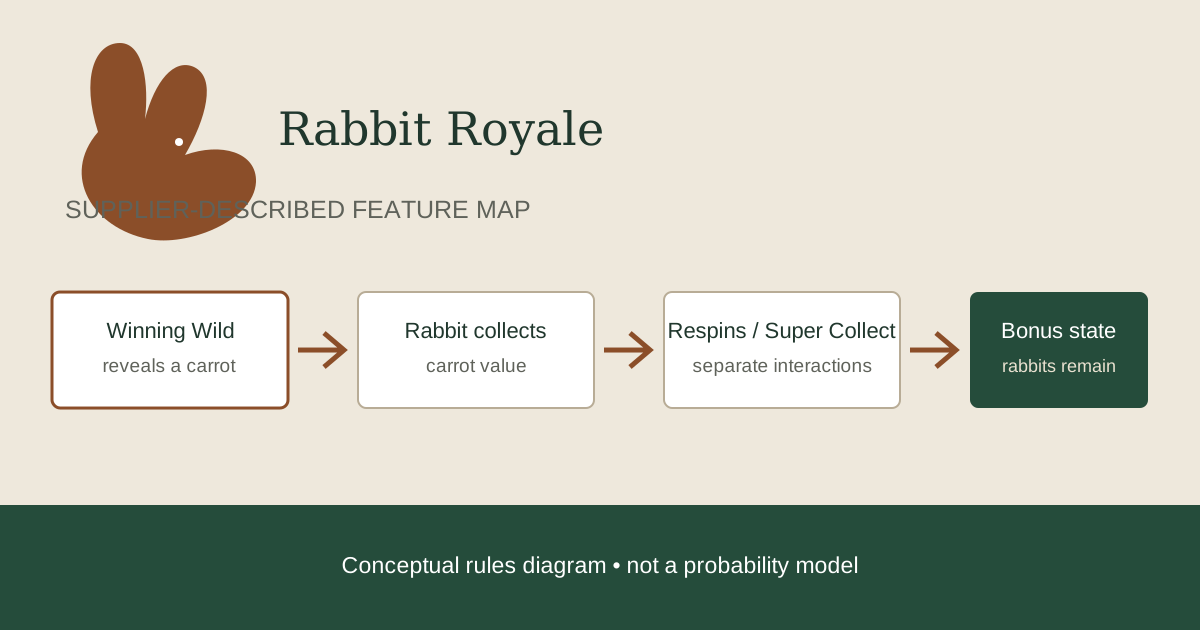
Rabbit Royale is an ELK Studios slot centred on rabbits collecting carrot values. The supplier says a Rabbit Respin can be awarded when a rabbit collects a carrot or faces another rabbit. A Wild that is part of a win reveals a carrot, and adjacent rabbits can trigger Super Collect. In the bonus, rabbit symbols stay in place; the supplier also says that time is not deducted from the free-spin count during Rabbit Collect Respins and that base-game rabbits carry into the bonus. Those relationships give the game its identity, but the exact help screen remains the authority for an operator’s client.
This review separates the public feature outline from mathematical and local-access claims. We checked the ELK Studios Rabbit Royale product page on 7 October 2026. The downloadable data sheet was not accessible during research, and no current New Zealand operator help was supplied. For that reason, this guide does not state an RTP, variant, volatility label, exact trigger count, bet range or payout cap.
Confirm Rabbit Royale, not another animal slot
Start by checking the exact title and provider in the client’s information panel. Rabbit Royale is not interchangeable with any other animal-themed or rabbit-themed game. Similar carrots, burrows or collection symbols do not prove that two games use the same rules. Record the displayed title, ELK Studios attribution, game identifier if available, version label if shown and inspection date.
The official catalogue confirms that ELK publicly documents Rabbit Royale as a product. It does not establish which operators distribute it or whether a particular account in New Zealand can access it. Availability should be checked with the intended operator. A review page from a different market can show how that page’s demo appears, but not prove a local casino version is enabled.
If the title in the game lobby is shortened, open its help or loading screen before relying on a search result. Keep the product name separate from the descriptive theme: “rabbits collecting carrots” explains a mechanic, not a unique build. This distinction prevents rules and payout claims from another title being attributed to Rabbit Royale.
The carrot is a value object
The game’s core loop makes more sense if a carrot is treated as an object with a displayed value rather than as a normal paying symbol. The supplier describes rabbits collecting carrots and awarding respins. The active client help should explain how the carrot value is determined, whether it can appear in more than one position, what happens when several carrots are present and whether a carrot can remain after a respin.
Read the carrot’s role alongside the paytable. It may block a position, carry a value, trigger a collection feature or do more than one of those things. Do not assume that a carrot pays immediately just because it displays a number. A value can be a target to collect, a feature amount waiting on the board or a result that settles only after a rabbit reaches it.
When reviewing a round, note the carrot’s position and value before the collection, then record which rabbit reached it and when the balance changed. If the rabbit moves or the carrot remains after the action, describe that state separately from the final payout. Round history is useful for confirming whether the game combines collected values or records multiple awards.
This careful language helps avoid overstating the feature. A carrot displayed on the board is not necessarily money credited to the balance. The rules and event history must show the collection and settlement. This guide does not infer how often a carrot appears or how large its value tends to be.
Rabbit Respins
ELK describes Rabbit Respins as a feature awarded when a rabbit collects a carrot or faces off against another rabbit. Additional carrots during respins, or lucky jumps by rabbits, can extend the sequence. The public page therefore describes more than a single fixed replay: the board can change while rabbit symbols remain part of the feature state.
The client help should explain what stays in place during a respin, whether rabbits can move, how a new carrot is selected and what ends the sequence. Does the feature stop when no eligible carrot remains, when a rabbit cannot move, or under another rule? The public product outline does not answer every end condition. Do not copy a stopping rule from another casino review without checking the current client.
Separate the event that awards a respin from the symbols shown after it. A rabbit collecting a carrot is one trigger path; a face-off between rabbits is another supplier-described interaction. They may have different outcomes or settlement timing. A concise review should explain both paths and then state what the client help confirms about the next board.
If the animation is rapid, open round history after the sequence. Record each collection or face-off, the carrot values shown and the final credited total. That creates a factual description of one example, not a claim that the feature will last a typical length or produce a particular return.
Wild-to-Carrot: one symbol changes roles
The supplier says a Wild that is part of a win reveals a carrot. It also says Wilds substitute for symbols except for bonus, rabbit and carrot symbols. This means the Wild has at least two roles in the public feature description: substitution during a qualifying win and a carrot reveal connected to that win. The help should specify whether the Wild itself changes, whether the new carrot occupies its position, and at which point the next evaluation occurs.
Do not describe every Wild as a carrot. The supplier’s wording ties the reveal to a Wild that participates in a win. A Wild that appears without being part of a qualifying result may follow a different rule. Check the paytable for the exact condition and inspect the round history if the replacement happens between animations.
The exceptions matter. A Wild that does not substitute for the bonus, rabbit or carrot symbols cannot be treated as a universal replacement. If a near-winning set contains a special symbol, the ordinary Wild rule may not bridge the gap. Use the symbol legend rather than assuming that all special symbols can be substituted.
When a Wild reveals a carrot, keep the win calculation and the revealed carrot’s later value collection as separate steps. The first may settle a symbol result; the second may start or contribute to a collection state. The supplier summary does not provide a complete accounting order, so the operator help must resolve whether the value is included immediately or after a follow-up action.
Super Collect and adjacent rabbits
ELK says that adjacent rabbits face off and collect their respective values from each other in Super Collect. The key term is adjacent. The active help should define whether adjacency means side-by-side horizontally, vertically, diagonally or under another board-specific rule. A picture can illustrate an example but does not prove every permitted arrangement.
The phrase “collect their respective values” also raises an accounting question: does each rabbit take the other’s value, do values combine, or does the client apply a separate formula? Do not simplify the rule into “the values double” unless the current help states that exact calculation. A feature can move or aggregate values without using a simple addition rule.
For a review, record the location of each rabbit before the face-off, the values visible at that point, the adjacency condition, the movement animation and the final settlement. If the interface shows one total, compare it with the history rather than calculating from memory. This makes the guide more useful to a reader trying to follow a complex feature.
Super Collect is different from a rabbit collecting a carrot. One interaction is rabbit-to-rabbit; the other is rabbit-to-carrot. The two can share a visual theme without sharing the same trigger or payout rule. The supplier outlines both, and the client’s paytable should keep their descriptions distinct.
Bonus entry and free-spin state
ELK describes a bonus game entered by bonus symbols and says that more trigger symbols award more free spins and rabbits. The exact number of symbols and award table should be read in the live help. This page avoids a numerical trigger claim because no current operator screen or accessible data sheet was provided.
The bonus changes how rabbit symbols behave: ELK says all rabbits are sticky in the bonus. It also says rabbits from the base game carry into the bonus, in addition to rabbits awarded at entry. This makes the transition state important. Before the bonus begins, note which rabbits are already visible; after entry, check which remain and which additional rabbits appear.
The game also states that free spins are not used during Rabbit Collect Respins. That is a meaningful timing rule: the ordinary bonus counter is paused while that named collection sequence resolves. The help should clarify what happens if the respin leads into another interaction, whether the counter resumes afterward, and how the game displays remaining free spins.
Sticky does not mean guaranteed payment. It means the rabbit remains in the relevant position or state under the bonus rule. A carrot still needs to be collected or another qualifying event must occur before a value is settled. A bonus can therefore continue with the same rabbit in place without every subsequent drop producing a win.
Retriggers and the end of the bonus
The product outline says the bonus can award more free spins and rabbits based on the trigger symbols, and the broader public description leaves the full retrigger table to the game help. Check whether bonus symbols can retrigger during the bonus, how many additional spins or drops are awarded, and whether new rabbits are added to the existing sticky set.
The end condition is just as important as the entry condition. Does the feature end when the free-spin counter reaches zero, or can an active Rabbit Collect Respin finish first? The supplier’s statement that free spins are not used during such respins suggests the counter pauses during that event, but the exact resume and settlement steps should be verified in the operator client.
When the bonus closes, check which total is credited and whether a round-history entry includes the base spin that triggered the bonus. If the interface presents an accumulated amount and then returns to the base screen, the history should confirm the final payout. A theme animation or a “bonus complete” banner is not enough to confirm the amount.
Do not describe a retrigger as a likely outcome. It is a rule available under a qualifying event. The frequency depends on the mathematical model, which is not established by the public feature page or a few observed rounds.
X-iter and optional feature modes
ELK describes X-iter as optional modes that can increase the chance of a bonus or begin a Super Bonus with a defined starting setup. These modes may not appear in all markets or operator builds. If a menu is available, the client should display the cost, what it includes and what starting state it provides.
Treat such a menu as a paid choice, not as a free sample or a way to make an outcome certain. Compare its cost with the ordinary stake basis, read which game mode applies, and check whether the RTP information changes. This guide does not quote a price or encourage a purchase. A paid entry changes the cost and the starting state; it does not guarantee a profitable result.
An operator may disable a mode while still offering the base title. Conversely, a supplier’s general product page may mention a mode that a particular casino does not show. Report the actual client interface and date instead of assuming universal access from a promotional description.
Optional access is a separate concept from a free demo. A demo may let someone inspect controls without a stake, while an X-iter choice is a paid feature path if enabled. Do not confuse them in a review or imply that a paid feature mode is a no-cost practice tool.
RTP and return variants
RTP is a theoretical long-run return measure for a defined configuration. It does not describe a guaranteed share of one person’s balance, predict a bonus, or tell someone when a win should occur. Short sessions fluctuate and cannot validate the game’s model.
No verified Rabbit Royale percentage or variant is provided here. Competitor pages checked in this research publish values, but they may reflect a country-specific build, an older client or a review database rather than the configuration a reader can open. The official ELK public page did not supply an accessible game-data sheet during the check, and no live New Zealand operator help was made available.
To verify RTP, open the information screen in the intended client and locate the explicit RTP or theoretical return field. Record the active value, exact title, operator, account jurisdiction and date. If the game shows a range, identify which option is active rather than copying all values into the review as if they all apply. If no figure appears, mark it unknown and ask the operator.
Do not calculate an RTP from a sample of spins, an observed session total or a demo. A short run can be far above or below the theoretical model. A demo can also use a different build. An exact percentage without an attributable configuration is false precision.
Volatility and maximum payout
Volatility describes how variable outcomes may be; it is not an RTP value. Labels vary between publishers and review sites, and a numerical score may lack a public method. This guide does not assign Rabbit Royale a volatility class because the active client’s help was not available.
The same caution applies to a maximum win. A supplier’s maximum-potential headline, an operator’s per-round cap, an individual carrot value and a bonus total are different pieces of information. Check the live help for the specific cap and how it is calculated. If a special collection feature can aggregate values, the client should explain whether those amounts are included within a round limit.
A multiplier or collected carrot value may appear larger during an animation than the total eventually credited. Use the account’s game history to distinguish displayed feature values from settled balance changes. If the rules page and history appear inconsistent, pause and ask the operator before describing the outcome.
Do not use a volatility label to advise a reader how much money to bring or how long to play. The safest useful explanation is that outcomes vary, a label is not a forecast, and a spending limit should be chosen independently of the feature design.
Mobile, demo and interface checks
Rabbit symbols, carrots and moving feature objects should remain readable on a phone. Check that the information control, paytable, balance, stake control, game history and exit option are reachable without the animation covering them. If the screen crops an object, rotate or resize only if the game supports that interaction; do not assume a missing symbol means the rule has changed.
Read the symbol labels in text. The feature relies on distinguishing rabbits, carrots, Wilds and bonus symbols, and the help should explain which roles each one plays. Colour or artwork alone may not be enough, especially when a symbol transforms during a round.
A demo can help explain the controls if legitimately provided, but it does not prove an operator’s real-money client is available in New Zealand. Check the demo title and information panel. If no demo is listed by the intended operator, do not send a reader to an unrelated site and describe that as local access.
Before opening a game, locate the operator’s play limits and account controls. If the rules are not readable or the client will not open the help panel, stop rather than relying on assumptions. The site’s safer gambling page gives New Zealand readers independent support information.
A review checklist for a complete round
To make a useful review, begin with the live title and help version. Then document the base symbol rules, carrot values, what a rabbit must do to collect one, how respins keep or move symbols, and what the game means by adjacent rabbits. Note whether a Wild has to participate in a win before it reveals a carrot and which special symbols it cannot replace.
For the bonus, record the entry rule, starting rabbits, sticky behaviour, free-spin counter and retrigger terms. Pay close attention to Rabbit Collect Respins because the supplier says they do not consume a free spin. The help should also clarify when the bonus ends and how its total is credited.
Use evidence labels consistently. “ELK describes” is appropriate for a public product-page feature. “The operator help confirms” is appropriate only after the current client has been inspected. “Observed in one round” describes an example, not the usual behaviour. This vocabulary prevents a third-party review’s claims from being treated as universal rules.
Avoid an invented personal test, star rating or performance claim. If a game wasn’t played, say that the article is a rules review based on supplier material and a current help check that remains outstanding. If a demo was used, document the demo’s source, date and version. The reader can then judge the scope of the evidence.
Responsible verdict
Rabbit Royale has a distinct collection loop: rabbits can collect carrots or face other rabbits, a qualifying Wild can reveal a carrot, and the bonus retains rabbit symbols while pausing its free-spin counter during Rabbit Collect Respins. This is enough to explain why the sequence differs from a conventional symbol-only slot.
The exact RTP, variants, volatility category, stake limits, win cap, demo availability and New Zealand operator access are not verified. As a result, this guide gives a mechanics-level verdict rather than a numerical rating or recommendation. The live help should be consulted before relying on any setting.
Gambling can result in loss. If you choose to play, set a time limit and a spending limit before opening the game and leave when either is reached. Do not increase a stake to recover a previous result or wait for a rabbit feature. If gambling starts to create harm or pressure, stop and seek independent help.
Frequently asked questions
What starts a Rabbit Respin?
ELK describes a respin after a rabbit collects a carrot or faces another rabbit. The current help should define which symbols remain, how rabbits move and what ends the feature.
What is Wild-to-Carrot?
The supplier says a Wild that is part of a win reveals a carrot. It also lists bonus, rabbit and carrot symbols as exceptions to Wild substitution. The exact transformation and settlement order should be checked in the client.
Do bonus spins pass while rabbits collect?
ELK says free spins are not used during Rabbit Collect Respins. Check the live help to see how the counter resumes and how a completed collection is settled.
What is Rabbit Royale’s RTP?
This review could not verify a current operator setting or variant. Read the RTP field in the specific game client; do not treat another market’s review value as universal.
Can I play Rabbit Royale in New Zealand?
This guide does not confirm distribution by a New Zealand operator or eligibility for a specific account. The supplier catalogue alone cannot establish local access.
Sources and date checked
- ELK Studios Rabbit Royale product page and ELK catalogue — checked 7 October 2026.
- Competitor sample checked 7 October 2026: Online-Slot, Gambling.com UK, FruitySlots, and OLBG. Their numerical settings were not used as local-client evidence.
- DIA guidance for online gambling advertisers and Online Casino Gambling Regulations 2026 — checked 7 October 2026; affiliate promotion withheld pending qualified compliance review.
