ELK Studios game guide · South Island guide
Grizzly Stampede: rules, features and settings to verify
 Best casinos available in New ZealandUpdated 7 November 2026

Grizzly Stampede is an ELK Studios slot with a five-by-four base grid, a row-triggered Stampede feature and a token-based bonus. This guide follows the supplier-published feature sequence and flags game settings that require the active help panel.
The short answer
Grizzly Stampede is an ELK Studios slot with five reels and four rows. The official product page describes a row-based feature: two Stampede symbols in the same row can trigger Stampede or Super Stampede, turning symbols between and including them into Grizzly symbols. If a pair does not trigger the feature, the symbols can charge a Totem that later adds Stampede symbols. The page also describes Wilds that substitute and may reveal a multiplier when part of a win, plus a separate token-based bonus.
ELK states a potential maximum of 50,000 times the bet and lists five X-iter modes. The supplier page displays “Release September 1st” without a year in its accessible text. It does not show a full paytable, an RTP, a volatility label or a stake range. The product sheet could not be accessed during the check on 6 October 2026. Confirm those operator-specific fields in the active game help before quoting them. This guide does not establish New Zealand availability.
Identify the game and read the release line carefully
The primary reference is the ELK Studios Grizzly Stampede page. It identifies the title and supplier and summarises the feature mechanics. Its visible release line reads “September 1st”. The accessible text does not include a year, so this guide preserves the month and day wording without claiming a specific year. A date supplied elsewhere in a tracker is not the same as a date visible in the current page.
The studio page is a product overview. It does not prove that each casino has integrated the game or that a New Zealand player can open it. Check the exact title in the operator catalogue and the loading screen, then use its information panel to confirm the supplier and any version identifier. If the operator uses an abbreviated catalogue card, the help screen can distinguish this game from another wildlife or stampede-themed slot.
When a supplier page and an operator’s help panel differ, make the source and version explicit. The supplier summary is valuable for understanding the broad feature map. The live operator help is the relevant reference for the settings attached to the build a player is considering. A page date is not a substitute for a rules version, and neither one should be used to imply local regulatory approval.
Five reels, four rows and what the grid does not tell you
The base layout has five reels and four rows. Those dimensions provide a starting point for following a round, but they do not state whether wins use paylines, ways, clusters or a different evaluation method. The accessible supplier text does not list the base-game paytable or ordinary symbol values. It also does not provide a minimum stake, maximum stake or a currency.
Do not infer a payline count from the number of cells. A 5-by-4 display has twenty visible positions, but that count is not a win rule. Read the operator’s paytable for the ways symbols connect, which direction combinations are evaluated, whether wins can be simultaneous, and what a Wild can replace. If that information is absent from a casino listing, say that it is absent rather than borrowing a number from an unrelated ELK game.
It is useful to sketch the base game as three stages: the ordinary spin result, any Stampede-symbol check, and any later feature or bonus state. The source establishes relationships between some of those events, but it does not publish every priority rule. This distinction lets a reader understand what a symbol is for without assuming that all features can happen at once or that a single event always produces a payout.
The row-based Stampede trigger
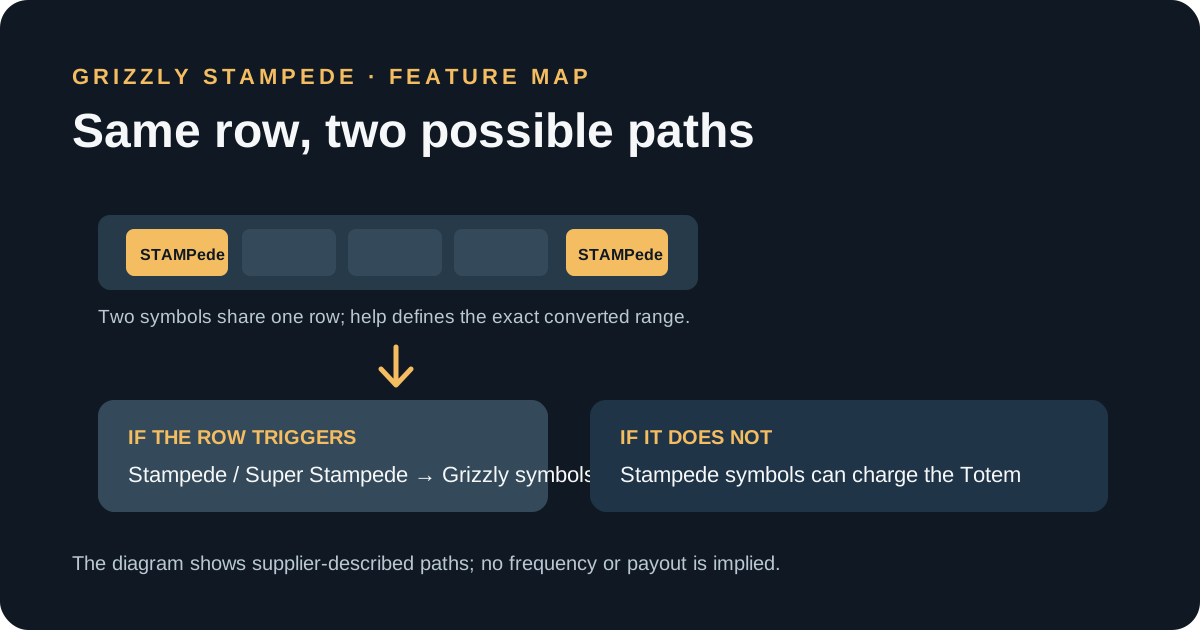
ELK says that two Stampede symbols in the same row trigger Stampede or Super Stampede. The position matters: the summary names a same-row pair, not simply any two symbols anywhere on the board. The effect converts symbols between and including the pair into Grizzly symbols. Super Stampede adds more Grizzly symbols. The public page does not give trigger probabilities, explain what selects the regular or Super version, or list the exact number added by Super Stampede.
For an on-screen example, first locate the two Stampede symbols and confirm that their row matches. Next trace the range the feature highlights, including the positions the display treats as between or part of the endpoints. Then note whether the game labels the result Stampede or Super Stampede and count the newly transformed symbols. The final win must still be read through the game’s paytable; a conversion animation is not itself a statement about its monetary value.
The accessible product summary does not state whether the row wraps, whether diagonal positions matter, or what happens if more than one qualifying pair appears. Do not invent those rules from a screenshot. Use the active help for the exact client, especially where overlapping pairs or a boundary position could change the number of converted symbols. If a help panel leaves the question unresolved, report that limitation clearly.
Grizzly symbols and the meaning of conversion
In the supplier description, a Stampede changes symbols in a defined row segment into Grizzly symbols. That tells the reader which symbol replaces the prior board content. The available text does not show the Grizzly symbol’s paytable value, whether it can form a win in every transformed position, or whether conversion happens before all base wins are evaluated.
Those details matter because “turns into a Grizzly” is a feature description, not a complete settlement calculation. Consult the symbol table and game history to see which combinations qualify. If the interface shows a result before a conversion, distinguish the pre-feature board from the post-feature board. A feature may change the board and then the game evaluates the resulting combination, but the detailed order should come from the rules for this version.
When describing a win, name the condition and the resulting symbol positions, then use the displayed credit or history entry for the settled amount. Avoid estimating a value from visual size or multiplying a symbol label by a wager without the official paytable. The product page’s 50,000x potential maximum belongs to the whole product description; it does not disclose the value of an individual Grizzly symbol or this one feature.
Totem charge when the row trigger does not happen
The official summary describes a second path for Stampede symbols: if they do not trigger a Stampede, they charge the Totem, which then adds Stampede symbols. This is distinct from the immediate same-row conversion. It indicates that a symbol can contribute to a later event even when no qualifying row pair is present in that moment.
The page does not say how many charges the Totem needs, whether charges persist between spins, how many extra symbols it adds, where they appear or whether those new symbols can satisfy a row condition immediately. These are precisely the details that an operator’s help needs to establish. A progress meter can visually suggest accumulation, but it does not tell the reader whether the count carries over after a feature or session ends.
Follow the meter and written rules rather than relying on the animation. Note the number of non-triggering symbols, the meter change, when the Totem activates and the positions of the added Stampede symbols. If the counter resets, check whether the help explains why. Do not claim that a Totem is “due” after several spins; no sequence of previous results guarantees a future activation unless the published rules explicitly define a deterministic counter.
Wild symbols and their conditional multiplier
ELK says Wild symbols substitute and may reveal a multiplier if they form part of a win. The word “may” leaves room for the multiplier not to appear in every circumstance. The public product summary does not show the multiplier range, how its value is selected, whether one or multiple Wilds can reveal values, or how it combines with the payout for a winning combination.
Read the paytable for the Wild’s eligible substitutions and any exclusions. A Wild does not necessarily replace a Bonus or Stampede symbol, and a feature symbol can have a different role from a paying symbol. If the interface presents a multiplier, check whether it attaches to the Wild, the line or combination, the resulting win, or a subsequent feature. These are different settlement models and should not be collapsed into a generic statement that the Wild “multiplies the bet”.
An example can be explained without assigning an unverified value: a Wild appears, the game marks a multiplier because the Wild participates in a win, and the history panel reports the settled amount. If no multiplier appears, do not treat that as a defect based on the summary alone. The exact condition is described as conditional, and the operator help is needed to define it precisely.
Bonus entry and the token system
The supplier states that three or more Bonus symbols trigger the Bonus game. Tokens then convert symbols into Grizzly or Raging Grizzly symbols. The Super Bonus awards extra tokens before its first spin. These relationships give a reader a useful framework: identify the entry symbols, distinguish ordinary Bonus from Super Bonus and follow how each token changes the board.
The accessible page does not list the full token count, every possible conversion, whether tokens can be retriggered, the values of Grizzly versus Raging Grizzly, or the exact bonus ending condition. It also does not publish the probability of landing three Bonus symbols. Do not create a token-value table from an operator review that covers a different configuration.
For a feature log, record how many Bonus symbols qualified, which bonus mode opened, how many tokens were displayed before the first spin, what each token changed and what the help says about any ending or retrigger. A Super Bonus’s extra tokens describe its starting state; they do not guarantee that each token converts into a high-paying symbol or that the feature returns a particular amount.
If the operator help uses the phrase “Raging Grizzly”, quote it as the game’s term and check the symbol table for its differences. Do not assume it is simply a stronger version with a fixed multiplier. The accessible supplier description says that tokens can convert symbols to either type, but does not attach a numeric value or mathematical ranking to the two symbols.
Super Stampede, regular Stampede and the token bonus
These feature names refer to different things and should not be used interchangeably. Stampede and Super Stampede are row-triggered transformations. The bonus is entered through Bonus symbols and uses tokens. The supplier’s summary gives each mechanic a separate condition, even though each can bring Grizzly symbols onto the board.
Keeping the pathways distinct helps answer practical questions. If two same-row Stampede symbols appear, the reader should look for the row feature. If there is no row activation, the Totem charge is a separate consequence. If three or more Bonus symbols appear, the token feature begins. The source does not state every interaction when conditions overlap, so a guide should not assert that one feature always interrupts or overrides another.
An operator may display a history log that labels each event. That can be more reliable than a sequence remembered from a fast animation. Where the game offers no history, pause on the rules page and record the exact text. Do not promise that a chosen mode or observed pattern can force one of these routes. The source describes game events, not a player-controlled strategy.
Five X-iter modes: prices are multiples, not outcomes
ELK’s page says Grizzly Stampede has five X-iter modes. The summary describes an option priced at three times the bet with more than four times the chance of the bonus, and a 250-times-bet Super Bonus at the upper end. The public text does not display a complete list of all intermediate choices or the complete rules for each mode. Confirm the menu in the active build before publishing its full details.
“More than four times the chance” is a relative probability claim attached to the supplier’s mode description; it is not a promise that the next round enters a bonus. The summary does not state the underlying base probability or the exact comparison method. The 3x amount is also a cost multiple, not a payout. A player who chooses an optional mode pays the displayed cost whether its resulting feature produces a return above or below that cost.
Use a simple calculation only to understand the denomination: at a hypothetical bet of NZ$1, a 3x mode would cost NZ$3 and a 250x mode would cost NZ$250. This example is arithmetic, not a recommended stake, confirmation that NZ$1 is available or an assertion that any local casino offers these choices. The real cost depends on the operator’s permitted stake and screen.
Before selecting a mode, inspect its label, full cost, included state, whether the feature can retrigger and any local restrictions. Include the total price in a budget set before play. A feature purchase can produce a losing result; a higher chance of reaching a bonus does not mean higher expected return. The product page’s maximum win cannot be used to justify the cost of an optional entry.
Potential maximum and mathematical fields
ELK states a potential maximum of 50,000 times the bet. This is a product ceiling, not an expected return, a typical result or a promise that the active casino build has exactly the same limit. The accessible summary does not explain the probability of reaching it or the path required. If an operator help panel states a different cap, preserve that configuration and date in any casino-specific discussion.
The available official text checked on 6 October 2026 does not display an RTP percentage, volatility category, complete paytable, hit frequency, or stake limits. A third-party review may list figures, but that does not establish which game configuration a particular operator has enabled. The linked supplier product sheet returned a 403 response. No content from that inaccessible file is used here.
If RTP appears in a live game’s information page, capture the exact percentage and any label for the configuration. Do not report only a rounded value if the screen shows more precision. A title can have multiple mathematical settings, and a percentage from an older or different build may not describe the current screen. RTP concerns theoretical long-run return for a specified configuration; it says nothing certain about a single session.
Volatility is also separate from the maximum. Do not infer it from the 50,000x ceiling, a dramatic animation, a rare-looking feature or a review’s adjectives. Use an official displayed label where available, and attribute it to the source. Without one, state that this research did not verify a volatility setting. The distinction is more useful than attaching an unsupported “high” or “medium” label to the game.
Read the paytable and feature-help panel
The paytable should explain each symbol, qualifying combination and any substitutions. Check whether the base game uses lines, ways, clusters or another win method; whether a Wild has exclusions; what counts as a Bonus symbol; and whether special symbols can appear together. These are baseline questions, not a way to infer a result from artwork.
The feature help should then explain the Stampede row boundaries, the Totem charge requirement, the Wild multiplier, the token conversions, Bonus and Super Bonus entry conditions, feature persistence and settlement. If the rules page separates “normal play” from “feature play”, review both parts. One abbreviated information card may not contain the details required to explain every state.
Do not transfer a rule from another ELK game. Studios reuse feature vocabulary across products while changing the mechanics. A “token”, “Totem” or “Super” label is not enough to assume the same trigger count or multiplier. The title-specific page is the right starting point, and the operator help is the final confirmation for its build.
If a help panel does not disclose a value, say that it was not displayed. A careful omission is better than a neat table assembled from pages with unknown dates. For a settings audit, save the URL or screen label, date, title and version so that a future editor can recheck whether the information has changed.
Mobile use, demo access and display quality
The supplier’s accessible page recommends a 1600-by-900 desktop view. It does not establish that every operator has a mobile client or that a demo works in New Zealand. A catalogue page may contain a play control while the game itself remains unavailable to a specific visitor or jurisdiction.
On a phone, check whether the five-by-four board, row markers and Totem counter remain legible. The same-row trigger relies on understanding positions across a line, so a clipped column or small symbol can affect comprehension. In landscape, confirm that the browser still exposes the help control. In portrait, check whether a rules sheet is scrollable and whether its text can be resized.
No live game or demo was opened for this article. That means this page does not claim tested mobile performance, touch controls, load speed or local access. If an operator offers a demo, the demo’s rules may help explain a sequence but do not prove its real-money configuration. It cannot confirm account eligibility, withdrawals or the operator’s New Zealand terms.
New Zealand access and responsible checks
This guide is written for an en-NZ site and does not say that Grizzly Stampede is available to New Zealand players. A supplier’s global catalogue, an overseas casino review or a date in a game tracker cannot confirm a local operator listing. Availability depends on the operator’s current catalogue, location rules and terms. Follow those rules and do not use a VPN or another account to bypass a restriction.
The Department of Internal Affairs advertiser guidance checked on 6 October 2026 explains that online gambling advertising is prohibited during the current transition and includes third-party advertising within the framework. Its player guidance says providers must not advertise to New Zealand customers during that period. This page therefore provides no CPA button and no affiliate link. The assigned website route has not been opened or used.
Regulatory guidance can change, so check the official DIA pages again before altering the commercial treatment. This is a report of the current official guidance for the site workflow, not individual legal advice. A game’s feature diagram is not a recommendation to play. If gambling is creating stress or financial harm, take a break and use independent New Zealand support instead of chasing a Totem, bonus or previous loss.
A disciplined way to verify the live version
Before quoting a rule, use the following sequence:
- Confirm “Grizzly Stampede” and ELK Studios in the loading screen and help panel.
- Record a version or rules date if one is present.
- Confirm five reels and four rows, then inspect the win method and paytable.
- Check the two-same-row trigger, endpoint treatment and regular/Super Stampede distinction.
- Read what happens when Stampede symbols do not trigger and how the Totem charges.
- Verify Wild exclusions and when a multiplier may be revealed.
- Check the three-or-more Bonus rule, token mechanics, Raging Grizzly and Super Bonus start.
- Copy each X-iter label and price from the active menu, if available.
- Record displayed RTP, volatility, stake range and maximum win only when the screen states them.
- Note date, currency, jurisdiction and any operator-specific restriction.
If the official summary and live help use different wording, preserve both quotations in your working note and state which one describes the active build. Avoid smoothing over a real discrepancy. If a value affects how a result settles and the help does not explain it, request clarification from the operator instead of publishing a guess.
Questions readers commonly ask
How does the Stampede feature start?
The supplier says that two Stampede symbols in the same row can trigger Stampede or Super Stampede. The symbols between and including them become Grizzly symbols. The help panel is needed for overlapping pairs and other edge cases.
What does the Totem do?
Stampede symbols that do not trigger the row feature can charge the Totem. The Totem later adds Stampede symbols. The accessible summary does not state its charge threshold or persistence rules.
What does a Wild do?
ELK says Wilds substitute and may reveal a multiplier when part of a win. The supplier summary does not give a multiplier range or the exact settlement formula.
What is the difference between Bonus and Super Bonus?
Three or more Bonus symbols trigger the bonus according to the supplier page. The Super Bonus is described as awarding extra tokens before its first spin. Exact token counts and ending rules need verification in the active help.
What does 50,000x mean?
It is the potential maximum listed by ELK, expressed as a multiple of the bet. It is not an average or a forecast and does not show how often the cap can occur.
Are the X-iter prices confirmed?
The supplier summary mentions a 3x option and a 250x Super Bonus at the upper end, but it does not list every intermediate mode in the accessible text. Confirm the menu and total cost in the operator build.
What is the game’s RTP or volatility?
Neither value was displayed in the accessible official summary checked here. Verify the exact operator help; do not treat an unversioned third-party listing as the active setting.
Can I play it in New Zealand?
This research did not verify a New Zealand operator offering the game. A supplier catalogue entry is not evidence of local availability.
Does a Super Stampede guarantee a large win?
No such guarantee is stated. It adds more Grizzly symbols according to the supplier summary, but the resulting combination and its value depend on the game’s rules and outcome.
For independent New Zealand safer-play information, see the site’s safer gambling guide. This article is informational and includes no casino offer.
Sources and verification boundary
- ELK Studios official Grizzly Stampede page — 5-by-4 layout, Stampede and Totem summaries, Wild, token bonus, X-iter summary, 50,000x potential, display recommendation and visible “September 1st” release wording; checked 6 October 2026. The year was not visible in the release line.
- ELK product-sheet link on the official page — returned HTTP 403 on 6 October 2026; its contents were not used.
- Competitor pages opened: AboutSlots, BigWinBoard, Sigma, Clash of Slots. Secondary pages list settings and board mechanics not all confirmed by the accessible supplier text; those numbers are not presented as active operator settings.
- DIA advertiser guidance and DIA player guidance — checked 6 October 2026; used for the New Zealand commercial-content boundary.
