ELK Studios game guide · South Island guide
Langley Street 23: rules, features and settings to verify
 Best casinos available in New ZealandUpdated 7 November 2026

Langley Street 23 is an ELK Studios slot whose bonus can begin with a sticky Mystery or Wild mode before its features unlock. This guide explains the supplier-published feature chain and the settings that still need checking in the active game help.
The short answer
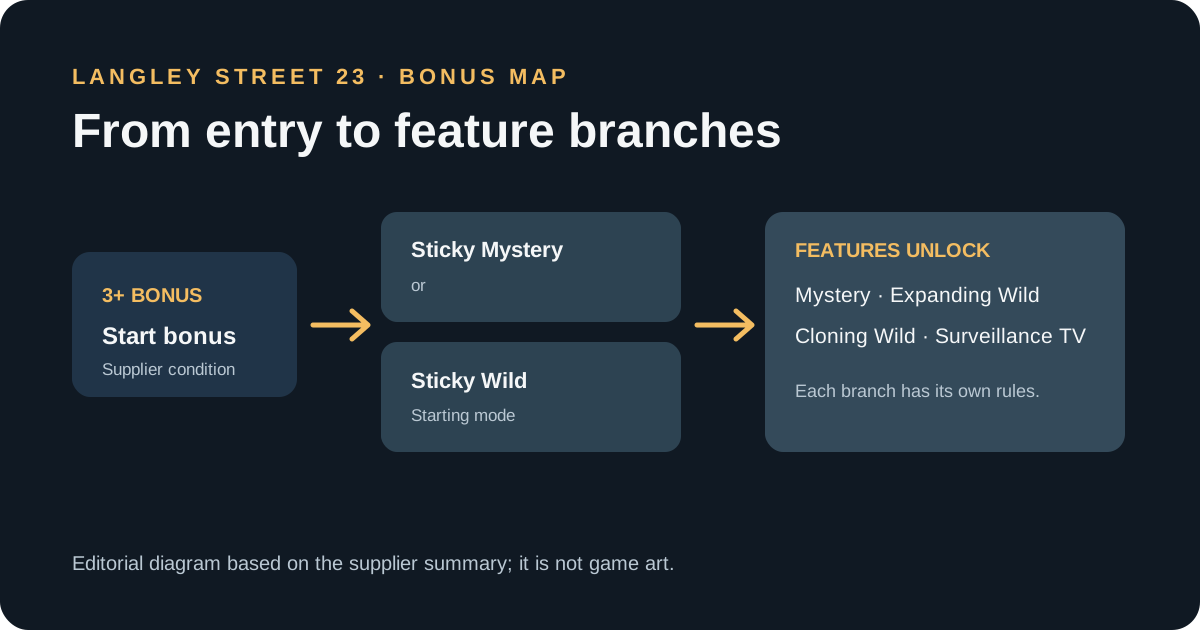
Langley Street 23 is an ELK Studios five-by-five slot. The supplier page says that three or more Bonus symbols start the bonus, where all features are unlocked. Before the bonus, the game uses either a sticky Mystery mode or a sticky Wild mode. Its named features include Mystery symbols that reveal a paying symbol or a Wild, an Expanding Wild that covers a reel, a Cloning Wild that creates another Wild at its own and the adjacent-left position, and Surveillance TV, which may trigger a Mystery, Cloning, Expanding or bonus-trigger respin.
ELK lists a 10,000x potential maximum and five X-iter modes, including a 2.5x-bet option described as giving more than four times the chance of the bonus and a 200x spin with at least two Expanding Wilds. The accessible official text shows “Release August 25th” without a year. It does not display RTP, volatility, full paytable or stake range. Its linked product sheet returned 403 on 6 October 2026. Confirm those settings in the active help; this guide does not confirm New Zealand operator availability.
Start with the precise title and source
The official ELK Studios product page is the primary reference for this guide. Its title is Langley Street 23, with the number written as part of the name. The accessible page shows a release line reading “August 25th”; it does not include a year in the text inspected on 6 October 2026. This page therefore avoids adding a year from a secondary listing.
The studio’s summary describes the theme and feature chain, but it is not an operator’s rules screen. A casino may use a particular configuration, omit an optional feature or show settings that are not in the catalogue page. Confirm the exact title, supplier and any rules version in the client before attributing a value to it. A game image or “play” tile alone does not show that the title can be opened in New Zealand.
The title-specific help should answer both ordinary play and bonus questions. If a setting is missing there, it remains unverified for that operator. If a source uses a different date, label the source and the date that was visible. This simple habit is especially useful for new or recently listed games, where pages can be updated at different times.
Five-by-five grid: layout is not the paytable
ELK describes a five-reel, five-row grid. That gives a reader a visual frame for following the symbols, but it does not reveal the full win calculation. The accessible supplier page does not provide a complete list of symbol values, the base game’s line or ways structure, the stake range, or every Wild exclusion. A 25-cell board should not be mistaken for a statement that all cells form one win path.
Open the active help and identify how ordinary symbols are evaluated. Check whether combinations pay left to right, in fixed lines, ways, clusters or another defined pattern. Look at the paytable for the value of each symbol, the role of Bonus symbols and the permitted Wild substitutions. This matters because Mystery symbols can reveal either a paying symbol or a Wild, but the value of the revealed result still depends on the operator’s paytable.
Keep the base board and bonus rules distinct. A feature can use the same 5-by-5 presentation while changing which symbols are available or how a result is counted. Note any rules that persist from the starting mode into a feature. The public summary says that the initial Mystery or Wild mode is sticky, but the exact persistence boundaries should be read in the active help.
Bonus entry and the sticky starting choice
The supplier says three or more Bonus symbols trigger the bonus. It then describes an initial mode that is either sticky Mystery or sticky Wild. “Either” tells us the two modes are alternatives at the beginning; the accessible page does not state the selection probability, what determines which one appears or whether an operator can configure the choice.
Sticky describes a state that remains in place for a defined part of play, but the product summary does not list exactly how long it remains, which positions it affects or whether a later feature can replace it. Read the bonus help to see whether the first mode lasts for the entire bonus, until a particular event or for a fixed number of spins. Do not infer that all symbols on the starting board become sticky just because the mode is named that way.
Once the bonus begins, ELK says all features unlock. This is a feature-access statement; it is not a guarantee that every feature will occur in one bonus. The active help should explain which symbols or events trigger each feature and how a round ends. If the bonus can retrigger, the retrigger condition also belongs in that panel. The official public summary does not specify all of those details.
Mystery symbols and their reveal
The Mystery feature can reveal the same paying symbol or a Wild, according to the official product page. This gives a concise possible outcome but leaves several mechanics open: how the original symbols are selected, whether the reveal applies to a group, how many positions are involved and whether the revealed symbol has a special role in the current mode.
When a Mystery symbol appears, follow the reveal and then return to the paytable. If it becomes a paying symbol, identify the symbol value and the combination it completes. If it becomes a Wild, check which symbols that Wild may substitute for. The mystery animation itself is not a payout; the final board and the game’s settlement determine the result.
Do not assume that “same paying symbol” means all Mystery symbols become identical in every situation. The supplier summary does not explain whether a reveal is shared, local, random or limited to a particular set. Those details may be in the operator help. Until verified, explain only that the feature can reveal a paying symbol or a Wild and avoid inventing the selection logic.
Expanding Wild: whole-reel coverage and a fight
ELK describes an Expanding Wild that can cover an entire reel. The feature also includes a fight, after which a multiplier applies to a winning result. The accessible overview does not give the fight sequence, the conditions for a win, the multiplier range, whether it applies to one reel or a resulting combination, or any maximum value.
Follow the feature in order: identify the Expanding Wild, see which reel it covers, watch the fight state and then inspect the settled result. If a multiplier is displayed, check whether the help defines its target. A multiplier can apply to a specific winning combination or feature total; the word alone does not show whether it applies to the entire wager.
The phrase “on a win” is important. The summary does not promise a winning combination every time an Expanding Wild appears. It also does not state that each expansion gets a multiplier or that the multiplier is fixed. Do not write a range or expected value unless the active help supplies it. In the absence of that evidence, a guide can explain the sequence and leave the number open.
Cloning Wild and its adjacent-left position
The supplier describes the Cloning Wild as creating another Wild at its own position and the adjacent-left position. The direction is a specific part of the summary: the added Wild is to the left of the original. The public text does not explain what happens at the left edge, whether the feature can repeat, or whether the original and clone have identical substitution rules.
When this feature is shown, first locate the original Wild, then check where the clone appears. If a reel or position is at a boundary, read the active rules rather than assuming the board wraps around. Also check whether the feature produces a respin or changes the current board before win evaluation; the supplier summary does not settle every timing question.
Cloning is a board change, not a guarantee of a payout. The resulting symbols still need to meet the game’s win condition. If the feature is part of an optional mode, do not describe a clone as “free” or assign a value without checking the mode’s cost and settlement. The accurate description is limited to the stated placement behavior and whatever the current game help confirms.
Surveillance TV and the respin branches
Surveillance TV can trigger a Mystery, Cloning, Expanding or bonus-trigger respin. It therefore connects the street setting with several feature paths. The summary does not publish the odds of each event, the order in which multiple outcomes are selected or whether every TV activation results in a respin.
To follow it, record the symbol or message shown on the television, the feature label that follows, and the new board state after the respin. Keep the four branches separate in notes. A Mystery respin, a Cloning respin and an Expanding respin can change the board in different ways, while a bonus-trigger respin has its own entry implications. A fast animation can make them look alike, but their rules are not interchangeable.
The word “can” describes a possible event, not a guaranteed result on every spin. Do not say that the TV increases bonus probability by a numerical amount unless the active game help states such a value. A respin is another game action, not a cash prize. Its result can be zero or a win depending on the resulting board and rules.
Put the feature map in one place
| Feature | Supplier-published description | Detail that needs the active help |
|---|---|---|
| Mystery | Reveals a paying symbol or a Wild | Selection method, group behavior and paytable value |
| Expanding Wild | Covers a reel; a fight and a win multiplier are described | Trigger, multiplier values and settlement target |
| Cloning Wild | Adds a Wild at itself and adjacent-left | Boundary rule, repetition and evaluation timing |
| Surveillance TV | Can trigger four named respin branches | Event selection and exact branch conditions |
| Sticky start | Bonus begins with sticky Mystery or sticky Wild | Selection, positions and duration |
Use this as a reading aid, not as a numerical prediction. A feature overview helps a person follow a screen, while the paytable and information panel establish the rules that apply to an actual result. The supplier page does not show probabilities or feature weights, so the table does not rank features by frequency or expected value.
If the operator’s help uses different labels, record its wording alongside the supplier summary. A name can be localised, shortened or updated. Preserve the title and version to ensure that the same feature is being discussed. If the operator text conflicts on the trigger or settlement, do not silently rewrite the rules to make the two summaries appear consistent.
X-iter: understand both the label and the price
The public ELK page says there are five X-iter modes. It names a 2.5-times-bet option described as giving more than four times the chance of a bonus and a 200-times-bet spin with at least two Expanding Wilds. The accessible page does not show all intermediate prices and inclusions. A complete menu should be copied from the current game, not reconstructed from screenshots or a review for another market.
A multiplier of the bet is the price basis. With a hypothetical NZ$2 bet, a 2.5x mode would cost NZ$5. That arithmetic does not confirm the minimum bet, the currency used by an operator, or that the mode is available to New Zealand players. A 200x mode at that hypothetical stake would cost NZ$400. These examples show how a multiple scales; they are not recommendations or statements about a real casino’s limits.
The “more than four times the chance” wording is relative to an unspecified baseline in the public summary. It does not reveal the base probability and does not guarantee that the bonus will appear on the next spin. Likewise, at least two Expanding Wilds describes a starting condition for one mode, not a guaranteed profit. Review the price, all mode conditions and the operator’s restrictions before deciding whether the cost fits a pre-set entertainment budget.
Optional entry can produce a result below its purchase price. A larger mode price is not an investment or a promise of a larger settled amount. If the mode entry is missing from a casino build, do not assume another operator’s menu proves it should be there. The supplier’s product page documents the product family; the active help confirms the specific offer.
Maximum potential is not a forecast
ELK states a potential maximum of 10,000 times the bet. That is a ceiling from the official summary checked on 6 October 2026, not the typical return or an estimate of a session. The accessible text does not say how often the ceiling can occur, which mode is required or whether every casino version uses the same configuration.
Keep maximum win and RTP separate. A maximum says how large the stated upper outcome can be relative to the bet. RTP is a theoretical long-run percentage for a particular mathematical setup. Neither measure predicts a short session, and a large maximum does not prove that ordinary spins have a high return. A win cap can also differ by operator or jurisdiction.
When an operator panel states a different maximum, record that exact value with the date, version and market. If it does not show a number, leave the operator-specific cap unverified and attribute the 10,000x figure to the supplier page. Avoid phrases such as “you can win 10,000x” without explaining that this is a potential ceiling and not a likely or guaranteed outcome.
RTP, volatility, paytable and stake limits
The accessible supplier text does not display a numerical RTP, a volatility label, a complete paytable, hit frequency or stake limits. The product-sheet link on the official page returned HTTP 403 when checked on 6 October 2026. This article has not used content from that blocked file. It also has not taken third-party figures as proof of the active operator configuration.
If the live help offers several RTP variants, capture the exact value and identify the build or configuration to which it belongs. Do not quote one figure as universal. Check the page or game panel for the precise percentage, not just a rounded number copied to a directory. If the operator’s value and another official source differ, show both with their contexts and ask the operator which build is active.
Volatility should also be attributed rather than guessed from the feature names, maximum win or X-iter menu. A game with a high potential ceiling is not automatically described by a particular volatility label. The paytable should identify values and win conditions, while the stake range shows the permitted wager in that build. Check each separately; one does not fill in for another.
RTP describes theoretical behaviour over a very large number of rounds under the stated mathematical configuration. It is not a promise to return a percentage during one visit. A volatility descriptor is not a schedule of wins. This is why the exact version and its own help matter more than an undated comparison table.
Mobile display, demo and help access
ELK’s page recommends a 1600-by-900 desktop view and 16:9 scaling for this title. That is a display note, not confirmation that a mobile build is supported by every casino. On a narrow screen, the five-by-five grid may fit while the small feature explanation or paytable becomes difficult to read.
Check whether the operator’s help panel can be opened without losing the active round, whether it scrolls, and whether the Surveillance TV and Wild labels remain visible. Rotate the device if necessary, but do not infer a clipped multiplier from a partial number. For readers using keyboard navigation or assistive technology, check whether focus reaches the help control and whether the content has readable text rather than relying on animation alone.
No game or demo was launched for this article. The presence of a supplier play button does not establish demo availability in New Zealand. A demo, if offered, can help explain a feature sequence but does not verify an operator’s real-money RTP, stake limits, account eligibility or local availability. Do not describe the game as mobile-tested without testing the exact client and screen sizes.
New Zealand availability and the site’s commercial boundary
This article belongs to an en-NZ site but does not state that Langley Street 23 is available in New Zealand. A supplier catalogue is not a local operator catalogue. Availability depends on a casino’s current offering, location controls and terms. Check those directly and do not bypass a restriction with a VPN or another person’s account.
The Department of Internal Affairs advertiser guidance checked on 6 October 2026 says online gambling advertising is prohibited during the current transition and covers third-party advertising activity. Its player guidance states that online casino providers must not advertise to New Zealand customers during this period. The assigned CPA route is therefore not used; this article contains no affiliate link or commercial button.
The DIA pages are official guidance and may be updated. Re-check them before changing this page’s commercial treatment. This is an editorial application of the published guidance, not personalised legal advice. The game’s distinctive features and maximum should not pressure a reader to play. If gambling is affecting sleep, relationships or finances, pause and seek independent support rather than increasing a stake to chase a bonus or a multiplier.
Checklist for an operator-specific review
Before publishing a casino-specific statement about Langley Street 23, verify the following from the active client:
- The displayed full title, supplier, build and rules date.
- The 5-by-5 board’s evaluation method and full paytable.
- The qualifying Bonus symbol count and the exact entry condition.
- Which sticky starting mode is used and how long it persists.
- The Mystery reveal rules and eligible symbols.
- Expanding Wild conditions, fight sequence and multiplier target.
- Cloning Wild placement, including the left-edge case.
- Surveillance TV’s trigger conditions and four respin branches.
- The complete X-iter menu, price, included state and restrictions.
- RTP variants, volatility wording, maximum win and stake limits.
- Currency, jurisdiction and whether the title is listed by the operator.
- The date the information panel was checked.
Do not publish an empty field as a zero or interpret silence as a universal rule. If a value is not visible, use “not stated in the accessible help” and explain where it should be confirmed. If the operator help is versioned, preserve that version so readers understand which game state the guide describes.
Questions readers commonly ask
How many Bonus symbols start the feature?
ELK’s page says three or more Bonus symbols trigger the bonus. The exact operator build should still be checked for any configuration-specific detail.
What is the sticky starting mode?
The supplier says the bonus starts with either sticky Mystery or sticky Wild. The public page does not state how the mode is selected or exactly how long it remains active.
What does Surveillance TV do?
It can trigger a Mystery, Cloning, Expanding or bonus-trigger respin. The accessible summary does not publish the probability of each branch.
Does an Expanding Wild always produce a multiplier?
The official description connects a fight and multiplier to a win. It does not say that every appearance results in a winning combination or specify the multiplier values.
What does a Cloning Wild add?
It creates a Wild at its own position and one adjacent-left. Check the active help for how it handles the left edge and when the resulting board is evaluated.
What does the 200x X-iter mode guarantee?
The supplier describes a 200-times-bet spin with at least two Expanding Wilds. That is a mode condition, not a guarantee that the result returns its price or makes a profit.
Is 10,000x the RTP?
No. It is the potential maximum win stated by the supplier. RTP is a different mathematical setting and was not displayed in the accessible product summary.
Can players in New Zealand access the game?
This research did not verify a New Zealand operator offering. Check the operator’s live catalogue and terms; the supplier page alone does not establish local access.
Can a demo confirm the game’s real-money settings?
No. A demo may illustrate mechanics but does not confirm real-money configuration, account eligibility or the operator’s current RTP and stake limits.
For independent local safer-play information, see the site’s New Zealand safer gambling guide. This article is informational and contains no casino offer.
Sources and verification boundary
- ELK Studios official Langley Street 23 page — 5-by-5 layout, feature sequence, X-iter details, 10,000x potential, display recommendation and “August 25th” release wording; checked 6 October 2026. No year was visible in the release line.
- ELK product-sheet link on the official page — returned HTTP 403 on 6 October 2026; the unavailable file was not used.
- Competitor pages opened: AboutSlots, OLBG, BigWinBoard. Other search results included Spin&Tell, whose page returned a cache miss. Third-party RTP and feature claims were not used as operator-confirmed settings.
- DIA advertiser guidance and DIA player guidance — checked 6 October 2026; used for the New Zealand commercial-content boundary.
