ELK Studios game guide · South Island guide
Bamboo Pandits: rules, features and settings to verify
 Best casinos available in New ZealandUpdated 7 November 2026

Bamboo Pandits is an ELK Studios slot with a 5-by-5 base grid, a 6-by-6 bonus board and three character-linked effects. This guide explains the supplier-published sequence and separates it from settings that need the active game help.
The short answer
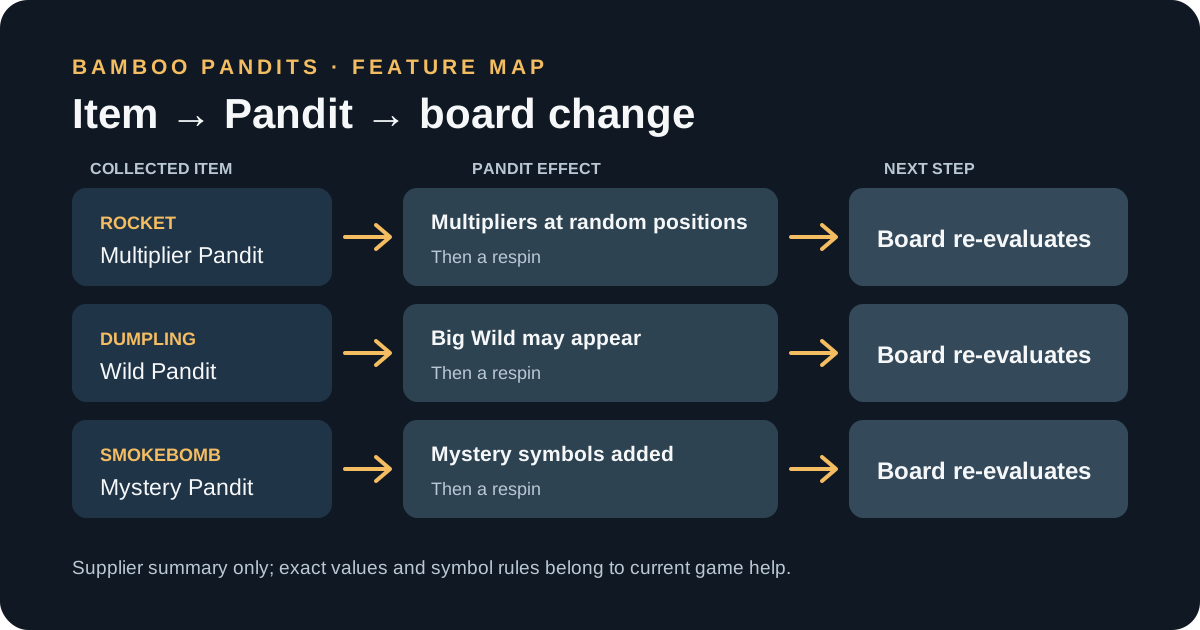
Bamboo Pandits is an ELK Studios slot built around a five-reel, five-row base board and three named Pandit effects. The official product page says that three or more Bonus symbols lead to a wheel and a six-by-six bonus grid with 44 fixed paylines. It also links each Pandit to a collectible: a rocket for the Multiplier Pandit, a dumpling for the Wild Pandit and a smokebomb for the Mystery Pandit. Their possible results include multipliers, a Big Wild or Mystery symbols, followed by a respin. A reader can follow the feature by noting which item was collected and which character responds.
The supplier page lists a potential win of 10,000 times the bet and shows “Release October 6th”. It was checked on 6 October 2026, but the accessible release line does not state a year or guarantee that a New Zealand operator has enabled the slot. The public page does not show a complete paytable, RTP variants, volatility label or stake range. Those values should be reported only after checking the active game’s help.
Identify the title and release notice
The official Bamboo Pandits page is the primary source for the title spelling and the feature summary. On the date checked, it displayed the release notice “October 6th”. Record that wording and the check date; do not turn it into an exact launch hour, a universal operator release or proof of local access. A supplier’s product page is not a casino lobby and does not list every account that may open the game.
The page identifies a five-reel, five-row slot with multipliers, Big Wilds, Mystery symbols, respins and a bonus. It states the 10,000x potential, but it does not establish which currency a casino uses, the amount a player can stake or which mathematical configuration is active. If an operator uses a similar title graphic, compare the full name and rules heading on the loading screen before attaching supplier facts to it.
The official product-sheet link was visible but returned an access-denied response when checked on 6 October 2026. This guide therefore relies on the accessible product page. It does not claim to have read a blocked PDF or tested a live client. If the product sheet later becomes accessible, check for a rules date and settings that could update this summary.
Base board and bonus board are different states
The base game uses a five-by-five board. That tells a reader its visible dimensions, but it does not reveal the base-game line count, the value of ordinary symbols or the complete win calculation. The public supplier text does not expose those fields. Do not copy a payline count from another ELK title or from a third-party page and label it as the base game’s rule.
The bonus has a different specified layout: six by six with 44 fixed paylines. These dimensions describe two separate states, not a conflict. A good rules note labels the state beside each board size. The same note should distinguish the bonus entry condition from the subsequent wheel, then identify what the bonus help says about retriggers, symbol values and settlement. The available summary does not answer every one of those questions.
When reading the operator’s information panel, make two entries in your notes. The base-game entry should capture the displayed board, win method, ordinary symbol values and special-symbol rules. The bonus entry should capture the larger grid, the 44 fixed lines, the wheel transition and which Pandits remain active. If a rule is missing, leave it open instead of filling it from a different game.
What the Bonus symbols tell you
ELK says that three or more Bonus symbols lead to a wheel spin that powers up the Bonus game. This is the published entry condition. The accessible page does not list the wheel’s possible results, their weights or all operator-specific settings, so avoid describing the wheel as if each result were known. It is safer to explain what the page confirms and direct readers to the live help for the exact selection rules.
The product summary says activated Pandits persist throughout the bonus. That statement means a character already activated is not simply discarded at the bonus transition. It does not tell us every effect’s duration, how a multiplier combines with a winning line or whether a Mystery state reveals a particular symbol. Those details remain character-specific and belong to the game help.
A useful observation sequence is: note the symbols that qualify the bonus, read the wheel display, record the board that opens and identify the Pandits already active. Then check the current rules for any retrigger condition and how the 44 lines evaluate. An animation can make the order easier to follow, but a short example is not evidence about how frequently a feature occurs.
Gust of Wind: a possible setup before a spin
The supplier says Gust of Wind may activate before a spin and add multiple feature or Bonus symbols to the reels. “May” matters. The description is a possible setup state, not something that happens before every spin. It also does not publish how many symbols are added in each instance or the probability of an activation.
This effect should be kept separate from the Pandits’ collection actions. Gust of Wind changes the symbols present before the spin. The Multiplier, Wild and Mystery Pandits act after their own item is collected. A reader can note that the two kinds of event have different points in the sequence, but the public summary does not specify how every possible combination is prioritised. Do not invent a universal order for simultaneous features.
When describing a sample, say only what the interface shows: whether symbols were added, which ones appeared, and what the next game state was. One Gust of Wind animation cannot establish a trigger rate or prove that a bonus is more likely. If the active help gives a probability or a rule about eligible symbols, record that source and version explicitly.
Multiplier Pandit: rocket and random positions
The Multiplier Pandit is linked to a collected rocket. The supplier says the effect may add multipliers to random positions and then award a respin. The rocket is the trigger item; the random positions are where multipliers can appear; the respin is the next action. This wording does not provide a multiplier range, number of positions, probability of a useful placement or a formula for combining values.
Do not call the feature a fixed multiplier on the whole wager. To understand a result, inspect the game screen and help: does a multiplier apply to a particular symbol or line, can two values combine, and does a later respin change the marked positions? The accessible supplier summary does not answer those details. The exact operator help should be the primary reference.
A neutral walkthrough can explain what to observe without inventing a payout. If the Multiplier Pandit collects a rocket, note the marked positions, let the respin finish and check whether the resulting win crosses one of those positions. That explains the interface. It does not suggest that a reader can choose a position or improve the random outcome by timing an action.
Wild Pandit: dumpling and Big Wild
The Wild Pandit responds to a dumpling. ELK says it may jump onto the grid as a Big Wild and award a respin. The public description does not state the Big Wild’s dimensions, exact substitution rules, exceptions or duration. Do not infer its size from a different ELK slot that also uses a large Wild.
The sequence is still clear enough to explain: locate the dumpling, observe the character’s move, record the Wild’s position and note the respin. Then check which paying symbols it substitutes for and whether it can replace Bonus or other feature symbols. A familiar label is not a complete settlement rule; studios can give “Wild” symbols different exceptions across products.
The phrase “awards a respin” describes another game action, not a cash prize. A respin can end without a winning combination. The accessible page does not state a separate stake charge for this feature-triggered respin, so do not assert a fee or a monetary value without the current game help.
Mystery Pandit: smokebomb and Mystery symbols
The Mystery Pandit is linked to a smokebomb. The official page says it may add Mystery symbols to random positions before awarding a respin. That differs from the Multiplier Pandit, which adds multiplier positions, and from the Wild Pandit, which creates a Big Wild. They share a broad collectible-and-respin pattern, but their board changes are distinct.
The available source does not say what a Mystery symbol reveals, whether several symbols reveal the same item, which symbols are eligible or how the result is evaluated. Those are useful questions for the operator’s rule panel. Until it answers them, a guide can explain the random placement and follow-on respin without borrowing rules from another game’s Mystery feature.
When documenting a Mystery event, note whether the display reveals the symbol before the respin or during it, which cells changed and what happened to the resulting board. That helps a reader understand the sequence without turning one sample into a probability estimate. Do not claim that a smokebomb improves the chance of a high-paying outcome when the source does not publish a distribution.
Compare the three effects by input and output
| Pandit | Supplier-named item | Published possible effect | Fields to verify in game help |
|---|---|---|---|
| Multiplier | Rocket | Multipliers may appear in random positions, then a respin is awarded | Values, placement count, multiplier combination and settlement |
| Wild | Dumpling | A Big Wild may appear, then a respin is awarded | Wild dimensions, substitutions, exceptions and persistence |
| Mystery | Smokebomb | Mystery symbols may be added in random positions, then a respin is awarded | Reveal rules, eligible symbols and evaluation |
This comparison is intentionally descriptive. The official summary does not rank these effects by expected value, frequency or win potential. A feature with a larger-looking animation is not necessarily a more valuable one. Such a comparison needs version-specific mathematical information, not a marketing summary or a single screen recording.
If more than one effect appears close together, use the game history or written help to work out which item triggered which state. Fast animations can obscure the sequence. If the help explains simultaneous activations or priority, record the exact rule; if it does not, keep the interaction unresolved rather than inventing a formula.
X-iter: price and entry state need a separate check
ELK’s product page says Bamboo Pandits has five X-iter modes. It describes a 2.5-times-bet option with more than three times the chance of reaching the bonus and a 250-times-bet Maxed bonus at the upper end. The public summary does not name every intermediate mode or list all prices, so the current in-game menu is required for a complete table.
The cost notation is a multiple of the selected bet. If a base bet is five units, a 2.5x mode would cost 12.5 units; that is only an arithmetic example, not a recommended stake or a promise about the game’s currency. A higher chance of reaching a bonus is not a guarantee that the bonus pays more than the feature price. “Maxed bonus” is a mode name, not a guaranteed maximum win.
Before choosing a mode, check the price, the state it guarantees or makes more likely, any return figure shown for that configuration and the operator’s restrictions. Include the entire cost in a loss budget. Optional entry can use several times the ordinary stake while still producing a result below its price. The product’s 10,000x ceiling does not reduce the risk of paying to enter a feature.
A casino may omit a feature purchase from its build or disable it in a market. A supplier description is not proof that a menu appears everywhere. If the operator screen has no X-iter menu, do not assume a hidden purchase exists. If it does appear, copy its exact wording and cost from the active screen before publishing.
Maximum win, RTP and settings that remain unknown
ELK states a 10,000x potential. That is a published ceiling, not an average result, a forecast or a guarantee. It does not reveal how often the cap can occur, which mode applies it, or whether every operator version uses the same configuration. Treat the number as a ceiling attached to the supplier’s product page, then verify the active version before making a casino-specific statement.
The accessible page checked on 6 October 2026 did not display a numerical RTP, volatility rating, complete paytable, hit frequency or stake range. Some third-party reviews publish figures, but those listings do not replace the operator’s current help. The official product-sheet link was inaccessible during research. These limits describe the evidence inspected; they are not proof that no official information exists elsewhere.
If an operator’s help displays RTP, retain the full value with the title, version and check date. If it shows two percentages, do not choose the higher one without knowing which is active. If the supplier and operator figures differ, document the discrepancy and ask which build is being offered. RTP describes long-run mathematics for a defined configuration; it cannot predict a short session or the result of one bonus.
Mobile layout and demo boundaries
ELK recommends 1600-by-900 for desktop browsers and a 16:9 ratio if scaling is needed. That is a display recommendation, not evidence that every operator has a tested mobile version. On a narrow screen, inspect whether the six-by-six bonus board remains readable, whether paylines are listed in text, and whether the help panel scrolls without hiding the important controls.
If a symbol table or multiplier label is clipped, rotate the device or open a text version of the rules. Do not guess a missing digit from a small screenshot. The supplier page’s Play button does not prove that a demo is available to a New Zealand visitor, and a demo cannot establish the operator’s real-money RTP, account eligibility or stake limits. No game session or demo was launched for this guide.
New Zealand access and responsible checks
This is an en-NZ page, but it does not say Bamboo Pandits is available in New Zealand. Supplier release wording, an official product page or a studio business licence does not establish local operator access. Check the operator’s current catalogue and the relevant regulator information. Do not use a VPN or another account to work around a geographic restriction.
The Department of Internal Affairs says online casino advertising is prohibited during the current transition and explains that third parties which publish or arrange advertisements are included in the advertising framework. This guide therefore has no operator offer or affiliate link. Before describing any consumer-facing availability, recheck current DIA information and the operator’s own terms.
For a personal play decision, identify the title and version, read its help before staking, set a loss limit in advance and stop at that limit. Feature names and large multipliers are not expected outcomes. An optional mode does not guarantee that the resulting round returns its price. If gambling is becoming difficult to control, step away and contact independent support rather than increasing a stake to recover losses.
A field-by-field title check
Before relying on a Bamboo Pandits setting, verify these fields from the exact source you can access: the displayed title and provider; the base-board dimensions and win method; the paying-symbol table; the Bonus-symbol condition; the wheel’s options; the 6-by-6 bonus board and 44 fixed lines; the meaning of each persistent Pandit; the Wild’s size and exceptions; the Mystery reveal rule; the multiplier values and settlement; and every X-iter mode offered by the operator.
Then record the displayed RTP, volatility, maximum win, currency and minimum/maximum bet only if the active help states them. Note the rules date, version and jurisdiction. If any answer is missing, mark it unverified. This checklist helps a reader distinguish a useful rules reference from a promotional summary: it shows what is known and which question still belongs to the operator.
Questions readers commonly ask
What happens when three Bonus symbols land?
The supplier says that three or more Bonus symbols lead to a wheel spin and power up the Bonus game. The bonus uses a six-by-six board with 44 fixed paylines. The accessible page does not list every wheel result or operator-specific rule, so check the active help for those details.
What does each Pandit collect?
The page associates a rocket with the Multiplier Pandit, a dumpling with the Wild Pandit and a smokebomb with the Mystery Pandit. Each item leads to a different possible board effect. The source does not state a frequency or probability for these items.
Do activated Pandits stay in the bonus?
ELK says activated Pandits persist throughout the Bonus game. The exact effect of each character still depends on its own rules. Check the active help for multiplier duration, Wild behaviour and Mystery-symbol reveal conditions.
Is 10,000x the expected return?
No. It is the potential ceiling stated on the supplier page. A maximum is not an average, forecast or guarantee, and it does not show how frequently the outcome occurs.
Does every operator offer all five X-iter modes?
The supplier describes five modes for the product, but an operator may not show every purchase in every build or jurisdiction. Read the menu and help for the exact game you can access. The public summary does not list all intermediate costs.
Is the RTP 96%?
That value appears on some third-party pages, but it was not present in the accessible official product text checked here. The product-sheet link returned an access-denied response. Confirm the active percentage in the operator’s game help rather than importing a number from another version.
Can I play it in New Zealand?
The supplier’s page does not establish New Zealand operator availability. That depends on the operator’s current catalogue, its rules and the customer’s eligibility. This guide does not confirm that any local operator carries the game.
Does X-iter guarantee a win?
No. A mode can enter or increase the chance of a feature without guaranteeing a positive return. Check the full cost and rules before deciding whether to use it.
For independent support information, see the site’s New Zealand safer gambling guide. This article is informational and contains no casino offer.
Sources and verification boundary
- ELK Studios official Bamboo Pandits product page — base/bonus boards, feature descriptions, X-iter summary, potential maximum and display recommendation; checked 6 October 2026.
- ELK product-sheet link on the official page — returned access denied (403) on 6 October 2026; not used as evidence.
- Competitor pages searched/reviewed: AboutSlots, OLBG, OnlineCasinoGround, Chase the Scatter, BigWinBoard. Some results returned cache misses when opened. Their numerical settings were not treated as operator-confirmed.
- DIA advertiser guidance and customer guidance — checked 6 October 2026.
