ELK Studios game rules · South Island guide
Mystic Orbs: rules, Wild Orbs and settings to verify
 Best casinos available in New ZealandUpdated 7 November 2026

ELK describes Mystic Orbs as a five-reel, five-row slot with Wild Orbs, Charged Wild Orbs, symbol upgrades, respins, multipliers, cash prizes and bonus entry on a Feature Reel. A Wild Orb activates the feature above it; a Charged Wild Orb activates all features on that feature reel. Collecting five Orbs or landing the Bonus feature can start a bonus game with a persistent multiplier. The public Game Data Sheet was inaccessible during review, so the active RTP, volatility, cap, stake range and New Zealand availability remain unverified.
The short answer
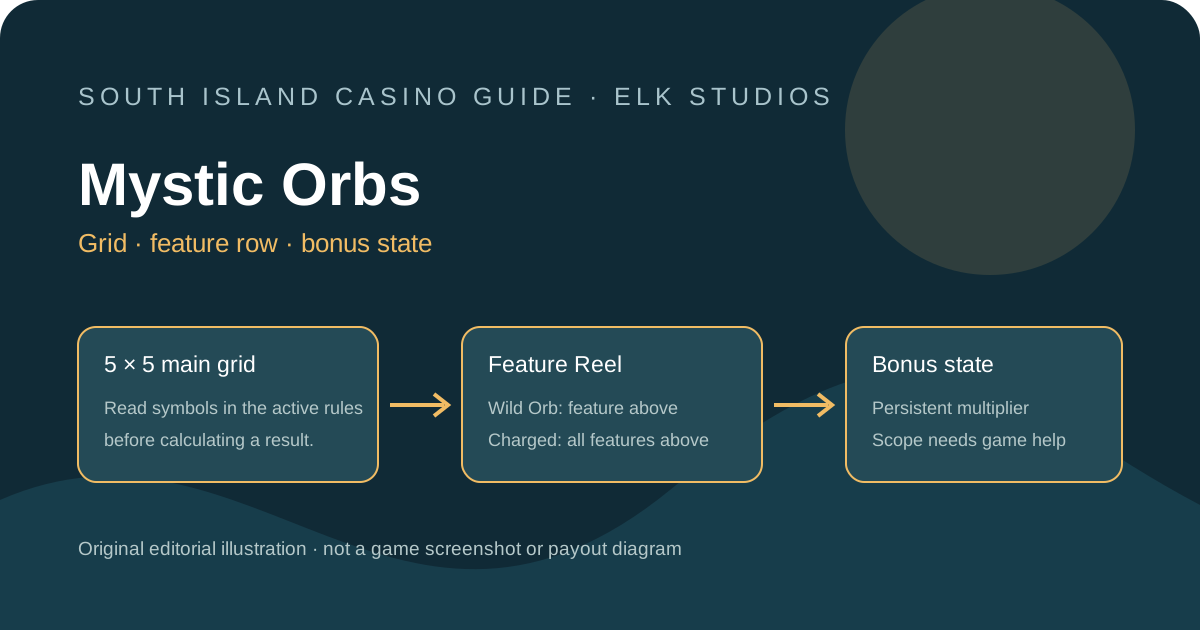
Mystic Orbs is a five-reel, five-row slot from ELK Studios. The feature that gives its rules their shape sits above the main grid: ELK calls it the Feature Reel and says it can hold up to five features. A Wild Orb activates the feature vertically above it, while a Charged Wild Orb activates all features on that feature reel. The public description names symbol upgrades, multipliers, respins, cash prizes and bonus entry as possible feature effects. A bonus can begin after collecting five Orbs or triggering the Bonus symbol in the Feature Reel; its multiplier persists during that bonus.
Those points describe the supplier’s public mechanics, not every rule needed to predict a payout. The accessible official Game Data Sheet returned 403 on 7 October 2026, and no active casino help screen was supplied. This guide therefore does not verify a numerical RTP, volatility, hit rate, maximum win, stake range or the availability of any particular option in New Zealand. Read the exact client help before staking and do not substitute figures from a third-party review.
Identify the exact game and its visible areas
The provider’s page identifies the title as Mystic Orbs and labels it “Live Now”. That means ELK lists the product in its catalogue; it does not confirm that a particular casino carries it, that the game is enabled for a New Zealand account, or that an operator uses a specific return setting. Verify the game name and ELK Studios credit in the client’s own information screen. A thumbnail, search snippet or name shared by another slot is not enough to establish the loaded version.
The five-by-five main grid is the play area described by ELK. Above it is a Feature Reel containing modifiers. Treat the two regions as different parts of the interface rather than counting the Feature Reel as a sixth ordinary row. The product page says features become active through the Wild Orb relationship with the reel above it. A visible icon in that upper strip is therefore not automatically an already-completed cash win or a modifier that has affected the main grid.
When you inspect a round, record what is in the main grid, which Orb appears, the corresponding feature directly above it and whether that effect actually starts. Then watch the feature reel after activation: ELK says that once a feature is activated, a new feature is added. The public summary does not explain every order, animation, selection weight or reset boundary. These details belong to the live rules and paytable, not to assumptions based on the artwork.
What the Feature Reel does
ELK describes the Feature Reel as populated with up to five features at the start of each game round. When a feature is activated, another feature is added. The feature set includes symbol upgrades, multipliers, respins, cash prizes and bonus entry. This is a changing menu of possible modifiers above the grid. It is not a published probability table: “up to five” does not say that every round begins with five, and the public page does not state the chance of each item or whether all are equally likely.
The phrase “feature reel” is easy to read too literally. It does not mean that the strip must be evaluated like an ordinary reel of paying symbols on every spin. The help should clarify which visible icons are modifiers, how a feature is selected, whether a feature remains after use and how newly added effects appear. A modifier can change what follows, but the title and placement alone do not reveal the exact settlement. Use the label shown in the active game and compare it with the help illustration.
An orderly observation separates three events. First, a round shows one or more modifiers. Second, an Orb or other stated trigger activates an effect. Third, the game evaluates the changed grid and records a result. Keeping these stages separate avoids claiming that a multiplier has paid when it has only been displayed, or that a respin guarantees a win. The history panel, if supplied by the operator, can help reconstruct the sequence after the animation ends.
The Feature Reel can include direct cash prizes and bonus entry as well as effects that alter symbols. These are different categories. A cash prize is a listed result under the game’s rules; an upgrade changes a symbol; a multiplier changes a later calculation only if its stated conditions are met; respins repeat a defined part of the feature sequence. The help needs to say where each cash value appears and whether it is credited immediately, held for a bonus or multiplied by another event.
Wild Orb and Charged Wild Orb
ELK says both the Wild Orb and Charged Wild Orb are Wild symbols. Landing a Wild Orb activates the feature vertically above it on the Feature Reel. Landing a Charged Wild Orb activates all features on that feature reel. The distinction is a scope distinction: one Orb activates the corresponding feature, while the charged version affects every feature in the relevant vertical column. The active help should confirm what counts as “above” when symbols, reel labels or animations make the column less obvious.
Do not merge the two effects into the broad statement “an Orb activates all features”. The supplier describes the charged Orb as the all-feature trigger. For the ordinary Wild Orb, follow the matching vertical position. If the feature strip changes as part of the round, note the order: the modifier lineup may have to be established before the Orb’s column is known. The public page does not specify whether a feature row changes before or after each trigger, so do not infer the sequence from another ELK slot.
The word Wild also needs a paytable definition. It may substitute for certain paying symbols in the main grid, but the official public summary’s Wild Orb description focuses on feature activation. The client help should explicitly state whether it substitutes, which symbols it cannot replace and whether a charged version differs in substitution. Until that is visible, the safest account is the confirmed feature activation rule, not an expanded claim about every Wild use.
For a neutral example, imagine an ordinary Wild Orb lands below one active modifier. The supplier description supports checking whether that modifier is activated. It does not tell us whether the effect will produce a win, what amount it can return or whether another feature in a neighbouring column also activates. If the Orb is Charged, the public description says all features on its feature reel activate. The values and interactions still depend on the game’s rules. This distinction makes a useful review possible without manufacturing a result.
Symbol upgrades, multipliers and respins
An upgrade feature changes a symbol according to a rule the active help should identify. A review should ask which symbols are eligible, whether the choice is random or fixed, when the conversion happens and whether the new symbol is evaluated in the current result or a later one. ELK names symbol upgrades but does not publish the complete selection logic in its short overview. A diagram or a third-party screenshot cannot establish the active operator’s precise rule.
A multiplier also needs a scope. It could apply to one prize, one feature, a bonus total or an outcome after another event. Mystic Orbs’ official overview separately describes multipliers on the Feature Reel and a persistent multiplier during the bonus game. Do not assume the first is the same as the bonus multiplier. When the game displays a multiplier, look for its start condition, what result it affects, whether multiple multipliers combine and the event that resets it.
Respins are another named modifier, but the public page does not state their trigger, number, stop condition or whether a win is required to continue. These are important details for a volatility description. A respin repeats part of the game state; it does not mean an additional stake is always collected, and it is not a prediction that a payout will land. The client’s help should identify the exact loop and when the current round closes.
The game can also show cash prizes and bonus entry on the Feature Reel. Check whether each effect is independent or can be combined. If a symbol upgrade and multiplier appear together, do not automatically multiply a cash award unless the help says the multiplier applies to that award. If a respin occurs after a cash prize, verify whether it repeats the same grid or continues with newly supplied symbols. The rules, not the names alone, decide these interactions.
Bonus game and persistent multiplier
ELK describes two routes into the bonus: collect five Orbs or trigger the Bonus symbol in the Feature Reel. That provides a useful distinction between a collection threshold and a direct feature trigger. The accessible summary does not say how a collected Orb is counted, whether the five must appear in one paid round, whether a partial collection carries forward, or whether a Feature Reel trigger can happen on every spin. Those conditions should be taken from the in-client help before they are described as exact rules.
The bonus game has a persistent multiplier that can increase in value. “Persistent” here refers to the bonus state described by the supplier; it does not mean that a value carries into another session, remains after the bonus ends, or affects unrelated paid rounds. Check when the multiplier begins, which event increases it, whether it applies to each bonus result or to the final total, and what ends its persistence. The official description says it can increase but does not list a starting value, increment, maximum or distribution.
ELK also says an Orb payout pays the Orb’s value multiplied by the placed bet. That is the only payout formula stated in the public overview. It does not reveal the values an Orb can show, whether all Orb payouts use the same bet basis, how a displayed prize is rounded or how other features modify the result. A review should quote the formula only with that boundary and direct the reader to the active paytable for the values.
Keep base-game wins, feature cash prizes, Orb payouts and bonus total in separate notes. A game history may display a single round total after several events. That total can hide which feature contributed each amount. If you are checking a sample session, record the original stake, each feature’s label, any multiplier, the bonus state and the final credited amount. This does not prove how the next round will behave; it makes one completed result understandable.
X-iter: a different way to enter an action
ELK’s product page describes X-iter as five game modes ranging from a 5× bet with a guaranteed win up to a 500× Super Bonus where all Orbs are charged. The exact mode list, mode cost, selection rules and jurisdiction restrictions must be checked in the client. The supplier’s overview gives the endpoints and the number of modes, not a complete menu or assurance that the option appears for every operator or country.
The word “guaranteed” needs its stated scope. The product summary describes a guaranteed win for the lowest X-iter mode; this should not be rewritten as a guaranteed profit or a promise that the win will exceed the cost of the selected mode. A purchased game state still has a price and a result under its paytable. Compare the cost against the usual stake, read what the mode guarantees, and avoid inferring an expected return from the word alone.
The 500× Super Bonus is likewise a choice with a much larger stated cost than the starting mode. ELK says all Orbs are charged for that mode. That changes the starting feature conditions; it does not define the final payout or guarantee any specific symbol combination. If the operator offers these modes, the menu should list the cost and the selected bonus rules before confirmation. If the option is absent, do not treat a review from another market as proof that it should be available.
X-iter may be restricted by jurisdiction, operator policy or product configuration. Verify the actual menu only within a permitted client and do not use a demonstration from another country to establish access. The mode menu is not part of the standard base-game outcome process. A useful review separates normal spins, the bonus triggered naturally under the rules, and any optional paid entry or feature mode.
RTP, volatility, cap and other settings
RTP is a long-run theoretical return for a defined game configuration. It does not promise a particular session result or say what the next spin will pay. A title may be supplied with more than one configuration, and an operator’s client may use one particular setting. To verify the active value, identify the game version, operator, client date and help-screen wording. A number in a third-party article is not sufficient evidence that the same setting is active in a New Zealand account.
The official Mystic Orbs page links a Game Data Sheet, but the PDF returned 403 when checked on 7 October 2026. The readable page documents the grid and mechanics, not a current numerical configuration. No casino client or operator help was provided for this review. This guide therefore leaves RTP variants, active RTP, volatility, hit frequency, maximum win and stake limits unconfirmed. A competitor summary that prints one number, or an apparent variant range, does not resolve the setting in a particular client.
Volatility describes the distribution of outcomes, not a guaranteed pattern of wins and losses. A modifier-rich reel does not prove high or low volatility. Maximum win is a separate limit, and it can be different from the maximum shown in a demo, paytable, data sheet or operator configuration. Hit frequency also has its own definition: it might count any paid result, a feature trigger or a return above a threshold. Do not compare figures until the measurement is defined.
When a reliable help screen becomes available, note the exact value and the stated version rather than saying “Mystic Orbs RTP” as if every client were identical. Record whether the field is theoretical return, the allowed range or the specific active setting. If the help only shows one figure, do not invent additional variants. If it shows a range but not the active configuration, report the range and say the selected value is not shown.
A careful way to inspect the game
Begin with the game information page. Confirm the title, supplier, five-by-five layout and whether the operator says the game is available for the account’s jurisdiction. Open the written rules and identify the Feature Reel, Wild Orb, Charged Wild Orb, bonus trigger, paytable, settings and any X-iter menu. If the client offers a demo, use it only where the operator makes it available and where local rules allow it. A demo can teach interface labels; it cannot establish that the same RTP, stakes or bonus options apply in real play.
On a sample round, note the feature lineup, Orb type, vertical feature position and event order. Then check the result/history view to see whether the game records a cash prize, a modifier, a respin or a bonus entry. Do not add a potential bonus to a current payout unless it actually triggers and the rules say how it settles. This small checklist helps distinguish a feature animation from a paid outcome.
For a mobile layout, ensure the entire five-by-five grid and the Feature Reel remain visible or can be inspected without hiding the help and stake controls. Use the operator’s full-screen or orientation setting if available, but do not assume that a desktop recommendation guarantees performance on a phone. The supplier’s public page recommends a 16:9 ratio when scaling for desktop. That is a display recommendation, not proof that any specific mobile client or operator has been tested.
This guide has not logged into an operator, played the game, confirmed a demo or measured mobile performance. The diagram is an original explanation of the public feature relationship, not a screenshot. For the site’s general guidance on setting limits, see safer gambling; for the developer’s catalogue context, use the ELK Studios games guide.
Common reading mistakes
One mistake is to count the upper Feature Reel as part of the five-by-five grid. Keep the areas separate until help says how they interact. A second is to treat every icon as active as soon as it appears. The supplier says an Orb activates features; the icon’s presence may only describe a potential effect before the trigger occurs.
A third is to use “Wild” as shorthand for every behavior. The public description calls the Orbs Wild symbols and explains feature activation. It does not provide a complete substitution list, so that detail still needs the game help. A fourth mistake is to assume the Charged Orb’s all-feature effect applies across the whole screen. ELK’s wording limits it to the features on that feature reel; do not expand the scope to neighbouring columns without evidence.
Players can also confuse a multiplier with a return. A multiplier changes a payout only under a stated calculation; it is not itself a guaranteed award. Similarly, the persistent bonus multiplier lasts in the named bonus state, not indefinitely. X-iter’s purchase cost should be treated as an additional cost, not as proof of value. Keep each label attached to its actual rule.
Finally, do not treat a history list, a previous Orb pattern or a round with several modifiers as evidence that the next one is more likely to trigger a bonus. Past display states do not establish future outcomes. Set a session budget before playing, avoid increasing it to recover a loss and pause if the mechanics or stake level are unclear.
Frequently asked questions
How many reels and rows does Mystic Orbs have?
ELK describes a five-reel, five-row main grid. The Feature Reel above it is a separate modifier area, not simply another standard row.
What is the difference between a Wild Orb and a Charged Wild Orb?
The supplier says a Wild Orb activates the feature above it vertically. A Charged Wild Orb activates all features on its feature reel.
How does the bonus start?
ELK lists two routes: collect five Orbs or trigger the Bonus symbol in the Feature Reel. The exact counting and carryover conditions need the active game help.
Does the bonus multiplier reset after each win?
The official summary says it persists and can increase during the bonus. It does not provide the exact reset or increment rules; check the client help.
What is Mystic Orbs’ RTP?
The accessible supplier page does not show an active RTP value, and its linked Game Data PDF returned 403 on 7 October 2026. No operator setting is verified here.
Is X-iter available to every player?
No universal availability is established. ELK describes five X-iter modes, but operator and jurisdiction settings can affect the menu. Check the actual client before relying on it.
Can I play Mystic Orbs in New Zealand?
This guide does not verify a New Zealand operator or account that offers the title. Check current, lawful operator information rather than assuming supplier catalogue status means local access.
Sources and verification boundary
- ELK Studios, Mystic Orbs official product page, accessed 7 October 2026: https://www.elk-studios.com/games/mystic-orbs/. Primary source for grid, Wild Orb/Charged Wild Orb behaviour, feature list, bonus trigger, Orb payout wording and X-iter summary.
- ELK Studios, Game Assets catalogue, accessed 7 October 2026: https://www.elk-studios.com/promo-package/. The linked Mystic Orbs Game Data Sheet returned HTTP 403 on 7 October 2026.
- Secondary pages reviewed: SlotCatalog, Mystic Orbs slot page (https://slotcatalog.com/en/slots/Mystic-Orbs?cISO=DE); Gambling Zone, Mystic Orbs review (https://www.gamblingzone.com/uk/slots/mystic-orbs/); Search Casino, Mystic Orbs review (https://search-casino.com/games/slots/mystic-orbs/); each accessed 7 October 2026. Numeric settings and unsupported details were not adopted.
- Department of Internal Affairs advertiser guidance, accessed 7 October 2026: https://www.dia.govt.nz/Online-gambling-for-advertisers. No CPA link is included pending compliance review.
