ELK Studios game rules · South Island guide
Pacific Gold: rules, features and settings to verify
 Best casinos available in New ZealandUpdated 7 November 2026

Pacific Gold is a six-reel, four-row ELK Studios slot with dropping symbols, stacked and Big Symbols, the collecting Ghost Box, Pacific Wave Free Drops and a growing Power Stack. ELK describes winning symbols being collected, larger symbols being split into 1×1 instances, and collected symbols being released after no more wins remain. Pacific Wave and Power Stack have distinct roles during avalanches. This guide separates those mechanics from RTP, volatility, cap and operator settings that require current help.
The short answer
ELK describes Pacific Gold as a six-reel, four-row slot with dropping symbols, vertically and horizontally stacked symbols, Big Symbols and a collection feature called Ghost Box. The Ghost Box collects symbols that are part of a win; larger symbols are broken into individual 1×1 symbols. When there are no more wins, the box releases what it has collected, and those symbols drop back in from above. Three or more Bonus symbols trigger Pacific Wave Free Drops, where at least one Pacific Wave appears on every free drop and the feature can retrigger. A Pacific Wave is a horizontal stack that can leave Wilds in the empty spaces beneath it. The Power Stack begins as four identical payout symbols and grows by two symbol instances for each avalanche cycle it is not part of.
These supplier descriptions explain a feature loop, not the full paytable. ELK’s official Game Data Sheet returned HTTP 403 when checked on 7 October 2026, and no operator help screen was available. RTP, volatility, hit rate, win cap, stake range, event probabilities and New Zealand availability remain unverified here.
Confirm the product before reading a review
Start with the exact client title, “Pacific Gold,” and the supplier credit. A casino may display a cropped logo or a thumbnail without the complete rules. Check the in-game information panel and compare it with ELK’s official product page. A similar “Gold” title from another studio is not the same product, and another ELK game with a Ghost or collecting feature does not inherit Pacific Gold’s collection sequence.
The supplier profile describes this game as six reels and four rows. That is its baseline layout, while the feature rules can change symbol shapes and the contents of a later drop. Keep title identity, grid dimensions and active state together in notes. If the client has another title or an alternate label, do not use this review until the rule text is matched.
The official profile links a Game Data Sheet and the asset catalogue lists Pacific Gold. The PDF link returned 403 during this check. This matters because current secondary reviews publish specific RTP and win-cap numbers that could refer to different configurations or originate from unsourced summaries. The article does not select a number from those pages. A numeric review needs a readable supplier source or the active operator’s game help.
ELK’s public feature copy is still useful for the high-level mechanics. It names the Ghost Box, Pacific Wave and Power Stack and explains how those pieces interact with wins or avalanches. Those descriptions can be discussed accurately while being explicit that the exact values, settlement and local game distribution have not been established.
Six reels, four rows and dropping symbols
ELK’s page describes a six-reel, four-row grid with dropping symbols. A dropping-symbol game can evaluate a layout, remove symbols that form wins and allow another arrangement to fall into place. The supplier’s public copy identifies this general movement, but does not provide every base-game rule: qualifying symbol count, adjacency or line/ways evaluation, whether all directions count, the paytable or how a round ends after several drops.
Read the active help for the starting rule before interpreting the animation. Find out what makes a combination pay, which symbols substitute for others and how the game treats stacked or Big Symbols. Then look at the grid after a winning group is removed. The following arrangement is part of the same chain unless the rules indicate otherwise; a drop is not automatically a new paid spin. The history panel can show whether the chain produced additional wins or simply stopped.
The baseline 6×4 dimensions should not be confused with a count of ways or winning patterns. Six reels and four rows tell you there are up to twenty-four ordinary grid cells, but stacked and Big Symbols may occupy multiple cells or be displayed as a single object. Only the title’s help establishes how positions count toward a qualifying result. A visually adjacent set of symbols is not sufficient evidence that it forms a win.
For a clear explanation, track three things independently: the paid spin, each subsequent avalanche/drop and the final settlement. If the Ghost Box is active, record which symbols it has collected before a release. That observation separates the standard tumble loop from the named collector feature and avoids over-crediting an animation for a result that the paytable does not show.
Ghost Box collection and release
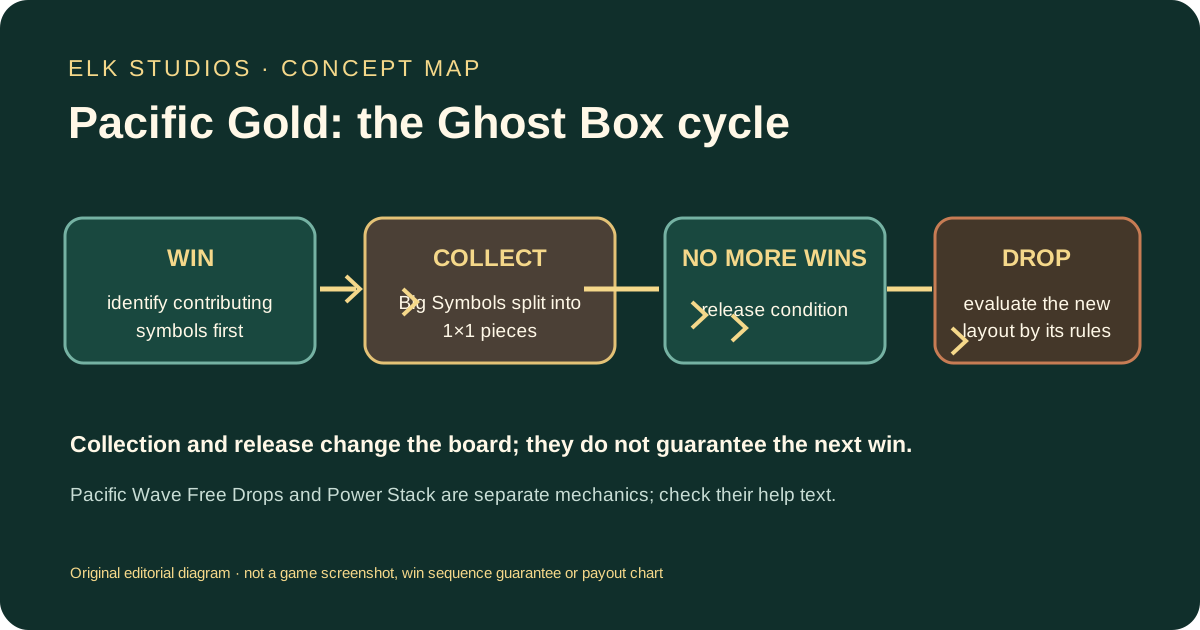
ELK says the Ghost Box collects all symbols that are part of a win. Bigger symbols are broken apart and collected as individual 1×1 symbols. When there are no more wins, the box explodes and releases the collected symbols, which drop back in from above. The sequence has distinct stages: a qualifying win, collection, a stop in further wins, release, then a new layout. The box is a stateful feature, not just a visual frame around symbols.
The phrase “all symbols which are part of a win” is tied to winning symbols. It does not say that every symbol on the grid enters the box. A symbol that looks valuable but is not part of a qualifying combination should not be assumed to be collected. Check the client animation and help text to see how it identifies contributing positions. The feature may show a collection counter or visual contents, but the paytable determines how each collected symbol is treated.
Splitting a Big Symbol into 1×1 units is another step worth explaining precisely. A larger image can occupy a multi-cell shape; breaking it into individual units changes how those pieces are stored and later released. It does not automatically mean the pieces pay individually or guarantee that they will form a new winning combination after the drop. The game needs to evaluate the released layout under its ordinary rules.
When the box releases its contents, the feature loop can continue if a new layout produces another win. ELK’s public summary says it releases the symbols after there are no more wins and drops them in from above. It does not specify in accessible prose whether an additional collection cycle is always possible or the exact stopping condition after a release. The active client help should define whether newly formed wins refill the box and how the overall spin ends.
One useful round log is: initial grid, win positions, symbols collected, any Big Symbol split, end of current win chain, Ghost Box release and resulting drop. Keep the amount won separate from the set of symbols in the box. If the interface reports a final total, compare it with the itemised results rather than assuming every stored symbol has already paid.
Pacific Wave and the Free Drops feature
ELK says three or more Bonus symbols trigger Pacific Wave Free Drops. At least one Pacific Wave is dropped in every free drop, and the Free Drops can retrigger. The supplier describes a Pacific Wave as a horizontal stack of identical symbols in sizes 1×2, 1×3 or 1×4. Empty spaces beneath the wave are filled with Wild symbols. Those mechanics create a connection among a stack’s width, the spaces under it and the next symbol evaluation.
Keep the guaranteed wave placement in the feature separate from the question of whether the result wins. “At least one Pacific Wave per free drop” describes a feature appearance, not a promise that the wave will connect with a payable combination. The Wild positions below it fill empty spaces under the stack as described; they only matter to settlement if they participate under the active paytable and Wild rules.
At bonus entry, record the trigger symbols and the Free Drops count shown by the client. The supplier’s overview does not state the exact initial count or every retrigger condition. During each free drop, note the Pacific Wave size and where it lands, whether empty spaces beneath it are filled with Wilds and whether the resulting symbols win. If the bonus retriggers, record which symbols caused the retrigger and how the remaining count changes.
The term “Free Drops” refers to a feature mode in the game, not an independent guarantee or a separate balance. Confirm how it accounts for the initial wager and whether the feature can continue after a retrigger. Do not infer the chance of triggering from the three-symbol threshold. A threshold states what condition activates a feature; probability requires separate math data.
The help should also distinguish Pacific Wave Free Drops from any other optional feature mode listed by the client. A product page may mention instant-start modes, but such modes can involve optional costs and separate conditions. This guide describes how to read the ordinary feature and does not recommend purchasing any mode.
Power Stack and avalanche cycles
ELK says the Power Stack represents a stack of four identical payout symbols. It grows by two more symbol instances for each avalanche cycle that it is not part of. The key condition is negative: the stack grows when that cycle does not involve it. A player who assumes the stack grows on every avalanche will misunderstand the supplier’s description.
To follow the stack, note its initial symbol type and size, then inspect each avalanche cycle. Was the Power Stack part of a qualifying win? If so, the supplier’s stated growth condition is not met for that cycle. If not, the stack increases by two symbol instances according to the public overview. The active rules should explain how it is displayed after growing and how the next evaluation treats its component symbols.
The stack’s increase does not itself say that its value rises, that it guarantees a pay or that it grows without limit. “Two symbol instances” is a structural count. The paytable must explain how those identical payout symbols form combinations and how a stack that spans multiple positions is evaluated. Do not substitute a multiplier interpretation for a symbol-count mechanic.
Power Stack, Ghost Box and Pacific Wave can each affect the visual arrangement, but the public ELK summary does not say that all three always appear together. Treat them as separate mechanisms unless the current game help documents an interaction. If two features are active in the same round, record their timing and check whether one resolves before the other. Do not invent a priority rule from a single display.
Distinguishing a feature event from a payout
Pacific Gold uses several visual state changes: dropping symbols, collection into the Ghost Box, splitting larger symbols, the release drop, a wave stack, Wilds beneath a wave and a growing Power Stack. To read a round correctly, ask at each step whether the game has only changed the board, or whether it has also evaluated a qualifying win. A feature animation can be significant without changing the final balance.
The result panel is the bridge between mechanics and settlement. It should identify the symbol combination and award, or show that a chain ended without a payable event. If the client offers a round history, check whether each avalanche is separately listed, how the Ghost Box release is represented and whether the Free Drops total is grouped into one bonus outcome. Do not add visible symbol values by hand unless the rules explain that method.
An example can show the sequence without making a prediction. A qualifying combination appears, its contributing symbols enter the box, a larger symbol is shown as individual pieces, the win chain stops, and the box releases the collection into a new layout. That illustrates the published flow. It does not say that the released set will match, that the next layout pays, or that the same feature appears at a particular rate.
Keep event order factual. If the client shows a Power Stack growing during a chain, verify whether that avalanche cycle was not part of its win as the supplier description requires. If a wave appears during Free Drops, verify its width and any Wild positions. This method makes the review useful while avoiding unsupported commentary such as “the collector makes every round pay more”.
RTP and alternate settings
RTP is a theoretical statistic over a very large number of game outcomes for a defined configuration. It is not a guarantee for one session and not the probability that a given spin returns the full stake. A game may be distributed with alternate settings, and a review has to identify which configuration it describes rather than presenting a universal value.
ELK’s Pacific Gold product page links a Game Data Sheet. The official asset catalogue also lists Pacific Gold. When checked on 7 October 2026, the linked data PDF returned 403 Forbidden. The accessible product page establishes the qualitative mechanics but does not provide a readable RTP table. No specific operator’s client was supplied. Therefore this review does not state a numeric RTP variant or claim that an operator in New Zealand uses a particular setting.
To verify a value later, open the help or information panel inside the exact game version. Record the title, provider, operator, viewed date, version if shown and the RTP wording exactly as presented. If the screen lists several return settings, identify which one is active rather than copying the list as though all values apply at once. If help does not show the percentage, mark it as not shown and request the documentation from the operator.
Third-party review pages may be useful for spotting terms such as “avalanche”, “collector” or “bonus”, but they do not replace the active rules. Numbers can differ because of configuration, region, date or an incorrect game match. Repeated figures on several websites are not independent confirmation if they trace back to the same source. This page withholds values until they can be tied to primary evidence.
Volatility, hit rate and maximum win
The accessible ELK overview does not state a verified volatility rating, hit frequency or maximum win for the active operator build. Its linked game-data PDF was inaccessible, so this review does not assign a label or import numeric figures from competitor pages. Feature complexity is not a statistical classification. A sequence with repeated drops can finish without a qualifying outcome; a simple-looking round can still pay according to the rules.
Volatility is about the distribution of returns over time, not how exciting an animation appears. A small sample of spins cannot establish it, and a long break between features does not prove that a bonus is due. If a client provides a volatility label, record it and attribute it to that version. If the panel is silent, report that absence rather than describing an impression as a fact.
The maximum-win field also needs exact wording. If a client lists a cap, check whether it is a multiple of the stake, whether it applies per spin or across a feature, and what happens to a round that is still resolving. A Power Stack count or a visible Wild pattern is not a win-cap value. The size of a Ghost Box collection is not a maximum payout either.
Hit rate and bonus probability should be sourced separately from a valid game-data file or operator rules. The fact that three or more Bonus symbols trigger Free Drops does not quantify how often those symbols appear. Do not convert a condition into an expected waiting time. Where a numeric field cannot be verified, an honest “not confirmed” is more informative than precision borrowed from another title or casino.
Reading the paytable and round history
Use the paytable to establish which symbols pay, the sequence or positions required and how Wilds substitute. Then check how the game treats stacked symbols, Big Symbols, 1×1 pieces released by the Ghost Box, Pacific Wave stacks and the Power Stack. The supplier summary describes these feature objects, but the paytable determines how they count toward an actual award.
For a single round, compare the bet display with the final win display and the history’s component awards. If there are multiple avalanches, note whether the result panel combines them. If a bonus retriggers, record the additional feature state separately from any immediately paid win. If a displayed amount is rounded to the local currency, use the client’s official settlement history rather than recalculating from the screen image.
Check whether the help explains when the Ghost Box releases. The supplier says it happens when no more wins remain. If an operator client shows a release at another moment, record the exact version and seek clarification instead of assuming the supplier summary covers every configuration. Likewise, check what “empty spaces beneath the wave” means in the current grid and whether its Wilds remain for one evaluation or a longer feature state.
The round history is also useful for auditability. It can help distinguish a feature animation from the event that paid. A good review should be able to explain where its game-rule statements came from, which screen or document verifies a number and which uncertain detail remains unanswered. No test results are claimed in this guide because no live client was opened.
Mobile layout, demo and New Zealand access
ELK’s product page recommends a 1600×900 desktop resolution and a 16:9 ratio if scaling is required. This is not a certification of mobile support. The page also contains a supplier play link, but following that link would not establish casino availability in New Zealand. No mobile device, operator client or demo was tested for this review.
If a casino lists Pacific Gold on a phone or tablet, check whether the six-reel grid, stacked symbols, Ghost Box contents and feature history remain readable. The Ghost Box can hold several collected symbols; make sure that its contents are not hidden by a pop-up or a small overlay. Confirm that the paytable is reachable before a wager and that the close control returns to the same round or lobby state.
A demo should be identified by title and version. It may use simulated credits or omit market-specific settings. A demo can be a useful way to understand the order of an avalanche, box release and subsequent drop; it cannot verify a real-money casino’s RTP, country access or exact configuration. This package did not verify a demo route.
ELK’s product status does not prove a casino offer is available to a person in New Zealand. DIA’s current guidance discusses restrictions on online casino advertising and obligations for third parties. This affiliate-site draft therefore contains no CPA buttons while compliance review is pending. The existing /go/south/south-cashdesk-8a14.php route was not linked, altered or opened.
A specific checklist for Pacific Gold
For an update based on the active client, record: exact title and provider; grid and win evaluation; meaning of dropping symbols; how stacked and Big Symbols count; which winning symbols the Ghost Box collects; how Big Symbols are split; what ends collection; when contents are released; whether a new win can restart the sequence; the Pacific Wave trigger; initial Free Drops count; retrigger condition; wave widths; Wild spaces beneath the wave; Power Stack starting count and growth condition; RTP setting; volatility; cap; stake range; mobile layout; demo version; and country eligibility.
For the Ghost Box, capture one cycle without assuming the game will repeat: mark qualifying win positions, symbols removed from the grid, pieces stored, the moment no further win is present and the release result. For the Power Stack, mark each avalanche and whether the stack contributed to it. For a Pacific Wave, note whether the stack’s empty lower spaces display Wilds, then check if those Wilds connect to an eligible symbol sequence.
This is not a recommendation to play or a prediction exercise. The record helps describe the mechanics accurately and identify missing source data. If the game help omits a field, leave it unfilled and ask for the operator’s rules or a data sheet with a title/version match. Never fill the gap from a different ELK product merely because the feature terminology sounds similar.
Questions readers ask
What does the Ghost Box collect?
ELK says it collects symbols that are part of a win. Larger symbols are split into individual 1×1 symbols for collection. The help should clarify exactly which positions contribute in the active build.
When does the Ghost Box release symbols?
The supplier says it releases the collection when there are no more wins, then drops the symbols back in from above. The full chain and whether a later win can restart collection should be confirmed in client help.
What is a Pacific Wave?
It is a horizontal stack of identical symbols, described by ELK in sizes 1×2, 1×3 or 1×4. Empty positions below the wave are filled with Wilds. The feature description does not guarantee a win.
How does the Power Stack grow?
ELK describes a stack of four identical payout symbols that gains two symbol instances for each avalanche cycle it is not part of. The paytable determines how the enlarged stack is evaluated.
What is Pacific Gold’s RTP or volatility?
Neither was confirmed for an operator configuration. The linked official data sheet returned 403 on 7 October 2026 and no current game help was supplied.
For the provider context, see the ELK Studios guide index; for New Zealand support information, use safer gambling resources.
Summary
Pacific Gold’s main reading task is to follow a win through the Ghost Box, recognise when the collected symbols are split or released, and keep that loop distinct from Pacific Wave Free Drops and the Power Stack. ELK’s public page supports the 6×4 layout and those qualitative feature descriptions. It does not make a numeric RTP, volatility, cap, stake range or New Zealand availability verifiable in this package. Use active game help for settings, keep a date and title match beside each value, and do not read a feature animation as a guaranteed payout.
Sources and verification boundary
- ELK Studios: Pacific Gold — supplier feature descriptions; checked 7 October 2026.
- ELK Studios: Game Assets — official catalogue lists Pacific Gold and links a Game Data Sheet; checked 7 October 2026. PDF returned 403 Forbidden.
- Department of Internal Affairs: Online gambling for advertisers — guidance checked 7 October 2026.
- Fortune Games: Pacific Gold review — competitor sample opened 7 October 2026; numeric claims were not adopted without a readable primary data sheet or active operator help.
The qualitative features are based on ELK’s public profile. Numeric RTP or variants, volatility, hit rate, maximum win, stake range, feature probabilities, active operator settings, mobile support, demo availability and New Zealand access were not verified. No game client or CPA route was opened.
