ELK Studios game guide · South Island guide
World Eaters: rules, collector features and settings to verify
 Best casinos available in New ZealandUpdated 7 November 2026

World Eaters is an ELK Studios game organised around collectors, five evolving worlds, a Piggy Bank and a bonus route. This guide maps those features and distinguishes the supplier’s public description from unverified operator RTP, volatility and stake settings.
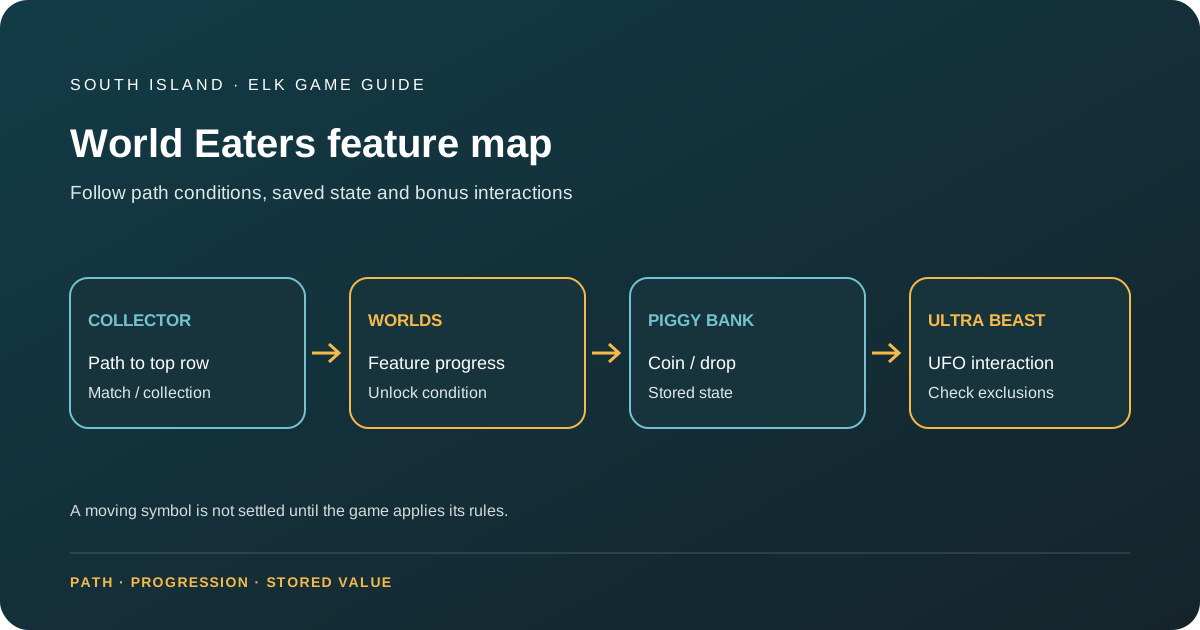
The short answer: track what a collector can reach
World Eaters is an ELK Studios slot whose public product description centres on collectors that gather eligible symbols, a progression through distinct worlds, a Piggy Bank feature and a bonus route. The game is not best explained as a simple list of symbols. A reader needs to follow what a collector can reach, which features are currently unlocked, whether an object holds value, and what happens when the board enters a bonus state.
ELK describes five worlds and says that a world advances after its feature has been triggered enough times. The product overview also describes a Collector that can pick up payout symbols and feature symbols when there is a clear path to the top row. Those mechanics make the board state important: a symbol can be present but not yet collected; a feature can be visible but still locked; and a coin can be stored in a Piggy Bank rather than paid immediately.
The public supplier summary is not the same thing as the active operator’s help panel. No current game-help configuration was supplied for this review, so it does not publish a numeric RTP, volatility label, stake range or maximum payout. Third-party reviews list numerical settings, but they may describe another jurisdiction or game build. This page explains the supplier-supported feature structure and tells readers where the exact settings must be checked.
Start with the exact title and source boundary
Confirm the title in the in-game information menu and compare it with ELK’s official World Eaters page. The title is also a useful search key, but an operator lobby label or a review snippet is not a version record. If the help shows a rules revision or product build, keep it with the page URL and the date checked.
There are three useful sources, each with a different job. The supplier page explains the game concept and named features. The actual game help defines the version’s paytable, trigger conditions and any numerical settings. The operator’s terms answer account, eligibility, currency, responsible-play and cashier questions. A statement from one layer should not be used as proof of a fact that belongs to another.
This page is focused on World Eaters itself. It does not create separate guides for its RTP, bonus or demo, and it does not attempt to repeat ELK’s general catalogue hub. For studio-level navigation, use the site’s ELK Studios games guide. This page remains a single-title guide: it explains how to read the board and where the product summary leaves questions open.
Read the board as a changing system
The ordinary way to follow a complex slot is to make a small map of the active board. Identify the positions used to create a payout, the location where feature symbols appear, the top-row condition mentioned by the supplier, and any storage area such as the Piggy Bank. Then mark which part changes after a win or feature. This prevents a reader from treating every animated element as a paying symbol.
For World Eaters, keep four states separate: current world; collector position and path; feature symbols currently accessible; and stored coins or prizes. The supplier overview says a Collector can pick up matching payout symbols and feature symbols when there is a clear route to the top row. A prize symbol can therefore need a collection step before it contributes. A feature symbol may also depend on a path condition rather than simply landing anywhere on the board.
When a round resolves, read the animation in order. First determine whether there is a base-game win. Next see whether symbols are collected, whether a feature marker is activated, and whether a world-progress condition changes. Finally inspect the credited result and any counter that carries forward. If the interface shows an animation before settlement, wait for the final total; a symbol moving toward a collector is not proof of a payout until the game’s rule says it has been collected.
The word “matching” also needs context. It may refer to the payout symbol’s type, a collector’s own identity, a feature marker that the current world accepts, or a combination of those. Read the paytable and feature help for the exact match rule. Do not assume all collectors gather every symbol or that one collector can activate every named feature.
Collectors and the clear-path condition
The Collector is central because its action connects the visible grid to a payout or feature. ELK’s public summary says that Collectors pick up matching payout symbols and feature symbols with a clear path to the top row. That makes the route condition as important as the destination. A matching object elsewhere on the board may not qualify if the path is blocked or if the collector has not reached the required state.
In the exact help, find how a collector is selected, whether it moves or appears at a fixed position, what blocks its path, and whether the collection happens before or after a symbol transformation. A symbol can be both a feature marker and a target for collection, but the order of those effects changes what gets counted. If the public page does not expose the order, avoid asserting one.
A useful manual reading method is to trace one hypothetical path without assigning a payout. Mark the collector, identify the top-row route, note the qualifying matching symbols, and ask what happens when the collector reaches the row. This shows which parts of the game rule are needed to understand a collection. It avoids a misleading cash example when symbol values and game-help rules have not been checked.
The “clear path” phrase should not be paraphrased into “the collector eats everything in a column” unless the specific rules say so. A clear path can be a particular route, a line of unobstructed cells, or another game-defined condition. Similarly, “collects the feature symbol” does not necessarily mean the feature begins immediately; the game may record progress or require additional conditions. Each outcome belongs to the help sheet for the exact build.
Five worlds and progression
World Eaters uses a progression structure rather than a single static backdrop. ELK says the game contains five worlds and describes moving to the next world after that world’s feature has been triggered repeatedly. The official summary gives this as a sequence rule; it does not make the worlds into separate games or establish that progression is the same as a guaranteed payout.
For the reader, the useful information is what changes at a world transition. Does a new feature become available? Do collector targets change? Does a visual theme change while the base payout rules remain the same? Does progress persist through a feature exit? These questions should be answered from the in-game help. The supplier’s short page confirms world progression but does not specify every state-retention or transition rule.
Record each world as its own row while reading the help: current feature, trigger condition, collector interaction, stored-value effect, and unlock condition. If a particular feature must be triggered a certain number of times before the next world opens, write the exact threshold only from the game help. In this article, no threshold count is quoted because the requested evidence standard is the current game rules, and those were not supplied for inspection.
The sequence can make a single session difficult to summarise from one screenshot. A screenshot taken in an early world might not show features available later; a screenshot from a bonus may not reveal the ordinary game state. When reviewing a sequence, label which world and mode it represents. Never imply that every player sees the same sequence or reaches all worlds.
Progress displays can create an expectation that a transition is “due”. They show recorded game state, not a prediction of future outcomes. If a world advances only after a named feature trigger, repeated ordinary spins without that trigger do not establish that the next trigger is more likely. Explain progress as a state condition rather than a promise.
The Piggy Bank and coin handling
The Piggy Bank adds a separate storage concept. ELK’s description says it collects coins left after wins have been paid, may then explode, trigger a coin drop and refill. That means a coin can have a different timing from a normal paid symbol: it may be stored, held for a later event and only then participate in a drop sequence. A simple review should show that chain explicitly.
Read the coin rules in order: what coin qualifies; when it is deposited; what event can cause the Piggy Bank to explode; how the coin drop is resolved; and what “refill” means in the current build. The short public description does not specify every deposit threshold or how a stored coin’s value is calculated. Do not infer a fixed value from artwork or a coin counter unless the help identifies it.
It is especially important to distinguish money that has already been credited from value that is still pending inside a feature. A coin animation may represent a stored amount, a symbol that must be collected, or a step in a later payout. The game’s ledger and the help panel settle which. Until then, avoid saying that the coin is “banked winnings” if the actual rule calls it a collected feature item or makes its payment conditional.
If the Piggy Bank explodes during a round, observe what happens to the stored state afterwards. The supplier summary says a coin drop and refill can occur, but the exact refill amount, next threshold and whether the feature can repeat are operator-help questions. A reviewer should not assume that a refill begins an identical cycle or resets the same counter.
The bonus and Super Drops
The public ELK description says that three bonus symbols trigger the Bonus Game and award Super Drops, while an additional bonus symbol during the feature awards another Super Drop. The important conceptual point is that the Bonus Game and its drop sequence are linked but not identical: the bonus trigger starts a feature, and the extra symbol changes the feature’s remaining actions or drops according to the rules.
In the active help, verify the exact symbol condition, initial drops, extra-drop rule, and end condition. Confirm whether bonus symbols must appear in particular positions or simply meet a count, and whether an added drop can occur at any point in the feature. The current article does not convert the supplier summary into a numeric award because no version-specific operator help was available to check.
Follow the Super Drop sequence with a counter. At each step, mark the symbols that move, any collector that acts, and any feature element that triggers. If several features occur in one drop, the rules may specify an order. The displayed animation alone may not show which event is evaluated first. If the order changes a collector’s eligibility or stored value, the help panel is the necessary source.
The word “Super” is a feature label, not a statement about expected value. It does not mean every drop produces a win or that the bonus returns more than its entry cost. A careful guide explains the function while avoiding an implication that the feature is financially favourable.
Ultra Beast and the UFO feature symbol
The supplier describes an Ultra Beast in the bonus: a UFO feature symbol scares the Collectors and collects all payout symbols. This combines a change in collector behaviour with a broad collection effect. It is not safe to summarise as “the UFO pays every symbol” without checking which symbols are payout symbols, whether blockers are excluded, and how the final combination is settled.
Check when the UFO can appear, whether it must be collected or merely land, and how its effect changes the collectors. The phrase “scares the Collectors” describes the event’s theme but is not the complete mechanical rule. The other half—collecting eligible payout symbols—is more informative, but still leaves questions about symbol matching and payout calculation. Use the exact terms from the game’s help, then explain them in neutral language.
If the UFO event takes place during a Super Drop, track which part of the sequence is altered. Does it gather the board immediately, move collectors first, or resolve after a current win? Is the effect limited to payout symbols or does it interact with feature symbols too? The public overview does not answer every timing detail. Do not invent an answer just because a third-party reviewer describes a likely animation sequence.
This feature also illustrates why the game needs a source-aware review. A highlight reel can show a spectacular collection, but a single clip cannot tell the viewer whether the event is rare, how often it happens, or what ordinary rounds look like. No probability statement belongs in the article without a published game-help or certified source for the exact configuration.
Settings: RTP, volatility, stake and maximum payout
No numeric RTP, volatility rating, stake range or maximum payout is published in this article because the exact current game-help panel was not available for verification. Search results and review databases can list values, but they may be tied to a particular casino, currency, territory, default demo, or older version. A number that is repeated on several review pages can still be the same copied source rather than independent confirmation.
RTP is a theoretical long-run return for a defined version. It does not predict what a person will receive in a short session. Volatility is a label for how outcomes are distributed, and third-party pages may rate the same title differently. A maximum payout is the rules ceiling, not a likely outcome. Stake range is an operator setting and is meaningless without the displayed currency and mode. Keep these fields separate in any comparison.
If an operator help panel shows several RTP variants, record each value with the game version and mode. If the base game and an optional feature have different return figures, do not blend them. A “maximum win” statement should be tied to its unit and whether it applies to a complete round, base bet or feature cost. An unqualified multiplier is easy to misread.
When no value appears, say “not shown in the source checked.” If the operator will not expose the game rules before an account action, do not take a deposit or create an account merely to fill an editorial field. Ask the operator for a public rule sheet or mark the setting unverified. This article does not open operator sites or the supplied CPA route.
How to evaluate the help panel
Use the following sequence to understand the game without substituting guesses:
- Match the product title and version shown in the game.
- Identify the ordinary payout condition and distinguish payout symbols from feature symbols.
- Read the clear-path condition for a Collector and identify what it can gather.
- Record each world’s feature and the stated progression condition.
- Read the Piggy Bank deposit, explosion, coin drop and refill rules separately.
- Check bonus entry, initial Super Drops, additional-drop triggers and the feature’s ending condition.
- Read the UFO and Ultra Beast effect, including timing and symbol exclusions.
- Only then record RTP, volatility, stake limits and payout cap if the same help panel displays them.
This order keeps cause and outcome apart. A collector’s path is a condition; a world unlock is a progress state; a piggy-bank explosion is an event; and a paid result is a settlement. They may be connected, but the help should say how. When it does not, an editor should identify the missing rule and refrain from presenting the question as resolved.
Mobile reading and demo boundaries
World Eaters uses several kinds of information at once: collector positions, path conditions, world state, a storage feature and bonus progress. On a narrow screen, make sure those indicators remain visible when the help pane opens. If the game frame hides one side of the board, rotate the device or inspect an accessible text rule sheet. Do not infer a blocked collector route from a cropped screenshot.
Tables and symbol diagrams should be read at a size where their labels can be distinguished. If the game uses colour as the only sign of an active or locked feature, look for another label or legend. Do not assume a colour has the same meaning as a different ELK game. Accessibility and interface behaviour can vary among operator implementations, and this guide has not tested a specific phone, app or live casino build.
A demo may help someone learn which symbol is the collector or see a world transition. It cannot confirm the real-money configuration, account eligibility, cashier terms or long-run probability. A short sequence is only a sample. No demo or live session was launched for this guide. If access is restricted, do not use a tool or location workaround to open it.
Suitability as an information question
The game’s collection and progression systems may be interesting to readers who enjoy following a board that changes over time. A reader who prefers one simple paytable may want to learn the collector and world rules before making any decision. This is a statement about how much rule-reading the design asks of someone, not a recommendation to wager.
Someone evaluating settings should prioritise the exact RTP and stake information rather than the number of named features. More feature names do not establish a better return or a better personal fit. Someone comparing a sequel or another collector game should compare only source-backed mechanics: path rules, persistence, progression and the way a collected symbol is settled. Avoid importing a memory of Slurpy or another title into World Eaters; similar concepts can be implemented differently.
No strategy can make the next world trigger or force the Piggy Bank to explode. Progress meters are not a schedule. A large-feature animation is not evidence of a common outcome. Set a time and spend limit in advance, and use local support if play is causing concern. The page’s New Zealand safer gambling guide lists break and support information.
New Zealand availability and advertising
This page explains a supplier product for New Zealand readers; it does not claim that an NZ-facing casino currently provides World Eaters or that a person’s account can access it. A game’s presence in ELK’s catalogue and a player’s eligibility are separate questions. Check up-to-date regulatory information and the legal operator’s published terms where appropriate.
The DIA’s current guidance says online casino advertising is prohibited during the transition and can apply to third parties that publish or arrange publication. The same guidance notes that advertising and marketing rules extend to third parties and cites affiliate marketing among initial regulatory decisions, before the later restricted regime. For that reason, this page has no CPA button, partner referral or substitute link. The supplied commercial path remains unused while the compliance issue awaits review.
Questions readers commonly ask
How do the Collectors work?
ELK describes them as collecting matching payout symbols and feature symbols when a clear path to the top row is available. The active help should define what qualifies as matching, what blocks a path, and when collection is settled.
How does the game progress between worlds?
The supplier describes five worlds and says progression depends on triggering each world’s feature. The exact trigger threshold and what carries between worlds should be taken from the current game help; this guide does not quote an unverified count.
What does the Piggy Bank do?
The supplier says it collects coins left after wins are paid and may explode, causing a coin drop and refill. The help panel should define the qualifying coins, thresholds, stored values and repeat rules.
How does the bonus begin?
ELK’s overview says bonus symbols trigger the Bonus Game and that another bonus symbol can award an additional Super Drop. Check the current version for exact entry and retrigger conditions.
What happens when the UFO appears?
The supplier describes an Ultra Beast event in which the UFO feature symbol scares Collectors and collects payout symbols. Timing, exclusions and settlement should be confirmed in the in-game rules.
What is World Eaters’ RTP or volatility?
This guide does not state a numeric value because it was not verified in the active game help. Third-party reviews may show a market or build that differs from the version a reader sees.
Can I infer the maximum payout from a review page?
Not safely for a particular operator build. Verify the applicable ceiling and its unit in the game help. A supplier or third-party headline may not be the active configuration.
Is the game available in New Zealand?
The supplier catalogue does not prove operator distribution or customer eligibility. No NZ availability claim is made here.
Where are the ELK catalogue and other game guides?
Use the ELK Studios games guide for supplier navigation, then visit the game guide index for existing individual-title references.
For local support information, see New Zealand safer gambling support.
Sources and verification boundary
Primary source checked on 6 October 2026: ELK Studios World Eaters product page. It documents the collector path, feature-symbol collection, world progression, Piggy Bank, bonus and Ultra Beast concepts. No current operator help sheet was available for this review, so no numerical game settings or local availability are asserted.
Competitor pages checked on 6 October 2026: Bigwinboard, SpinHunter, FruitySlots, SlotCatalog, and Sigma World. They differ in descriptive assessments and may report market-specific numerical settings; these were not used as universal claims. Regulatory context checked on the same date: DIA guidance and Online Casino Gambling Regulations 2026. No demo, operator account or CPA route was accessed. Search-volume data was not supplied.
