ELK Studios game guide · South Island guide
Quackers: rules, duck features and settings to verify
 Best casinos available in New ZealandUpdated 7 November 2026

Quackers is an ELK Studios 6-by-6 slot built around four duck modifiers, a global multiplier, a separate Coin Game and an 8-by-8 Quack Drops feature. This review explains the published sequence and marks numerical settings that the accessible supplier page does not disclose.
The short answer
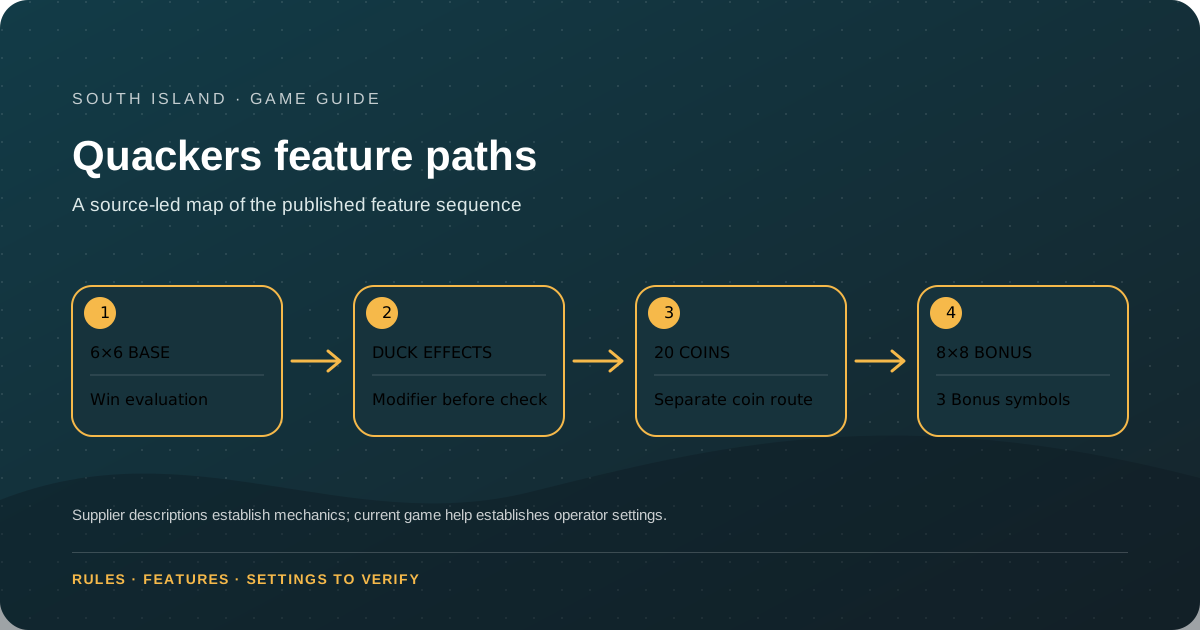
Quackers is a 6-by-6 ELK Studios slot where a win can lead into another board evaluation, while duck characters change the symbols or multipliers before those evaluations. The official description names a global multiplier, Wilds, symbol multipliers, a Coin Game, a standard Bonus and a Super Bonus. It says that collecting 20 coins triggers the Coin Game, while three Bonus symbols start the Bonus on an 8-by-8 grid. Ducks persist during that bonus; a Super Bonus symbol in the trigger set starts the enhanced version with all four ducks present. The supplier states a potential ceiling of 10,000 times the bet.
That is enough to understand the broad structure, but it is not a complete paytable. The public supplier text inspected on 6 October 2026 does not state RTP, volatility, symbol values, stake limits, feature probabilities or the full X-iter price menu. Its product-sheet link returned 403. Those fields should be copied from the exact game help available through an operator, if one lawfully provides the title to the reader. This guide does not confirm New Zealand access or promote an operator.
What is confirmed, and what remains open
ELK’s Quackers product page is the primary source for the details described below. It names the product, depicts four character modifiers and describes the 6×6 base format, the 8×8 bonus board, the Coin Game trigger, the 20-coin threshold and a five-option X-iter range whose named endpoints are 2.5× and 500× the selected bet. The official text also recommends a 1600×900 desktop resolution or a 16:9 ratio when scaling is needed.
The page has a Play control, but the accessible text does not include a dated release line or a separate release-status label. A product listing and a Play control are not enough to establish a jurisdiction-specific launch, current live status at a casino or eligibility for a New Zealand account. We therefore record the supplier listing as observed, while leaving operator availability and the exact release date unverified.
The difference between “a feature exists” and “a setting is verified” is practical. Knowing that a symbol multiplier can be added does not reveal its range. Knowing a mode’s price multiple does not reveal whether that mode is available in a particular build. A title-specific article should separate the published mechanics from unanswered fields instead of filling the gaps with a number found on another market’s page.
The 6-by-6 board and the order of a round
Six columns and six rows describe the visible base board; they do not, by themselves, define how a combination qualifies. ELK’s summary page does not publish a complete set of win conditions or a table of symbol values. Read the operator’s help for the actual evaluation rule before treating an adjacent group, a line or a collection as a paying result. The feature overview is clear about what the ducks can change, but it is not a substitute for the game’s settlement rules.
For reading a round, it helps to keep the stages separate: the initial symbols appear; any eligible duck effect happens before win evaluation; a qualifying result settles under the active pay rules; winning symbols may be removed or the board may otherwise change; and the next evaluation, if any, is resolved. The first part of that sequence—the duck modifiers preceding evaluation—is explicitly stated by the supplier. The exact cascade trigger and termination condition are not fully explained in the accessible official summary, so confirm them in help rather than assuming every win starts another drop.
This distinction also matters when more than one duck is visible. The source says the characters each have a unique feature that triggers before any win evaluation. It does not set out a public priority order for simultaneous effects or say whether each one modifies the same initial state. In the client, watch the feature animation and resulting board, then check that the help describes the same order. A sequence observed once is not a probability estimate and should not be written up as an invariant rule unless the text supports it.
Four ducks, four kinds of board change
ELK groups the duck effects into four categories: increase the global multiplier, increase the value of payout symbols, add or increase a symbol multiplier, or upgrade payout symbols to Wilds. The page calls them individual features but does not associate each character name with each effect in its text. Some review sites do name them; because this guide prioritises the available supplier text, those name-to-effect assignments are not presented as officially verified here.
Before interpreting a duck activation, identify what changed on screen. Did the multiplier applying to wins change? Did one kind of paying symbol become more valuable? Did a symbol acquire a local multiplier? Did symbols turn Wild? These are different paths to a possible winning result, and a modifier can have no cash value if the board still fails the game’s win condition. Describe the changed state, not a presumed payout.
The page says every duck has its own feature and that the feature happens before evaluation. This places character effects at the decision point where the next board is assessed. For a reader, that is a useful guide to what to watch: record the symbols before the duck acts, the modifier it displays, the symbols afterward and the following settlement. If several effects appear, note each change independently. This gives a reproducible explanation without guessing which character was “best” or implying that a duck guarantees a win.
The public page does not specify a trigger chance, character weights, maximum multiplier, conversion count or whether a modifier persists beyond the current round. Do not infer those values from the size of a graphic or from a clip. If the active help has separate paragraphs for each duck, retain those conditions exactly, including exclusions and reset points.
The Coin Game is a separate collection path
The supplier states that 20 collected coins in the base or bonus game trigger the Coin Game. That makes the collection threshold a different path from the three-symbol Bonus trigger. A coin collected toward this feature should not be confused with a Bonus symbol, and the trigger should not be described as a guaranteed result after a fixed number of spins: the source says 20 coins are required, not how quickly they arrive.
ELK’s summary says the Coin Game is played on a 6-by-6 grid. It also describes coins, chests and multipliers as components that can affect the result. The supplier’s short description says that more coins, chests and multipliers in the Coin Game mean a larger win, but the publicly visible summary does not provide a full settlement formula, symbol values or all end conditions. Treat the dedicated feature help as necessary before giving a step-by-step calculation.
When inspecting the feature, track four facts separately: which positions show coin values, which objects collect or combine them, how multiplier symbols affect the value and what ends the round. If a multiplier appears, note whether it applies to one position or to a group. If a chest collects values, establish whether the visible values are added, multiplied or handled another way. A bright animation is not enough to distinguish those operations. The information screen, not a visual guess, controls a factual review.
This feature also creates a useful question for a game-history panel: does the record show only the final total, or does it preserve the individual results that produced that total? If a reader wants to review a disputed outcome, the record and the operator’s help should identify how the intermediate symbols were settled. Our source review did not access an operator build, so no assertion about the history display is made.
Quack Drops and Super Bonus
Three Bonus symbols trigger the Bonus Game, according to the official page. The feature is described on an 8-by-8 grid, larger than the base board, and the ducks remain persistent during it. “Persistent” is important because the character modifiers can continue to have a presence across the bonus. It should not be stretched into a claim that every other element, such as a multiplier or coin count, also persists; the source does not say that.
If one of the three trigger symbols is a Super Bonus symbol, ELK says the Super Bonus starts with all four ducks on the grid. This tells the reader how the supplier distinguishes the two bonus entry states. It does not, in the accessible description, list the number of drops, possible retriggers, multiplier carry-over, payout limits or whether every duck acts on every evaluation. Those are exact-help questions, not details to fill from a review for another configuration.
The 8-by-8 area changes how much of the screen a player must follow. A quick scan should include all occupied positions and the duck area, then any multiplier or feature indicators. Do not equate a larger grid with a higher probability of a prize; a board dimension is a display fact. To judge whether a feature result is a win, follow the rules for symbol groups and settlement in the active help.
If a screen offers “Quack Drops” as a feature label while the supplier text says “Bonus Game,” record the exact wording and the version shown. Product pages may use a descriptive phrase while the client’s help uses a formal mode name. An article can explain that relationship only when the two labels are clearly linked in the source.
X-iter: a price multiple is not a promise
ELK says X-iter offers five modes, with an example at 2.5× the bet that is described as giving more than three times the chance of triggering a bonus, and a 500× bet Super Bonus at the upper end. The summary does not list every option or their full terms. The phrase “more than three times the chance” is relative: the page does not disclose a baseline probability or guarantee a bonus on the next round.
Translate a displayed multiple into a cost only after selecting a real stake. As a hypothetical arithmetic example, a 2.5× option against a NZ$1 base stake would have a nominal cost of NZ$2.50 if the client states that the multiple applies to that stake. A 500× option on the same hypothetical basis would be NZ$500. These are calculations, not a statement that NZ$1 is an allowed stake, that the mode is accessible in New Zealand or that a particular casino uses those options.
Before selecting any mode, establish whether the cost is one-time or attached to each round, which feature state begins, whether the game’s ordinary bonus rules change and which RTP configuration applies. A guaranteed start in a bonus describes entry, not the cash outcome. A mode can settle below its cost or return nothing. If the price is not clear before confirmation, cancel and look for the help text instead of guessing.
No feature mode should be budgeted by borrowing from a later session or by treating a multiplier as a likely recovery. Set an overall amount and duration before opening a game. If an optional price would use most of that amount, the practical choice is to skip the option; there is no strategic requirement to purchase it to understand the basic game.
Potential maximum, RTP and volatility: three different fields
The supplier’s public overview gives a potential maximum of 10,000 times the bet. This is the largest potential result stated in that summary, not the average return, the result of a typical session or a promise that a player will reach it. The page does not publish how often it can happen or what exact route to that ceiling would be. Use “potential maximum” and attribute the figure to ELK.
RTP answers a different statistical question: a long-run theoretical return for a defined mathematical configuration. No numeric RTP appears in the accessible official Quackers summary checked on 6 October 2026. A third-party listing may show one or several percentages, but those do not identify which configuration an operator currently offers. The active game information panel is the relevant place to look for a configured return, if it displays one.
Volatility describes the distribution of outcomes, not the quality of a session. The supplier page inspected here does not assign Quackers a public volatility label. Do not derive one from the existence of a 10,000× ceiling, four modifiers or a long feature animation. Those tell a reader about mechanics and a potential cap, not the time between prizes or the size distribution of ordinary wins.
For an audit, record the displayed value and context together: title; operator; game version or rules date; currency; stake range; RTP; volatility wording; maximum payout; mode availability; and the time of checking. A percentage without the title or configuration can be misleading, while a stake in a different currency cannot be copied as a New Zealand limit.
Mobile readability and game-help access
ELK recommends 1600×900 for desktop and a 16:9 ratio when scaling is necessary. This is a supplier display recommendation, not a promise that every phone, browser or network will render the game smoothly. The 8-by-8 bonus board has more positions than the base board, so on a phone it may require scaling or landscape orientation. That is a practical reason to inspect controls before starting a round, not proof of mobile availability.
Locate the information/help control, the paytable, the history control and the bet selector before staking. Check that the full stake, any feature price and the settlement panel remain visible after rotating or zooming. If the instructions become clipped, pause. It is better to read the rules in a text view than to try to infer them from a compressed animation.
The official page links to a product sheet and an asset package. The sheet returned HTTP 403 when opened through the available reader on 6 October 2026, so this article does not rely on its contents. No live client, phone, casino account or demo was accessed. That limitation means we can describe the source summary and a sensible verification process, but cannot report mobile test results or say that a demo is currently available.
How to check an operator version without importing its promotion
If an operator legitimately provides a game interface to a reader, begin at the exact title screen and confirm that it says Quackers and names ELK Studios. Open help before play and save the visible rules date or version. Record the pay method, symbol values, feature conditions and any variant note. Then read the operator’s general terms for account eligibility, currency and location. These checks answer different questions; the supplier’s product page alone cannot establish all of them.
Avoid combining evidence from unrelated screens. A review article may refer to UK pounds, Canadian dollars or a particular operator. A separate demo may use a different build. A game launch card may identify the title without identifying the mathematical settings. Keep every claim next to its source so a reader can tell whether it is a supplier mechanic, an operator setting or editorial explanation.
For a mismatch, capture the title and wording, note when it was seen, and contact the operator with the question. Do not keep staking while trying to discover which rule applies. If the operator cannot point to the relevant help or version, leave that field unresolved in the article rather than giving a confident but unsupported answer.
A practical reading checklist
Use this short audit when comparing the supplier page with a client screen:
- Confirm the full title and provider branding; do not confuse Quackers with another duck-themed slot.
- Find the base grid and the stated rule for a qualifying result.
- Read when each duck effect runs and whether the help assigns a character to each modifier.
- Note how global and symbol-specific multipliers are shown and settled.
- Locate the 20-coin Coin Game trigger and its separate feature help.
- Confirm the three-Bonus trigger and the 8-by-8 bonus board.
- Check precisely what changes when a Super Bonus symbol is part of entry.
- Record X-iter prices and terms shown in the actual menu, including any market restrictions.
- Write down RTP, stake range, currency, volatility and cap only when the current help states them.
- Save the source date and state which items remain unavailable or unclear.
This checklist is useful because it prevents one confirmed feature from standing in for an entire configuration. If a reader only knows that the game has a 10,000× potential, they still do not know the stake, the return figure, the method of winning or whether the cap applies in their build. The audit leaves a visible boundary between those facts.
New Zealand availability and safer-play context
An ELK catalogue listing does not prove that an online casino offers Quackers to someone in New Zealand. Supplier distribution, an operator’s catalogue, account eligibility and the regulatory position are separate checks. This guide has not tested an operator or opened the supplied CPA route.
The Department of Internal Affairs says online casino advertising is prohibited during the current transition, and its advertiser guidance says the rules apply to operators that publish or arrange advertisements, including third parties. The 2026 regulations identify ads involving an affiliate arrangement as a prohibited form. The user-supplied route is a CPA affiliate route, so this package does not add the requested promotional buttons pending owner and compliance review. This is a conservative editorial blocker based on current public guidance, not individual legal advice. See the official DIA advertiser guidance and Online Casino Gambling Regulations 2026.
If gambling is affecting sleep, finances or relationships, pause and seek independent support. The DIA’s player information lists New Zealand help options, including the Gambling Helpline. A feature guide cannot turn a game’s animations or theoretical ceiling into a way to recover losses.
Questions readers commonly ask
Is Quackers a 6-by-6 slot?
Yes. ELK’s public product description calls the base game a 6-column, 6-row slot. The bonus is separately described on an 8-by-8 grid. These dimensions identify the displayed boards; check the active help for the exact win evaluation.
What triggers the Coin Game?
The supplier says that 20 collected coins in the base or bonus game trigger it. The public summary does not give a complete collection probability or the full payout formula.
What starts Quack Drops?
Three Bonus symbols trigger the Bonus Game. A Super Bonus symbol among those triggers the Super Bonus, which the supplier says starts with all four ducks on the grid.
What is Quackers’ RTP?
No numeric RTP appeared in the accessible official product text checked on 6 October 2026. Check the exact operator’s information panel; do not treat a third-party value as universal.
Does a 500× X-iter mode guarantee a win?
No. The supplier describes a Super Bonus mode at 500 times the bet, but a starting condition is not a guarantee that the settled result will be positive or exceed the mode’s cost.
Is Quackers available in New Zealand?
The supplier page does not establish availability at a New Zealand-facing operator or eligibility for a customer. This guide makes no such claim.
Can I try a demo?
The official page has a Play control but does not identify a public demo mode in the text reviewed. No demo was launched for this article. Availability depends on the source and jurisdiction.
For independent support, see the site’s New Zealand safer gambling guide. This article is informational and contains no casino offer.
Sources and verification boundary
- ELK Studios Quackers product page — grid, modifiers, coin threshold, bonus entry, X-iter endpoints, potential maximum and display guidance; checked 6 October 2026.
- ELK product sheet linked from that page — access returned HTTP 403 on 6 October 2026; not used.
- Competitor pages opened 6 October 2026: BigWinBoard Quackers review and Chase the Scatter Quackers review. Online Slot UK review was surfaced but returned a cache miss; several other URLs returned fetch errors. Competitor numerical claims were not treated as official operator settings.
- DIA advertiser guidance, DIA player guidance, and Online Casino Gambling Regulations 2026 — checked 6 October 2026.
