ELK Studios game rules · South Island guide
Pug Thugs of Nitropolis review: four-way rules and features
 Best casinos available in New ZealandUpdated 7 November 2026

Pug Thugs of Nitropolis is an ELK Studios slot whose connecting wins can begin from any edge of the grid. Nitro Reels, random start-of-spin effects and corner feature screens create separate paths into the bonus. This review explains those paths, how to read their order, and which numeric rules still need confirmation in a current operator help panel.
The short answer
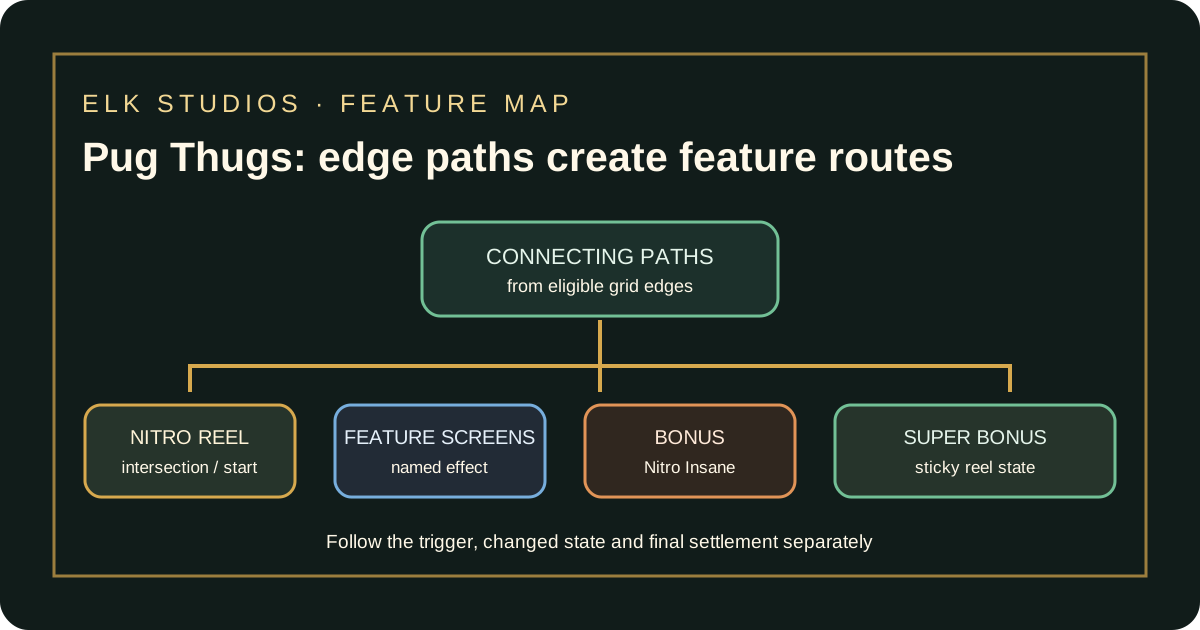
ELK’s public description presents Pug Thugs of Nitropolis as a slot with connecting paylines that can begin from all sides of the game grid. Intersections in those paths can create Nitro Reels, while a random opening feature can add more Nitro Reels before the ordinary outcome is evaluated. Corner feature screens may then introduce effects such as Make Big, Nitro Wild, Nitro Match or Collect. The bonus and Super Bonus are separate states with different reel behaviour, so a reader should not compress every symbol change into one generic “free spins” description.
The best way to understand a round is to follow the board in order: identify the eligible connections, see whether a Nitro Reel appeared, read what each corner screen actually awarded, and then confirm whether the current result entered a bonus. During the bonus, ELK says the opening feature is guaranteed for each spin; in the Super Bonus, Nitro Reels remain sticky. The exact help must define the trigger symbols, all payout details, number of spins, and how a later feature changes the board.
The assignment spells “NItropolis” with an unusual capital letter, but ELK’s official product page displays “Nitropolis.” The article keeps the assigned URL and query while using the supplier’s spelling in its visible title. This is the Pug Thugs game, not the similarly themed Dirty Dawgs, Rogue Rats, Gritty Kitty or the main Nitropolis titles. No current operator build for New Zealand was supplied, so RTP, volatility, maximum win, stake limits and local access are not asserted.
Identify the exact title and build
A game review starts with identity, not a star rating. Open the game information panel and check the full title, supplier, version or build information if shown, and any jurisdiction notice. Nitropolis is a series label, not a single ruleset. Different entries reuse the city, gangs, Nitro terminology and visual style while changing their grid, feature sequence and payout logic. A review of a neighbouring title cannot substitute for this game’s help.
The official product page is useful for the supplier’s feature vocabulary and broad outline. It does not prove that one operator has loaded the same configuration, exposes the same optional mode, or serves a particular country. The operator’s live help is where you confirm the rule text that applies to the session. A casino directory may describe a historical demo or a market-specific version; record its date and region before relying on it.
Some competing pages show a useful feature overview but disagree on details or mislabel the product as an ordinary left-to-right slot. One search result even assigns a different supplier. Those conflicts show why the exact identity check matters: if the provider, grid method or feature labels do not match ELK’s product summary, do not carry that description into a rules guide. Use competitor pages to identify questions that a reader may have, not to settle a rule that the current help should answer.
Connecting paylines from the edges
The unusual part of the base game is the direction of the connecting lines. ELK says the paths can begin from all four edges, and intersections create Nitro Reels at the intersecting positions. A player who expects only a left-to-right line check may therefore misread a highlighted route. The correct question is not “did the symbols look close?” but “does this exact connected path satisfy the paytable from an eligible starting edge?”
Read the paytable diagram before studying a busy spin. It should show which matching symbols can connect, whether gaps interrupt a path, which directions count and how a result is valued. A glowing route may show one qualifying connection, a feature may mark a possible intersection, or the game may be animating a transformation. Each visual cue needs to be tied back to the rule that governs settlement.
When several connections overlap, treat each one as a path through the grid, not as an assumption that the same symbol is counted repeatedly. The help should explain whether intersecting routes produce a single result, several evaluated routes, or a modifier in the intersection. ELK’s summary says intersections create Nitro Reels; the live instructions must say when that effect occurs relative to win evaluation and whether it changes the current result or a later drop.
A practical review note can track a spin without copying a full screen recording. Write down the entry layout, the matching symbols, the starting side of any path, the intersection location, the feature that followed, and the amount displayed after the game settled. If the history screen gives a different account from the animation, use the written round history to clarify settlement and contact support about a balance discrepancy.
Do not confuse a path with a reel
A connecting payline is a route used to evaluate symbols. A Nitro Reel is a special position that can contain a vertical stack. They can interact because an intersection can create a Nitro Reel, but they are not synonyms. The line describes how symbols connect; the reel describes a feature object occupying a place on the board. A review that calls every path a “reel” makes the game harder to understand.
The public supplier description says a Nitro Reel occupies a single symbol position while displaying a stack of symbols. This is an important distinction: the visual stack can be taller than the position it occupies. The help should explain how the stack participates in a connection, whether each symbol in it is evaluated separately, and if the reel can change or remain through a respin. Do not count each symbol in a stack as an independent wager or payout without the paytable’s exact rule.
Nitro Reels and the random opening effect
ELK describes Nitro Reels as appearing inside an inner area of the game grid and carrying a stack of symbols. The “Nitro Insane” effect is described as a random trigger at the start of a spin that places a random set of Nitro Reels on the board. This changes the starting state of the spin. It does not guarantee a winning connection, and the word “random” provides no estimate of the chance of the effect.
For a clean review, separate the opening effect from later line intersections. If a Nitro Reel appears before a player can see a path, note that it came from the start-of-spin effect. If another one appears after connecting paths meet, record that as a consequence of the intersection rule. The board may contain both kinds in one round, but their causes are different and may have different persistence rules.
The help panel should answer whether the opening effect can place reels in every eligible position, whether the number is capped, and whether the feature uses the same distribution in the base game and bonus. If those details are hidden, state that the supplier describes a random placement but the exact range is not disclosed in the available version. Avoid assigning a probability based on a few demo spins; a short sample is not a statistical test.
A Nitro Reel can make connections easier to visualise because it presents a stack in one area, but “more symbols on screen” is not automatically “more wins.” The route still has to satisfy the matching rule. If a reel shows several different symbols, only the symbols that qualify under a given payline can contribute. The result history or paytable should reveal how the game interpreted the stack. This is one reason to follow the route highlighting instead of judging the board by overall density.
Corner feature screens
The four feature screens sit in the corners and can trigger named effects. ELK’s summary lists Make Big, Nitro Wild, Nitro Match and Collect. Each name points toward a different kind of change: symbol size, Wild behaviour, symbol matching or collection. That vocabulary helps distinguish the effects, but it is not a complete trigger rule. The help should say whether a screen activates on its own, requires a qualifying line, targets a specific symbol, or changes a later spin.
Make Big should be read as a size change, not as a guaranteed payout. Confirm which symbol is enlarged, where it appears and whether it remains for the next evaluation. A larger symbol might occupy more positions or have another effect, but size alone does not tell you its paytable value. Avoid assuming an enlarged high-value symbol will connect simply because its image covers more space.
Nitro Wild suggests a Wild effect associated with a Nitro Reel. Check whether it substitutes for all regular symbols or only selected ones, whether it has a separate paytable award, and whether it is sticky or temporary. A Wild can help a connection complete, but it cannot create a winning result unless the completed path meets the game’s requirements. The exact rules belong to the current version’s paytable.
Nitro Match should not be interpreted from its label alone. Look for the help description that explains which symbols are matched, what the matching operation changes and at what stage the grid is evaluated. A match may affect a symbol configuration without being an immediate payout. If the rules use “match” and “win” as separate terms, retain that distinction in any explanation.
Collect may refer to a collection action, but the reader still needs to know what is eligible, where the collected value goes, when it is settled and whether it can be applied more than once. Ask whether the game displays a meter, coin, total or destination symbol. If the answer is not clear, explain what the visible screen shows and leave the settlement mechanism unverified.
A reviewer should also look for how the screens choose among these features. Does a corner screen randomly select an effect, or does a prior event determine the available effect? Does one feature screen activate per event, or can multiple corners act in sequence? The official summary says that the screens randomly trigger features; the exact client help should clarify selection and order. Do not infer a hidden weighting from which icon appeared during a short session.
Bonus and Super Bonus
The supplier says a qualifying group of bonus symbols starts the bonus game and guarantees the Nitro Insane effect at the beginning of each bonus spin. A trigger that includes a Super Bonus symbol starts the Super Bonus, where Nitro Reels are sticky. “Sticky” means the feature object remains under the specified rule, but the help must define what can still change it, when it clears and whether its stack contents can be replaced.
When the bonus begins, record the starting state: any Nitro Reels already in place, the number of bonus actions shown by the interface, and which mode has started. Confirm whether existing reels carry over or whether the feature constructs a new board. If the game labels the mode Super Bonus, check for the exact difference in the help rather than assuming it only changes how long the feature lasts.
A guarantee that a feature effect occurs is not a guarantee that the effect creates a connected win. Each spin still follows the symbol and payline rules. Similarly, a sticky Nitro Reel can remain on the board without forming an eligible path. Descriptions such as “Nitro Reels every spin” should be attributed to the feature effect, not rewritten as “a win on every spin.” That distinction is central to fair reporting.
If more bonus symbols appear while a bonus is underway, the client may add actions or alter the mode; the supplier’s short description does not state every retrigger condition. Read the current help for the number needed, whether the symbols must appear in a particular position and whether an additional trigger can move the game into Super Bonus. If the panel does not provide the detail, do not import it from another Nitropolis slot.
The round history is useful after a feature ends. It may show the original trigger, the bonus mode, the feature reels and the final total. A summary page can help you reconstruct the sequence, but it should not replace the paytable. Use the game’s own ledger for an individual result and the rules panel for the general rule.
X-iter and optional feature entry
ELK lists X-iter as a menu of selected play modes. The current operator may present different options, omit some modes or apply jurisdiction-specific terms. Before confirming any paid option, check the exact price, the feature state that will begin, the mode’s payout rules and whether the stated RTP covers that mode. A review from another market cannot establish those details for a New Zealand visitor.
The phrase “higher chance” is not a numeric probability. If an interface or public product page uses a comparative claim, find the definition and baseline before interpreting it. The baseline might mean a relative change in a feature trigger, not a higher expected return or a better chance to leave with a profit. If the operator’s screen does not specify the comparison, treat the phrase as a supplier feature label rather than a forecast.
Feature entry also changes the shape of the decision. Instead of paying for the ordinary spin loop, the player pays for a named route or starting state. Compare what is known: cost, mode, rules, restrictions and whether a purchase confirmation appears before the balance is debited. If any item is unclear, back out. A direct route to a bonus is not a guarantee that the bonus pays the cost, and no feature mode should be described as an investment.
RTP, volatility and win cap: avoid borrowed settings
This review does not state an RTP number, volatility rating or maximum win for a New Zealand operator version. No current New Zealand operator help or paytable was supplied. Public review pages sometimes repeat a single value as though every casino uses it; others attach stake limits from a different jurisdiction. These numbers are not interchangeable and should not be presented as local facts without the current configuration source.
RTP is a theoretical long-run measure for a particular game configuration. It does not describe the result of one session and cannot tell a reader whether a particular spin will pay. If the operator offers more than one game configuration, the game help should identify the value that applies to the open client. Preserve its label, market and date. A provider-level page, third-party review or old data sheet may describe a different deployment.
Volatility is about how results are distributed, not a schedule for wins. A high label does not mean a particular number of losses will happen before a bonus, and a low label does not make a session safe. If an official help panel supplies a defined volatility label or scale, report it with that context. If it is absent, do not convert a reviewer’s impression into an official characteristic.
A maximum-win figure is a stated ceiling, not an expected outcome. Verify whether a disclosed cap applies to one round, a bonus or a specific entry mode. The public supplier page may use a promotional potential figure, but this guide does not treat it as a current local setting. A ceiling also does not say how likely it is to be reached; that requires a verified probability model, which has not been provided here.
The review pages found in search contain inconsistencies. Some describe all-sided connections and Nitro Reel stacks; others flatten the game into conventional paylines or attach figures without identifying an operator build. A useful article can explain the mechanics while declining to repeat uncertain numbers. That is more helpful than filling a fact box with values that may not belong to the reader’s version.
Mobile, controls and demo
The supplier recommends a desktop display ratio, but that does not confirm mobile compatibility in every casino’s wrapper. On a phone, check that the complete grid and the corner screens remain visible together. If an overlay hides a corner, the player may miss which feature was activated. Confirm that the paytable can open and close without losing the round, and that the stake control cannot be mistaken for the spin or feature confirmation control.
A useful mobile test is about readability and continuity, not speed. Can you identify which edge a path starts from? Can you read the feature notice at normal magnification? Does the balance update after the round settles? Can you open history after a reconnect? If the page rotates, does the game preserve the same round and state? Record practical problems as interface observations, not as changes to the mathematical rules.
A demo may be offered by an operator or authorised provider, but the public ELK page alone is not proof that a demo is enabled for a New Zealand visitor. If an operator shows practice mode, check that it identifies play credits and the same game title. Use it to learn where help and history are located. Do not treat a handful of practice spins as evidence of RTP, volatility or a feature-trigger rate.
For a review, separate “the screen did this in one observed spin” from “the rules say this always happens.” The first is a session note; the second needs help text or a source tied to the current build. If the game cannot be accessed or the help is incomplete, the review should make that boundary visible.
Practical reading sequence
Before each round, identify the ordinary stake and confirm whether any special mode is selected. After the grid appears, look for an opening Nitro effect. Then follow a connected path from its starting edge, noting any intersection. If the game creates a Nitro Reel, record the location and stack, but wait for the client to show how it participates in the outcome. Only after the result settles should you write down the amount.
When a corner screen changes, read its label and compare the result with the help. Do not infer that a Wild conversion occurred just because the symbol art changed colour; check whether the game replaced the symbol and whether it was eligible for that connection. If a Collect feature appears, note its target and destination. If the screen does not reveal a destination, stop short of stating how it affects the balance.
When the bonus triggers, capture the mode label and starting board, then follow the bonus-specific rule. Check if Nitro Insane appears as described, whether a Nitro Reel remains sticky in Super Bonus, and how the feature ends. The end-of-round history provides a useful record. If there is disagreement between what you saw and what the total says, use that history before writing a claim.
This sequence makes the guide useful without pretending to know a hidden probability. It also gives another reviewer a way to reproduce the explanation from the same help panel. Each step answers a different question: path eligibility, feature cause, state persistence or settlement. Keeping those questions separate reduces the chance of mixing rules from other games in the series.
New Zealand availability and responsible play
This article is written for the site’s New Zealand audience, but it does not confirm that any operator offers Pug Thugs of Nitropolis to people in New Zealand. Check the operator’s current title list, eligibility and account terms directly. The supplier catalogue shows that ELK lists the title; it is not a local operator directory.
The Department of Internal Affairs states that online casino gambling advertising is prohibited in New Zealand, and its advertiser guidance lists affiliate marketing among the initial prohibited advertising decisions. Accordingly, this article adds no operator, sign-up or affiliate button. The topic remains blocked pending qualified review of any future promotional placement; this is not legal advice. The published rules are subject to change, so an editor should revisit the guidance before publication.
If gambling is legally available to you, set a money limit and time limit before you begin, and stop when either one is reached. Do not try to recover a loss by increasing the stake or purchasing a feature. A game has no memory of how long it has been since a bonus. If play stops being a chosen form of entertainment or begins to affect essential spending, take a break and seek independent help.
Frequently asked questions
Does Pug Thugs pay from all four sides?
ELK describes connecting paylines that start from all four edges. The paytable for the current version should show how each direction is evaluated, which symbols qualify and whether a route can include an intersection. Do not rely on a simplified review that describes only a left-to-right line system.
What is a Nitro Reel?
It is a special reel position that can display a stack of symbols. The official summary distinguishes the position from the stack displayed inside it. Check the current help to see how the stack participates in payline connections, whether it can respin and what happens when it remains during a bonus.
What does Nitro Insane do?
ELK describes it as a random opening effect that places Nitro Reels at the start of a spin. In the bonus, the supplier says this effect is guaranteed at the start of each bonus spin. This does not guarantee a qualifying connection or cash win. The live help should define the eligible positions and mode-specific rules.
What do the corner screens do?
They can activate named features such as Make Big, Nitro Wild, Nitro Match and Collect. Each has a different label, but the help must explain its trigger, target and effect. A label alone does not establish that a payout has occurred.
What is different in the Super Bonus?
ELK says a qualifying trigger that includes a Super Bonus symbol enters the Super Bonus, where Nitro Reels become sticky. The exact symbol requirements, persistence and end conditions should be checked in the current help. Sticky reels can remain without producing a winning path.
What are the current RTP and volatility?
They are not verified for a New Zealand operator in this review. Use the values shown by the current operator’s game help, with its version and mode. A third-party page may refer to another operator or jurisdiction.
Is the game available in New Zealand?
This article makes no availability claim. Check the current operator’s game list and terms, and distinguish an ELK supplier listing from an operator’s offer.
Can a demo prove the game’s return?
No. A demo can show where controls and help are located, but a short sample cannot establish an RTP, volatility or trigger rate. Those claims need a current source tied to the actual configuration.
Sources and verification boundary
- ELK Studios, Pug Thugs of Nitropolis product page and game catalogue, checked 7 October 2026. Used for supplier feature names and broad mechanics, not local configuration.
- Competitor pages reviewed 7 October 2026: FruitySlots, AllSlotSites, Casinos.com, HideousSlots, and Online-Slot. Their market-specific figures and play-session claims were not transferred to a New Zealand build.
- New Zealand advertising context: Department of Internal Affairs advertiser guidance, checked 7 October 2026.
