ELK Studios game rules · South Island guide
Hit It Hard review: multiplier Wilds, board bonus and bank
 Best casinos available in New ZealandUpdated 7 November 2026

Hit It Hard is ELK Studios’ three-reel, five-payline retro slot. Multiplier Wilds on reel three can win immediately or remain for a respin. A die on the centre row of that reel starts a board bonus: dice movement can award reel spins, further rolls, mini-games or the Bank. One win in an awarded feature keeps the bonus journey going. ELK states a maximum prize of 250,000 coins; no stake-multiple conversion or current RTP variant is confirmed here.
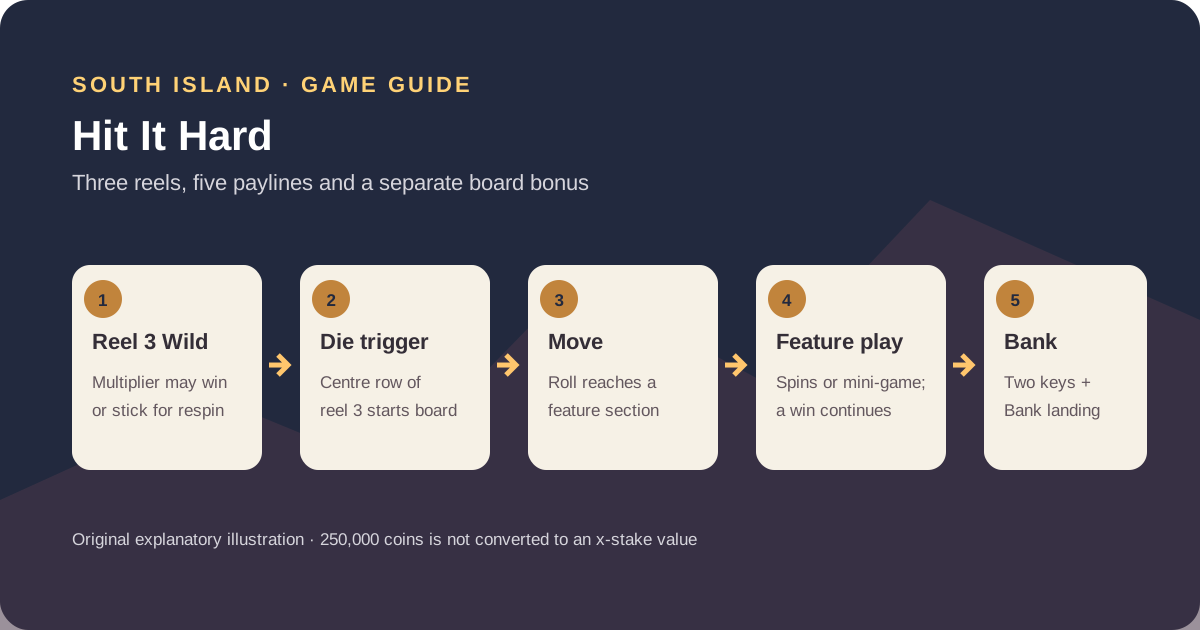
The short answer
Hit It Hard pairs a compact base game with a board-style feature. ELK describes three reels and five paylines. Multiplier Wilds are loaded on reel three; they can contribute to an immediate win or remain in place for a respin. A die landing on the centre row of reel three triggers the board bonus. Dice movement on that board can award more rolls, reel spins, mini-games or a Bank space.
The bonus is continuation-based. ELK says one win in an awarded feature is enough to keep the bonus going, so the round may continue for another board action. Its public description names two pachinko-style mini-games: Lucky Ballz gives four shots, while Super Ballz continues until the same basket is hit twice. The supplier describes both as guaranteeing a win.
The Bank requires two collected keys and a landing on the Bank section; ELK states the maximum win is 250,000 coins. That is a coin-denominated amount, not a verified multiple of stake. The readable supplier page does not give the current RTP, volatility label or operator stake range, and its linked Game Data Sheet returned HTTP 403 on 7 October 2026.
Identify the right Hit It Hard
The title is an ELK Studios product in its Classic Series. Confirm the provider and exact title in the game’s information menu before using any other review. A similar name, a different Hit It title or a third-party slot with dice graphics can have unrelated rules.
ELK’s product page describes a three-reel game and five paylines. This is a small base layout compared with the larger board feature above it. A reviewer should not treat the upper board as extra paylines or as another reel. It is a separate bonus display that changes what feature is awarded after a die trigger.
The supplier page is a catalogue product description, not an operator directory. It confirms the supplier’s published rules summary but does not prove which casino carries Hit It Hard today, whether the exact build is enabled in New Zealand, or what currency a customer would see. Write down the operator and version label from the actual game screen before discussing an account-specific setting.
Three reels, five paylines and the role of the third reel
The base game uses three reels and five paylines according to ELK. The special concentration is reel three: the supplier says it is loaded with multiplier Wilds. This makes the final reel a focal point in the official description, but it does not make every third-reel symbol a Wild or guarantee that a Wild aligns with a paying symbol.
Open the paytable to see which symbols form a win across the five listed paths. The official text in the readable summary does not list symbol values, the minimum match length, whether all lines are active at any stake, or the payout basis. Those fields should remain unanswered until the exact game help is inspected.
A five-payline display is not enough to calculate the probability of a payout. It also does not imply that each line is a separate wager. The operator may show a total stake, coin value or denomination. Retain the paytable’s own units when comparing a symbol payout or the multiplier Wild with another slot.
Multiplier Wild: immediate win or respin state
ELK says multiplier Wilds on reel three can either contribute to an immediate win or stick around for a respin. The two outcomes form a useful decision tree: first check whether the current combination wins; if it does not, the Wild may remain for another reel result. The Wild Respin also operates during bonus-game spins according to the supplier.
The public summary does not give a complete list of the multiplier values or state whether every Wild uses the same multiplier range. It includes an illustrative example of a 10× Wild combined with a 20× board-awarded multiplier, producing a 200× multiplier. That example explains that two multipliers can interact, but it is not a published RTP or a promise that the displayed values are available in every operator build.
For a current version, read how the multiplier attaches to a win: does it apply to the whole line, only to combinations that use the Wild, or to a feature result as described by the help? Record whether the Wild locks on reel three for one respin and what ends the respin. Do not assume that a Wild which did not contribute once will be held indefinitely.
The “second chance” description is an animation rule, not a user action. The supplier does not describe a button that lets the player choose whether to accept a respin. Do not tell readers they can time the hold or control which symbol appears on the other reels.
The die trigger is specific to reel three
ELK says the bonus starts when the die lands on the centre row of reel three. That position-specific condition should be kept intact. “A die appears” is too broad if it omits the centre row or reel. The game help should show whether a die can land in other positions without starting the bonus and what those positions do.
The die is more than a visual symbol: it initiates the board sequence. After the trigger, a dice roll determines movement across feature sections. Those sections can award a new roll, spins on the reels, a mini-game or the Bank. The exact board layout and landing labels belong to the version’s help. The supplier’s summary does not list the full space-by-space board.
When reviewing a session, separate the die that triggered the board from a later dice roll that moves around it. They are not necessarily the same event. Record the board’s starting position, roll, destination and award. If a movement passes over a section, do not assume that section activates unless the rules say it does; ELK’s public page only describes the sections as awards and does not fully define pass-through behaviour.
Board awards and continuation condition
The board can award additional spins and multipliers. ELK states a range from one to five spins and multipliers from 1× to 20× in the corresponding sections. It also says a win in the awarded feature is enough to keep the bonus game journey going. This means the board phase and the reel-spin phase should be read together.
Do not report that the board itself guarantees a return. An award of several spins is a count, not a payout. A multiplier is a modifier, not an outcome by itself. If no qualifying win appears in the awarded spins, the feature may stop according to its rules. The public supplier wording says the journey continues “as long as you keep winning”; the exact game help should define which win counts and whether a mini-game follows the same continuation rule.
The rules summary says some sections award another roll. A further roll can extend the path, but the supplier’s public description does not provide a maximum number of rolls, an overall bonus duration or the probability of any board space. Do not call the bonus “infinite” based only on the possibility of another roll. If the exact help states a cap or a stop condition, quote the rule with its version.
Lucky Ballz and Super Ballz
Both mini-games use a pachinko-style board. Lucky Ballz awards four shots. Super Ballz continues for an unlimited number of shots until the same basket is hit twice. ELK says both mini-games provide a guaranteed win, which guarantees the bonus journey continues under the supplier’s described rule.
The guarantee should be interpreted narrowly. It concerns a win event in the mini-game, not a guaranteed amount, positive net result or future board award. The mini-game may produce an award defined by the current rules, but the public product page does not list the basket values or how they combine with the active stake. Read those rules before treating “guaranteed” as a financial result.
The stopping condition for Super Ballz is unusually important: repeating a basket ends the shot sequence. Keep a simple list of observed basket outcomes when explaining a sample round, and distinguish the repeat that stops play from a basket’s payout. The public summary does not provide the probability of any basket or say that all baskets pay the same amount.
The term “infinite shots” describes the feature’s stopping rule, not a literally endless activity. The repeat condition can occur, and the feature can finish. Do not use “unlimited win” or “unlimited bonus” in a review.
Keys and the Bank award
The Bank is the named top-end feature in ELK’s description. Two collected keys are needed to unlock it, and the game must land on the Bank section with those keys in hand. ELK states that the maximum win is 250,000 coins.
Keep the unit exactly as published. A coin amount is not automatically equal to 250,000 times the stake, NZD, or any particular cash value. To convert it, a reader would need the active denomination, coin value, stake basis and operator’s settlement rules. The supplier’s public text does not make that conversion for every operator configuration.
Also distinguish the Bank condition from the key collection condition. Possessing two keys does not itself award the maximum; the board must also reach the Bank section under the supplier’s description. If a key can be won in a specific subgame or through a special route, use the actual help to document it. Do not invent a map path based on an affiliate review.
The maximum published coin award is not a likely outcome or a measure of RTP. It says nothing about how often two keys are collected, how often the Bank is reached, or whether the player’s account denomination matches the sample shown in a review.
RTP, volatility and coin-to-stake conversions
RTP is a theoretical long-run measure for a particular version of a game. It does not forecast a single round or tell a player how much will be returned over a short session. Volatility describes a different property of the outcome distribution. A maximum prize is the ceiling, not the average.
The readable ELK page for Hit It Hard does not show a current RTP variant, volatility score or operator stake range. Its Game Data Sheet link returned HTTP 403 on 7 October 2026. The only explicit upper amount in the supplier text is 250,000 coins. This review does not convert it to an x-stake figure because the required denomination and settlement basis are not available in the readable source.
Some competitor pages state RTP and maximum-win multipliers. Those figures can be useful clues for research, but they do not show which version is active at a particular casino today. In the sample opened on 7 October 2026, summaries also disagreed about whether the 250,000 figure is a coin value or a multiplier. The official supplier wording supports the coin unit; no unsupported conversion is used here.
If the game information menu displays an RTP, record the value beside the mode, date, currency and version. If it offers more than one configuration, keep each value separate. If the display only shows a coin cap, report coins. Do not calculate a multiplier unless the official help gives a clear formula and stake basis.
Use a session log to understand a feature sequence
A simple log can keep the board and reels straight:
- Record the base stake and the result that showed the die on the specified centre position of reel three.
- Write the board location, dice movement and the next section.
- Record whether the section awards spins, a new roll, a mini-game or another feature.
- For a reel-spin award, count the spins and any stated multiplier.
- Note whether the spin produces a qualifying win under the exact rules.
- If keys are visible, record when each is collected and whether the Bank condition has been met.
- Record the final paid amount and its unit from the game history.
This is documentation, not a strategy for improving the result. A movement log can show how a feature is structured, but a handful of rounds cannot establish the odds or expected return. It also cannot prove that a casino’s build uses the same settings as another operator’s game.
If a result seems inconsistent, save the round identifier, time, stake, board movement and the operator’s displayed game history. Ask support to reconcile the settlement rather than replaying the game in an attempt to reproduce a rare sequence.
Release, demo and mobile information
ELK’s catalogue and dedicated page document Hit It Hard as a product in the Classic Series. The readable page does not provide a dated release-status field. This article therefore does not supply a launch date or claim that a listed game is currently live at a New Zealand operator.
ELK recommends a desktop browser resolution of 1600×900 and a 16:9 ratio if scaling is needed. That is not a mobile certification or a claim about every casino’s frame. On a narrow display, check whether the board and reels are both legible, whether a round history can be opened, and whether the feature rules remain accessible while the board is active.
A legally accessible demo, if one is offered, can help a reader learn where the board and history controls are. It is not evidence of an account’s RTP, stake range or money settlement. No demo was launched during this review, and no casino or CPA route was opened.
Who may prefer this format
Hit It Hard’s base game is compact, while the bonus introduces a separate board and several kinds of award. A reader who likes mapping a feature path, recording keys and following a sequence from dice movement to reel spins may find the format easier to inspect than a game with many overlapping reels. Someone seeking only a simple reel-and-paytable explanation may find the board adds extra rules to learn.
That is a comment about interface and rule complexity, not about expected returns or suitability for gambling. The continuation condition can make a feature last longer than a player expects, while the 250,000-coin cap can attract attention disproportionate to the unknown odds. A person should not use the theoretical top amount as a reason to increase the stake.
Read the rules before making a stake decision. Decide in advance how much time and money to spend, and stop at those limits even if a board path is unfinished. A feature cannot recover a loss on demand.
New Zealand availability and safer play
The ELK page describes a supplier product, not a New Zealand casino offer. It does not confirm operator availability, customer eligibility or the local version’s setting. The Department of Internal Affairs says current providers must not advertise to people in New Zealand during the transition, and that third parties which publish or arrange advertising can be covered by the restrictions. Its initial decisions include prohibiting affiliate marketing.
This article contains no CPA button or operator referral. Current legal and market changes should be checked on official DIA pages, not inferred from an old casino review. The supplier’s licences for supplying game software are also separate from a consumer-facing casino’s permission to offer a service in a particular market.
Use the site’s New Zealand safer-gambling information for support resources. If gambling is affecting finances, relationships, sleep or wellbeing, stop and contact independent support. Keep the game guide’s feature descriptions separate from any advice to gamble.
Questions readers ask
How many reels and paylines are in Hit It Hard?
ELK describes a three-reel slot with five paylines. The public product summary does not give the complete paytable or payout basis, so read those fields in the exact game’s help.
What starts the board bonus?
The supplier says the die must land on the centre row of reel three. A die displayed elsewhere should not be reported as the same trigger without checking the current rules.
What keeps the bonus journey going?
ELK says a single win in an awarded feature is enough to continue the board journey. The exact help should define which win counts and how mini-games interact with the continuation rule.
What does Super Ballz do?
It awards shots until the same basket is hit twice. ELK describes a guaranteed win in the mini-game, but that does not guarantee a net profit or a particular cash amount.
Is the maximum win 250,000 times the stake?
ELK’s public page states 250,000 coins. It does not make that value a verified stake multiplier. The operator’s denomination and payout basis would be needed for a conversion.
Which RTP does Hit It Hard use?
The linked official data sheet returned HTTP 403 during this check, and the readable product page does not give the active RTP variant. Check the help in the operator’s exact version and retain the displayed mode and date.
Sources and verification boundary
- ELK Studios, Hit It Hard product page, checked 7 October 2026. Supplier-published reel format, Wild respin, board, mini-game and coin-cap descriptions.
- ELK Studios, games catalogue, checked 7 October 2026.
- ELK Studios Game Data Sheet link from the product page: HTTP 403 on 7 October 2026; current RTP, volatility and stake settings not verified.
- Competitor pages opened 7 October 2026: Casino Hipster, AskGamblers, AboutSlots. GamingSlots and SlotCatalog appeared in search results; the GamingSlots fetch was blocked by its robots rules. Numeric claims vary; no multiplier conversion is adopted.
- New Zealand Department of Internal Affairs, advertiser guidance and customer guidance, checked 7 October 2026.
