ELK Studios game rules · South Island guide
Cygnus slot review: gravity, avalanches and Free Drops
 Best casinos available in New ZealandUpdated 7 November 2026

The original Cygnus is an ELK Studios slot built around a six-column grid that begins with four rows. Winning symbols can avalanche away, while the remaining symbols shift under the current gravity direction and additional rows can appear. The supplier describes a maximum of eight rows and 262,144 ways, multiplier scatters that activate at the bottom row up to x64, and a Free Drops feature triggered by a Bonus symbol reaching the left pillar. RTP, volatility, maximum win and New Zealand operator availability are not confirmed by that public feature summary.
The short answer
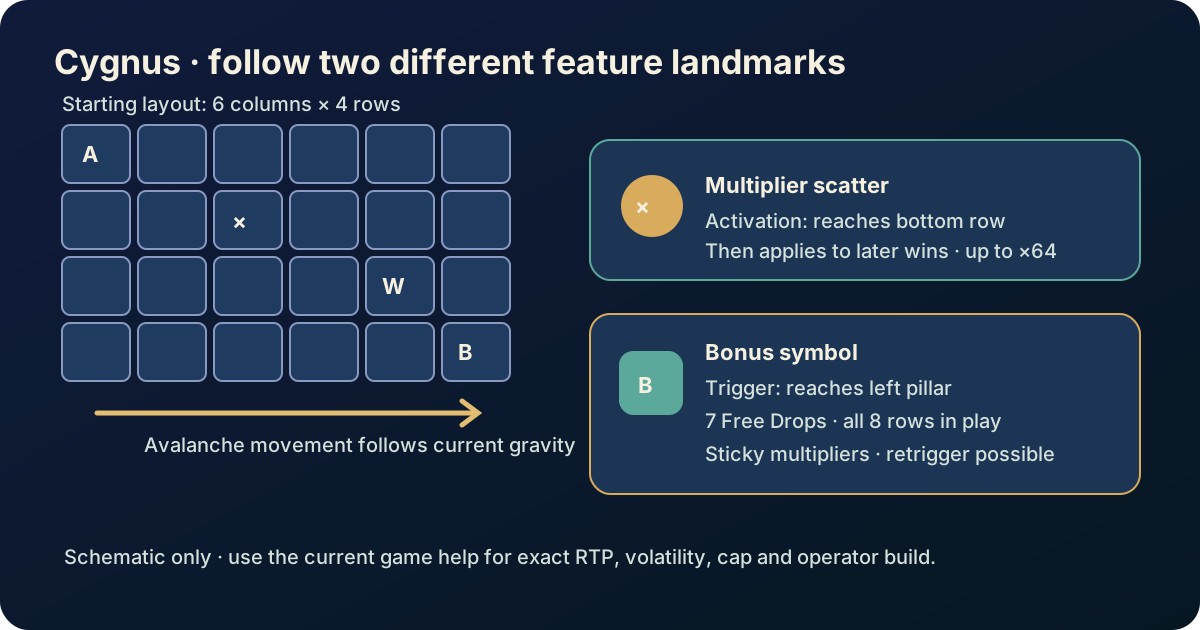
Cygnus is the original ELK Studios title, not a shorthand for Cygnus 2, 3, 4, 5 or 6. The supplier describes a six-column, four-row starting grid. Wins can trigger avalanches: winning symbols disappear, remaining symbols move left or right according to the current gravity, and new symbols can enter. The grid may grow to eight rows, which the supplier says creates up to 262,144 ways to win.
Its multiplier scatters have a position condition. They can appear during a drop, but ELK says they become active when they reach the bottom row. An active multiplier applies to later wins and each newly activated scatter doubles the current value up to x64. Separately, one Bonus symbol reaching the left pillar triggers seven Free Drops with all eight rows active. Multiplier scatters become sticky during that feature, and the bonus can retrigger.
Those are supplier-published mechanics, not a full mathematical specification. The accessible official game page does not state the RTP variant, volatility label, maximum win, stake range or operator build. Do not borrow any of those values from a numbered Cygnus sequel or a casino review. The ELK listing confirms that the studio has a page for the original game; it does not prove that a New Zealand operator currently offers it or that a demo is available to a particular account.
Confirm the exact Cygnus title
The first task is to make sure the game being considered is the original. ELK’s catalogue has separate pages for Cygnus and multiple numbered releases. Their related names and visual language do not make their rules interchangeable. Cygnus 2 and later versions can introduce a different grid, feature sequence, multiplier behaviour, bonus design, cap or RTP configuration. A review that omits the version number may therefore describe another game accurately while still misinforming a reader about the one they opened.
Check the title in three places where possible: the lobby tile, the game loading screen and the in-game help heading. Preserve the spelling and any visible version identifier. Then match the title against the official supplier page. If an operator’s tile truncates the title to “Cygnus”, open its help rather than assuming the base game. If the title in the supplier catalogue and client differ, record the discrepancy and ask the operator which build is active.
The supplier’s current public catalogue includes the original Cygnus alongside numbered titles. That is evidence that the name is a distinct catalogue entry. It does not establish the exact release date, current distribution to a given casino, or an account’s right to launch it. Availability is a separate operator-level question: a game can be listed by a supplier but absent from an operator lobby, restricted by account, or hidden in a jurisdiction.
This distinction is especially important when checking a review’s numeric claims. A search result may display “Cygnus” in a heading while discussing a sequel, an old version or a game with a similar theme. Before relying on a figure, open the source and check the article body, version, paytable and date. If the source does not identify those fields, regard the number as unverified rather than filling in the missing version from context.
Read the base grid before following a feature
ELK describes Cygnus as a six-column grid that starts with four rows. This gives a reader a practical starting point: count the columns from left to right, note the four active rows and identify the left pillar, bottom row and any gravity indicator. The supplier says rows can expand to eight during play. If the screen changes height, the new visible area is part of the game state; it is not necessarily decorative space or an unrelated overlay.
“Ways to win” is a way to describe eligible symbol combinations across the active grid. It is not the number of ways a player is guaranteed to win, nor a measure of return. ELK states that the maximum eight-row grid reaches 262,144 ways. The number of ways is tied to the board configuration and symbol rules; it does not tell a reader how often a combination occurs or what it pays. To interpret a result, the paytable and help must explain qualifying symbols and the relevant payout calculation.
The phrase “gravity forces symbols to slide left and right” can sound like ordinary downward falling, but the official page describes a more specific movement. After winning symbols explode, remaining symbols can move toward one side depending on the current gravity forces; additional symbols enter from above and may start another avalanche. A useful review should separate the initial arrangement, the win evaluation, the removal of winning symbols, the direction of movement and the next drop. Combining all of that into “symbols fall” hides the game’s main state changes.
The source summary does not explain every board transition. It does not, for example, provide an exhaustive diagram of how the gravity direction is selected or changed, whether every row is active at every point, or the precise order for all symbol effects. Those details belong to the current help panel. This guide uses only the broad published mechanic and does not invent an unlisted rule to make the animation easier to narrate.
When reading the client, note whether a win is a single evaluation or one part of a sequence. A cascade or avalanche can contain several symbol arrangements inside one paid round. A visible new drop does not automatically mean the player has paid for another spin. The game’s history and total-win display can show how the client groups the sequence. Use that recorded grouping rather than counting animation pulses as separate wagers.
Avalanches and the role of gravity
According to ELK, winning combinations explode and create room for remaining symbols to slide either right or left, depending on the current gravity forces. New symbols then drop from above and may create additional wins. The sequence stops when no more winning combinations remain, though the source page also says the process can continue as newly dropped symbols enter the board and create another avalanche cycle.
To understand a round, follow the board in chronological order. First identify the evaluated arrangement. Next, check which symbols were removed and which remained. Then observe the movement direction and whether the grid gained a row. Finally, note which symbols arrived from above and whether they produced another evaluation. This order helps distinguish a feature effect from a simple animation transition.
Gravity should not be treated as a signal that predicts what appears next. The direction tells how remaining symbols move under the stated rule; it does not show that a certain symbol is due or that a prior miss makes a later win more likely. Each round’s visual path is a game mechanic, not a forecasting tool. Past avalanche length also does not establish the expected length of the next round.
If the interface uses an arrow, label or colour to show gravity, compare it with the help diagram. On a mobile display, a small indicator can be obscured by a win banner or cropped area. Do not infer direction from where a symbol ended up in a single frame; an animation can make the movement difficult to follow. The rules explanation and the round history take precedence over a screenshot of a transient animation.
The grid expansion changes the number of active positions described by the supplier, but it does not provide a simple measure of improved value. More rows and more ways can make it easier to form a visible combination under some arrangements, while the symbol probabilities, paytable values, stake and game mathematics determine expected return. Without the exact probability model, one cannot calculate RTP from the row count or from a long feature animation.
For practical note-taking, record whether the displayed board was still in the base game or had entered Free Drops, what row count was visible, the current gravity indicator and any active multiplier. If a result seems inconsistent with the help, capture the complete result state and the round reference, then check the same product’s rules. A partial screenshot of a single dropped symbol cannot establish the full settlement logic.
Multiplier scatters: appearance is not activation
ELK states that multiplier scatter symbols may appear with any drop. Their appearance alone does not activate them. The official summary says they activate when they reach the bottom row and then apply to subsequent wins. Every new activated scatter doubles the current multiplier, up to x64. This distinction between a symbol appearing and a symbol becoming active is central to reading the feature correctly.
Track three separate facts: where the scatter appeared, whether it reached the bottom row and which multiplier value the interface says is active. A scatter that remains above the activation position should not be counted as an active multiplier unless the help explicitly says otherwise. Likewise, a displayed multiplier can apply to subsequent wins rather than retroactively changing a win already evaluated. The active help is needed to determine exactly when the game calculates a payout.
The public page gives the x64 ceiling. It does not publish an RTP variant or the frequency of multiplier scatters. A maximum multiplier is a rules boundary, not an expected result or an indication of how often the ceiling occurs. It cannot be used by itself to calculate a likely session result. Any secondary review that converts the feature ceiling into a practical winning expectation is making an unsupported leap unless it supplies a complete and verified model.
The multiplier’s relation to gravity and avalanches also deserves careful wording. The scatter has to reach the bottom row under the game’s movement rules before activation. If symbols shift side to side, the current board state can affect the route. That does not mean a player can influence gravity or choose the symbol path. A feature description should explain the condition, but avoid implying that a visual position gives control over a random outcome.
In a record of a feature sequence, note the displayed multiplier before and after the new scatter activates, and whether the game labels the value as current, total or next-win. If a bonus round begins, separately check whether that value carries into the feature. ELK says the multiplier scatters become sticky in Free Drops, which supports persistence within that bonus. The exact reset point after the feature should be checked in the current game help, not inferred from another ELK game.
Free Drops: trigger, starting state and retriggers
The supplier says a single Bonus symbol reaching the left pillar triggers Free Drops and awards seven free drops. The feature begins with all eight rows active and in play. Multiplier scatters become sticky, and each newly activated scatter can double the current multiplier up to x64. ELK also says the bonus can retrigger. This gives a clear high-level path: qualifying Bonus symbol, Free Drops state, expanded board and persistent multiplier scatters.
The left-pillar trigger is not the same condition as the bottom-row multiplier activation. They use different board landmarks and different symbol roles. Watch for the Bonus symbol’s route to the left pillar and the multiplier scatter’s route to the bottom row. A page that collapses both into “special symbols trigger the bonus” loses the detail a reader needs to follow the client.
“Sticky” means the supplier describes the multiplier scatters as staying in place during Free Drops rather than leaving after every evaluation. The summary does not provide every boundary of that persistence, such as how an individual scatter behaves after activation or the exact reset after the bonus ends. The help page should answer those specifics. Do not transfer a sticky rule from Cygnus 2 or another sequel to the original.
Retriggering means that the bonus can be awarded again under the game’s defined trigger while the feature is already active. The public source confirms that retriggers are possible, but a reader still needs the current help for the qualifying symbol count, the number of additional drops awarded and any limit on repeated triggers. Do not promise an unlimited bonus or assume each retrigger adds the original number of drops.
Free Drops are a feature state, not a separate paid product. The stake that initiated the round and the feature’s own rules determine how wins are recorded. If the game offers a feature mode or direct entry, that is a different stake decision and may have separate terms. The official public page checked for this guide does not document a Cygnus feature-buy offer or its price. No such option should be assumed from other ELK titles.
RTP, volatility, maximum win and other settings
The most important gap in the public feature page is the absence of the current math and account configuration. RTP is a theoretical return calculated for a particular game configuration over a very large number of rounds. A single percentage cannot be assigned to every casino build without the relevant game help. The supplier may distribute different RTP variants, an operator may select a permitted configuration, and the interface can show a specific value for one account or market.
For Cygnus, the official product summary confirms mechanics such as grid dimensions, the maximum ways count, multiplier behaviour and Free Drops. It does not state a current RTP value, RTP variants, volatility label, win cap, stake minimum or maximum, feature-purchase setting or account-specific status. Those fields should be recorded as not verified from the reviewed public summary rather than filled with a number found on a competitor site.
Volatility is also not a substitute for a paytable. A label such as high or medium can be a useful broad description only if it comes from the exact game help or a reliable supplier statement. It does not predict whether a particular session will win, how long a bonus will take to appear, or the size of any individual return. If the provider does not publish the label in the accessible source, the honest answer is that this guide cannot confirm it.
A maximum win is an upper rule or cap, not a typical outcome. It must be tied to the exact version, stake basis and calculation language. A number in “x stake” is not the same as a coin amount or a fixed currency value. If a source does not state its basis, comparing the number with another title is unsafe. The official Cygnus summary available on the review date does not provide a maximum-win figure.
To verify settings in an operator client, open the help or paytable after confirming the title. Capture the visible RTP and whether it refers to base game, feature mode or another configuration. Record the stake range, maximum payout wording, game version or rules date, and the source’s currency. If the help panel is not available before launch, ask the operator how a player can see the game’s rules before wagering. Do not treat a general supplier catalogue as a substitute for the exact math sheet.
Device, mobile and demo checks
ELK recommends launching Cygnus at 1600 × 900 for the optimal desktop experience and keeping a 16:9 ratio if scaling is needed. That is the supplier’s stated desktop recommendation. It is not a minimum device requirement, a performance benchmark or proof that the interface works identically on every browser. A person using a smaller screen should check that all six columns, the bottom-row marker, left pillar and active multiplier remain readable.
On a phone, landscape orientation may make a wide grid easier to inspect, but device support should be confirmed in the live game client. Browser zoom or rotating during an active round can hide controls or move the help panel. Before starting, locate the paytable, history control, sound settings and exit route. If the interface clips the row count or multiplier status, use the official help or a larger screen instead of guessing.
The public supplier page has a “Play” link, but that alone does not establish a no-stake demo for every user. A play link may open a supplier experience, route through another page or depend on local access. We did not verify a demo session or a New Zealand operator listing. Therefore this guide does not state that Cygnus is available to play for free or for money in New Zealand.
A demo, if provided by an operator, is useful for learning where the controls and information sit. It does not confirm the operator’s real-money RTP configuration, account eligibility, limits, payment terms or current promotion. A simulation can also use a specific test build. Verify the rules and numbers in the actual help panel that governs the account you plan to use.
A practical verification checklist
Before relying on a Cygnus review or opening the game, check the following:
- Exact identity: the help heading says Cygnus, without a sequel number.
- Supplier match: the game information identifies ELK Studios.
- Rule version: record a rules date or game build if it appears.
- Base layout: confirm the starting six columns and four rows in the help.
- Avalanche sequence: identify how wins disappear, how remaining symbols move and when new symbols arrive.
- Gravity indicator: locate the current direction and distinguish it from a prediction.
- Expansion: confirm when additional rows appear and what the eight-row state means.
- Multiplier condition: verify that a scatter activates at the bottom row and how it applies to later wins.
- Bonus trigger: verify the Bonus symbol reaching the left pillar, seven Free Drops and the retrigger details.
- Maths fields: read the exact displayed RTP, volatility, cap and stake range; leave unavailable values unknown.
- Market availability: confirm the operator offers this exact title to the account and location.
This checklist is designed to stop information from one version bleeding into another. A review can be accurate about Cygnus 6’s 50,000x potential, for example, and still be irrelevant to the original. The number of rows, multiplier cap, feature name and maths must be checked against the right title. Search snippets, scraped casino catalogues and similar artwork are not a substitute for the title-specific game help.
Frequently asked questions
Is Cygnus the same game as Cygnus 2 or Cygnus 3?
No. ELK lists these as separate titles. The original Cygnus has its own public feature summary and should not inherit a numbered sequel’s mechanics, RTP, volatility or win cap.
How many rows and ways does the original Cygnus have?
ELK’s current public summary describes a six-column grid that can expand from four rows to eight, reaching up to 262,144 ways. Confirm the active layout in the exact game help before using a particular operator build.
What activates the multiplier scatters?
The supplier says they activate when they reach the bottom row. They then apply to subsequent wins, and each new activated scatter doubles the current multiplier up to x64. Exact payout timing belongs to the active help panel.
How does Free Drops start?
ELK says one Bonus symbol reaching the left pillar starts seven Free Drops with all eight rows in play. Multiplier scatters become sticky, and the bonus can retrigger. The public summary does not detail every retrigger boundary.
What is the RTP or volatility of Cygnus?
The public page reviewed here does not state a current RTP variant or volatility rating. Check the current in-game help and operator configuration. Do not copy figures from Cygnus 2–6 or an undated secondary review.
Can I play Cygnus in New Zealand?
This article cannot confirm that. ELK’s catalogue page documents the supplier product but does not identify which New Zealand-facing casino offers it to an eligible account or whether a demo is enabled.
Slot mechanics explain how a game behaves; they do not change its financial risk or make outcomes predictable. Decide your entertainment limit before play, and see the site’s safer-gambling information for support and ways to pause.
Sources and verification boundary
- ELK Studios, Cygnus game page and games catalogue, checked 7 October 2026. Mechanics and grid figures above are paraphrased from the supplier’s current public description.
- The accessible public description did not expose a current Cygnus game-data sheet during review. RTP variants, volatility, maximum win, stake limits, demo status and operator availability remain unverified.
- Competitor comparison checked 7 October 2026: Clash of Slots, OnlineSlot and OnlineSpielautomaten Cygnus reviews. Secondary sources disagree or risk mixing the original and later numbered releases; their numerical claims are not adopted here.
- No NZ search-volume, ranking or operator account data was supplied.
