ELK Studios game guide · South Island guide
Rex Stampede: rules, features and settings to verify
 Best casinos available in New ZealandUpdated 7 November 2026

Rex Stampede is an ELK Studios slot whose public summary lists Wilds, multiplier Wilds, symbol upgrades, stacks, Stampede and Bonus and Super Bonus features. This guide separates those components so the reader can follow what changes on the board and what the client actually settles. It does not assume that an animation or supplier summary reveals the live operator configuration.
The short answer
Rex Stampede is an ELK Studios slot with a feature set that the supplier describes through Wilds, multiplier Wilds, symbol upgrades, stacks and a Stampede event, alongside Bonus and Super Bonus states. Those labels suggest a progression from ordinary board symbols to changed symbols and a separate event, but the supplier’s short page does not establish every trigger or payout condition in the client a player might load.
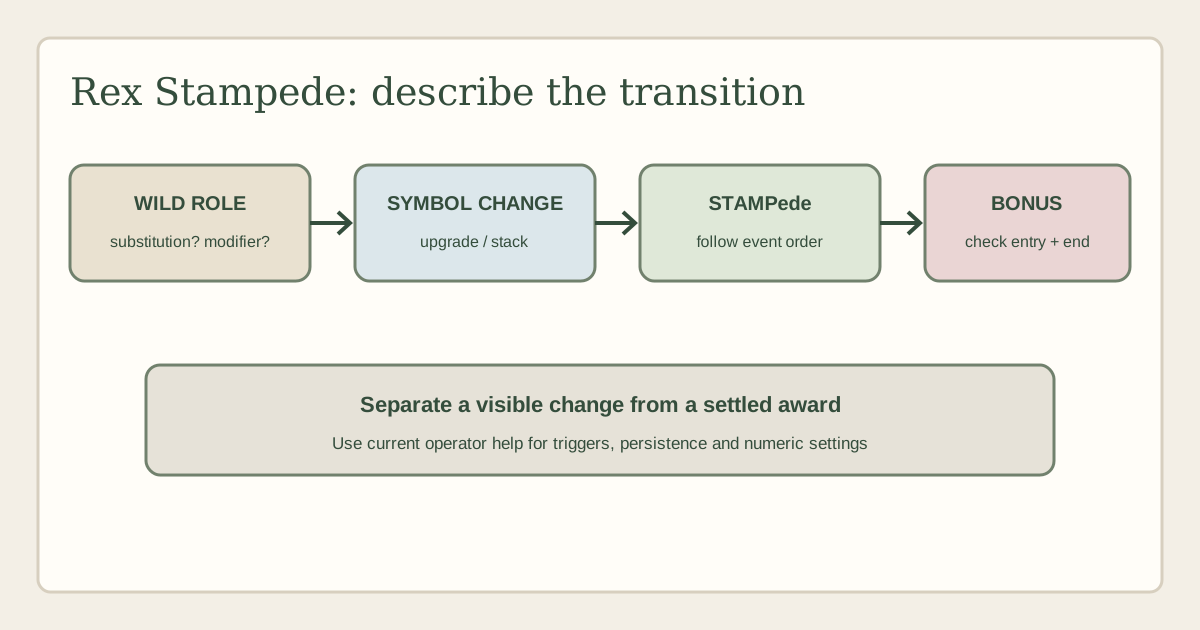
The useful review method is to track each state transition independently. Ask what symbol or event changed, what it became, whether the change affected later positions, and when the client evaluated an outcome. A multiplier Wild can have a role different from an ordinary Wild; an upgraded symbol can change a future board without being a credited win; a Stampede can be a distinct event rather than a synonym for any group of Wilds.
No current operator help screen was provided for this review. Accordingly, no numerical RTP or variant, volatility, hit frequency, stake range, maximum win, trigger probability or optional-mode price is stated. New Zealand access and demo availability are not confirmed. The only verified source for the qualitative feature vocabulary below is ELK’s supplier material, checked on 6 October 2026.
Confirm Rex Stampede, not another Stampede title
Open the information panel inside the loaded game and verify the full title and ELK Studios provider credit. Then compare it with ELK’s Rex Stampede page and the supplier catalogue. The word “Stampede” appears in more than one slot title; it is not a sufficient identifier. Check the named features in the help as well as the image or lobby label.
Record the operator, account region, displayed currency, date, client version and any help revision. These details matter when checking settings: two reviews may describe different configurations, markets or publication dates. A value copied from a search result without a matching build cannot be treated as the active setting. If a lobby shortens the name, use the client help to establish whether it is Rex Stampede specifically.
Separate supplier identity from game access. ELK’s catalogue confirms that the studio publishes a title. An operator listing would be separate evidence, and account eligibility in New Zealand is another separate question. None of the supplied material verified a New Zealand operator listing for Rex Stampede, so this page does not make that claim.
If the client’s help uses terms that differ from the supplier’s public page, retain both wordings in your notes and determine whether they refer to the same feature. Do not quietly translate an unfamiliar label into a familiar slot mechanic. Exact names are useful because they give a reader a route to the correct information panel and reduce the risk of importing a rule from a similar game.
Start with ordinary Wilds and multiplier Wilds
ELK lists both Wilds and multiplier Wilds. That distinction should be retained in a feature guide. An ordinary Wild generally has a substitution role only when the rules say so; a multiplier Wild may also carry a value or modify a qualifying result. The public summary names both categories but does not define each symbol’s scope, substitutions, timing or calculation for a current operator build.
Read the help panel for the exact substitution list. Does the Wild stand in for all regular symbols, selected symbols or none of the feature symbols? Is the multiplier attached to a position, a symbol, a line or a specific feature state? Does it apply before or after another effect? Those are separate questions. A broad phrase such as “multiplies wins” could be wrong if the symbol only affects a named event.
When a Wild appears, first identify the winning condition, then the multiplier rule. Check whether the game displays a base result and a modified result separately or presents only a combined credit. If multiple Wilds are visible, do not assume their values add or multiply together. The active rules need to define combination behaviour. Avoid calculating a hypothetical payout using a multiplier number from an unrelated screen or third-party review.
Watch whether the Wild moves, stays in place, expands or disappears after its action. ELK’s summary names Wild features at a high level; it does not supply every persistence rule. If a Wild appears in one outcome and remains on the next screen, that is an observed state, not a rule for every round. Confirm duration and reset conditions in the client before describing the symbol as sticky or persistent.
Symbol upgrades and stacks
The product summary also names symbol upgrades and stacks. These terms describe board changes but do not independently reveal what qualifies for an upgrade, whether the changed symbol remains in the same location, or how the stack participates in a later evaluation. Follow one change from the first symbol through its final state and read the help text that explains the transition.
For an upgrade, record the original symbol, the trigger, the resulting symbol or level, and the next time the board is evaluated. A changed symbol could affect the paytable, contribute to a feature, or be one part of a sequence. Do not call an upgrade a payout unless the client credits it as one. A visible level indicator may mean progress, not cash value.
For a stack, check whether it fills consecutive positions, appears as a single tall graphic or represents multiple symbols. That distinction affects how a player reads a board and whether a Wild or other feature can interact with each part. The supplier’s summary does not define all position rules. Use the paytable and symbol legend for the active version rather than assuming every stack behaves identically.
Upgrades and stacks can be presented together in an animation. Keep their functions separate: one may alter symbol identity, while another changes how many positions a symbol occupies. If both happen before settlement, record the order and ask which board state the game evaluated. A clear description tells readers what visibly changed and what was paid, instead of collapsing the event into a vague “big symbol feature”.
When reviewing the history, note whether the upgraded state carries into the Stampede or a bonus. Persistence is one of the most important differences between a temporary animation and a feature that affects later decisions. The official short description does not verify this across all operator builds. If the help leaves it unclear, state the gap and do not infer that a change remains active.
Stampede: treat the named event as its own branch
The Stampede is a named feature in Rex Stampede. A useful guide should state the event’s starting condition, the symbols involved, the sequence of actions and the point at which the result settles. The public supplier summary establishes the name, but it does not provide a complete trigger table or every interaction. Those details need to come from current game help.
If the board shows a Stampede marker or animation, identify what the game says initiates it. Then trace the event in order: the initial board state, the affected positions, any Wild or symbol change, the subsequent evaluation and the credited result. Do not treat a screen transition as proof that the event has paid. A feature can create conditions for later evaluation without itself being a cash award.
Check whether the Stampede can occur in ordinary play, only in a bonus or through a separate option. The page summary does not establish which access route applies. Do not describe it as player-selectable, guaranteed or purchasable without the operator’s current rules. If a mode menu shows an optional path, inspect its price, eligibility and settlement terms before making a statement about it.
Also check how the event uses stacks and upgraded symbols. A Stampede might move or change symbols, but no exact relationship should be claimed unless the client help says so. If the history shows several board changes, write them in their actual sequence. A coherent sequence is more useful than an unsupported description of a “high volatility stampede” or a promise that the feature creates a large result.
The name can tempt reviewers to talk about speed or frequency. Avoid that. A title and animation style do not establish how often the event appears, how long it lasts or the distribution of outcomes. If the operator help publishes a probability or a mode rule, transcribe it with the exact context and date. Otherwise keep the explanation mechanical and qualitative.
Bonus and Super Bonus states
ELK’s feature summary identifies Bonus and Super Bonus states. It does not, in the material supplied for this assignment, establish the precise symbol count, trigger conditions, number of actions, retrigger path, possible carry-over or termination rule for a particular operator build. Read the help for the loaded title and treat each mode as a separate branch until the rules show what they share.
At the point of entry, note the event that started the feature and which parts of the base-game board remain visible. Check whether Wilds, upgraded symbols or stacks are carried forward, rebuilt or cleared. Then read the feature’s own instructions. A special screen may use a different evaluation method, and the ordinary paytable might not explain it completely.
If a Super Bonus is offered, compare its documented rules with the ordinary Bonus. Do not interpret the word “Super” as a guaranteed larger payout or a fixed number of extra turns. It might describe a different starting state, symbol mix or selection condition; only the active help can confirm that. The title alone is not a mathematical specification.
The round history helps avoid counting the same value twice. A feature might display a running total and then transfer that amount to the final credit. If the game shows both, determine whether they are stages or separate awards. Use the operator’s wording when describing settlement. A small sample of feature rounds cannot establish average return or the chance of seeing a Super Bonus.
Settings: numbers must match the active build
No current Rex Stampede operator help screen was available for this review. The page therefore does not claim an RTP value, any selectable RTP versions, volatility, hit frequency, stake limits, a win cap, Stampede odds or the price of an optional feature. Such values may be specific to an operator and market, and a supplier feature summary does not verify the setting that is live in a casino client.
When checking RTP, copy the exact label, numerical value and any mode qualifier from the client. Record whether the screen says the number applies to the base game, a feature or a particular configuration. If the menu offers alternatives, distinguish offered settings from the active setting. Do not merge values from different sources into a range to make an incomplete listing seem comprehensive.
Read stake limits in the currency shown to the account. If the game has an optional mode, check whether the displayed cost is in addition to, or a multiple of, the selected base amount. For a cap, preserve the unit and the scope: a single-round cap, a feature cap and a stake multiple are not interchangeable. Without that context, even an accurate figure can mislead.
Volatility, when published, is a broad statistical description, not a guide to when the next Stampede appears. RTP describes a theoretical long-run return, not a promise for one user or session. Neither the Wild animation nor a stack of symbols predicts the next outcome. If the client help does not provide a requested field, mark it not stated rather than copying another reviewer’s setting.
Mobile, demo and a readable session record
If the game is available through an eligible operator, examine it on the device you expect to use. Make sure the symbol legend, Wild labels, stacked positions, upgrade status and feature instructions remain visible. A mobile layout can compress symbols or place a status panel behind an overlay. Confirm the balance and total stake before starting a round, and check that the history remains accessible afterward.
The sequence may be easier to follow on a larger display if the animation moves across the board. If the screen is crowded, slow down and use the help panel rather than treating a quick animation as a rule. Touching a feature control can also be different from watching a feature animation: confirm whether the game is asking for a real choice and what amount or state is involved.
No demo version was inspected. If an operator provides a practice mode lawfully, it may be useful for learning where settings and history are located. It is not proof of cash-game configuration, RTP, feature frequency or expected result. Verify that the demo identifies Rex Stampede itself and that it is not a video or promotional simulation.
For a useful record, note the date, operator, region, displayed currency, game build and help revision, then transcribe rules under four headings: ordinary Wilds, upgrades and stacks, Stampede, bonus modes. Separate direct observations from supplier claims and operator-confirmed settings. That keeps later corrections local: a changed operator configuration does not require rewriting a verified supplier description.
New Zealand availability has not been checked against an operator lobby or eligibility terms. Do not infer access from a foreign review page. If gambling is affecting wellbeing or finances, step away and use independent New Zealand support information rather than trying to recover losses.
Compare mechanics without inventing strategy
Rex Stampede can be described clearly by comparing the functions of its feature words. A Wild may substitute; a multiplier Wild may modify a qualifying result; an upgrade changes a symbol state; a stack affects the board’s symbol arrangement; a Stampede is a named event; Bonus and Super Bonus mark separate modes. The exact action behind each label still needs the current help.
This vocabulary is not a strategy. A player does not choose when the game upgrades symbols or starts an event unless the interface explicitly presents a choice. No sequence of prior losses or near misses makes a Stampede “due”. Avoid systems that claim to time a feature, predict a bonus or guarantee a return. A factual guide should not turn a mechanic explanation into advice to increase the stake.
When comparing Rex Stampede to another ELK game, compare one rule at a time. For example: do both games use stacks, and what does each help screen say about their evaluation? Are Wild multipliers attached to a symbol or a feature? Does a bonus carry board state? Similar labels do not imply the same answer. Record the source and date next to each comparison.
The safest review is precise about uncertainty. It can explain that ELK publicly lists a feature, show how to locate its help text, and say what a reader should verify without pretending to have tested the game or accessed an operator build. That approach remains useful even if the operator later changes an available configuration.
Frequently asked questions
What features does Rex Stampede have?
ELK’s public summary names Wilds, multiplier Wilds, symbol upgrades, stacks, a Stampede event, Bonus and Super Bonus states. Exact triggers, values and interactions require the current operator game help.
What does the Stampede feature do?
The supplier identifies Stampede as a feature, but the brief summary does not establish its full sequence. Check the active client for its trigger, affected symbols, event order and settlement before describing a specific result.
Are the Wilds and multiplier Wilds the same?
ELK names them separately. The current help should explain each substitution role and how any multiplier applies. Do not assume they combine or persist in a particular way without those rules.
What is the current RTP?
No current operator help was supplied, so this page does not publish a figure or variant. Check the exact client and record the displayed configuration and date.
Can I access Rex Stampede in New Zealand?
No NZ operator listing was verified. Check a current operator lobby and its regional eligibility terms; the supplier catalogue alone does not confirm account access.
Is a demo available?
No demo was inspected. Availability can depend on the operator and region. A practice mode can explain controls but cannot verify the cash configuration or estimate return from a small sample.
Do stacks or upgrades guarantee a win?
No. They describe board or symbol changes. A win still depends on the client’s evaluation rules and final settlement. Read the paytable and use the round history to see what was credited.
Does Super Bonus mean a larger guaranteed prize?
No guarantee follows from the name. Read how the current help distinguishes Super Bonus from Bonus, including its entry, state and settlement. A feature label is not a payout promise.
Sources and verification boundary
- ELK Studios: Rex Stampede — supplier feature summary, checked 6 October 2026.
- ELK Studios games catalogue — supplier listing, checked 6 October 2026.
- No current operator game-help screen, New Zealand operator listing or demo client was supplied or verified. Numeric settings and account access remain unknown.
- Competitor coverage sampled on 6 October 2026: Bigwinboard, Fruity Slots, Sigma and Hideous Slots. This page does not adopt their operator-specific setting claims.
