ELK Studios game rules · South Island guide
Cygnus 3 ELK Studios slot review: rules and features
 Best casinos available in New ZealandUpdated 7 November 2026

Cygnus 3 combines a changing reel layout with multiplier Wilds, a Cygnus Wheel and fixed-jackpot outcomes. This guide explains the public supplier outline while separating it from the RTP, volatility, stake limits and local availability that only a current operator help screen can confirm.
The short answer
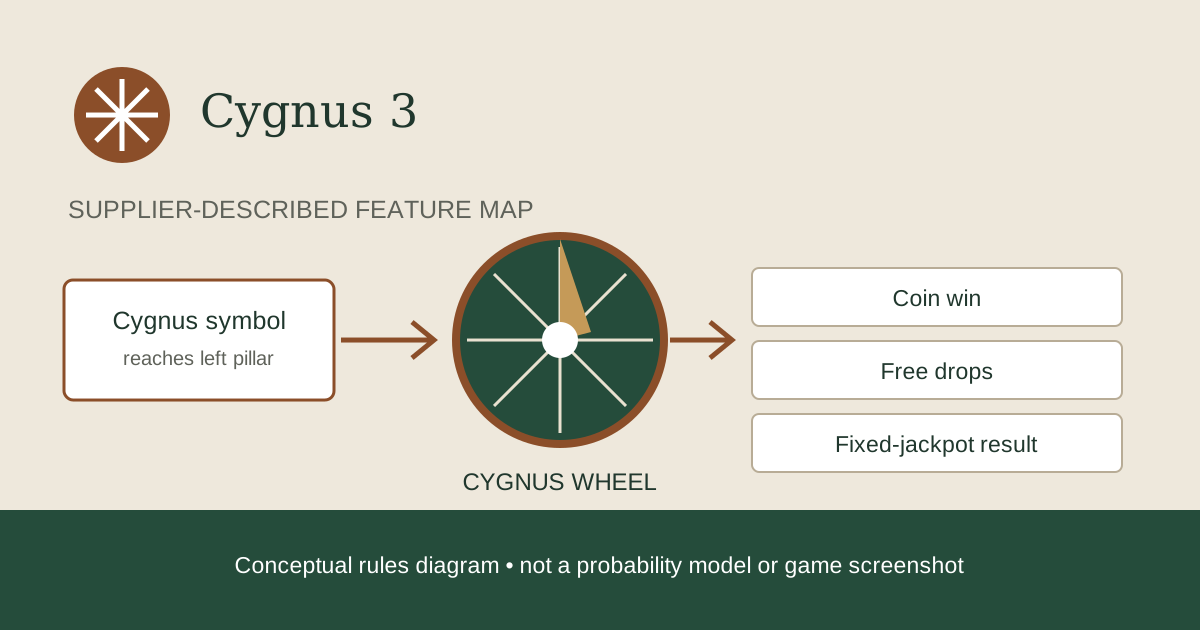
Cygnus 3 is a slot from ELK Studios whose public product description centres on rolling symbols, a changing grid, multiplier Wilds and a feature called the Cygnus Wheel. The wheel can award a coin win, a free drop or one of the title’s fixed jackpot awards. In the free-drop state, the supplier says multipliers stay in place between drops. Those details explain the broad feature map; they do not establish the return percentage, the odds of any award, the volatility label or the settings used by a particular casino.
This review is for someone asking what the rules mean before they decide whether the game is understandable. It does not treat a promotional page, a search snippet or a result from a different country as proof of the client a New Zealand account could open. We checked the ELK Studios Cygnus 3 product page and catalogue on 7 October 2026. The supplier’s public page is useful for the feature outline, while the downloadable game-data sheet was not accessible during research. Exact mathematical details therefore remain unverified.
Confirm the exact title and client
First confirm the game is Cygnus 3, rather than another title in the Cygnus series. A similar name, constellation image or remembered feature is not enough to establish that two clients use the same rules. Open the information panel in the game itself and record the displayed title, supplier, game identifier if shown, version or build label if present, and the date. These details matter because search pages may group related releases together even when their grids, bonus triggers or mathematical settings differ.
ELK’s own catalogue identifies Cygnus 3 as a separate product. The site also has a guide to Cygnus 5 and a guide to Cygnus 6; those pages should not be used to fill gaps in Cygnus 3. A title comparison may mention that all belong to a series, but a symbol rule or payout from one instalment cannot be transferred to another without direct help text.
An operator can distribute a game without offering it in every jurisdiction or to every account. A supplier listing proves that a title is documented by the supplier; it does not prove that a casino in New Zealand carries it, that a particular account may access it, or that a demo is enabled. Treat identity, release status, distribution and local eligibility as separate checks. If the game launcher shows a different name from the catalogue, pause and reconcile the difference before relying on a review.
Read the board as a sequence, not as a static picture
The supplier describes a six-reel, four-row starting layout and rolling symbols with expanding rows. Because those are product-page specifications rather than a current operator help panel, verify the displayed grid in the actual client before treating the layout as a precise rule. The useful reading method is to note what changes after a result: which symbols qualify, which positions clear or move, whether new symbols enter, and whether the next evaluation belongs to the same round.
That order separates a visual event from a settlement event. A symbol can roll, a row can appear, or a multiplier can move without creating a paid win at that exact moment. Conversely, a round may resolve several linked events before the balance changes. If the client provides a round history, use it to follow the sequence after the animation has ended. The paytable should define how a qualifying symbol combination is measured, whether a Wild can substitute, and how the game treats symbols that arrive during a roll.
Do not assume that a familiar “ways” or “payline” model applies simply because other slots use it. The current help should say whether matching symbols are evaluated on lines, ways, clusters, scatter positions, or another rule. It should also specify the minimum combination and the direction of evaluation. If the rules page does not explain those terms, the safest review wording is that the exact settlement condition has not been verified, rather than borrowing a rule from Cygnus 5 or from a third-party table.
When checking a sample round, write down the initial board, the qualifying symbols, the movement or removal step, and the point at which the client reports a win. Then compare the event history with the paytable. This small discipline prevents an attractive animation from being mistaken for a payment, and it makes a written review reproducible without implying that one sample proves long-run behaviour.
What the expanding layout changes
An expanding row changes the number of visible positions and can alter the set of possible combinations. The supplier lists expanding rows as a Cygnus 3 feature, but the public summary does not provide the complete trigger, row-growth sequence or settlement rules. Check whether growth follows any win, a particular feature symbol, a wheel award, or another condition. Also note whether the expanded shape lasts for the rest of the spin, resets after a cascade, or persists to a later game state.
Those distinctions affect how a player reads the next screen. An expanded board is not automatically a bonus round. It may be a temporary layout change that creates additional symbol positions, with each position still judged by the ordinary paytable. The help should tell the reader whether new symbols drop into existing empty spaces, whether reels roll vertically, and whether the position of a multiplier Wild changes the calculation.
A compact review should avoid overpromising that more rows mean more wins. More visible symbols can create more possible combinations, but they do not guarantee a qualifying match. They also do not by themselves tell us the chance of an expansion. To evaluate the feature, distinguish three questions: what event changes the layout, what combinations count on the changed layout, and when the layout returns to its starting state. The operator help or a recorded rules screen should answer each one.
If a third-party review lists a maximum number of rows or a total number of ways, compare that value with the actual client and date. A table copied from an earlier release can stay indexed long after settings change. The exact number belongs in a review only when the active rules or a current, title-specific data sheet supports it. Here the public supplier overview does not settle every layout detail, so this page explains the function without presenting an unverified cap.
Multiplier Wilds and the order of evaluation
ELK’s summary identifies multiplier Wilds among the game features. That label alone does not explain whether a Wild substitutes for ordinary symbols, which combinations can use it, what its displayed value applies to, or whether several multipliers combine. The current help should answer those questions. In a review, separate the symbol’s role as a Wild from its role as a multiplier; a symbol may do both, but only the paytable can show how the client applies the two functions.
Look for the order of operations. A multiplier may be calculated for one winning line or ways result, for an entire spin, for a feature award, or for a round containing multiple evaluations. If multiple multiplier symbols appear, the help should say whether their values add, multiply, or are applied one after another. Never assume that two visible values automatically produce a simple product. The wording and round history need to agree.
The wheel and multiplier can appear close together in one animation. That proximity is not proof that the multiplier changes a jackpot award. Treat ordinary symbol wins, wheel prizes and fixed-jackpot awards as separate categories unless help explicitly links them. A useful test is to read the paytable entry for the wheel, then the separate multiplier explanation, and finally the round-history record for any combined event.
For a fair description, avoid phrases such as “the multiplier keeps growing” unless the client states when it increases and when it resets. The supplier says that multipliers are added together and applied to each win, and that they remain sticky throughout the wheel’s free drops. This is a broad supplier-level description, not an operator-specific schedule of every multiplier value. It should be explained as a feature relationship, not translated into a claim about average return or likely prize size.
Cygnus Wheel: trigger, decision and reward
The Cygnus Wheel is the signature feature. ELK says it is triggered when the Cygnus symbol reaches the left pillar. Once triggered, the wheel may award coin wins, free drops or a fixed jackpot. That description helps a reader understand why symbol position matters: the feature is not described merely as “several symbols anywhere”. The exact symbol animation, eligible position and game-state transition should still be checked in the version being reviewed.
The wheel outcome is distinct from a standard reel combination. A reader should identify whether the game records the trigger before showing a reward, and whether a reward is added directly to the round total or starts a separate state. If a coin win appears, check the help’s explanation of its value basis. If the wheel awards free drops, move to the free-drop rules instead of assuming the ordinary game continues unchanged. If a jackpot appears, record the exact award wording, the stake basis if stated, and whether it is fixed or changes over time.
The supplier calls the jackpots fixed. A fixed award and a progressive meter are different concepts: a progressive amount typically changes with contributions or a shared pool, whereas a fixed award is presented as a set prize in the published rules. Do not call a jackpot progressive, networked or growing unless the current game help says so. Nor should a headline amount from a supplier page be represented as a guaranteed outcome or as the value an operator necessarily displays in its market.
The official page names three fixed jackpots and gives promotional values, but this guide does not repeat those numbers as current game-help settings. They must be checked against the exact client. A provider’s public overview may be global marketing content; a casino’s live build may use different permitted configurations, currencies or presentation. For this page’s purpose, the actionable point is the category and trigger: the wheel can route to a fixed-jackpot result, and the live help must be consulted for the actual displayed terms.
Free drops and sticky state
ELK says the Cygnus Wheel can award free drops and that multipliers remain sticky throughout them. “Sticky” means the described feature state remains in place between relevant drops rather than disappearing immediately after one evaluation. The help should define which multiplier symbols are retained, what happens to ordinary symbols, how a new drop is evaluated, and whether another wheel trigger can occur during the free-drop sequence.
Keep the free-drop feature distinct from a standard free-spin round. The naming may reflect the supplier’s mechanics; the exact award and settlement are determined by the client. If a balance or total-win panel updates only after several drops, use the rules to understand whether intermediate wins accumulate, whether a later event modifies them, and when the final amount is credited. Do not infer that a sticky multiplier makes each later drop a win.
A practical review can track state with a short ledger: starting multipliers, new multipliers, symbols that remain, each drop’s result, any wheel re-trigger, and the final settlement. This is more informative than collecting only the biggest animation. It also avoids a common error in promotional summaries, where the most dramatic end screen is described as if it were representative of all rounds.
The public supplier description is not a complete statistical model. It does not show the chance of entering the feature, the distribution of wheel sectors, the expected value of each reward or the conditional probability of a jackpot. The game’s theoretical return cannot be reconstructed from a handful of screenshots. Those values require the correct mathematical documentation and game-help setting for the client, neither of which was available in this research.
Base bonus and Super Bonus are separate labels
The product page refers to a bonus game and a Super Bonus game. Treat those names as separate feature labels until the client’s help describes their conditions. It is not safe to assume that a Super Bonus has a specific number of free drops, a guaranteed jackpot, a particular multiplier or a fixed entry route just because another slot uses the same phrase.
The current information panel should specify the entry condition, whether a bonus can be retriggered, which elements carry into it, and whether its result settles differently from the base round. Record the symbol requirement exactly from the active help rather than repeating a number from an old affiliate review. The page’s downloadable data sheet was not accessible during the current check, so this article does not state an exact entry count or bonus payout.
If a client offers an optional mode that begins closer to a feature, understand that as a separate paid game choice rather than ordinary bonus probability. ELK describes X-iter as a set of modes, including a higher-priced route to a Super Cygnus Wheel. Availability and terms may vary by market and operator. This guide does not quote prices, suggest using a feature purchase or imply that paying more improves expected value. If the option appears, its cost, included stake and restrictions belong in the in-client help.
For comparisons, ask whether the ordinary game and a purchased feature use the same RTP setting, whether the cost is additional to the base stake, and whether the jurisdiction permits that option. Do not test a paid route merely to complete a review. A readable rules panel and official configuration document are better evidence for its definition than a single run.
RTP: how to verify the return setting
RTP is a theoretical long-run return percentage under a defined mathematical model. It is not a promise about an individual session, a minimum amount returned, a target balance or a prediction for the next spin. It should not be calculated from a short play sample. A result from a brief session can differ widely from a theoretical value without proving that the published model is incorrect.
This page does not publish a Cygnus 3 RTP or a list of variants. Search-result snippets and competitor pages show numerical claims, but they do not establish which client they describe. Even pages for the same game can report different values or labels. The supplier’s current public product page did not expose an accessible game-data sheet during this review, and no New Zealand operator help screen was provided. Therefore the correct answer for a specific account is “check the live help”, not an unsourced percentage.
To check, open the game’s information or rules panel and find a field explicitly labelled RTP, theoretical return or equivalent. Confirm whether the panel shows one setting or selectable alternatives. If there is a variant selector, record the selected value and selection conditions. Note the operator, game title, display date and account jurisdiction. If the client does not show a value, ask the operator for the applicable help or technical information rather than using a review page as a substitute.
If you compare two values, first verify that they refer to the same exact game and configuration. A value from another title in the series, a different jurisdiction, a retired build or a generic supplier table cannot be treated as the current setting. If no current, attributable source is available, mark RTP as unverified. That is a factual finding, not a failure to review.
Volatility, hit rate and maximum payout
Volatility describes the variability of results over time; it is not the same as RTP. A volatility label can help describe how often and how unevenly a game may distribute wins, but only when the operator or supplier states a relevant measure. “High” is not a formal guarantee of a particular losing streak, and “low” does not mean a player cannot lose the stake. A short session cannot validate a label.
This review does not assign Cygnus 3 a volatility category or hit frequency. Some third-party pages disagree even within their own detail tables, such as a narrative label that differs from a field in the specifications. Other pages use ratings without showing the method. Treat those values as editorial claims, not evidence of the current build.
Maximum win and jackpots also require careful reading. The largest potential award, an ordinary per-round cap, a fixed jackpot value and an operator’s payout restriction are not interchangeable. The current help should identify which one is being described, how the stake is used in the calculation, and whether a special award sits inside or outside any cap. Do not infer the answer from a headline “maximum potential” or from an image.
If the game shows both a multiplier and a jackpot, check whether the published maximum includes jackpots. A single round may be subject to a cap even when a feature displays a larger theoretical figure, or a jackpot might have separate terms. Only the current paytable and applicable operator rules can resolve this. This guide avoids repeating competitor caps because no current operator help was available to confirm them.
Mobile, help panel and demo checks
A mobile-friendly game should resize its board and keep controls readable, but a responsive screen alone does not prove that the mobile and desktop versions use the same market settings. Check that the game title, provider, balance, stake display, information icon and game history remain accessible at the viewport you use. If a feature animation covers the rules button, wait for the animation to end before trying to inspect the help.
Before any play, look for the paytable, game rules, responsible-gambling tools, and a way to close or leave the client. The information panel should be navigable by keyboard if the platform supports it, and it should not rely on colour alone to identify a winning symbol. If the interface is clipped or text is unreadable, use the operator’s accessible support channel instead of guessing what a rule says.
A demo is useful only when it matches the game version and is available under applicable local conditions. Supplier page availability or an embedded demo on an overseas review does not prove that a New Zealand user can lawfully or practically open a local casino version. Do not use a demo to claim that a real-money account can access the title. If a free mode is offered by an operator, check its version label, whether it uses the same paytable and whether the mode is restricted by location.
The site has guides for other ELK games, but they are not recommendations or evidence of local availability. Use the ELK Studios guide hub to distinguish game identities and follow the help-screen checklist for the relevant title.
A measured way to review a session
If a person chooses to examine a game, they can make the review more precise without treating it as a way to find a winning strategy. Start with the rules screen, write down the mechanics that are actually stated, and set a limit before opening any play view. The purpose is to understand the interface, not to recover losses or prove that a feature is due.
For Cygnus 3, a neutral observation sheet could have fields for displayed build, stake unit, board layout, qualifying event, grid change, multiplier state, wheel result, bonus state and balance settlement. Leave a field blank if the help is silent. Distinguish an observation (“a wheel appeared after this position”) from an inference (“this feature is likely to appear soon”). The first can be checked; the second is not established by a sample.
Keep an eye on the amount spent as well as the feature story. A bonus animation can make time pass quickly, particularly when a round resolves through multiple stages. Decide beforehand how long to spend reading or watching the game, and stop when that limit is reached. Do not increase a stake because a feature has not appeared, and do not chase an earlier result.
If gambling is not enjoyable or starts to affect finances, work or relationships, stop and use independent support. A slot guide is not a bankroll plan and cannot make gambling safe. The safer gambling page explains practical limits and support options for New Zealand readers.
What a responsible verdict can and cannot say
The public feature outline supports a clear description: Cygnus 3 links a changing reel layout and multiplier Wilds with a Cygnus Wheel that can lead to coin wins, free drops or a fixed jackpot. The supplier says multipliers persist during the free drops. These observations describe the design, not whether the game is favourable, frequent, easy to access or suitable for any reader.
We cannot give a numerical RTP verdict without the exact client configuration. We also cannot label the title’s volatility, report an operator payout cap, verify a demo or claim New Zealand distribution from the product page alone. A rigorous review makes this separation visible so a reader can see what is known and what is still waiting for primary evidence.
If an operator later provides current help, update the article’s settings section with the date, exact title/build, the displayed RTP and any alternatives, volatility wording, win cap, stake range and demo status. Keep a screenshot or saved help document as editorial evidence where permitted. Do not silently replace one number with another; state which client and check date the update applies to.
Frequently asked questions
What is the Cygnus Wheel?
ELK describes it as the main feature triggered when a Cygnus symbol reaches the left pillar. The wheel can award a coin win, free drops or a fixed jackpot. The exact trigger animation, payout display and terms should be checked in the operator’s current game help.
Is Cygnus 3’s jackpot progressive?
The supplier calls the title’s jackpots fixed. That distinguishes them from a growing progressive meter in the public description. The precise values and any operator-specific presentation should still be verified in the live client; this guide does not treat a promotional value as a current account setting.
What is the Cygnus 3 RTP?
No current operator help or accessible game-data sheet was available for this review, so a verified percentage cannot be stated. Check the RTP field in the exact game client. Third-party review figures can describe a different market or build.
Does a sticky multiplier guarantee a win?
No. “Sticky” describes a feature state remaining between relevant free drops. It does not mean the next drop will form a winning combination, or that a particular amount will be paid. The help explains which multiplier symbols persist and how a win is calculated.
Can I play Cygnus 3 in New Zealand?
This review does not confirm that any New Zealand operator offers the title or that an account can access it. A supplier catalogue entry is not proof of local distribution. Check current operator information and local eligibility before relying on an availability claim.
Sources and date checked
- ELK Studios Cygnus 3 product page — checked 7 October 2026; public mechanics outline, no operator-specific RTP verified.
- ELK Studios games catalogue — checked 7 October 2026; title identity.
- Competitor sample checked 7 October 2026: Online-Slot, CasinoWizard, FruitySlots, and Fortune Games. Their numerical settings are not adopted; the accessible Online-Slot page contains an inconsistency between its volatility narrative and specification field.
- New Zealand DIA advertiser guidance and Online Casino Gambling Regulations 2026 — checked 7 October 2026. Commercial referral links are withheld pending qualified compliance review.
