ELK Studios slot rules · South Island guide
Hula Balua slot review: rules, features and RTP checks
 Best casinos available in New ZealandUpdated 7 November 2026

Hula Balua is an ELK Studios slot built around large symbols, symbol merges, redrops, an Elmo feature and separate bonus states. The central review task is to identify which events change the board, which accumulate a multiplier, and what persists into the next drop. Public review sites disagree on some details and often repeat regional return figures; verify RTP, volatility, maximum win and available modes in the current operator help rather than treating those figures as universal.
The short answer
Hula Balua is an ELK Studios slot where the board can develop through matching symbols, large-symbol effects, merges and redrops. The supplier’s page names several distinct mechanics: Big Symbols, Merging Symbols, Sticky Redrops, Elmo Redrops, a Bonus Game and X-iter options. A useful review describes how each mechanic changes the state of the round, not just what its animation looks like.
The most important questions are: what creates a winning group; when are symbols removed or retained; how does a merge affect the multiplier; what does Elmo change; and which symbols trigger or extend a bonus? The active operator help should answer those points and display the math configuration. Exact RTP, volatility, maximum win, stake range and mode availability are not verified here because a live New Zealand game-help panel was not accessible.
Search results publish different numerical claims and sometimes use confident labels that are not present on ELK’s public overview. Those figures may describe a particular client or be copied from another page. This article keeps the official feature descriptions separate from unverified operator settings. It does not promise a demo, real-money availability, or a specific configuration in New Zealand.
Confirm the title and the current version
Check the title in the casino lobby and repeat the check in the help panel. A game with a similar island theme or related character may share visual elements without sharing Hula Balua’s exact rules. A supplier product page establishes that ELK documents this named slot; it does not establish that a particular operator has installed it, that a demo launches locally, or that the math setting matches a foreign review.
The help panel should identify the symbol set, winning condition, sequence of a drop, feature entry, and available modes. If it displays a version label or return setting, make a note of it with the date and operator. If there is no version identifier, record the displayed product title and the actual setting shown rather than inferring a release date from a search result.
Separate standard play from an optional X-iter entry. ELK’s page describes predefined modes, some oriented around a feature. They may not be permitted or visible in every jurisdiction. Their cost and starting condition are part of the rules. A feature-entry button is not a strategy and does not prove that the same game mode is available to a New Zealand user.
When comparing two sources, ask what each can prove. The supplier page is strongest for the named mechanics it publishes. The current in-game help is strongest for the loaded rules and settings. A casino page can demonstrate local availability only if it belongs to the relevant operator and territory and is current. A third-party review can offer context, but should not be used to fill gaps in the official rule text.
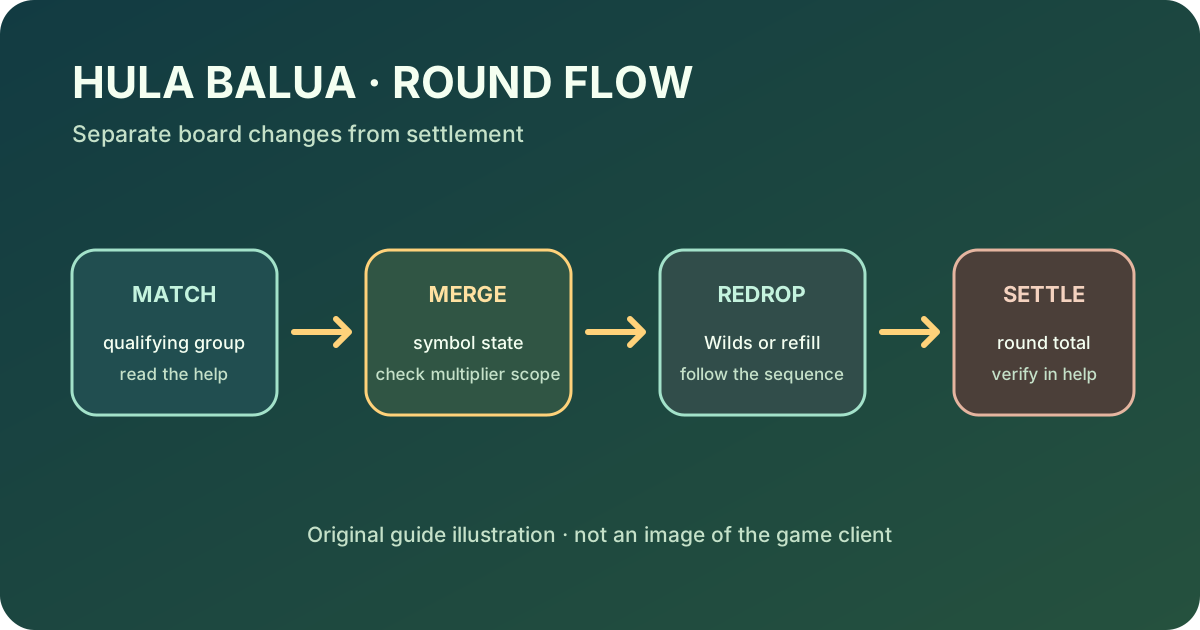
The base sequence: match, clear and redrop
Hula Balua is presented as a cluster-style slot with a grid rather than a conventional line map. The active game help should state which matching symbols form a winning group and whether adjacency is horizontal, vertical or both. It should also say whether Wilds can complete a group, what symbols do not pay, and whether a group is evaluated once or can participate in overlapping results.
Once a qualifying win occurs, follow what happens to those positions. Do the symbols disappear? Does the game refill from above? Does a new evaluation begin immediately? If yes, the next state is a redrop, and a chain may continue until the defined stop condition occurs. The help should distinguish the initial spin from later redrop steps, because the same symbol can have a different role at different points in the sequence.
The screen may keep a running total while the board changes. Do not read each animation as a separate cash-out unless the settlement panel says it was paid. A feature can accumulate a sequence total and resolve it at the end. To understand this, trace the round total, the current multiplier display and the final settlement separately. If the value changes after a merge, confirm whether the earlier wins are recalculated or only later wins receive the changed value.
Good descriptions use a clear state order: initial board, first winning group, symbols removed, replacement symbols arrive, any special feature runs, and the next evaluation begins. This is much easier to verify than an undifferentiated statement that “cascades keep paying.” It also helps identify when an effect ends and whether a symbol has been carried forward.
Big Symbols and the merging system
The supplier describes Big Symbols and Merging Symbols as separate parts of the design. A Big Symbol occupies an expanded area of the grid. The help should show how its covered cells count toward a matching group and whether only particular symbol types can become large. A large icon is not automatically a win; the group still has to satisfy the game’s stated combination rules.
Merging happens when matching big symbols meet under the feature’s condition. ELK’s page says their multipliers can combine into a larger symbol and contribute to a global multiplier. The operator help should explain which symbol shapes can merge, whether adjacency is required, whether they must be the same symbol, and what the merged shape replaces. These questions decide whether the merge is a visual upgrade, a new win condition, or both.
When reviewing a merge, note where the multiplier is displayed. If it is global, it may apply to a wider set of wins than the symbol that created it. If it is local, it may attach only to a symbol or combination. Do not call a multiplier “global” just because it appears near the total. The paytable should state the scope, reset condition and whether multiple merge events add, multiply, or follow another formula.
It also matters when the merge is evaluated. Does it happen before a cluster is scored, after winning symbols are removed, or during a new redrop? A merge can change the board and create a later group, but that does not prove the previous payout is retroactively multiplied. Follow the displayed sequence and check the help for the point at which the multiplier is applied.
The feature may present several symbol sizes or combinations. Exact dimensions, counts and multiplier values should be read from the current help, not reconstructed from a screenshot. Mobile scaling can make a multi-cell symbol appear like a single tile, so use the diagram or symbol key where available.
Sticky Redrops and Elmo Redrops
Sticky Redrops and Elmo Redrops both affect a sequence, but they are not the same mechanic. The supplier page describes Sticky Redrops as continuing while additional matching symbols land, with a feature payout when no further qualifying symbols arrive. It describes Elmo Redrops as awarding redrops and creating Wilds as Elmo moves across the board. The help should specify which symbols trigger each feature and whether the effects can overlap.
For a sticky feature, identify exactly what stays on the grid: a symbol, a symbol type, a position, or a feature state. “Sticky” by itself does not say how long it persists. It might last for the current sequence or a bonus mode, then reset. The interface should show the retained state so a player can tell whether the next drop is using the same setup.
For Elmo’s action, check the route and conversion rule. Does he move across a row, a column or another path? Which positions become Wilds? Do the Wilds stay until used, disappear at the next evaluation, or follow a separate rule? ELK’s summary describes a walk that creates Wilds, but a live help screen is needed to confirm its full path and persistence in the current version.
If an Elmo-created Wild completes a group, observe whether the resulting symbols clear before the next redrop. A Wild may bridge a gap or contribute to a group, but it does not guarantee a cascade. The next symbols are still determined by the game process, and the sequence may stop after one settlement. A review should explain possibility and condition without describing an outcome as due or predictable.
When sticky symbols, merges and Elmo all appear in one round, their order is central. First mark the retained state, then note the character’s action, then read whether the merge is evaluated, and finally check the next group. If the interface presents no accessible replay, rely on the help’s documented order and do not invent one from an animation that was too fast to inspect.
Bonus Game and Super Bonus
The ELK product page identifies a Bonus Game and a Super Bonus and says Bonus symbols can start the feature. It also says the bonus can be retriggered and that a particular symbol arrangement can upgrade Bonus symbols. Exact trigger count, award, upgrade threshold, maximum state and retrigger rules belong to the active help. This review does not quote a threshold or a number of free drops without that evidence.
The standard bonus and Super Bonus should be treated as two modes with their own entry and persistence rules. Read what starts each one, whether a bonus upgrade changes the symbols or only the current mode, and whether it preserves any multiplier accumulated before entry. A mode name alone does not establish a higher return or guarantee that a particular feature will appear.
During the feature, track what carries over between drops: multiplier state, sticky symbols, Elmo-created Wilds or the grid shape. Then identify what resets when the bonus ends. The difference between “retained for the next drop” and “retained into the next paid spin” is significant. If the UI displays a counter, find the matching definition in the help rather than guessing its function from placement.
A retrigger can add time, change the state or award another drop, depending on the game. Ask which of those the rules actually say. If a public review states that all Bonus symbols upgrade after a particular pattern, confirm that the same condition appears in the current operator help. This is especially important where reviews describe different regional builds or use a simplified explanation.
RTP, volatility and the cap
RTP is a theoretical long-run measure for a specified game configuration. It is not a forecast for a session, a minimum return, or a guarantee attached to a bonus. The current value must be taken from the game information in the operator’s live client. A percentage found on an older review, a stream, or a casino site in a different market does not confirm the version shown to a New Zealand player.
Volatility is a broad description of how variable the result distribution is. It does not say when a large result will occur, how many losing rounds to expect, or how much money is required to reach a bonus. A specific label should be attributed to the help source that shows it; if the help does not provide a label, do not infer one from the size of a top-line cap.
The maximum-win cap is another independent rule. Confirm whether the number applies per paid round or to a feature, whether it is expressed as total return or profit, and how an amount above the cap is settled. The ELK overview includes potential-win language, but this review does not present that as a verified current operator cap. Check the exact line in the active help before citing it.
If several RTP values are presented, record the one tied to the loaded mode and note whether feature-entry options use a different configuration. A list of variants is not proof that all variants are selectable at one casino. If the client hides the value until after loading, use the information screen or contact operator support before calling the value confirmed.
Mobile display, help and demo status
Check the game on the intended screen rather than assuming a desktop description guarantees phone support. A 6-row visual grid can compress the help text; a merge animation may hide the stake field; a sticky symbol can be hard to distinguish from a normal symbol. The interface should let a reader return to the paytable, see the current stake and inspect the round result without losing the game state.
For mobile, inspect the rotation guidance, touch targets, scroll behaviour and whether the game’s help panel fits the screen. If the symbol legend opens over the game, close it and verify that the game still shows the same active mode. For keyboard access, check that focus moves through the stake, help and close controls in a visible order. Availability of these controls may depend on the operator’s platform.
A demo can help explain a button sequence, but it does not prove real-money access, a local setting or the current return. The provider’s public page may offer a play link that behaves differently by territory. No demo availability in New Zealand has been verified here. Do not describe a third-party demo as official unless the source and page clearly establish that status.
How to judge a review when sources disagree
Competitor pages for Hula Balua often lead with a headline RTP, volatility label or hit-frequency explanation. Some pages say to verify the live help; others treat an advertised percentage as universal. The latter wording can make a page look more definitive than its evidence. A useful comparison separates what the supplier documents, what the operator currently displays, and what a third party reports from one build.
When mechanics differ, compare the exact rule statement rather than a rating or verdict. For example, one source may describe Elmo-created Wilds as disappearing after evaluation while another says they remain through more than one redrop. The official supplier summary confirms that Elmo creates Wilds, but the active help must settle the persistence boundary. A careful guide names this unresolved detail instead of copying whichever version sounds more plausible.
Demand metrics for New Zealand were not available in the supplied project. A search result or a page’s use of “popular” does not prove local search volume. This article follows the assigned question and its narrow game-only boundary. It does not add separate RTP, demo, bonus or comparison pages for Hula Balua.
A step-by-step review checklist
Use the following sequence to verify a loaded version:
- Confirm the exact title and operator, then open the current help panel.
- Read the winning condition and the role of ordinary Wilds before studying special features.
- Observe one base round and record the order of removal, replacement, evaluation and settlement.
- Check the Big Symbol rules and the exact event that permits a merge.
- Determine whether the merge changes a global or local multiplier and when it is applied.
- Compare Sticky Redrops with Elmo Redrops and record each persistence boundary.
- Read Bonus and Super Bonus entry, progress, upgrade and retrigger rules separately.
- Find the current RTP, volatility label if provided, maximum cap and stake range in the help.
- Note whether the optional mode is available and whether its disclosure differs from standard play.
- Check how the mobile client presents a stake, a feature and a settled result.
This process produces a review that is both specific and appropriately limited. It tells a reader what a feature means, where the answer came from, and what still depends on the casino. A precise “not verified in this client” is more useful than a numerical assertion borrowed from a different jurisdiction.
Frequently asked questions
What is the main feature in Hula Balua?
The supplier describes interacting Big Symbols, merges, redrops and an Elmo Wild feature, plus separate bonus modes. Which interaction dominates a specific round depends on the active help and the symbols shown.
Does a merge multiply every win in the round?
The public description refers to a global multiplier, but the exact scope and application timing should be confirmed in the current help. Do not assume every win is retroactively multiplied.
Are Sticky Redrops and Elmo Redrops the same?
No. The supplier describes one as continuing while matching symbols land and the other as an Elmo movement that creates Wilds. Their triggers and persistence should be checked separately.
What is Hula Balua’s RTP for New Zealand?
It is not verified here. Use the RTP shown in the active operator game help and record the exact mode or variant to which it applies.
Is a demo guaranteed to work in New Zealand?
No. A supplier or third-party demo can be restricted by territory or platform. This guide does not verify local demo availability.
Does a top-win figure predict a likely result?
No. A cap or potential describes an upper rule boundary, not the probability of reaching it or the expected outcome of a session.
Sources and scope
- Official ELK page checked 7 October 2026: Hula Balua. Used for public mechanics and feature names; no New Zealand operator setting is claimed.
- Official ELK catalogue checked 7 October 2026: Games.
- Competitor sample checked 7 October 2026: Online-Slot.co.uk Hula Balua review, Gambling.com Hula Balua review and SlotCatalog Hula Balua page. Their RTP, volatility and mechanics descriptions are treated as snapshots to check, not universal NZ settings.
- Internal navigation: ELK Studios catalogue and selected game guides.
- New Zealand advertising context: Department of Internal Affairs guidance, checked 7 October 2026.
