ELK Studios game rules · South Island guide
Shadow Shifter: rules, features and settings to verify
 Best casinos available in New ZealandUpdated 7 November 2026

Shadow Shifter is an ELK Studios slot centred on a column-pushing mechanic. The supplier says a win creates a pusher that shifts columns vertically, while column multipliers can add to one another and multiply wins. The same supplier page lists expanding Wilds, Both Ways, Max Grow and a bonus with retained multiplier and row state. Current RTP, volatility and operator settings still need confirmation in the game’s own help.
The short answer
Shadow Shifter is a slot from ELK Studios whose most distinctive public rule is the column pusher. ELK says that each win generates a pusher which moves the columns vertically to create new winning combinations. The supplier also describes multipliers on the columns that add their values and multiply wins. Its product page lists Wilds, Expanding Wilds, Both Ways, Max Grow, a Bonus and a Super Bonus, with multiplier and row state persisting into the bonus and between free spins.
That short description explains the rhythm of the game better than a list of symbols: a result can change the grid, and the altered arrangement can be evaluated again under the game rules. It does not mean every win creates another win, every pusher reaches a useful symbol or every displayed multiplier applies to the same payout. The exact symbol evaluation, expansion limits, multiplier formula and bonus trigger need to be read in the active game’s help.
The public ELK page states a potential win ceiling, but the current operator help was not supplied. This article therefore does not repeat a numerical cap, RTP, volatility rating, hit frequency or stake limit from third-party review pages. Those figures can be tied to different markets or versions. No operator client was tested, and no claim is made that Shadow Shifter is available to New Zealand accounts.
The guide keeps rules, mechanics and settings checks in one place. It helps a reader distinguish what the official profile establishes from what a particular casino must show before the details can be trusted. It does not create a separate bonus, RTP or demo page for this one title.
Confirm the title before applying a rule
Search results for a game can blend the supplier profile, a casino lobby entry, review pages, demo embeds and pages about other titles. Start by matching the exact name “Shadow Shifter” and the supplier shown inside the game. ELK’s official catalogue and dedicated profile are the primary sources for identifying the product and its public feature outline. A similar woodland theme or a shared feature label is not enough to transfer rules from another slot.
The product page identifies Shadow Shifter as an ELK game and describes its mechanics in a short summary. That confirms that the title has a public supplier profile, but it does not establish which casinos currently distribute it. Nor does it establish that a visitor in New Zealand can open a real-money client. Distribution, account eligibility, currency and account-specific limits are separate operator questions.
When a casino launches the game, check the title shown on the loading screen and open the rules panel from that client. Record any version date or help revision shown. Then compare the operator’s title with the official supplier profile. If the wording differs, do not resolve the mismatch by assuming that an older review must be correct. Ask the operator to identify the client or do not rely on an unverified rule.
A title-specific review can still be useful when it is explicit about its evidence. Here, the supplier profile is used for named mechanics; competitor pages are used to identify questions readers encounter, not to set this casino’s mathematical configuration. The active game help remains the right source for values, exact conditions and payout settlement.
How the column pusher changes a round
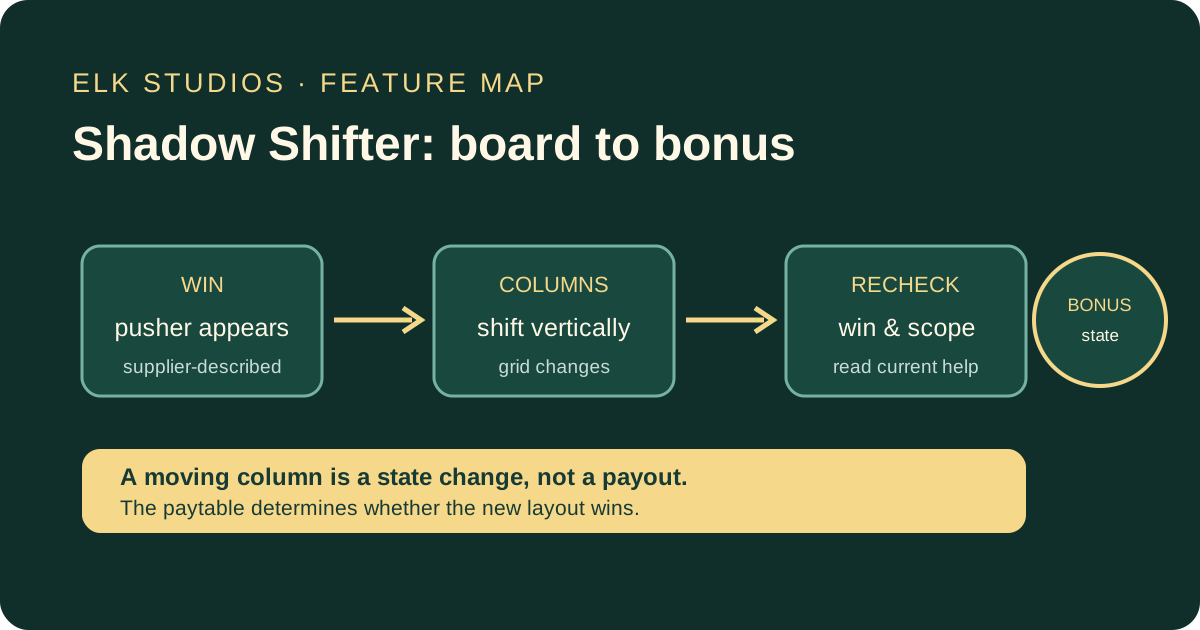
ELK describes the pusher as an effect generated by a win. It moves columns vertically, producing new arrangements that may create winning combinations. This makes the board state important: after an initial combination is resolved, symbols can shift and the game can evaluate the changed layout. A player should follow the order of those events rather than treating the animation as one unexplained result.
A careful read of a round separates the initial symbol arrangement, the win that qualifies for a pusher, the direction and scope of the movement, and any new evaluation after the move. The public profile tells the reader that columns move vertically, but it does not explain whether every column moves on every win, whether all pushers move the same distance or how the game handles a position with no useful symbol. Those are current-help questions.
The pusher mechanic can create repeated opportunities for the layout to change, but movement alone is not an award. If a column shifts and no valid combination follows, the sequence may end without another credited win. If a later arrangement does qualify, the game’s paytable and multiplier rules determine its value. Do not count each movement as a separate payout unless the result history shows a separate credited amount.
Because the columns move, a screenshot of the final board may not show the symbol arrangement that triggered the first win. If the client provides a round history, it can help reconstruct the initial and post-push states. Compare those states with the rule panel. The purpose is to verify how the game accounted for a result, not to search past rounds for a pattern that predicts what will happen next.
A player can also misread a pusher as a standard reel spin. It is a state change inside the current round as described by the supplier. The help should say whether the symbols refill, remain, or transform after movement. If the help does not explain an event that appears in the client, leave it unresolved rather than inferring a general rule from the visual effect.
Column multipliers and how to read their scope
The supplier says multipliers sit on columns, add their values together and multiply with each win. This confirms that multiplier state is connected to the columns and can interact with wins. It does not provide a full calculation formula in the brief public description. The active help needs to clarify which columns contribute, when the values combine, and whether a multiplier changes before or after the win calculation.
Several questions are worth checking. Are multipliers attached to positions, columns or an overall feature state? Does a pusher move the multiplier with its column? If a win spans more than one column, which multipliers apply? Are values added and then used as one multiplier, or are separate multipliers applied at different stages? The supplier’s phrase “add their value and multiply each win” is a useful overview, but the client’s paytable should answer the precise settlement questions.
A column multiplier can remain visually displayed after a result without applying to every subsequent event. Its scope may be defined by the current spin, current bonus, current grid or another state. Do not assume that a number stays active simply because it remains on screen. Read the help for whether it persists, resets or changes when the game enters a bonus.
The official page explicitly says multipliers and rows are persistent when entering the Bonus Game and between free spins. That is a particular persistence promise for those feature states. It does not say the same state carries indefinitely between ordinary spins or into a new casino session. The distinction between feature persistence and session persistence is essential when describing the game accurately.
If a multiplier is involved in a disputed result, note the sequence in the game history: the visible multiplier before movement, the win that generated a pusher, the column state after movement and the final displayed payout. That record is more useful than an estimate based on animation speed or memory. The operator’s account ledger shows the credited amount; the game help explains how that result should be calculated.
Expanding rows, Max Grow and Wild features
The official profile lists expanding rows and names Max Grow among the feature symbols. It also describes Expanding Wilds and ordinary Wilds. These features can make more of the grid participate in a later event, or change the role of symbols already present. The exact trigger for row growth, maximum layout and interaction with column pushers are not specified in the public summary and must be checked in the active help.
An expanding row changes the available layout; an Expanding Wild changes the identity or coverage of a symbol. The two ideas may appear together in an animation, but they are not the same rule. Confirm whether Max Grow extends the grid, expands a symbol or affects a different component. The feature name alone is not enough to determine which positions are included in a win evaluation.
A Wild usually substitutes for other paying symbols, but an individual game may limit which symbols it substitutes for or exclude special symbols. If a Wild expands after a pusher, check whether it occupies a full column, a row or selected positions, and whether it remains present for another evaluation. A visual glow can indicate activation without proving that the Wild has already been applied to the paytable.
Both Ways is another named feature. The term commonly means a combination can be evaluated in more than one direction, but the exact scope for this title must come from its own rules. Check when the feature is active, whether both directions are evaluated on the same arrangement, and how the game settles overlapping combinations. Do not import a generic “both ways” assumption if the title-specific help uses a narrower definition.
For each feature, keep four pieces of information separate: trigger, effect, duration and settlement. “Trigger” explains what makes it activate; “effect” explains what changes; “duration” says how long that change remains; “settlement” describes how the resulting win is calculated. That framework helps a reader make sense of complex feature names without inventing a precise rule that the supplier has not stated.
Bonus and Super Bonus states
ELK says the Bonus Game starts when the required bonus symbols appear, and its profile specifies that the bonus trigger uses a threshold of bonus symbols. The exact value is stated in the product page, but this guide omits the numeric trigger because the topic brief requires numerical game settings to be verified against current game help, which was not provided. A trigger condition should be checked in the active client before it is repeated as a universal setting.
The supplier does confirm that multiplier and row state is retained when entering the bonus and between free spins. That means the bonus begins with relevant progress from the prior game state rather than automatically discarding everything. A reader should check which multiplier values and expanded rows qualify for retention, and whether a new feature can change them during the bonus.
A Super Bonus is named as a distinct feature state. The supplier page does not explain every way it can occur in ordinary play or whether a particular casino makes it available through an optional mode. If an X-iter selection is offered, read its price, starting conditions and any different rules before choosing. A mode name does not show whether its payout model matches the standard bonus.
Persistent state makes it useful to follow the sequence carefully. Note what existed before entry, what the game carries into the feature, and what changes between free spins. If a round summary reports a combined amount, distinguish the intermediate feature wins from the final credited result. A long feature can still finish with a small result; persistence describes state retention, not guaranteed profit.
The help should explain how the feature ends, whether further free spins can be awarded, what happens to remaining state on settlement, and how the game handles a maximum win if it occurs. Because those details are client-specific, this article does not assign exact trigger counts or bonus length from third-party pages. Use the information visible in the version actually opened.
RTP, volatility and maximum win
RTP is a theoretical return for a particular game configuration over an extremely large number of rounds. It is not an expected refund for one account, one session or a short series of spins. If a title has more than one RTP variant, the selected value matters, and a review page may be describing a different operator or jurisdiction. Check the exact help panel for the version you can access.
Volatility is a description of how outcomes may be distributed, not a forecast of the next win. Labels vary: one site can call a game medium-high while another uses a high label, in part because their scales and sources differ. Neither phrase tells a player how long a losing sequence will be or what an individual bonus will pay. Do not treat a label as a promise of frequent or large results.
The supplier profile describes a potential maximum win, but its public summary is not a substitute for current in-game help. The assigned brief specifically requires numeric settings to come from the current game help. Since that help was not supplied, this article does not copy a numeric maximum, RTP, volatility value, hit rate or stake limit from a secondary review. The exact operator configuration remains unverified.
When you open a game’s information panel, look for the chosen RTP if displayed, the meaning of the volatility label, the maximum payout basis, the base stake range and any X-iter mode conditions. Note the currency and whether limits apply to each spin, total wager or a selected feature. The same number can mean different things if a bonus mode uses a different charge basis.
If one source gives a different figure from another, do not choose the larger or newer-looking result by default. Check whether the pages refer to the same version, same operator market and same feature mode. If those conditions cannot be matched, mark the figure unknown. This review does not claim that the game is available in New Zealand or that any public numeric setting applies to a local account.
X-iter and the cost of optional modes
ELK’s page describes X-iter as a set of predefined game modes, including a Super Bonus option. The product summary identifies different entry costs and starting conditions. It does not establish which of those options a casino currently enables, nor should a mode’s supplier-level description be treated as a guarantee that every feature interaction works identically to ordinary play.
Before using an optional mode, read its cost as part of the total wager. Confirm whether it is charged as a multiple of the base stake, what state begins, which feature is included, and whether the help assigns a separate RTP or maximum cap. If a mode says it starts with more rows or a multiplier, that describes a starting state, not an expected return.
Compare a mode with the ordinary game only after separating price from probability. “More than a chance to trigger” or “starts with” can be an accurate feature statement without saying the player will profit. A guaranteed event is not a guaranteed monetary result. The final result still depends on symbols, feature rules and the game’s settlement.
If the live interface does not show X-iter, do not assume that the game has been misconfigured. The operator may not offer optional modes, or a regional or technical version can differ. If it is present, a reader should be able to open a description before confirming the cost. If the mode rules are not clear, avoid selecting it until support or current documentation clarifies the terms.
This guide does not recommend a mode, stake or casino. Its purpose is to make the key comparison visible: what does the option cost, what feature state does it provide, and which exact help screen documents its settings? A named feature is not evidence of value for money by itself.
Reading a demo, mobile client and help screen
A demo can be useful to see the sequence of a pusher, grid change and multiplier event without staking real money, where a permitted demo is available. This review has not launched one. A demo may be restricted by location or by the platform hosting it; its availability should be checked at the actual source. A visible “play” link on a supplier page does not prove a New Zealand account can use the game.
A demo can also use a configuration that differs from a real-money operator build. It may teach the controls and illustrate feature order, but it should not be used to claim the active RTP, account eligibility, stake limits or settlement at another casino. Open the help inside the operator client for those questions. If the demo and real-money client differ, prioritize the information for the version actually in use.
On a phone, check that the help icon, paytable, history and stake controls are reachable without covering the grid. The theme uses moving columns and feature animation, so a small viewport or fast speed can make it harder to distinguish the initial win from the post-push state. Reduce animation speed if the interface allows it; doing so does not change the game’s underlying rules.
Before a real-money round, check the displayed amount and whether an optional mode is enabled. Touch targets can sit close together. Make sure a selection is not an inadvertent stake change. The visual layout should still allow access to the game rules, and any table or client-specific conditions should be reviewed before wagering.
A good support request includes the game name, casino, date, currency, round identifier and a description of the displayed feature sequence. It should not include passwords or private account credentials. If a final amount cannot be reconciled with the help text, preserve the round details and ask the operator to explain the settlement.
How to assess the competing reviews
Search results for Shadow Shifter tend to emphasise the enchanted-forest artwork, expanding grid, multipliers and a headline maximum. Those pages can be useful for identifying recurring reader questions. Their mathematical summaries are not interchangeable: a site’s volatility term or RTP figure may reflect a review date, market or secondary source that does not match the operator client. This is why the article does not repeat unverified numeric settings.
The official ELK profile is stronger for the mechanics it describes: the column pusher, multiplier relationship, named feature symbols and state retained into the bonus. Secondary articles can add consumer-facing discussion of how those mechanics are presented, but they cannot determine the configuration currently loaded at a specific casino. Treat claims about exact row counts, symbol values, hit rates, stake limits and demo status as questions to recheck.
Some competitor pages use verdict scores or personal-play language. A score may express an editorial preference, not an objective ranking or a verified statistical result. This page does not claim personal play, a tested session or a comparative rating. Instead, it uses a transparent evidence split: supplier statements for the feature outline, the current client for settings, and clearly labelled editorial guidance for how to read the interface.
The useful gap is not another promise of “big wins.” It is a simple explanation of how a pusher changes the board, how multiplier scope should be checked, and why a retained bonus state is different from a guaranteed payout. A reader can apply that checklist even if a third-party page becomes outdated.
Before you decide whether to continue
Read the game help first, then decide whether the mechanics and settings are clear enough for you to continue. Identify what ends a round, what causes the grid to move, which multiplier applies to a win, what persists into a bonus and how an optional mode is charged. If the client leaves a crucial rule unclear, do not fill it with a guess from another operator’s version.
The core feature path is conceptually straightforward: a win may create a column pusher, the columns shift, the updated layout can be evaluated, and the multipliers may affect the win under the title’s rules. Bonus entry can retain some state. The official source confirms those broad mechanics; it does not give a full table of values or guarantee a payout on each action.
Set a budget and a time limit before using any real-money game. A high ceiling or an animated feature does not make a stake more likely to return. Do not raise stakes to recover losses or continue because a feature seems overdue. If play stops being enjoyable or controlled, take a break and use independent New Zealand safer-gambling support.
This review is complete at the level of its available evidence, not at the level of a verified operator build. A current help file would be needed to complete exact RTP, volatility, cap and stake fields. Until then, the reliable answer is to keep those values unconfirmed and use the information in the client that would actually be played.
Frequently asked questions
What is the main feature in Shadow Shifter?
ELK identifies the column pusher: a win can create a pusher that moves columns vertically, producing a new arrangement. The supplier also describes column multipliers. The exact evaluation and movement conditions belong to the active game help.
Do column multipliers apply to every win?
The supplier says multipliers on columns add their value and multiply with each win, but the public summary does not explain the complete calculation scope. Check the current help for which columns contribute and when the value is applied.
What persists into the bonus?
ELK says multipliers and rows persist when entering the Bonus Game and between free spins. That does not establish that the same state persists across ordinary rounds or a full session. Confirm the current client’s wording.
What does Both Ways mean in this title?
It is a named feature on the supplier page. The exact qualifying direction, timing and settlement should be taken from the title’s help; generic definitions from another slot may not match.
What is Shadow Shifter’s current RTP?
This article does not verify a current operator RTP because the active game-help screen was not supplied. Check the value shown by the exact client and do not substitute a review-site figure.
Is the game available in New Zealand?
The supplier publishes a product page, but that does not prove a particular casino distributes it to New Zealand accounts. Availability was not tested; check the operator’s current game lobby and terms.
Does the Super Bonus guarantee a win?
A mode may guarantee a feature state or starting condition, but that is not the same as a guaranteed monetary win. Read the mode’s cost and rules before making a choice.
Can I try a demo first?
A demo may be available where access is permitted, but this review did not launch one. A demo can illustrate controls without confirming the settings or rules of a real-money operator version.
Sources and verification boundary
Checked 6 October 2026. ELK’s supplier page confirms the mechanic descriptions and public feature outline used here. Its linked product-sheet PDF returned HTTP 403, and no current operator help, RTP variant, volatility setting, numeric cap, stake limits or New Zealand operator access were available to verify. Search demand was not measured. This informational article has no casino referral button.
