ELK Studios game rules · South Island guide
Dropz slot review: rules, expanding rows and settings to verify
 Best casinos available in New ZealandUpdated 7 November 2026

Dropz is an ELK Studios slot built around a changing grid, expanding rows, chocolate blockers, locked Wilds and a bonus sequence called Free Dropz. The useful way to understand it is to separate the ordinary symbol-removal loop from row growth, the Pair Matching meter and bonus states. ELK’s public page confirms the feature names, but a current operator help screen is required for exact thresholds, RTP, volatility, stake limits and maximum win settings.
The short answer
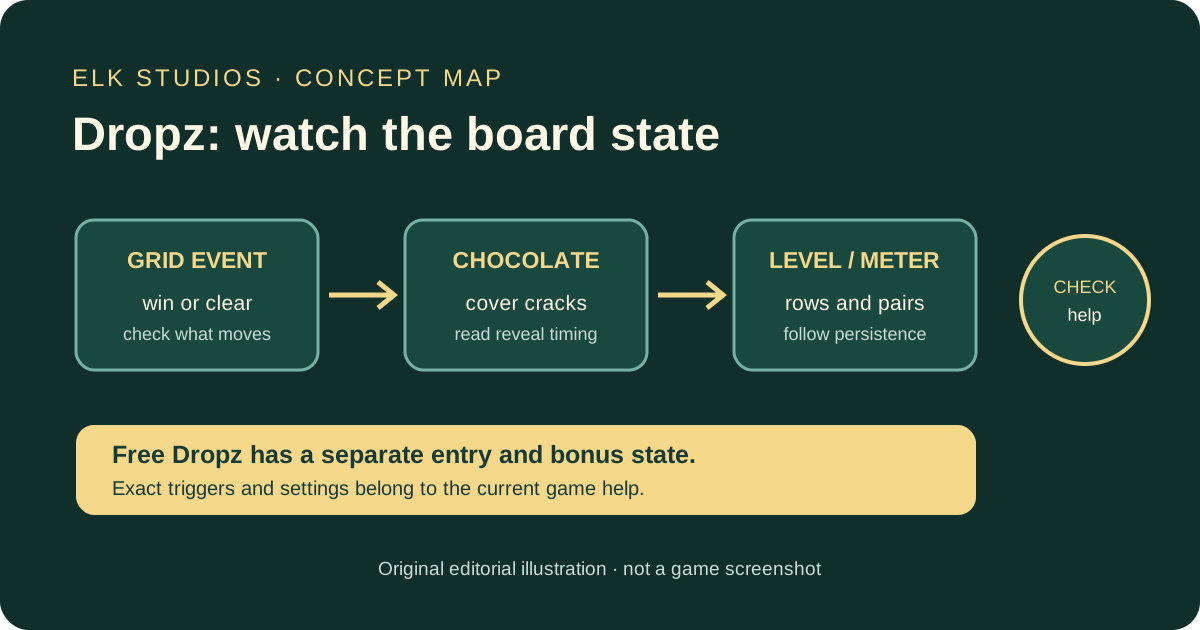
Dropz is a candy-themed ELK Studios slot whose public product page describes an expanding grid, locked Wilds, multipliers, bonus modes and chocolate spaces that can conceal symbols or features. The supplier also describes a Pair Matching meter: matching symbol pairs contribute to that meter, and a completed meter adds a multiplier to the win multiplier. These mechanics make it important to watch both what disappears from the grid and what the board has accumulated across the sequence.
The title is not best understood as an ordinary fixed-reel slot with a single payline table. A round can change its available rows, unlock a chocolate-covered space, or carry a multiplier from one event to a later event. The exact order matters. A symbol breaking open, a row being added, and a win being calculated may be separate steps. Read the in-game help to learn the active sequence instead of treating every animation as an immediate payout.
ELK’s official Dropz page confirms the named feature family and the broad Free Dropz concept. Its linked game-data sheet returned HTTP 403 in the research browser, so current RTP variants, volatility, cap and operator configuration could not be verified. Some review pages publish different figures or describe a particular casino build. This guide does not select one of those snapshots as a current New Zealand setting.
Confirm the exact title and source record
Start by checking that the lobby entry and help panel say Dropz by ELK Studios. A themed title, similar candy artwork or an operator’s category label is not enough to establish that you have the same game. ELK’s official catalogue includes a Dropz product page and a catalogue entry, which confirms the supplier has a game under that name. It does not confirm whether any named casino has activated it for New Zealand accounts.
The distinction between supplier information and operator configuration is central to this review. The supplier’s product description is useful for identifying features. The launched game client explains how a particular game build handles a trigger. The operator’s interface may determine whether optional modes are available, what stake limits apply, and which mathematical configuration is active. A source page can support the first of these tasks without answering the latter two.
Before relying on a review, compare its title, provider, date and market. Pages can retain older screenshots or data after a game update. A review written for a UK casino can discuss settings that are absent in another market. If the reviewer does not identify an operator or date, treat the figures as an unverified lead rather than a live specification.
Read the board as a sequence, not a static reel window
ELK describes Dropz as a grid with rows that can expand. That changes how a player should read the play area: the visible field at the start of a round may not be the same shape as the field after a feature has triggered. A useful walkthrough identifies the initial board, the event that unlocks extra space and whether newly active positions participate immediately or in the next part of the sequence.
When a cluster or group wins, note the symbols that formed it, the grid spaces removed, and what happens to the symbols above or beside them. The public product description says Dropz has exploding symbols and an expanding-row feature, but the exact clearing and refill order belongs to the help panel. A game review should avoid asserting that every win causes the same kind of fall or that every empty space reveals a feature.
The board’s changing height can affect what the player sees without changing the meaning of the underlying stake. It is easy to confuse a larger visual field with a guaranteed improvement in chance or value. Extra rows may create more positions for symbols, but they do not promise a win, a bonus, or a favourable return. The rules and mathematics define how the additional positions are used.
For a careful inspection, record the board state immediately before a feature, the animation or message that changes it, and the state immediately after. This makes it possible to distinguish a row extension from a symbol expansion and a new symbol entering the board. Those are visually related events, but they may have different triggers and settlement effects.
Chocolate blockers and what “cracking” means
The supplier describes Chocolate as a feature in which chocolate adjacent to an exploding symbol cracks and activates a symbol or feature inside. That wording suggests two separate pieces of the sequence: an adjacent win or clearing event, then the removal or opening of a chocolate cover. The symbol hidden beneath it may be a normal symbol, a feature marker or another state-dependent item. The active client’s help should say which possibilities exist.
When the board shows a chocolate tile, do not assume it is a Wild, a scatter or a guaranteed bonus. Its visible role is a blocker or cover until the rules say what lies behind it. A useful rule explanation shows what “adjacent” means in the game’s grid, whether a tile can be opened more than once, and whether the underlying feature activates as soon as it is revealed or waits for a later evaluation.
The timing of the reveal matters for settlement. If an underlying symbol appears after an exploding group, does it count toward the same evaluation, or does it wait for the next drop? Can the newly revealed feature create another clear? Does the chocolate cover itself contribute to a win? The public supplier summary does not spell out every timing edge case. Those details should be taken from the actual help or a verified rule sheet, not inferred from a short marketing description.
This is also where a player can misread a near miss. A tile opening to reveal an ordinary symbol is one possible game event; it does not prove that another feature is due. A row or blocker that remains unresolved is not a promise. Past animation cannot make a future result more likely in a properly random game, and a meter display should not be treated as a signal to increase a stake.
Levels and expanding rows
ELK says the Level Up feature activates new levels with more rows in place. That gives Dropz a progression mechanic: the board can move into a more expansive state during play. The product page does not provide enough detail to state every threshold or how a level is reset. The current help should identify what counts toward the level, whether progress is limited to one paid round, and what happens after a bonus ends.
To understand a level-up, distinguish a threshold from a reward. A progress meter may fill because qualifying events occur; the level-up may then alter the layout, expose new positions or change the next stage. The animation might display these parts together, but the settlement record and rule text can separate them. Do not describe the level itself as a payout unless the game’s help explicitly awards money at that transition.
It is useful to ask whether the larger layout remains active for the rest of a round, carries into a feature, or returns to a starting state after the result. A review that says “the reels expand” without describing persistence leaves a practical question unanswered. If a feature can hold the enlarged board, the player should know whether that is a bonus-only state or part of regular spins. The supplier summary confirms that rows are added; it does not answer every persistence question.
Compare only equivalent states when reading a demo or screenshot. One image from the base game and another from a later level do not necessarily show a different version of the game. They may show different points in the same feature flow. Check the game title, help version and state label before deciding that a screenshot supports a specific configuration.
Pair Matching meter and win multiplier
ELK’s public description says matching symbol pairs add to the Pair Matching meter. When that meter fills, an awarding multiplier is added to the Win Multiplier. The practical implication is that a pair can matter beyond the ordinary symbol combination: it may contribute to a feature meter even when the player is focused on the immediate win. The meter and the final win calculation should be read as connected, but not collapsed into one event.
The active help should identify which symbols form a qualifying pair, whether the pair is collected from the full visible board or only a defined subset, and when the meter resets. It should also clarify whether a pair must be part of a winning group or simply appear in a particular state. Without those details, it would be risky to tell a player that any two matching pictures always advance the meter.
The term Win Multiplier should be interpreted from the displayed rules. A multiplier can apply to one win, accumulated wins in a feature, or a defined total. Do not assume that the largest number shown next to a meter multiplies every result in the same way. Look for the scope of the multiplier, the point when it is applied, and any maximum defined by the active version.
A simple accounting example helps. Imagine the meter becomes complete after one board event. First confirm whether the feature awards a multiplier or adds it to an existing multiplier. Then note whether the next qualifying win receives the value or whether it affects a running total. Finally inspect the settlement panel to see whether the game records gross return, bonus contribution and stake separately. This is a method for reading the rule, not a claim about a particular numerical outcome.
Locked Wilds, ordinary wins and multiplier scope
The public Dropz description mentions locked Wilds and multipliers, but a summary page does not define every symbol’s substitution limits, lock duration or interaction with the row feature. The paytable or help legend should identify which symbols can be substituted, which special symbols are excluded, and whether a locked Wild remains in place for a later drop, a respin or a specific feature only.
Locked is a state word, not a complete rule. It could mean that the symbol stays in the same cell while other symbols change, or it could refer to a different feature-specific persistence. The help should state when the lock begins and ends. If a Wild remains visible after a win, determine whether it is eligible to contribute again and whether a newly created symbol can occupy the same position.
Similarly, “multiplier” does not tell the player what is multiplied. It might modify an individual win, a total across a sequence or a bonus result. More than one multiplier could combine according to a rule that differs from simple addition. A reliable guide should not invent a calculation. Use the game’s own example, and check whether the amount is shown as a gross return or an added win.
One safe way to evaluate a feature is to follow one symbol through a complete event. Identify its origin, record what triggers it, see whether it changes, and then locate the settlement line that uses it. If the help uses a defined term such as “locked Wild,” copy the term accurately but explain it in ordinary language. Do not reuse a feature explanation from another ELK game just because the symbol looks familiar.
Free Dropz and bonus-state boundaries
ELK names a Free Dropz bonus game and says a set of bonus symbols triggers it. The supplier’s public page also describes an expanded board and states that a multiplier reached in the base game is carried into the bonus. This establishes a broad connection between the pre-bonus state and the bonus state. The exact symbol requirement, awarded event count, retrigger rule and end condition should be read from the current help.
Before calling any symbol a bonus symbol, check the legend. A feature symbol may enter through a chocolate cover or a row expansion, while the dedicated bonus marker might have a separate appearance. The help should show whether symbols can arrive during a chain, whether multiple triggers can occur in one round, and whether the feature begins immediately after the ordinary evaluation finishes.
The carried multiplier is a particularly important boundary. The supplier says the base-game win multiplier transfers into Free Dropz. The active help should explain which multiplier is carried, whether its value is fixed at the moment the feature begins, and how later meter progress changes it. A graphic may show an accumulated number, but the actual rule says which subsequent wins receive it.
The bonus should be treated as its own state with its own start, events and end. A player can make a readable note of the entry condition, the value carried, any feature changes, the result display and the reset point. This makes it possible to tell a base-game event from a bonus event. It also prevents the false assumption that a particular number of spins or a particular outcome is guaranteed.
Super Bonus and X-iter: optional mode, separate cost
ELK’s site says X-iter offers optional modes that can enter parts of the action with a predefined feature state. The modes are not the same as an ordinary spin, and they can have a separate cost and rule. The Dropz supplier page describes a range of modes, but the linked game-data sheet could not be fetched in the research browser. We therefore do not reproduce costs, exact mode names beyond those publicly visible, payout values or New Zealand availability as current facts.
If the client displays an X-iter or feature-entry option, read its terms before selecting it. Confirm the cost, the starting state, any stated RTP or separate setting, whether the mode is allowed in the account’s jurisdiction, and what counts as a completed result. A mode that begins with a feature does not mean the feature is guaranteed to return the price paid. It changes how a round starts; it does not remove variance.
Keep an optional mode out of the base-game explanation unless the help explicitly states that the mode is enabled. A third-party article may describe a button that is absent from a given operator or market. That absence does not automatically mean the title is broken; it can reflect local configuration or an older interface. The operator’s own help and account terms are the proper sources for whether a mode is currently available.
Avoid making a choice based on a headline “guaranteed feature” phrase without reading what is guaranteed. It might refer to the appearance of a particular mechanic, not a positive payout or a target return. Set a spending limit before play and do not chase a feature cost after losses. The site’s New Zealand safer gambling guide lists independent support and ways to take a break.
RTP, volatility, maximum win and current settings
RTP is a theoretical long-run return for a mathematical configuration. It does not describe an individual session, and it does not promise that a given stake will come back. Different RTP variants may exist for the same title, and an operator can select or expose one version. The right evidence for a live review is the active game help or a current, official data sheet that matches the configured build.
For this review, ELK’s official page was accessible but its linked Dropz Game Data Sheet returned 403. The public page does not provide a verifiable RTP variant, volatility label or cap value in the accessible content. Third-party pages show different claims and may refer to another jurisdiction. We therefore leave those numbers unreported rather than presenting a competitor value as verified New Zealand data.
Volatility is a descriptive statistic about the distribution of outcomes. It is not a timetable for when a meter will fill, a bonus will start or a win will appear. A label such as low, medium or high should never be treated as a forecast for the next round. Likewise, a maximum-win statement is a theoretical cap, not an expected result. The active help should clarify whether that cap applies to the total round, a feature, or a specific optional mode.
If you can access the game help, record the title, version or table identifier, displayed RTP wording, volatility label, maximum win basis and stake limits. Save the date and the market context. Do not combine an RTP from a product sheet with a cap from another casino review. If the game help contains no value, report that the setting is not displayed instead of filling the gap from memory.
Mobile play, controls and demo limits
On a phone, the changing grid may use more screen space than the paytable or meter labels. Before starting, locate the help icon, symbol guide, stake control, sound setting and history. Check that the entire grid can be seen without horizontal scrolling, and that a chocolate tile, Wild and bonus symbol can be distinguished without relying on colour alone. A smaller screen may crop decorative artwork but should not obscure a material rule or accepted bet.
Pay attention to whether a feature message remains on screen long enough to read. If a meter fills during a quick sequence, use the help or history panel rather than guessing what changed. Keyboard access, visible focus and text alternatives depend on the operator’s client and were not independently tested for this article. ELK’s public product page gives a desktop aspect-ratio recommendation; it does not verify a particular mobile casino wrapper.
A demo, where available, can help a reader learn the button layout and event order. It may not show cash-play availability, account limits, the same RTP setting or optional X-iter modes. We did not launch a Dropz demo. Do not treat a demo link on a third-party review site as proof that the game can be played in New Zealand or that its configuration matches an operator’s real-money client.
If the connection drops during a sequence, check the operator’s round history before attempting to repeat a stake. A changing board can make a delayed animation look like a new round. The account record, not a replayed animation, identifies the accepted amount and settled result. Keep any support enquiry specific: game title, time, round reference, displayed stake and the rule or feature that appeared unclear.
New Zealand availability and responsible reading
The official ELK page establishes that Dropz exists in the supplier’s catalogue. It does not establish which online casino offers the game, whether an operator permits a New Zealand account to open it, or what customer protections apply to that operator. Those questions are market- and operator-specific and were not tested. This guide makes no claim that Dropz is available to a New Zealand player.
New Zealand’s Department of Internal Affairs says online casino gambling advertising is subject to the new regulatory regime and identifies affiliate marketing among the initial prohibited advertising decisions. The department also says third parties are within the scope of advertising rules. This local article therefore contains no casino referral button while qualified local compliance clearance is absent. It is an informational rules guide, not a recommendation to open an account.
Read the supplier’s mechanics as game description, not as a promise of value. Words such as “generous,” “super” or “unlimited” are promotional language unless the help defines an exact condition. A feature’s presence does not make it more likely to occur in the next round. If play affects finances, sleep or relationships, stop and use independent New Zealand support; a new bonus or bigger stake is not a remedy for a losing session.
A practical inspection checklist
First, confirm the full Dropz title and the provider in the game lobby. Second, find the help panel and read the base symbol table, the rule for removing winning symbols, the expanding-row condition and the Chocolate feature. Third, inspect the Pair Matching meter and determine what increments it, when it awards a multiplier and how long that multiplier stays active. Do not begin by guessing from animation.
Next, read the Free Dropz trigger, entry state, multiplier transfer, any retrigger rule and the end condition. If a Super Bonus or X-iter control is shown, open its own terms and note the cost and eligibility. Look for the RTP variant, volatility and cap in the active client. If a field is missing, mark it unknown. A concise unknown is safer and more useful than a precise but mismatched number.
Finally, check that the stake and selected controls are still visible on your device. Review the accepted wager and result history after a round. Decide in advance how much time and money to spend and stop at that boundary. Do not use the expanding grid, a partially filled meter or a near feature as a reason to extend a session. Feature progress is a game state, not an account balance.
Frequently asked questions
What is Dropz’s main mechanic?
ELK’s public page describes an expanding board, chocolate blockers, locked Wilds and a Pair Matching meter that adds a multiplier when complete. The current help controls the precise triggers and order.
What does the Chocolate feature do?
The supplier says Chocolate adjacent to an exploding symbol cracks and activates a symbol or feature inside. The help should clarify what “adjacent” means and when a revealed symbol is evaluated.
Does the Pair Matching meter guarantee a bonus?
No such guarantee is established by the public summary. It says matching pairs contribute to a meter and a completed meter adds a multiplier. It does not make a future outcome certain.
What is the current Dropz RTP in New Zealand?
This review could not verify a current New Zealand operator setting. The supplier’s linked game-data sheet returned 403; check the active client’s help for the displayed variant.
Is Dropz available at a New Zealand casino?
No operator availability was verified. A supplier catalogue entry is not evidence that a particular casino has enabled the title for New Zealand accounts.
Can I use X-iter in the standard game?
The supplier describes X-iter as optional modes, but availability and terms are operator-specific. Read the current game client before treating any mode as enabled.
Sources and verification boundary
Checked 7 October 2026. ELK’s official Dropz page verifies the supplier identity and broad product feature descriptions used here. The official catalogue confirms that Dropz is listed. The linked Game Data Sheet returned 403 to the research browser; no RTP variant, volatility value, current cap, stake range or active New Zealand configuration is asserted. Reviewers disagree on numeric fields, so their snapshots were not adopted. The New Zealand Department of Internal Affairs guidance was reviewed on the same date. No game client, demo or operator account was tested.
- ELK Studios: Dropz
- ELK Studios: Games catalogue
- Department of Internal Affairs: Online gambling for advertisers
- Competitor pages reviewed 7 October 2026: All Slot Sites: Dropz, SlotJava: Dropz, Casinofy: ELK Studios catalogue. These pages offer feature summaries and numeric snapshots; their settings were not transferred as current operator facts.
