ELK Studios slot rules · South Island guide
Propaganda slot review: rules, features and RTP checks
 Best casinos available in New ZealandUpdated 7 November 2026

Propaganda is documented by ELK Studios with title-specific grid and feature rules. This guide distinguishes confirmed mechanics from RTP, volatility, win-cap and availability fields that require the selected operator’s current game help.
The short answer
Propaganda is an ELK Studios slot with title-specific mechanics documented on the supplier’s public page. The most useful review follows the game’s visible rules from the base grid into its named features, then separates those mechanics from numerical settings that must come from the active operator help. This page keeps the discussion to Propaganda; it does not claim New Zealand availability, a verified demo or an RTP value that could not be checked.
The concise supplier summary is a starting point, not a substitute for the full client rules. Confirm the exact title and version, open the help, and check the paytable, RTP configuration, volatility wording and maximum win. The official feature page reviewed on 2026-10-07 documents the mechanics summarised below. The linked data sheet was not available during this review, and independent review sites disagree on some figures, so their unverified numbers are not repeated.
This guide is written to explain how to read Propaganda, not to promise a result or promote access. A catalogue entry confirms that ELK documents the product; an operator listing and local terms are needed to establish whether it is available to a New Zealand account. The rules remain useful without an affiliate link or a claim that the game is offered locally.
Six-by-six cluster game
ELK describes Propaganda as a six-reel, six-row slot with clusters and a progressive multiplier. That is a broad format statement, not a complete definition of adjacency, minimum cluster size or win settlement. The current help should define which connected positions qualify and when the multiplier is applied.
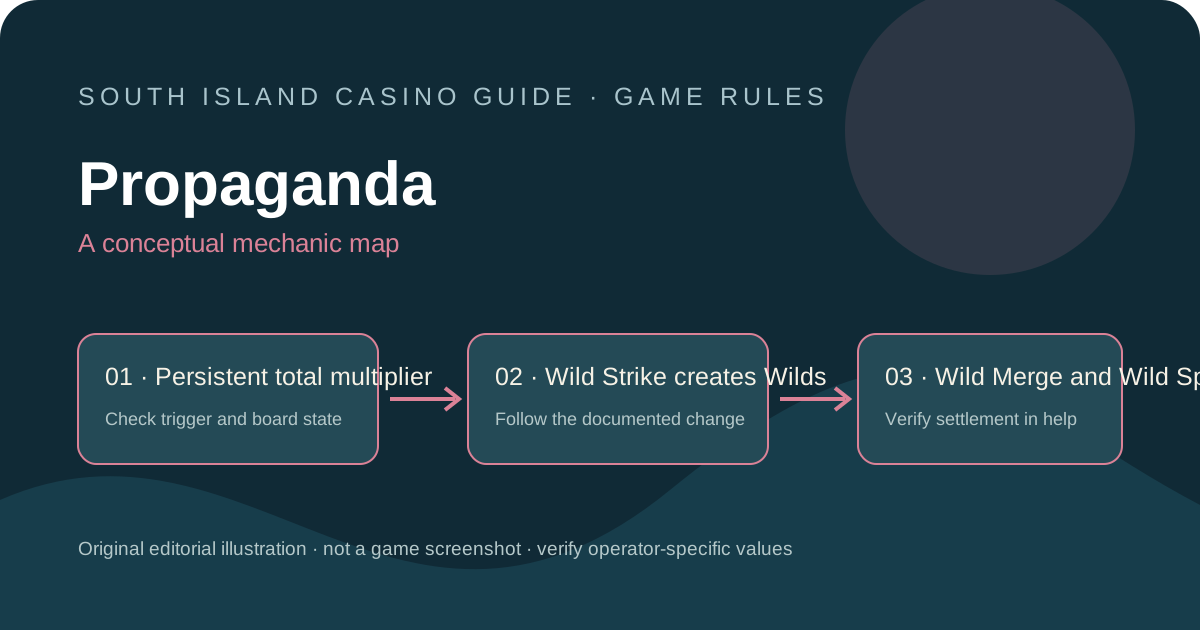
Persistent total multiplier
The total multiplier applies to all winning clusters, and each winning symbol increases it, according to the supplier page. A reviewer should separate the shared total from a multiplier attached to one Wild, and verify whether the increment is counted before or after the current payout. Those details affect explanation of order, not an individual result prediction.
Wild Strike creates Wilds
Wild Strike randomly replaces symbols with Wilds or multiplier Wilds. The supplier summary establishes the replacement types and randomness, but not the eligible positions, timing, multiplier values or whether the feature can trigger again within a drop. The active client should define those boundaries.
Wild Merge and Wild Split differ
Wild Merge combines multiple Wild symbols inside a winning cluster into a multiplier Wild. Wild Split separates multiplier Wilds that connect multiple winning clusters into the respective clusters. One consolidates within a cluster; the other allocates across connected wins. Do not treat the names as the same operation.
Free Drops and Super Bonus
Three Bonus symbols trigger Free Drops, and the total multiplier persists throughout the feature. One Super Bonus symbol with two Bonus symbols triggers Super Bonus, where Wild Strike is guaranteed in every free drop. These distinct entry conditions and guaranteed-feature language should be preserved exactly.
X-iter is a separate mode
ELK describes five X-iter modes from a 2× bet with more than double the bonus chance to a 500× Super Bonus with guaranteed Wild Strike in each free drop. This optional entry is not the ordinary game loop. Confirm costs, availability and exact mode rules from the selected operator client.
Supplier release label is not NZ access
The product page displays “Live Now!” as a supplier status. That establishes the title’s status in the supplier’s catalogue at the time reviewed, not whether a New Zealand operator offers it, which RTP applies, or whether local demo play is available. Use a current operator source for those separate claims.
The multiplier is global only as described
The supplier says the total multiplier applies to all winning clusters and each winning symbol increases it. It does not publish an RTP, volatility or cap on the accessible page. A large multiplier mechanic is not a substitute for those settings. This guide leaves numerical fields to current operator help.
Cluster connection controls the merge/split explanation
Wild Merge and Wild Split refer to the relationship between Wilds and winning clusters. A reader needs to know how the client defines a cluster, which Wilds connect separate clusters and when the game resolves them. The 6×6 visual field alone does not reveal the adjacency model or exact merge formula.
Desktop ratio and mobile frame
ELK recommends a 16:9 desktop ratio and 1600×900 display. Check a live mobile client separately for the large cluster grid, feature labels, total multiplier and bonus state. A supplier recommendation is a display note, not evidence of an operator’s responsive design.
How to verify this exact game version
When checking Propaganda, separate a supplier description from an operator setting. The supplier page is useful for identifying the title and its named feature structure; the active client is needed for the paytable, current RTP selection and account-specific availability. Record both the URL and the date checked, because a game page can be updated while a saved screenshot remains unchanged.
RTP: what the number can and cannot say
RTP is a theoretical long-run return for a specific configured game, not a promise for one round or one player’s session. For Propaganda, the public supplier feature summary does not give the selected operator RTP. The figure must be read in the actual game help. If there is a list of RTP variants, record the full list and identify the active value only when the client clearly labels it.
Do not estimate RTP by recording wins in a short demo, counting bonus triggers or dividing a sample return by the amount wagered. Random outcomes vary, and a short series is not the mathematical model. The page should preserve the operator’s exact punctuation and decimal places, note the date, and avoid converting a displayed percentage into a forecast for a particular budget.
RTP variants and version control
A provider may supply the same named game under more than one mathematical configuration. That is why “the RTP of Propaganda” may be incomplete wording: the useful question is which value this operator build lists and which variant is selected for the relevant account. Check the game help rather than assuming a single global percentage.
If the client lists alternatives, do not silently choose the highest, lowest or most common one. Record all of them, then state whether the active configuration is visible. A change in operator, region or release build can make an old review stale. If the game does not expose the selected value, report the list and the uncertainty separately.
Volatility: avoid labels without evidence
Volatility concerns how returns are distributed over time. It is not synonymous with a busy animation, a rare-looking bonus, a large symbol or a high maximum-win headline. The accessible official page for Propaganda does not provide a current volatility classification. Without a relevant technical source, do not present a third-party “low,” “medium” or “high” label as fact.
A handful of spins cannot resolve the missing classification. A short sample may show how an interface works, but not the statistical profile. If a future help panel or technical sheet publishes a classification, attribute it and record the version. Until then, explain the difference between feature design and mathematical volatility so readers are not encouraged to mistake visual drama for evidence.
Maximum win and payout units
A win cap, when documented, needs its unit and scope: it might be a stake multiple, a currency amount or a feature-specific ceiling. The public Propaganda page does not publish a current maximum win. Do not infer a cap from an optional feature cost, a displayed multiplier or a memorable result.
If the active game help states a cap, copy the exact wording and say whether it includes the stake or applies only to a bonus. The difference matters when a figure is compared across operators. If the information is absent, a clear “not verified in the available official source” is the correct result; guessing would create a false comparison.
Mobile controls are part of the usable rules
On a phone, inspect Propaganda in the operator’s actual frame. Can the player read the symbol legend, see a feature counter and open help without losing context? Are stake, balance, spin and pause controls separated? A visually compact board can still hide an important state or produce accidental taps. Record the viewport and orientation rather than extrapolating from the supplier’s desktop image.
The supplier lists a 16:9 desktop recommendation for this title, which provides a reference size but not a mobile certification. Check browser zoom, portrait/landscape behavior and text scaling. The site’s article can describe the game’s mechanics in responsive text even when a specific operator embed has not been evaluated. Do not claim that an untested mobile layout is smooth or supported.
Use a demo only for interface orientation
If a New Zealand operator offers a lawful demo of Propaganda, it can help locate the help panel and see how the feature labels are arranged. A demo does not prove that a real-money game uses the same mathematical configuration, nor that every local account can access it. It is an interface aid rather than a source for RTP, expected return or operator availability.
When describing demo access, identify where it was verified, when it was checked and whether the game explicitly identifies its version. If those checks were not performed, use conditional wording or omit a promise of demo availability. The review remains useful without a demo because the supplier’s public page and current in-client help are the more relevant sources for rules.
New Zealand availability needs operator evidence
ELK’s catalogue tells readers that it documents Propaganda; it does not establish that a New Zealand-facing operator carries the title, has enabled a specific build or offers it to a particular account. Those are separate, changeable facts. Check the operator lobby and its local terms before making an availability statement. A game being “live” in a supplier catalogue is not equivalent to local access.
This guide therefore focuses on documented rules and clearly marks missing client-specific information. Search results, another country’s review, an old screenshot and a supplier PLAY link are not enough to confirm New Zealand access. If a local status cannot be checked, say so. Do not imply a recommendation to play or add promotional language that goes beyond the evidence.
A concise personal record prevents over-spending
Before choosing to play, a person can set a fixed time limit and a spending limit that is affordable to lose, then keep those limits independent of any feature state in Propaganda. A growing meter, persistent symbol, respin counter or near-trigger is part of the game display; none proves that a particular result is due. Stop when the planned boundary is reached.
If gambling stops feeling recreational, step away and use account limits, self-exclusion or local support. New Zealand’s Gambling Helpline is 0800 654 655; the site’s safer gambling page provides support links. These are practical safeguards, not an assurance that losses can be controlled or recovered. The article’s main purpose is to explain the game rules accurately.
Read the paytable before interpreting animation
Locate the paytable before spinning. For Propaganda, identify ordinary symbols, feature symbols, Wild types, the win pattern and the settlement basis. Then inspect the bonus section separately. A screen can show a collection, a drop or a multiplier without revealing which part is paid and which part is only a state transition.
A careful note contains the exact symbol name and what the help says it does. Do not assume two visually similar icons are equivalent or that a feature marker also substitutes for a payout symbol. Where an official description uses a broad phrase, let the operator’s help define details rather than filling them in from genre conventions.
Follow one event from trigger to settlement
A useful way to understand Propaganda is to follow one documented event in order: trigger, feature state, board or symbol change, next evaluation, final settlement. This is particularly helpful when several features appear close together. Record what happened at each step and what the rules say it means, instead of describing the entire animation as one undifferentiated “bonus.”
A single sequence can explain an interface but cannot prove how often it happens. Use conditional language for rules (“when the stated condition is met”) and avoid frequency words such as “often” or “usually” unless the math source supports them. A reader should finish knowing how to verify a mechanic, not expecting a particular event on their own next round.
Keep base play and optional entry modes apart
If Propaganda presents optional feature entry, treat it as a separate choice with its own price and starting state. Read the amount before selecting anything and compare it with the ordinary stake shown in the client. The display may use a multiplier of the bet, but that describes cost; it is not a return multiplier, expected value or guarantee of a win.
An optional mode can skip part of the regular base-game sequence or start directly in a bonus. That makes it a different route through the game, not a way to improve an individual outcome. Verify which mode is actually offered and whether the help describes separate rules. A review should not invite readers to buy a feature or imply that paying for entry is financially advantageous.
Check bonus persistence and reset points
For any feature that carries symbols, counters or multipliers, note what persists between steps and what resets when the feature ends. In Propaganda, use the supplier description as a starting point, then verify the active rules for retriggers, collected items, held symbols and multiplier timing. “Persistent” should always be attached to a specific state and time period.
A value that survives within one bonus need not carry to the next bonus or the next paid round. The help should define those boundaries. If it does not, avoid wording that sounds broader than the documented rule. A small state table in the editor’s research notes can prevent an ambiguous sentence from turning a temporary bonus state into a claim about the whole game.
A neutral way to describe a sample sequence
A useful example for Propaganda should illustrate the help text without pretending to be a test result. Start with a clearly stated hypothetical condition, name the feature state, then describe the possible sequence only as the rules define it. For this title, choose one documented mechanic from the feature list above. Explain the symbol or threshold that begins it, what the screen changes, and where the reader can check the settlement rule. Do not attach a currency amount unless the active paytable supplies it.
For instance, an editor might write: “If the documented trigger appears, the client enters the named feature; the feature then applies the transition shown in the current help.” That sentence is intentionally narrower than a story about a big payout. It communicates a testable rule while leaving the outcome open. If using a real screenshot, state its source and date, make sure it is permitted for reuse, and avoid presenting one unusual sequence as typical.
The same discipline applies to a losing or interrupted round. Record whether the game reports a settled result, a pending animation, a disconnection or an error. Do not call a technical interruption a loss or a win without checking the operator’s policy and transaction history. A guide to rules should point to the relevant support route when settlement is unclear, rather than trying to adjudicate an account-specific dispute from the public supplier page.
Frequently asked questions
What is Propaganda’s grid?
ELK describes a six-reel, six-row cluster slot. The active help defines the exact connection and settlement rules.
How does the total multiplier work?
The supplier says it applies to all winning clusters and increases for each winning symbol. Exact order of application needs the current game help.
What does Wild Merge do?
It combines multiple Wilds in a winning cluster into a multiplier Wild, according to ELK. The value and timing require active help.
What does Wild Split do?
Multiplier Wilds connecting multiple winning clusters split into their respective clusters. Do not treat this as the same action as Merge.
What triggers Super Bonus?
One Super Bonus symbol with two Bonus symbols triggers it. ELK says Wild Strike is guaranteed in each free drop.
What are the RTP and max win?
The supplier page reviewed here did not publish current RTP, volatility or cap values. Check the exact operator configuration.
Sources and date checked
- ELK Studios: Propaganda — supplier feature description reviewed 7 October 2026.
- ELK Studios games catalogue — product catalogue checked 7 October 2026.
- New Zealand operator availability and current game-help settings were not independently verified. The linked ELK game-data sheet was inaccessible during this review. No keyword-volume or New Zealand demand dataset was supplied.
- Cross-domain topic conflict checks are limited to the supplied project archive and owner hand-off registry; no separate multi-domain registry export was provided.
