ELK Studios game rules · South Island guide
Taco Brothers Deralied: rules, features and settings to verify
 Best casinos available in New ZealandUpdated 7 November 2026

The supplier title is rendered Taco Brothers Derailed, while the assigned Topic ID and canonical route use Deralied. The official summary describes a six-reel, four-row slot with Taco Brother Walking Wilds, respins, a Walking Multiplier Wild, a Free Spins feature and character interactions. This guide follows those mechanics while keeping RTP, volatility, cap, operator availability and New Zealand access unconfirmed until the active game help and applicable rules are checked.
The short answer
Taco Brothers Deralied, called Taco Brothers Derailed in ELK Studios’ page heading, is described by the supplier as a six-reel, four-row slot built around three character Wilds that walk left and can create respins. A walking multiplier version affects regular Wilds shown at the same time. In the bonus, the brothers arrive sequentially, their movement can be interrupted by Captain Diaz, and Senorita can change what happens to an imprisoned or returning brother. Those are the published feature ideas; they do not establish the game’s return, risk category, maximum win, local configuration or New Zealand availability.
The product page does not provide a complete paytable in its accessible text. ELK links a game-data sheet, but the linked PDF returned HTTP 403 when checked on 7 October 2026. Because the primary numeric document could not be read and an operator-specific help screen was not supplied, this review does not repeat RTP, volatility, hit rate, stake limits, multiplier values or win-cap figures from third-party listings. Confirm each value inside the exact client before treating it as a fact.
Confirm the assigned title and its spelling
The assigned entity and planned website URL use “Deralied”. ELK’s own game link also retains that spelling in the URL, while the accessible page heading says “Taco Brothers Derailed”. This guide preserves the owner-assigned entity, query, route and Topic ID, and records the supplier’s displayed spelling so a reader can match the guide to a casino lobby. The difference is a spelling variation for identification, not evidence of two separate products.
When a lobby lists Taco Brothers, Taco Brothers Derailed or another similarly named entry, check more than the thumbnail. Read the full title in the game’s information panel, note the credited studio, and compare the named features. The supplier describes Paso, Pepe and Pico as the walking brothers and names Captain Diaz and Senorita in the bonus account. A different Taco Brothers title or an unrelated Mexican-themed slot should not inherit these rules merely because the artwork looks familiar.
There is also a useful distinction between supplier product status and casino availability. ELK labels the title “Live now” on its official page. That describes the supplier’s catalogue status. It does not say that a particular casino has licensed, configured or enabled the title for a person in New Zealand. The provider catalogue can help confirm the named game exists, while an operator’s game information and local eligibility rules answer different questions.
The assigned route is one page for the named game. It keeps the rules, feature explanation, RTP-setting caveat, device notes and demo questions together. It does not create separate pages for the walking Wild, bonus or RTP, and it does not absorb other Taco Brothers titles. That one-page boundary helps prevent small variations in wording from becoming separate, competing explanations of the same title.
What the six-by-four display tells you
ELK describes six reels and four rows. That tells a reader the visible grid’s shape, but the shape alone does not specify how wins are evaluated. It does not tell you whether the game uses lines, ways, clusters or another evaluation method; nor does it establish which symbols pay, how many matching symbols are needed, whether wins must start on a particular reel, or what happens to overlapping combinations. The current help or paytable has to answer those questions.
Keep the screen layout separate from the settlement rule. A six-reel grid may contain rows of symbols and special features, but counting symbols by eye is not a payout calculation. If the client offers a paytable button, use it to find the symbol values, order, qualifying sequence and Wild substitutions. If a result is shown in a win panel, compare the panel’s explanation to the written rule rather than assuming that every visible matching icon contributed.
For this title, also distinguish a regular symbol that depicts one of the brothers from a brother appearing as a Walking Wild. The supplier says Taco Brother symbols can appear as Walking Wilds, but the accessible summary does not provide the complete symbol table or every condition for the change. The feature label is more specific than “the character is a Wild”: it includes movement and a respin sequence. A static symbol and an active moving feature should be recorded as different states.
An observation sheet can make the grid easier to follow. Before a spin, note the bet display and any feature state. After the initial stop, write down whether a brother is a regular symbol or a Walking Wild, whether a respin is shown, and what changes between stops. Then separate any resulting combinations from the animation. This is a way to understand the UI, not a system for predicting what the next spin will do.
Walking Wilds and their respin sequence
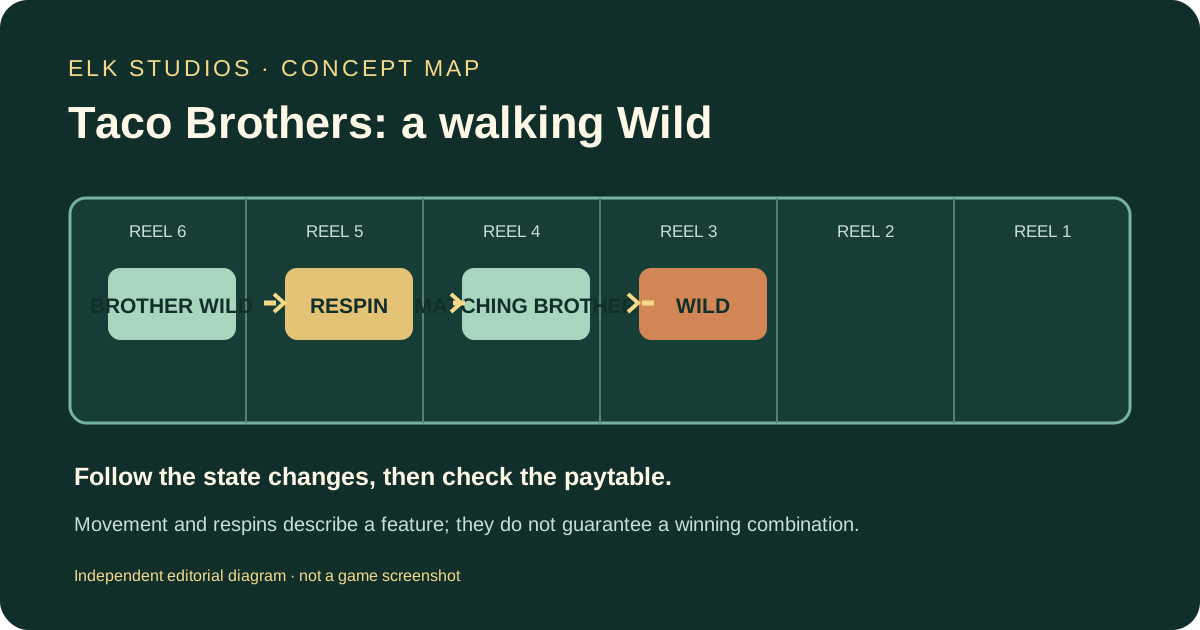
The central published feature is a Taco Brother Walking Wild. ELK says these Wilds move leftwards and turn corresponding Taco Brother symbols visible in the relevant positions into Wild symbols. A Walking Wild can therefore change both its own position and the status of matching character symbols as it travels. The supplier connects that movement with respins, so the feature is a multi-step sequence rather than a one-frame substitution.
To read the sequence, follow the same feature marker across each stop. At the first event, locate the Wild and note the reel position. At the next event, check whether the marker has moved left, whether the game has started a respin, and whether a character symbol in the relevant place has changed into a Wild. Continue until the feature’s movement ends or the client returns to the ordinary game state. The exact stopping condition and number of possible steps are not specified in the public prose, so they should be checked in help rather than guessed.
The phrase “corresponding Taco Brother symbols in view” matters. It does not mean all character symbols everywhere on the grid are necessarily transformed, and it does not provide a complete spatial rule by itself. The game help should show which positions count as corresponding and whether the brother identity matters. If a screen animation highlights a character, compare its location with the moved Wild. Avoid generalising one observed sequence into a universal rule without multiple checks or a written definition.
Several feature events may share the same round. If more than one moving element is shown, keep a timeline: initial stop, first respin, movement, conversion, next stop, any new win evaluation. This helps separate feature order from the final payout. A respin is not automatically a winning event; it creates another evaluation opportunity under the game’s rules. The round can change without producing a positive return.
The Walking Multiplier Wild
ELK describes a Walking Multiplier Wild as a Walking Wild carrying a multiplier. Its summary says regular Wild symbols in view receive the same multiplier as the walking multiplier Wild. That is the supported high-level relationship. The accessible supplier page does not specify a current multiplier number, maximum, combination order, or whether a particular operator client uses an alternate configuration. The linked data sheet could not be retrieved, so this review leaves those numerical details open.
When inspecting an actual display, first identify the multiplier symbol, then identify the regular Wilds that the help says are eligible. Ask whether the multiplier is applied once to each relevant combination, whether several Wilds are treated separately or together, and whether a multiplier affects only the feature sequence or other wins as well. A graphic showing a multiplier beside a Wild is not enough to answer these settlement questions.
Do not read the multiplier as a forecast. It describes how a qualifying result is evaluated under a feature rule; it does not make a result more likely or guarantee that a connected winning combination will exist. An eligible Wild may be visible without completing a paying pattern. If the game provides a win breakdown, compare the symbol combination, the Wild substitution and the multiplier step separately. That makes it easier to see whether the number shown was added, multiplied or applied at a later stage.
The supplier’s short description also does not prove that the multiplier value is the same in every regulated market or operator build. If the game help shows a value, record the exact client title, help date or version, and the relevant line of text. If a review elsewhere states a different figure, do not average the values or pick the newer-looking one. The active build’s rules are the useful reference for that session.
Bonus feature: brothers, Captain Diaz and Senorita
ELK’s page says three Bonus symbols trigger the Free Spins bonus. It then describes the brothers appearing one after another and generating respins as they walk across the reels. The accessible sentence says a “random” is attached to the brothers’ Walking Wilds but does not identify its object clearly in the visible text, so this review does not label it a multiplier or assign it a value without current help. Captain Diaz may imprison a Walking Wild Brother; Senorita may unlock an imprisoned brother or pull a brother back to reel six. These interactions create a feature state that needs to be read as a sequence, not just as a set of character names.
At bonus entry, confirm the trigger rule shown by the client and note the number of free spins or bonus actions awarded. The supplier summary confirms “three bonus symbols” for its described bonus, but not every operator setting or whether a separate Super Bonus state exists in the active version. It does mention a Super Bonus in the product summary, yet the publicly accessible text does not give its full trigger and settlement rules. Those details need the game help, not inference from third-party reviews.
During the feature, track each brother independently. Record where it begins, whether it moves, what multiplier label is attached, and whether Captain Diaz changes its state. If Senorita appears, note which of the two supplier-described outcomes occurred: an imprisoned brother was unlocked, or a brother was returned to reel six. A character appearing on screen does not, by itself, reveal how many respins remain or what happens next; check the status panel and rule text.
The interaction can be represented as a small state chart: walking, imprisoned, released, returned to the starting reel, or finished. Use the client’s exact terminology if it supplies one. The state chart is only a reading aid; it should not assign probabilities, predict the next character or suggest that a feature is due. The supplier does not publish outcome odds for Captain Diaz or Senorita in the accessible profile.
How to inspect one complete round
Choose a single round and make a simple record of the sequence rather than trying to interpret several spins at once. Start with the displayed title, stake, and any help version. Note the initial grid, identify regular symbols and special symbols, and mark the point at which the game changes from a normal spin to a respin. If a Walking Wild starts, record its direction and the symbol changes visible after each step. Then identify which event the client says produced a win.
If a multiplier Wild appears, note its label and the positions that the help says are covered. Do not use a displayed number until you know what it multiplies. When a bonus begins, record the trigger, the initial award and each new character event. If Captain Diaz or Senorita changes a brother’s state, note the before-and-after state. Finish by comparing the game’s total round result with the itemised win details, if an itemisation exists.
This method avoids a common interpretive error: treating a colourful sequence as a single rule. The animation may show movement, a conversion, a multiplier and a payout almost at once. The user-facing sequence could be compressed for speed. Written rules and the result panel provide the structure behind the presentation. If those sources disagree or leave an edge case unanswered, record the uncertainty rather than turning one display into an official rule.
An example should remain hypothetical. Suppose a brother marker moves left and a matching character becomes a Wild. That illustrates the supplier-described conversion. It does not imply that a win must occur, that every brother symbol changes, or that the respin will repeat a set number of times. Use examples to explain the order of features, not to claim the odds of seeing them.
RTP: what this review can and cannot verify
RTP is a long-run theoretical return percentage published for a specific game configuration. It is not the amount returned to an individual account, the probability of winning on the next spin, or a short-session target. Some games are distributed with more than one RTP configuration, and an operator may choose a particular permitted build. The supplier’s public product summary for this title does not state a usable RTP figure in the accessible text.
ELK links a Game Data Sheet from the official profile and lists Taco Brothers Derailed in its official game assets catalogue. The direct PDF request returned 403 Forbidden on 7 October 2026. A third-party review can provide a clue about what to verify, but it cannot establish the exact build used by a New Zealand-facing operator. This article therefore does not choose an RTP number from review sites or present one as current.
To check RTP, open the game’s own information/help screen inside the exact client. Look for the theoretical return label and whether the value applies to the base game, a feature mode or the full configuration. Record the displayed number precisely, including any decimal places, and note whether the client lists multiple variants. If the game help does not show it, ask the operator for the applicable game rules or the supplier’s configuration sheet. Do not infer the value from a demo, another casino or a general ELK page.
If two sources differ, preserve the source details: game title, supplier, operator, access date, version where shown and the exact label. A copied number without that context is not a verified setting. This page can explain how to check; it cannot authenticate a client that the editor has not accessed.
Volatility and the meaning of results
Volatility describes the distribution of outcomes over time, not whether a title is “good”, how often a particular player will win, or whether losses will be recovered. The public product summary does not provide a verified volatility label for the active New Zealand configuration. The linked official data sheet was inaccessible during research. Accordingly, this review does not call Taco Brothers low, medium or high volatility and does not convert competitor labels into a fact.
The walking respins and character interactions are feature descriptions; they are not a substitute for a volatility measure. A visually busy feature can end with no payable result, and a quiet ordinary round can still produce a qualifying combination under the rules. Feature names and animation length do not reveal probability distributions. Only a valid supplier or operator data source can support a technical classification.
A short personal session cannot reliably establish volatility. Small samples can contain clusters of wins or long gaps, neither of which proves that a game’s underlying distribution changed. Keep descriptive language grounded: “the supplier describes walking Wild respins” is supportable; “wins arrive every few spins” is not established here. Avoid staking more to force a bonus or compensate for a previous loss.
Maximum win, paytable and settlement checks
The maximum win is a rule or cap stated for a particular game version, usually expressed as a multiple of the stake or another clearly defined amount. The accessible ELK page does not provide a verifiable cap for the active build. Several review pages publish a figure, but the product data sheet’s failed retrieval means this review will not repeat a third-party value as fact.
If the help panel provides a cap, check the unit and the application point. Is it expressed as a total win multiple, is it a per-spin cap, and does it include feature rounds? Does the game stop at the cap, or can a feature continue without additional credit? The wording matters. Keep the cap separate from the most valuable symbol, the highest single combination or any multiplier animation; those are not necessarily the same thing.
The paytable should also clarify symbol values, the start and direction of evaluation, regular Wild substitutions, multiplier scope and how respin wins are accumulated. Where an interface offers a detailed history, compare the final total with its component wins. If the client rounds currency, the displayed total may be rounded for presentation; the rules should say how settlement is calculated. Do not claim an exact value if the screen does not state one.
Mobile, demo and accessibility checks
ELK’s page recommends a 1600×900 desktop display and a 16:9 ratio when scaling is needed. That is a supplier recommendation for desktop presentation, not a claim about mobile availability, the minimum supported browser or a New Zealand casino’s game launch. The official page contains a play link, but following a supplier link would not confirm that any third-party operator serves this title locally. This review did not open the game client or test it on a device.
If an operator offers the exact title on a phone or tablet, check whether the grid, help controls, bet display, feature labels and round history remain readable without zoom. Try opening the paytable before wagering and confirm that the close control returns to the same game state. Portrait and landscape behaviour may differ; a layout that fits the screen can still hide information behind a fold or overlay.
A demo is useful only if its title and configuration match the product being reviewed. Confirm that the demo is genuinely free-to-play, whether it uses simulated credits, and whether any real-money features are absent. A demo’s availability is not proof of access to a real-money version or a particular operator. If no demo link is verifiable for the user’s location, say so rather than inventing a playable route.
New Zealand availability and advertising context
This page does not establish whether Taco Brothers Derailed is available to New Zealand residents. The supplier’s Live Now label describes the catalogue entry, not an operator’s country permissions, licence status or account eligibility. A title visible in an overseas review or lobby is not proof that it can be offered locally. Check current information from the relevant New Zealand authority and the operator before drawing a conclusion.
The Department of Internal Affairs says online casino gambling advertising is prohibited during the current transition and explains that the advertising rules apply to operators and third parties. It also identifies affiliate marketing as among the initial prohibited decisions. Because this is an affiliate casino site, the local package is held from promotional linking pending qualified compliance review. No CPA button is placed in this article, and the existing /go/south/south-cashdesk-8a14.php route has not been opened, changed or used as a link. A future reviewer should reassess the law and applicable rules before public distribution.
This compliance note does not imply that the game itself is illegal or that a specific operator has been assessed. The article’s purpose in this local draft is to describe supplier-published mechanics and identify facts still requiring verification. It does not recommend a casino, promise access, endorse a betting method or offer a shortcut to a bonus.
Comparing reviews without importing unsupported figures
Secondary reviews can be useful for discovering which terms readers search for and where help may be unclear. They can also contain precise-looking RTP, hit-rate, bet-range and max-win numbers that apply to a different market or are not accompanied by a source. One current competitor page lists a numeric RTP, volatility label and cap, while ELK’s directly linked data PDF could not be opened in this research run. This gap is exactly why those values are withheld here.
When comparing a review with the supplier summary, begin with the title, release status and feature terminology. Then ask which source supports each number and whether it identifies the operator build. If a review uses a title heading that differs from ELK’s, check the URL and in-client title. If a review claims a grid size that contradicts the supplier’s current page, prefer the primary source for the broad mechanic and flag the mismatch. Don’t repeat a claim merely because it appears in several reviews; copied values can all trace back to one old page.
The supplier source confirms the six-by-four grid, walking brothers, leftward movement, corresponding character-to-Wild conversion, the multiplier Wild concept, three-symbol Free Spins trigger and the named Captain Diaz/Senorita interactions. It does not settle every edge case or numerical setting. A careful review distinguishes those levels of evidence instead of blending them into a single certainty statement.
A practical checklist for the active game help
Before relying on any specification, write down the full client title, provider credit, operator name, date viewed and country or currency context if the client displays it. Then check the basic controls and game rules. Capture the paytable wording for the base game, the exact start condition and direction of wins, the role of each Wild type, and whether the Walking Wild feature can retrigger or overlap. Note any sentence that is ambiguous rather than paraphrasing it into a rule.
For settings, locate RTP and its variant label, volatility if provided, maximum-win wording, minimum and maximum stake, feature prices if any and the treatment of simultaneous wins. This list is not a claim that all such data is visible or that this game has an optional paid feature. It is a reminder to inspect, not an instruction to buy a feature. If a field is missing, mark it “not shown” and contact the operator or supplier for documentation.
For the bonus, trace one entry sequence from trigger to end: symbols required, initial award, brother order, movement, attached multiplier label, Captain Diaz effect, Senorita effect, respin ending condition and bonus settlement. For the regular game, check whether the Walking Wild respin can carry other symbols forward and which symbols are eligible to convert. Verify all of this in written help before wagering; do not use a single observed run as the definitive rule book.
The result should be a concise record, not a prediction model. The note should help a reader understand which rules are public and which are still missing, so a later update can be made when a supplier sheet or properly identified operator help becomes available.
Common misreadings
“The Wild walks, so it must pass across every reel.” The official summary says it moves leftwards. It does not provide all movement timing, start positions or stopping conditions in the accessible text. Read the help for the actual sequence.
“A multiplier on the screen applies to every win.” ELK describes the multiplier Wild as affecting regular Wilds in view. That wording is narrower than every possible win on the grid. The active rules should define coverage and how the payout is calculated.
“Captain Diaz always ends the bonus.” The supplier says he imprisons a Walking Wild Brother. The accessible description does not say that every imprisonment ends the feature or specify all possible resulting states. Do not fill the gap with a competitor’s wording.
“Live now means playable in New Zealand.” It means ELK presents the title as a live catalogue product. It does not verify a local casino, player eligibility, legal status or a particular configuration.
“A review number is the game’s current RTP.” Not without matching the version and operator configuration. The primary data PDF returned 403, so exact values remain unverified in this package.
Questions readers ask
Is Taco Brothers Deralied the same title as Taco Brothers Derailed?
The assigned Topic ID uses Deralied, and ELK’s URL retains that spelling, while the public page heading says Derailed. This guide preserves the assigned route and identifies the supplier’s displayed title. Confirm the actual lobby title and provider credit before applying any rule.
How do the Walking Wilds work?
ELK says Taco Brother Walking Wilds move leftwards, generate respins and turn corresponding Taco Brother symbols in view into Wilds. The exact movement sequence and stopping condition should be checked in the active client help.
What is the RTP or volatility?
This package could not verify either value for an operator build. ELK’s linked Game Data Sheet returned 403 during checking on 7 October 2026, and no operator help screen was supplied. Use the current game help rather than a number copied from a different casino review.
Is a casino in New Zealand confirmed to offer it?
No. ELK’s product status does not establish a casino’s country availability or legal eligibility. Check current official local guidance and the operator’s terms; this article does not make an availability claim.
Does the bonus guarantee a result?
No. A feature trigger starts a defined bonus sequence, not a guaranteed profit. The game’s rules determine how events are evaluated, and a bonus round can finish without returning the amount staked.
For New Zealand harm-support information, use the site’s safer gambling resources and the ELK Studios game index for supplier-level context.
Summary
Taco Brothers Deralied/Derailed is most clearly understood through the movement of three brother-themed Wilds, the respins they create, the multiplier Wild’s stated relationship to regular Wilds, and the Captain Diaz/Senorita bonus interactions. ELK’s product page supports that qualitative outline and the six-reel, four-row layout. It does not provide a verified numeric configuration in the accessible page, and its linked data sheet was blocked from retrieval. Check the current client for paytable, RTP, volatility, cap, stake limits, mobile behaviour, demo and bonus edge cases. New Zealand access is not established, and the article remains on hold from CPA promotion pending compliance review.
Sources and verification boundary
- ELK Studios: Taco Brothers Derailed — supplier feature summary and displayed title; checked 7 October 2026.
- ELK Studios: Game Assets — official catalogue links a Taco Brothers Derailed Game Data sheet; checked 7 October 2026. The linked PDF returned 403 Forbidden.
- Department of Internal Affairs: Online gambling for advertisers — advertising update checked 7 October 2026.
- FruitySlots: Taco Brothers Derailed review — competitor sample opened 7 October 2026; numeric claims were not adopted because they were not verified against the inaccessible primary data sheet or an active NZ client.
Supplier feature prose supports the qualitative mechanics stated above. Exact RTP variants, volatility, hit frequency, stake range, cap, probability of named events, active operator configuration, mobile support and New Zealand availability were not verified. No demo was opened. No gambling or CPA link was followed.
