ELK Studios game guide · South Island guide
Toro 911: rules, Toro and Diaz features to verify
 Best casinos available in New ZealandUpdated 7 November 2026

Toro 911, styled with a space in ELK Studios’ official page, is built around Toro, Matadors, Diaz, respins and a named Clean the Streets interaction. This guide explains the supplier-described feature relationships while leaving numerical settings and New Zealand availability to the exact operator help.
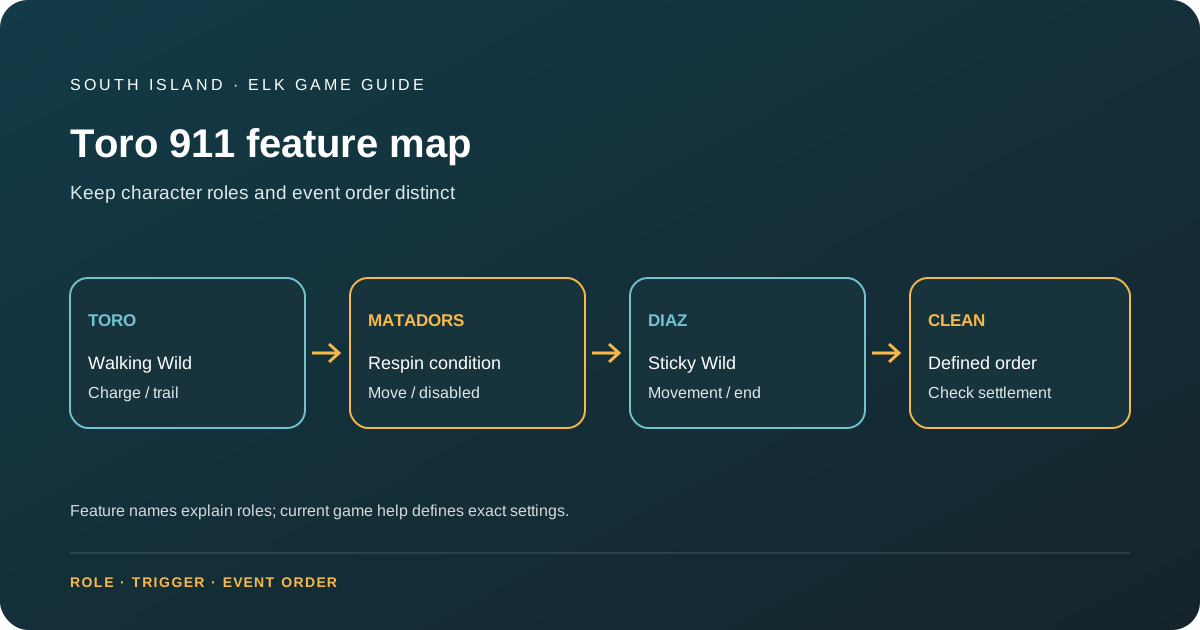
The short answer: follow Toro, Matadors and Diaz as separate roles
ELK Studios styles the title as Toro 911 on its official product page, while the planned route and search query use “Toro911”. This is the same assigned game; the article keeps the supplier’s spelling in the visible title and the canonical URL stays at the provided route. The public product description centres on Toro as a walking Wild, Matadors that can create respins, Diaz as a sticky Wild, and a Clean the Streets interaction that brings the characters together.
The useful way to read a round is to separate those jobs. Toro moves or charges and can leave a Wild trail. Matadors supply a respin condition while at least one remains active on the screen. Diaz has his own persistence and movement condition. Clean the Streets depends on Toro and Diaz interacting; during that feature, the two characters affect Matadors in a defined order. A single animation may show several of these effects, but they should not be described as one generic “Toro bonus”.
The active operator’s numerical settings are not established by the public product summary checked for this article. No verified game-help panel was supplied, so this page does not state RTP, volatility, stake range, maximum payout, feature price or a cash equivalent. Third-party reviews publish values tied to particular markets and builds; those are not a substitute for the version-specific help a player sees. No availability in New Zealand is inferred.
Confirm the title and the active version
Open the game’s rules menu and confirm that it identifies Toro 911. The title’s supplier page is ELK Studios Toro 911. Record the product spelling, the displayed version or rules date if present, and the exact page or help panel that supports each mechanic. This prevents a common mistake: using a rule remembered from Wild Toro, Gladiatoro or another related title as if all games in the character series were identical.
The official product summary is a reliable source for the broad named feature interactions, but it is not a complete operator configuration. The in-game rules should define paying symbols, Wild substitutions, the precise respin trigger, the duration of the round, feature-symbol eligibility and any mathematical fields. The operator’s terms answer separate questions such as currency, account requirements, access and customer support. Keep those source roles visible in your notes.
Before a round, locate the paytable, feature descriptions and history view. Identify which parts of the screen are the reel area and which are feature markers. A character may appear as an ordinary symbol in one state and as a feature actor in another; do not assume those roles are interchangeable. If the help does not say whether a character pays as a symbol, describe only its stated feature action.
Toro as a walking Wild
ELK describes Toro as a walking Wild. A Wild generally substitutes for eligible paying symbols, but the paytable must establish the exceptions. “Walking” describes movement; it does not tell a reader the path, direction, trigger, step size or which later result uses the Wild. The supplier summary adds that Toro creates respins and that a charge leaves a Wild trail. These are related effects, but each one has a separate rule.
Read the movement rule as an event sequence: what causes Toro to move; which positions he crosses; whether his current location becomes Wild; whether movement ends after a collision or target; and whether another respin follows. If the official game help shows more than one Toro state, record those as separate modes. A visual charge animation is not enough to determine the number of positions affected or whether a Wild remains after the animation.
The Wild trail is especially easy to overstate. A trail can mark positions Toro crossed, but the help determines whether all crossed positions become Wild, whether only selected cells count, and how long those symbols persist. If the supplier says a charge leaves a trail but the accessible text does not specify duration, leave persistence unconfirmed until the active rules resolve it.
When Toro contributes to a payout, distinguish his substitution role from his feature role. A Wild may complete an eligible combination, while the movement that placed him may also create a special state. Do not add those effects together unless the help says both are scored in the same result. The displayed total after the round, not the animation’s intermediate number, is the settlement evidence.
Matadors and the respin condition
Matadors are not merely background characters. ELK says they award respins while at least one Matador is on the grid. That gives the reader an explicit condition to check: the presence of a qualifying Matador keeps the respin sequence active. The current game help should then explain how a Matador appears, whether it must be in a specific place, and what changes during the respin.
The supplier’s page says that during a respin a Matador may be disabled or may move. Those outcomes mean the grid can change between steps. Keep track of which Matadors are still active, which ones have moved, and whether the respin condition remains satisfied. A symbol that moves out of one location may continue to qualify elsewhere, or it may not; only the current rule can settle that.
For a neutral example, imagine that a Matador is present when the game enters a respin. The reader should follow whether it stays, shifts, or becomes disabled; then see whether Toro can reach it; then check if another respin is awarded. This is an event map, not a prediction of what will appear. Do not put a fictitious payout in the example when the symbol values, exact positions and paytable have not been verified.
The phrase “while at least one remains” does not disclose whether multiple Matadors add respins, whether a respin count has a maximum, or what happens if a Matador is disabled at the same time another feature is triggered. Do not infer those details from a third-party clip. If the rules omit the interaction, identify it as a question for the operator instead of smoothing it over.
Diaz: sticky Wild and movement rule
The supplier describes Diaz as a sticky Wild. It also says that Diaz moves only when escaping Toro and stays until the spin ends or Toro hits him. This provides a clear role and an end condition, but a complete explanation still needs the in-game definition of “spin” in the feature sequence. A normal spin, a respin and a feature round can have different lifetimes.
Read Diaz’s help text for eligible substitutions and any multiplier association. The supplier description calls him a sticky Wild, but it does not mean his value or position is fixed across every stage. If he is shown to move only when escaping Toro, identify what qualifies as an escape and where he can move. If Toro reaches him, check whether the round stops, a feature begins, a trail is created, or a separate calculation takes place. The character encounter is not self-explanatory from artwork.
The word “sticky” needs a boundary. It usually indicates that a symbol remains in place for some defined period, but the period might be a respin sequence, a bonus or an entire feature. Here ELK’s public summary states that Diaz stays until the spin ends or Toro hits him. Use that wording and check how the current operator game defines the relevant spin. Do not expand the duration beyond what the source says.
If the operator’s help gives a multiplier for Diaz or a feature state, keep that as a separate field from his Wild substitution. A multiplier can be attached to a symbol, a win, a remaining Matador or a feature total. Those formulas are not interchangeable. Record exactly what the rule says the multiplier affects and when it is applied.
Clean the Streets: the linked interaction
Clean the Streets requires Toro and Diaz, according to ELK’s public feature description. In this interaction Diaz spawns Matadors; Toro charges the Matadors first and then Diaz. If Diaz and Matadors are present, Diaz increases multipliers on the remaining Matadors. The names describe a sequence, so a good guide preserves the order instead of reducing it to “all characters add multipliers”.
First, verify the feature’s entry condition in the active help. The public summary says the interaction requires Toro and Diaz but does not expose every eligibility or start condition. Next, note how Diaz spawns Matadors and which resulting symbols count as targets. Then follow Toro’s charge order. Finally, read what “remaining Matadors” means for the multiplier increase and how those multipliers are applied to any win.
The order matters because a Matador may be affected by Toro before the multiplier step. If Toro removes, disables or transforms a target, the set of remaining Matadors can change. Diaz’s later action may apply only to those left on the grid. This is a logical reading of the supplier’s stated order, not a claim about an unexposed payout formula. The game help must establish whether a target’s state changes before an award is calculated.
Do not assume the feature guarantees a payout simply because it creates targets and multipliers. The number of eligible symbols, the path Toro takes and the value of each result remain governed by the game’s rules and chance. A feature description explains what the game can do, not a minimum return. If the help includes an explicit guarantee of a feature entry or a payout, quote it with the exact mode and condition; do not infer a financial guarantee from the name.
Keeping the state readable during a complex round
When several character effects can occur together, use a three-column note: “event”, “board change”, and “settlement or next state”. For example, record Toro’s charge as an event, the positions that become Wild as the board change, and whether the game then awards a respin as the resulting state. Record Diaz separately. This method makes a tangled animation understandable and helps expose missing rules.
Pay attention to timing words such as “first”, “then”, “while”, “until” and “remaining”. They define order, persistence and eligibility. “While at least one Matador is present” is a continuing condition. “Until the spin ends” is a persistence limit. “First and then” describes sequence. If a translated interface uses different wording from the supplier page, keep both terms in a note and use the actual player-facing version for a local rules description.
Avoid relying on a single screenshot. A frame with Toro on the grid might be before a charge, during a respin or after a feature transition. The history panel can provide the final sequence if the game offers one. If it does not, the help should still define the feature conditions. A recording can document one sample, but it does not establish a typical result or a feature probability.
If the round displays provisional win figures while the characters move, wait for the game to finish its settlement. A multiplier may affect only a certain symbol or a single event; the visible value could change before the final total. Explain only the number shown after the round and only if the operator help supports its meaning. This article does not fabricate a numerical walk-through because the exact paytable and live version were not available.
RTP, volatility, maximum payout and feature modes
No numeric RTP, volatility label, maximum payout, stake limit or feature-mode cost is stated here. The public product page describes mechanics, but the evidence required for this assignment is the active game-help configuration. No operator help panel for the target market was supplied. Secondary review sites list values for their own snapshots; those may be accurate for the pages they inspected but do not prove the setting used by another operator.
RTP is a theoretical long-run return tied to a particular configuration. It does not predict a session or promise a result. Volatility is a description of outcome distribution, but reviewers may use their own scales. A maximum win is a ceiling, not the expected value of a round. A feature mode can have a separate cost and math model; never assume the base-game RTP applies to it.
If the active help shows a range or several configurations, record the exact value displayed, the mode, the currency, the operator and the date. If Toro 911 offers a priced feature entry, compare its cost with the entry state and listed rules; “guaranteed” may refer only to entering a feature. Do not claim that the purchase is profitable or that it eliminates chance.
The supplier’s X-iter material can explain how its feature-selection product works at a high level, but it should not be used to infer the price menu or availability of Toro 911 in a specific casino. The game’s own mode selector and help are necessary for the exact current offer. A game can be listed by the supplier while a particular mode is absent or disabled in an operator’s market.
Settings checklist for a current build
To evaluate the game without confusing sources, verify these items in the operator’s own help where accessible:
- Exact title spelling and the version or rules date.
- Reels or active grid and the base-game payout condition.
- Wild substitution exceptions and how Toro’s movement is evaluated.
- Matador appearance and the condition that keeps respins active.
- Which Matador movements or disabled states preserve eligibility.
- Diaz’s Wild role, movement condition and persistence limit.
- Clean the Streets trigger, event order and treatment of remaining Matadors.
- Whether multipliers exist and the precise item or win they modify.
- RTP by mode, the operator’s displayed volatility wording, stake range and payout cap.
- Demo presence and whether it represents the same version.
For each field, save the source and check date. If the information is not published, report that it was not visible. Do not copy a stake range in euros or pounds into a New Zealand dollar example. Do not claim that a mode is active just because the provider supports it elsewhere. An evidence-led table can contain a blank or “not verified” value; that is better than false precision.
Mobile display, help and demo
On a phone, Toro’s movement and the Matador positions should be readable at the same time as the respin indicator. Open the rules panel and check that it does not hide the feature state. If the display uses a history control, read the complete sequence after the spin; if a multiplier or target label is cut off, rotate or zoom before interpreting it. A screenshot that clips a symbol is not an authoritative rule source.
A responsive supplier page says nothing about an operator’s game-frame performance. Operators can present different interfaces, languages or controls. This editorial page has not tested a particular device, app or live casino product. The mobile checklist is a reader method, not a test result.
A demo can help identify Toro, Diaz and the Matadors, but it does not prove real-money settings, cashier terms, customer eligibility or long-run payback. A video shows a single recorded path and may omit the full rules. No demo was launched for this guide. If a game is unavailable or restricted, do not use a location or account workaround.
What this guide can and cannot tell a reader
The guide can explain the supplier-described feature roles and where their rules interact. It can help someone prepare to read the help panel in the correct order: Toro’s Wild effect, Matador respins, Diaz’s persistence, then Clean the Streets. It can also distinguish a game’s theme and supplier catalogue listing from the operator-specific version.
It cannot tell the reader how often Toro reaches Diaz, how frequently a respin begins, what a feature is worth, or what the next result will be. It cannot verify a New Zealand casino’s catalogue or tell a customer that an offshore operator will accept their account. Those statements require current evidence from the operator and regulator.
The design may suit a reader who wants a character-driven round with moving symbols and several event dependencies, but that is a neutral description of complexity rather than a recommendation. Someone seeking simple fixed rules may prefer to read the full help first. Someone seeking a precise mathematical comparison should stop until the active RTP, volatility label, stake range and payout cap are visible in the actual build.
New Zealand scope and responsible gambling
The product is discussed for a New Zealand audience, but no local availability claim is made. A software supplier’s page is not a directory of casino operators or permission to gamble. Customer eligibility, operator permissions and game distribution must be checked separately against current official information.
The DIA says the advertising prohibition for online casino gambling is in effect and that publishers or parties arranging publication can be within enforcement scope. Its advertiser guidance also says marketing regulations apply to third parties and identifies affiliate marketing among the initial regulatory decisions. Until this boundary is resolved through appropriate compliance review, this page has no affiliate button, promotional offer or direct operator referral. The project’s existing CPA route has not been used or opened.
If gambling is causing concern, take a break and use the support information in the New Zealand safer gambling guide. A feature, a character interaction or a progress counter is not a reason to continue after a personal limit has been reached. This article does not offer a system for predicting or beating the game.
Questions readers commonly ask
Is the official title “Toro 911” or “Toro911”?
ELK’s official page styles it as “Toro 911” with a space. The planned search query and route use “Toro911”; this guide preserves the assigned URL while using the supplier spelling in the article.
What does Toro do?
ELK describes Toro as a walking Wild that creates respins, with a charge that leaves a Wild trail. The active help should define the movement path, eligible substitutions and trail persistence.
How do Matadors affect respins?
The supplier says Matadors award respins while at least one remains on the grid and that a Matador may move or be disabled during a respin. Check the exact current conditions in the game help.
How does Diaz differ from Toro?
Diaz is described as a sticky Wild that moves only when escaping Toro and stays until the spin ends or Toro hits him. His substitution and persistence details should be checked in the same game version.
What happens in Clean the Streets?
ELK says Diaz spawns Matadors, Toro charges Matadors before Diaz, and Diaz increases multipliers on remaining Matadors when they are present. The feature’s exact entry and settlement rules require the active help panel.
What are the current RTP and volatility?
This page does not publish figures because no current operator help panel was available for verification. Third-party reviews can describe different builds, countries or operators.
Is Toro 911 available in New Zealand?
The supplier listing does not establish local operator distribution or customer eligibility. This guide makes no NZ availability claim.
Does a demo confirm a real-money configuration?
No. A demo can illustrate symbols and features but does not establish the operator’s live settings or an account’s eligibility.
Where are other ELK game references?
Use the ELK supplier guide for catalogue navigation or the game guide index to browse existing individual-title pages.
For local help and break options, see New Zealand safer gambling support.
Sources and verification boundary
Primary source checked on 6 October 2026: ELK Studios Toro 911 product page. It describes Toro’s walking Wild, respins and Wild trail; Matador presence and movement/disable states; Diaz’s sticky Wild role and end condition; and the Clean the Streets interaction. The active operator game-help panel was not supplied or inspected, so numerical RTP, volatility, stakes, payout cap, feature costs and operator availability are not asserted.
Competitor pages reviewed on 6 October 2026: Bigwinboard, FruitySlots, SlotCatalog, SlotGods, and Sigma World. They describe market-specific settings and are not used here as universal game-help facts. New Zealand regulatory context checked the same date: DIA advertising guidance and Online Casino Gambling Regulations 2026. No demo, live game, operator account or CPA route was accessed. Search demand data was not provided.
