ELK Studios game rules · South Island guide
Tropicool 3 review: COOL Reel, Avalanches and bonus rules
 Best casinos available in New ZealandUpdated 7 November 2026

Tropicool 3 uses a COOL Reel to feed feature symbols into the main grid, while wins can create an Avalanche sequence and Elmo’s position can trigger a full reel drop. Its bonus keeps a global multiplier between drops; the Super Bonus adds a special Elmo state. This guide explains the order and what to verify in an operator’s current help.
The short answer
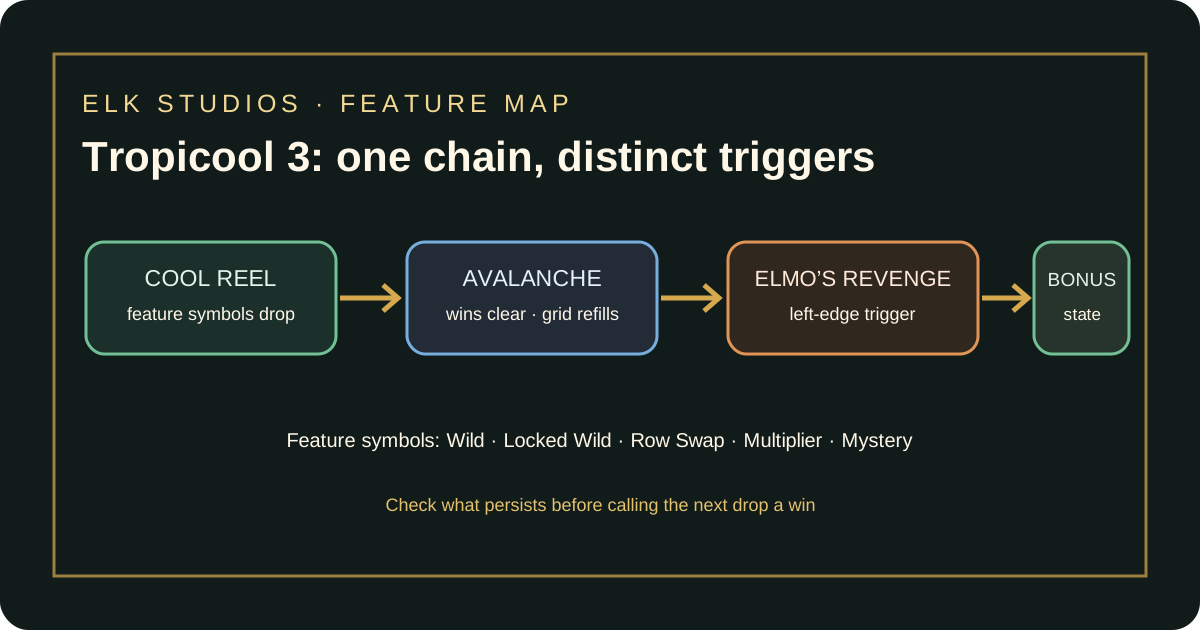
Tropicool 3 is the ELK Studios entry that brings the series’ COOL Reel into an ancient-Egypt-inspired setting. The supplier describes a reel that feeds feature symbols onto the main grid, winning symbols that can explode into an Avalanche, and Elmo’s Revenge when Elmo reaches the leftmost column. The same feature shelf can contain Wilds, Locked Wilds, Row Swaps, Multipliers and Mystery Symbols. These events can occur in sequence, but each has a separate trigger and should be explained as its own rule.
The bonus begins when the game’s required bonus symbols appear. The global multiplier persists through the bonus drops, while the Super Bonus is triggered by a qualifying combination that includes Elmo; in that mode Elmo is guaranteed in the main grid and remains sticky between free drops, according to the public supplier description. The current help should be checked for exact symbol conditions, sequence, state reset, payout and any regional configuration. This guide does not supply an operator-specific RTP, volatility, cap, stake range or New Zealand availability claim because a current local game-help screen was not provided.
The most useful way to read a round is to follow the source of each change. Was there a winning combination? Did it clear symbols and open positions? Did the COOL Reel fill those positions? Did Elmo reach the edge and activate a full drop? Did a multiplier affect the settled win or remain as a state for later drops? That sequence makes the interface understandable without treating each animation as a separate payout.
Identify Tropicool 3, not a neighbouring title
ELK uses Tropicool as a series name and has several numbered entries. This page is for Tropicool 3 only. Do not transfer the rules of Tropicool or a later title simply because the same characters or a COOL Reel appear. A sequel can keep a familiar theme while changing the symbol shelf, the order of events, the bonus trigger or the way a global multiplier behaves.
Open the operator’s rules panel and confirm the full game name and provider. Note the build or version if shown, then compare the feature names with the supplier page. A casino directory may write “Tropicool III,” omit the number or use a shortened logo label. The spelling difference does not create a separate product, but a missing title number can make a rules comparison unsafe. Verify that the help names Elmo’s Revenge, COOL Reel and the bonus state that this guide discusses.
The visual setting combines icy imagery with an Egyptian theme. That is a creative setting, not a historical explanation. Pyramids, palms, frozen symbols and the character animations help orient the player, but they do not determine how a wager settles. The actual rule comes from the paytable and help. A theme review and a mechanics review answer different questions; this article focuses on the latter.
The COOL Reel: a separate source of feature symbols
The COOL Reel is described as a multi-level reel that can send feature symbols down to the main game. ELK says winning combinations trigger a drop from the first level onto the grid. That means a base-game win can create a new symbol arrangement after the initial evaluation. The drop is a follow-on stage, not a new paid spin. The client’s round history should show whether the game continues evaluating after that change.
When a feature symbol reaches the grid, identify its type before assuming an effect. A Wild can substitute under the rules. A Locked Wild may remain in place under a defined condition. A Row Swap changes the symbols in a row according to its own instruction. A Multiplier can change an eligible award, and a Mystery Symbol may reveal another symbol or state. The supplier summary lists these categories, but the exact effect and eligibility should be read from the current game help.
The feature reel and main grid should not be conflated. The feature reel is a source of symbols; the main grid is where the game evaluates the resulting positions. If a winning symbol disappears, the newly available space may allow a feature symbol to fall. That sequence can produce a second evaluation, but the falling object is not itself evidence that the next state wins.
A practical review can describe a COOL Reel event in three parts: what caused a drop, what type of symbol entered the grid and whether a new qualifying result followed. If the help calls the reel “three-level” or names a position, record the exact wording from the live panel; this article avoids importing numerical settings from a page that may describe another deployment. A clean description can still be precise about order without guessing a probability.
Wild, Locked Wild, Row Swap, Multiplier and Mystery
The feature symbols have different jobs, so list them separately in the review. Ask whether the Wild substitutes for all paying symbols or only some, and whether it can participate in every type of combination. Ask what makes a Locked Wild lock and what releases it. For a Row Swap, learn which positions are exchanged and whether the change happens before or after a win check. For a Multiplier, determine the affected award and when the value is applied. For a Mystery Symbol, find what it can reveal and whether that transformation is guaranteed to complete before the next evaluation.
Do not infer that a Locked Wild lasts for the rest of the game because the word “locked” appears in the name. It may stay for one drop, a feature sequence or a bonus state; only the rule defines the duration. Likewise, a multiplier symbol may be attached to a cluster, apply globally or remain between drops. These are materially different arrangements. A screenshot can show one state but cannot establish the general reset rule.
A Row Swap is best understood by comparing the grid before and after the operation. Which symbols moved? Did the swap create a new winning combination? Were previously winning positions removed or preserved? The help should say whether all symbols shift as a group or if the feature chooses a particular row. A review should not say “the row changes randomly” unless the interface or rules support that description.
Mystery effects need the same careful separation between reveal and result. The Mystery symbol might reveal a symbol type or trigger another configured effect; neither possibility means the row will necessarily pay. Note what it revealed in one observed round, then state the general rule from help separately. This avoids turning one animation into a claim about every Mystery symbol.
Avalanche and Elmo’s Revenge
ELK describes Avalanche as a cycle in which symbols participating in a win explode, spaces open, and new symbols or feature symbols drop into those spaces. If another winning combination forms, the cycle continues. This gives the game a staged evaluation: the original grid is checked, qualifying symbols clear, new symbols enter and the altered grid is evaluated again. The player has paid for the initial action; later drops belong to that same sequence unless the operator’s help states otherwise.
A careful explanation distinguishes the cleared symbols from the new symbols. A winning group can disappear, while non-winning positions remain. The falling feature symbols can then alter the state of the next evaluation. A new group can use a Wild from a previous drop if the rule allows it, but the review should confirm that rather than presume. If the client displays a total after each stage, use that settlement history to show how the round accumulated.
Elmo’s Revenge has a spatial trigger: the supplier says the Elmo symbol causes a full drop of the COOL Reel when it reaches the leftmost column. “Reaches” matters. The help should explain how Elmo moves, whether it must enter the edge by a particular drop and what happens if it is already there. A review should use the supplier’s feature name but not claim that Elmo appears or moves at a predictable rate.
A full drop changes more than a single feature symbol; it brings the whole feature reel into the main game under the game’s rule. The new symbols still need to be evaluated. A helpful example can say: an existing win clears space, the feature reel drops, Elmo’s condition is checked, and any new combination is settled. This describes a possible sequence without asserting that it happens on every win.
If a round includes both Avalanche and Elmo’s Revenge, record the order visible in the history. Did the Elmo symbol reach its trigger position before the Avalanche settled, or did the game first remove a winning group and then update the reel? The order may affect which symbols are available at the next check. If the interface does not expose the order, describe the result at a high level and avoid a precise causal claim.
Bonus and Super Bonus
The public supplier description says the qualifying bonus symbols start the bonus and that the global multiplier persists throughout it. It also says the Super Bonus requires a qualifying combination that includes Elmo, guarantees Elmo in the main grid and keeps Elmo sticky between the free drops. The live rules should show the exact bonus-symbol condition, any additional symbols required and what causes the feature to end.
At entry, note what the game displays: mode name, remaining drops, multiplier state and whether Elmo appears on the grid. Do not assume the bonus always starts with the same multiplier or grid arrangement. If the help says the multiplier persists, check whether it carries only from one drop to the next or also from the base game. The supplier’s wording supports persistence through the bonus, but the operator’s version may use a specific entry and reset rule.
An additional free drop is another evaluation opportunity, not an additional guaranteed award. If new symbols enter, the paytable still determines whether they form a winning combination. A multiplier may remain visible without an eligible win. A sticky Elmo can stay in the grid, but the help must define whether its position changes, whether it triggers Elmo’s Revenge again or whether it has a separate effect in the Super Bonus.
Keep the ordinary bonus and Super Bonus distinct in a comparison. Use columns such as trigger, initial state, persistent features, what can change and exit condition. Fill a value only when the active help makes it explicit. If the rules only tell you that the Super Bonus “guarantees Elmo,” do not claim that it guarantees a win, a particular multiplier or a specific cash return.
X-iter and feature-entry choices
ELK presents X-iter as a set of modes that can start a selected scenario. Menus and availability depend on the operator and jurisdiction. If the current client offers such a menu, read each option’s description and price before accepting it. Confirm which feature starts, whether the mode is a bonus or a special base-game state, and what help text governs settlement.
A direct feature-entry option changes the choice being purchased; it does not turn the game into a predictable outcome. If a mode advertises a higher chance of reaching the bonus, find out what “higher” is compared with and whether the statement refers to trigger frequency or another property. It should not be rewritten as a claim of better value or profitability.
Pay attention to the confirmation step. A player should be able to see the full cost before accepting, understand if it is charged immediately, and know how to cancel. If the interface obscures any condition, exit and locate the help or contact the operator. A third-party review that lists a mode price or “bonus buy” label may be based on a particular market and should not be treated as an NZ offer.
The selected mode may also have its own RTP or eligibility conditions. Verify whether a displayed value applies to the normal game, the X-iter menu or both. Do not rely on a general supplier number if the live client distinguishes modes. This review has no current operator data, so those values remain unknown.
RTP, volatility and the maximum win
This article does not present a numerical RTP, volatility score, stake range or win cap. The current operator help for New Zealand was not made available, and those details can be tied to a particular game build or mode. Several review pages report similar figures, but repetition across pages does not establish which version the reader would see. The responsible answer is to show how to verify the relevant value, not to select a consensus number from search results.
RTP is a theoretical average across a very large number of plays under a defined configuration. It is not a session promise, a refund, or an estimate of what one person should receive. If a help panel gives more than one RTP variant, record which one applies to the current casino and any selected mode. If it shows no value, say so and avoid substituting a provider-wide figure.
Volatility concerns how results are distributed. It cannot predict the timing of a bonus, the length of a losing sequence or the size of the next win. A third-party rating or reviewer’s impression may be useful context, but it is not the operator’s numerical setting. The help must be consulted before saying the current game’s volatility is a verified fact.
A maximum-win amount is a ceiling under a defined set of rules. It is not a target, likely outcome or guarantee. If the provider advertises a potential ceiling, the current help should confirm whether it applies to one round, the bonus or an X-iter mode. Without that, a review should label it as an unverified supplier statement or leave it out. This page does not state that figure as a local operator setting.
Mobile and interface checks
ELK’s product page recommends a desktop aspect ratio for the game’s presentation. That supplier note does not confirm that every operator’s mobile wrapper supports the title or displays it identically. On a phone, check whether four-sided paths, corner screens and Nitro Reels are readable at once. If a corner panel is cropped, a player may miss which modifier triggered. Verify that the information menu and history remain available without accidentally confirming a wager.
A practical interface review should describe the device and browser, screen orientation, whether controls are readable, and what happened after switching orientation or reconnecting. It should not claim a game is “mobile optimised” simply because it opens on a phone. The relevant questions are whether the rules can be read, whether the board state is visible and whether the round history preserves the result after an interruption.
Demo play is only available if the operator or provider actually makes it available in the user’s context. If shown, confirm it is labelled as practice credit and the title identity matches the review. A demo is useful for finding the paytable, following an animation and learning the layout. It cannot verify an RTP, volatility, feature probability or New Zealand access, and a short session should not be described as a test.
When documenting a demo, distinguish the observed example from the general rule. “In this round a Nitro Reel appeared after an intersection” is a session note. “Nitro Reels appear whenever paths intersect” is a rule claim and needs the help text. That distinction protects readers from assumptions based on a small number of animations.
How to inspect a result without guessing
Start by capturing the title and mode, then note the starting grid. If a start-of-spin Nitro effect occurs, record it before evaluating paths. Follow each eligible route from its edge, mark the intersection, and wait for the game to display any Nitro Reel. Read the corner screen that activates, note its named feature and check whether the game shows an immediate award or only a changed state.
When the game enters a bonus, save the mode label and initial state. Follow what remains sticky, what is re-triggered and what can change. At the end, open the round history and compare the feature steps with the settled total. If the help does not explain a point, write “the available rules do not specify this” rather than extrapolating from similar titles.
A good fact-check note includes the source, date, market and exact phrasing. “ELK’s public description says…” is a supplier-level statement. “The current operator panel shows…” is a configuration-specific statement. “A review reported…” is a third-party claim. Those labels help an editor decide how much weight a number or interpretation should carry.
The same approach applies to competitor comparisons. If one review says the game is a line slot and another describes all-sided connecting paths, compare both with the provider’s product page and the live help. Do not average conflicting claims. Preserve the points that can be verified and omit unsupported numeric detail. Search results help reveal reader questions; they do not replace the primary evidence.
New Zealand access and responsible play
This site is aimed at New Zealand readers, but the supplier listing does not prove that Pug Thugs of Nitropolis is available at an operator for someone in New Zealand. Check a current operator’s own game list and terms. Do not infer availability from an international casino directory, a demo page or a review that was written for the UK, Canada or another market.
The Department of Internal Affairs says online casino gambling advertising is prohibited in New Zealand and lists affiliate marketing among initial prohibited advertising decisions. No casino registration or affiliate CTA is included here. A possible future placement is held for qualified review under current rules; this is an implementation decision, not legal advice. The availability and advertising rules should be checked again at publication time.
If you decide to gamble where the activity is legally available, set time and spend limits before beginning. Treat the stake as entertainment money you can afford to lose, not a way to earn income. Do not chase a loss, borrow to continue or raise limits because the game has shown several feature animations. Random outcomes do not become “due.” If gambling begins affecting important expenses or relationships, stop and contact an independent support service.
Frequently asked questions
Does this slot use ordinary left-to-right lines?
ELK describes connecting payline paths that can start from every edge of the grid. Read the current help for the exact route, symbol and payout conditions. A simplified description of a standard left-to-right slot does not match the supplier’s broad feature outline.
What does a Nitro Reel do?
It is a special reel position that can show a stack of symbols. The public description says intersections can create Nitro Reels in the relevant positions. Check the live help to understand how the stack is evaluated, whether it participates in later drops and what happens when it appears in a bonus.
Does Nitro Insane guarantee a win?
No. It is described as a random effect that places Nitro Reels before the spin’s evaluation. ELK says the effect is guaranteed at the start of bonus spins, but that guarantee concerns the feature placement, not a qualifying connection or cash award.
What are the corner screens for?
They can activate named effects such as Make Big, Nitro Wild, Nitro Match and Collect. Find each effect’s trigger and settlement rule in the current help. Do not infer a payout merely from a screen changing state.
Does Super Bonus keep Nitro Reels on the board?
ELK describes sticky Nitro Reels in the Super Bonus. Confirm the current operator version’s entry condition, persistence and reset rules. A sticky reel can remain without completing a winning path.
What is the current RTP for New Zealand?
It is not verified in this review because no current New Zealand operator help was provided. Use the value displayed for the actual game and mode. Do not adopt figures from another country or operator as local settings.
Can a demo show how often features occur?
A short demo session cannot establish feature probabilities, RTP or volatility. It can help locate controls and observe a particular example. General rules should come from the current paytable and help.
Is the title called “NItropolis” in the game?
ELK’s product page displays “Nitropolis.” The assigned topic row capitalises the “I” differently; the page keeps the reserved URL and search task while following the supplier’s title styling in the article.
Sources and verification boundary
- ELK Studios, Pug Thugs of Nitropolis product page and game catalogue, checked 7 October 2026.
- Competitor pages reviewed 7 October 2026: FruitySlots, AllSlotSites, Casinos.com, HideousSlots, and Online-Slot. Their numerical claims were not treated as universal settings.
- New Zealand advertising context: Department of Internal Affairs advertiser guidance, checked 7 October 2026.
