Live game rules · South Island guide
Always 8 Baccarat: rules, table logic and settings to check
 Best casinos available in New ZealandUpdated 7 November 2026

Always 8 Baccarat keeps the familiar Player, Banker and Tie decision but changes the starting information: Evolution says the Banker’s first card is always an eight. Card totals still use baccarat’s modulo-ten scoring, and a third card may be dealt under the game rules. The supplier’s public description does not provide a complete, jurisdiction-specific paytable, stake range or current operator configuration, so this guide separates confirmed mechanics from details that need checking in the exact table help.
The short answer
Always 8 Baccarat is Evolution’s baccarat variant in which the Banker’s first card is set to eight before the normal hand comparison proceeds. The usual objective remains to predict whether Player or Banker will finish closer to nine, or whether both totals will tie. The title’s defining feature changes the information at the table; it does not turn the round into a guaranteed Banker win, make a streak predictable, or remove the need to read the active rules.
Evolution’s public title page describes the fixed Banker eight, baccarat card values, a continuous shuffle machine and a possible third-card stage. It also mentions Player Pair and Banker Pair as side-bet choices. The public page is useful for identifying the product and its headline rules, but it is not a complete current operator help panel. It does not establish this site’s readers’ access, a local casino’s stake limits, every side-bet payout or the full settlement schedule. Those details are intentionally left open here until a relevant primary table help source is available.
Confirm the exact product before applying rules
First compare the name shown in the game lobby with the heading inside the table’s own help. “Always 8 Baccarat” is not interchangeable with standard baccarat, Always 6 Baccarat, Always 9 Baccarat or another product that uses an eight in its name. The number is a product mechanic, not a general label for a normal table with a particular shoe or betting pattern. If the title in the interface differs, pause and identify the game again before using any notes from this page.
This identity check also helps separate supplier information from operator configuration. Evolution publishes the game description, while the casino that hosts a table may set or display the limits, currency, account access and terms relevant to that session. A supplier page can confirm that the product has a fixed-eight concept. It cannot prove that a named operator currently offers it to a person in Aotearoa New Zealand, or that the same table settings apply across different accounts.
When records are available, note the exact product title, the operator’s table identifier, the help-panel heading and the date you checked. If the page includes a version or game code, preserve it instead of paraphrasing it away. That makes it easier to tell whether two apparently different descriptions refer to different configurations, an older screenshot, or a genuinely different baccarat variant.
What the fixed eight means
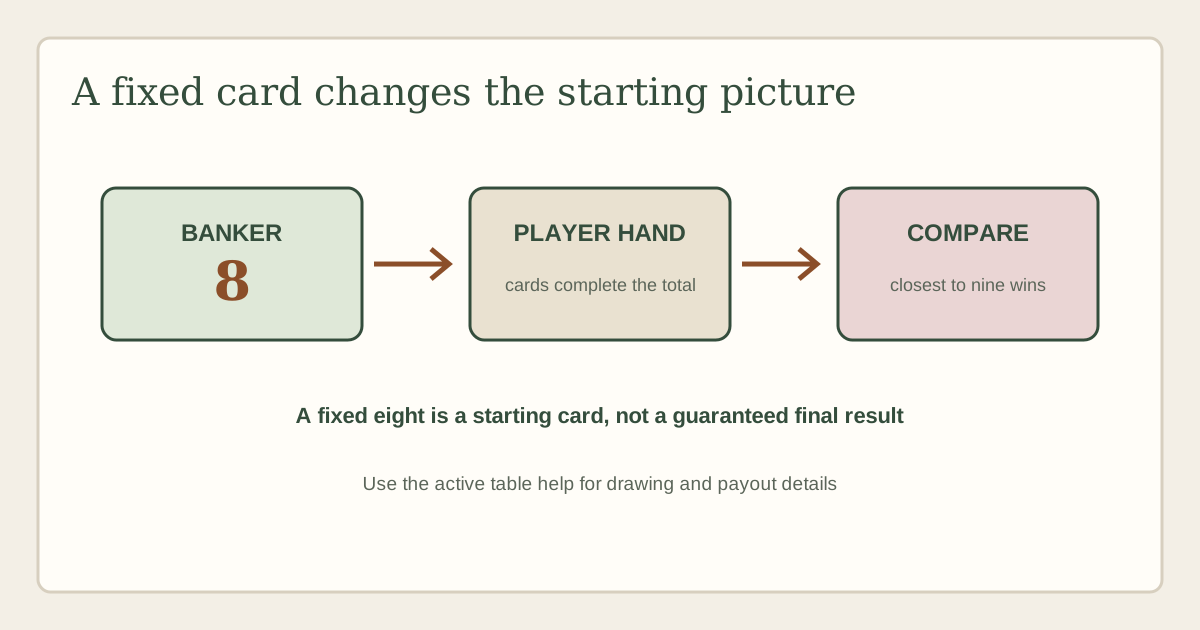
Evolution’s description says the Banker’s first card is predetermined as an eight and is already visible on the table when a round begins. That is the feature behind the title. The other parts of the hand are then dealt and compared under baccarat’s scoring and drawing procedure. The public description does not say that the Banker wins automatically, that every Banker hand ends on eight, or that no more cards can appear.
An eight is a card value, not necessarily the final Banker total. Baccarat totals are reduced to the ones digit. A fixed eight combined with a zero-value card makes a total of eight; paired with a one-value card, it produces a total of nine. Other card values can produce a combined total whose ones digit is different. The visible fixed card therefore gives one known part of the starting picture, while the remaining cards and the drawing rules still matter.
The page’s wording about the predetermined card and the subsequent deal should be read with the current in-game help rather than reconstructed from an animation alone. A screen may show a card slot already occupied before betting closes, then animate the remainder of a hand. The visual timing is not itself a complete specification of which cards count as the initial hand. If that distinction affects settlement, use the rule panel and hand history for the exact round.
Baccarat totals in plain language
In baccarat, the hand with a total closer to nine wins. The official description assigns an Ace a value of one, cards from two through nine their face values, and ten, Jack, Queen and King a value of zero. If a hand sum reaches ten or more, the tens digit is dropped. That rule is often called modulo-ten scoring: only the remainder after removing complete tens is used as the hand total.
For example, a hypothetical hand with a seven and a five adds to twelve, then counts as two after the tens digit is removed. A nine with a zero-value card remains nine. A King and an Ace total one. These examples explain how the arithmetic works; they do not state which hand receives a particular combination in Always 8 or predict the next deal.
The comparison happens after the required cards have been dealt. A total of nine is higher than eight, and eight is higher than seven. If the completed Player and Banker totals are equal, the result is a Tie under the main baccarat comparison. A player’s wager is settled by the corresponding market and its table-specific rules; the arithmetic alone does not tell you what a winning position returns or whether a stake is returned alongside winnings.
Round sequence and the third-card rule
The practical way to follow a round is to separate it into phases. The table first accepts selections while betting is open. Once the countdown closes, the deal is completed around the fixed Banker card. The hands are valued, and the baccarat drawing rule determines whether an additional card is required. The resulting totals are compared and the table settles each accepted selection.
Evolution’s public explanation says an initial two-card total of eight or nine means neither hand receives another card. It also says that a third card may be dealt to Player, Banker or both according to standard baccarat rules. The public summary is not a full decision chart. It does not reproduce every interaction for all possible initial totals, and a concise product page should not be mistaken for the entire rulebook.
If you need the exact decision for a particular initial total, consult the current rules panel before the round or the hand history after it. Do not use a chart for ordinary baccarat without checking that the fixed-card variant uses the same definition of each initial hand. A house rule can affect which total is considered initial, and that is a question the active title’s help should answer.
A safe hypothetical walkthrough
Imagine that the fixed Banker card is an eight and the Player’s first two cards total seven. The Player has not reached a natural eight or nine on those two cards. Whether the Player draws, and what the Banker does in response, depends on the rules applicable to that round. The fixed eight is visible, but it does not alone supply the final total or settle the outcome.
In a second hypothetical, the Player’s initial two-card total is nine. Evolution’s public summary says that when either side has an initial two-card eight or nine, no additional cards are dealt to either hand. The completed totals can then be compared directly. This example is useful for understanding a natural stopping condition, but always confirm that the active table’s displayed rule uses the same phrasing.
These examples deliberately avoid a payout calculation. The supplier overview does not publish the full combination of main-bet, tie and pair settlements in a single current table help panel accessible from this review. A made-up payout example would blur the difference between a correct hand total and a verified return.
Player, Banker and Tie selections
The main baccarat markets ask which side will finish closest to nine or whether both sides will finish on the same total. The labels Player and Banker name the two hands on the table; they do not refer to the person playing or the casino operator. A selection on Player is a prediction about the Player hand. A Banker selection is a prediction about the Banker hand, whose first card is the fixed eight in this variant.
A Tie selection predicts equal final totals. It is an independent market with its own settlement terms. Do not infer its payout from ordinary baccarat, a competitor’s screenshot or a table in another country. The tie market can have different payout language and eligibility rules from the two main sides. The same caution applies to whether simultaneous selections are allowed: read the active interface rather than assuming every combination can be selected together.
If a hand ends in a tie, the round result and the treatment of each non-Tie main selection are defined by the table’s help. In familiar baccarat formats, a tie can push the two main bets, but this page does not assert that treatment for every Always 8 table without the current rule text. Check exactly whether a stake is returned, lost, or handled under a special settlement before relying on a general convention.
Pair bets are separate markets
Evolution’s public page names Banker Pair and Player Pair as optional side bets. A pair market is separate from the main prediction about which hand will finish closer to nine. It asks about a specific card relationship under the game’s definition of a pair. The title’s fixed card can affect how a Banker Pair is interpreted, but the detailed qualifying-card wording and payout schedule must come from the exact game help.
Side bets can be easy to misread because the table may display them in a smaller area beneath the main markets. Before selecting one, check whether it is based on the first two cards, whether suits matter, whether the Banker’s fixed card participates, and whether a pair on a later drawn card can qualify. Those are distinct rule questions. The fact that the supplier lists a side bet does not answer every one of them.
Also verify whether the side wager is charged independently, how a losing side bet is settled when the main hand wins, and whether the interface shows the total amount at risk clearly. Never include an optional side market in your mental total only after the round begins. A simple pre-round check is to read every highlighted chip position and make sure the displayed wager total agrees with your intended selection.
Payout wording and what this guide does not claim
A paytable is more than a collection of ratios. It should make clear which outcome qualifies, what the notation means, whether a displayed amount is net winnings or total return, and whether the original stake is included. A number shown next to a side bet should not be copied into prose without the associated condition. A ratio on one supplier page can also differ from the live limits or display format at a particular operator.
Evolution’s public title overview gives a high-level description of the game and mentions that the Player payout differs from a conventional table, but the public material checked for this guide did not provide a complete current table help schedule for every main and pair market. This article therefore does not present a full Always 8 payout table, house edge, RTP or stake range. The absence of a public value is a reporting limit, not a reason to borrow values from another site.
When a paytable is visible, record the market name, ratio, stake-return convention, any commission, the jurisdiction or operator label, and the date. If the interface calls a value a “payout” without explaining whether it includes stake, preserve that ambiguity. A careful reader can compare only like with like: same title, same market, same rules version and same payout convention.
Shoe, shuffle and what they establish
Evolution’s public title information describes eight standard decks shuffled by a continuous shuffle machine. This provides useful context about how the supplier presents the game. It does not provide the probability of every outcome in the specific session, prove an independently audited return figure, or make the visible sequence a predictor of later cards.
A continuous shuffle machine changes how cards are prepared and reintroduced in the described format. It is not a signal that the same card will appear repeatedly, and it does not make a past sequence “due” to reverse. A scoreboard showing recent Banker, Player and Tie outcomes is a record of those displayed results. It is not a rule that constrains the next round.
If an operator’s current rules identify a shoe size or shuffle process that differs from the public supplier description, treat the active game help as the controlling source for the operator’s table. Save the discrepancy and date rather than choosing whichever number makes a more attractive explanation. A difference may be a stale cache, an interface label, or a version issue; it cannot be resolved just by guessing.
Reading the interface without overreading it
The most important areas to identify are the betting countdown, Player and Banker positions, any Tie area, separate Pair selections, the fixed card, and the result history. Each is evidence of a different part of the round. A countdown tells you whether the selection window is open; it is not evidence about odds. The fixed card tells you the special starting feature; it does not show the complete final Banker hand.
For a settled round, compare the cards visible in the hand history with the totals and winning market. If the result panel is abbreviated, open the full hand details before making a support query. Note the round identifier, time, table name and selected market. A precise record is easier to review than a vague claim that “the table got the eight wrong”.
On a narrow screen, a horizontally arranged table may hide a side bet or total behind a collapsed panel. Scroll within the game interface only after confirming whether the browser page itself or the embedded table owns the scroll. Avoid tapping a market based solely on a small, truncated label. If the screen is not clear enough to read the selection and total, do not submit the wager.
Streak displays, strategy claims and independent rounds
Baccarat roadmaps and streak boards can make recent outcomes prominent. Their visual patterns are descriptive, not predictive. A run of Banker outcomes does not mean the next result must be Player; a run of ties does not create an obligation for a non-tie result. The fixed eight changes the structure of this game relative to an ordinary table, but a chart still cannot turn the prior sequence into a guarantee about a future deal.
Be wary of systems that recommend raising a stake after a loss or chasing a particular pattern. A betting progression changes the size of later exposure; it does not alter the card values, force a particular result or cap the total amount risked. A stop-loss may reduce the duration or amount of a session, but it is not a way to convert an unfavourable wager into an expected profit.
If you are comparing a strategy claim, ask what exact paytable, shuffle assumptions, side bets and hand rules the calculation uses. A result derived for standard baccarat cannot automatically be carried into Always 8. A graph without its method and source is not enough to establish an edge. This page makes no strategy or profit claim and does not rank one market as a best choice.
Mobile, demo and operator configuration
The game title page may include a video or a link described as free play. Evolution states generally that demos and features may depend on jurisdiction. A visible button in a supplier showcase does not guarantee that a New Zealand visitor can launch a demo, or that it reproduces a particular operator’s table. This guide has not opened a real-money table and makes no claim about a demo’s local availability.
If you inspect a demo, use it to learn where rules, history and settings are displayed, not to infer a real-money stake range or eligibility. Record whether the demo has a title label and help panel. If the game is unavailable, that does not prove the product has been withdrawn worldwide; the reason may be location, session restrictions, a network block or an unavailable media component.
Mobile and desktop interfaces may arrange the same information differently. Confirm that the fixed Banker card, market labels, stake amount and total are visible before a decision. If a value is clipped or a confirmation state is unclear, stop. The supplier’s description remains a general product reference; the operator’s own current help and terms must establish its account-specific configuration.
New Zealand context and local access
The presence of an Evolution product page does not establish that an operator offers the title to New Zealand customers. Supplier availability, operator distribution, local eligibility and advertising rules are separate questions. No country-level access claim is made in this guide, and no local operator or promotion is recommended.
As checked on 6 October 2026, New Zealand’s Department of Internal Affairs says online-casino advertising is prohibited during the transition and says its rules can apply to parties that publish or arrange advertisements. The DIA customer guidance also says providers must not advertise to people in New Zealand during this period. These sources explain why this page is informational and contains no casino referral button. They are government guidance for New Zealand, not game rules.
Before distributing any online-casino content publicly, recheck the official DIA guidance and the legislation then in force. This page is a game-mechanics reference, not legal advice and not a statement that Always 8 Baccarat is available through any New Zealand service. A consumer should rely on the regulator and the exact operator terms for questions that the supplier catalogue cannot answer.
A practical verification checklist
Before treating a table setting as established, check the following items against the live help panel or an identifiable primary rules document. Keep the distinction between supplier-described facts and operator-specific details visible in your notes.
- Confirm the full title and whether the interface identifies the Evolution version rather than a similarly named baccarat product.
- Find the game-help heading for the exact table and check whether the document is current or identifies a version.
- Verify that the Banker’s first card is described as a fixed eight and note exactly when it appears in the round sequence.
- Read the card-value rule for Aces, number cards and ten-value cards rather than relying on a memory of another variant.
- Check how totals above nine are reduced and which initial totals stop further drawing.
- Use the table’s third-card chart for any hand where the public overview does not show a complete decision rule.
- Read Player, Banker and Tie settlement wording separately; do not transfer a standard-table commission or push assumption.
- Open the Pair market help and record qualifying cards, timing, suits if relevant, and the complete payout condition.
- Confirm stake minimums, maximums, currency and any account limit from the operator screen, not from a global supplier page.
- Preserve the hand-history identifier if the displayed total or settlement appears inconsistent with the written rules.
Questions readers commonly ask
Does the Banker always finish with eight?
No. Evolution describes the Banker’s first card as a predetermined eight. That is not the same as saying the completed Banker hand always totals eight. Other cards and baccarat scoring determine the final total; a third card may be dealt under the game rules. Read the current help for the exact hand sequence.
Does the fixed eight guarantee a Banker win?
No. It is a starting feature, not a result guarantee. The Player hand can finish closer to nine, the Banker can finish on another total, and the two hands can tie. A fixed card should not be treated as a promise or a prediction of the remaining cards.
Is the usual baccarat score used?
Evolution’s public page describes the familiar baccarat card values and dropping the tens digit from totals of ten or more. It says the game compares hands by closeness to nine. Confirm the live table’s exact help if you need a rule-level answer for a particular third-card situation.
What does a Player or Banker payout mean here?
The exact return depends on the paytable shown by the table. Read the main markets separately and determine whether the figure is net winnings or total return including the stake. This guide does not reproduce a complete current operator paytable or a New Zealand-specific setting.
Which Pair bets are listed?
Evolution’s public description names Banker Pair and Player Pair. It does not, in the version checked for this guide, expose every current qualification and settlement detail for a specific operator table. Consult the exact side-bet help before treating any third-party ratio as current.
Does this page confirm New Zealand access?
No. A supplier catalogue entry does not prove that a named casino currently offers the game in New Zealand or that an account is eligible. Check current official government information for legal status and the operator’s own terms for any account-specific access question.
Sources and verification boundary
- Evolution: Always 8 Baccarat — public title description, card values, fixed Banker card, shuffle description and named side bets; checked 6 October 2026. Table-specific operator help was not available for this review.
- Evolution Games catalogue — title indexing and general catalogue context; checked 6 October 2026.
- DIA: Online gambling for advertisers and DIA: Online gambling for players — New Zealand transition and advertising information; checked 6 October 2026.
Competitor pages reviewed for scope comparison: https://slotcatalog.com/en/slots/always-8-baccarat ; https://www.livecasinocomparer.com/live-casino-software/evolution-live-casino-software/evolution-live-baccarat/always-8-baccarat/ ; https://www.livecasinos.com/live-casino-games/always-8-baccarat/ ; https://slotwhale.com/game/always-8-baccarat/ . Competitor values were not used as current operator settings. One surfaced result described a conflicting Always 8 mechanic; the supplier source controls the product fact stated above.
